How to Understand the CFTC's Regulation of Prediction Markets?

marsbitPublished on 2026-10-13Last updated on 2026-10-13

Abstract

On October 9, the U.S. Commodity Futures Trading Commission (CFTC) released two conflicting documents concerning event contracts in prediction markets. A proposal seeks to classify contracts on sports, politics, and other events as "swaps" under CFTC jurisdiction, while a separate interim rule explicitly excludes licensed sports betting and casino games from the swap definition. This creates a regulatory split where bets on the same NFL game could be regulated as state-level gambling if placed at a Las Vegas sportsbook, but as a federally regulated swap if traded on a CFTC-registered exchange like Kalshi. CFTC Chairman Michael Selig argues these event contracts are commodity derivatives for hedging, speculation, and price discovery. However, the move faces legal challenges. The NFL and 39 states oppose the CFTC's stance, arguing these contracts create new gambling risks rather than hedging existing ones. Federal appeals courts are divided: the Third Circuit ruled such contracts are swaps, while the Sixth and Ninth Circuits concluded they are not. This circuit split has prompted New Jersey to petition the Supreme Court for review. The proposed rules are not yet in effect, pending publication and a comment period. The ultimate outcome hinges on court decisions and the future composition of the CFTC commission. The core conflict remains whether event contracts on prediction markets fall under federal derivatives regulation or state gambling laws.

Author: Huohuo, The Block

On October 9th, the U.S. Commodity Futures Trading Commission (CFTC) released two documents with opposing directions on the same day. One proposal aims to include event contracts for sports, politics, culture, weather, etc., found in prediction markets, within the definition of a swap, while another interim final rule explicitly excludes licensed sports betting and casino games from the definition of a swap.

In plain terms, a swap is a contract where payments are determined by an outcome. Under U.S. derivatives law, once a certain type of contract is classified as a swap, it typically falls under the exclusive regulatory oversight of the CFTC, preempting state gambling licenses and state taxes. This is federal preemption.

Therefore, the core issue of contention is: who writes the rules for the same NFL game? If placed at a Vegas counter or in the DraftKings app, it is state-regulated gambling; if turned into an event contract and placed on a federally registered exchange like Kalshi, the CFTC argues it is a swap.

CFTC Chairman Michael Selig is the only sitting commissioner among the five-member commission. He stated directly that Americans use event contracts to hedge, speculate, and obtain information, and these products fall within the category of commodity derivatives under the CFTC's exclusive jurisdiction. Casino-style products, however, are not derivatives.

The trading volume is the backdrop for this round of actions. The CFTC reported that event contract volume on U.S. registered exchanges (DCMs) reached approximately $1.5 billion in August, with about $1.2 billion related to sports. Market estimates are much larger. For example, Kalshi and Polymarket combined traded roughly $85.6 billion over a weekend in October, with sports contracts being the primary driver of this surge in volume.
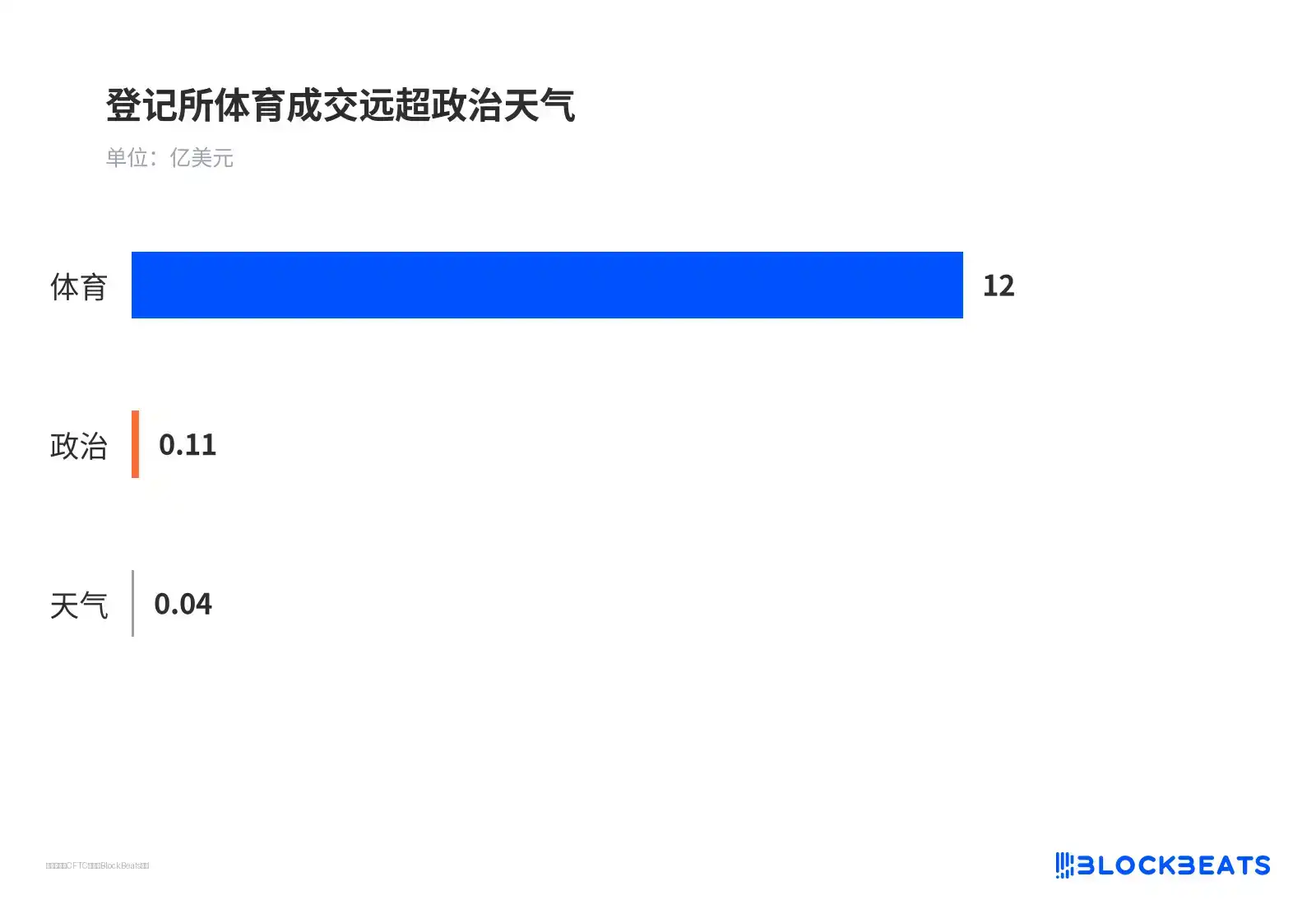
Trading volume for registered sports contracts far exceeds that for politics and weather

One inclusion, one exclusion: Two directions being written into the swap definition

The proposal answers what counts as a swap, while the interim final rule answers what does not. The latter uses two tests to define the boundary. Only wagers offered by licensed state or tribal gaming operators and that are not matched on a multilateral exchange platform are excluded. Both conditions must be met to be considered a casino-style wager.

Combining these two boundaries essentially splits sports betting in half—one half remains with the states, the other is handed over to the federal government. The same sports bet, if placed at a counter in Las Vegas, is gambling; if placed on a federally registered exchange like Kalshi, it becomes a swap.
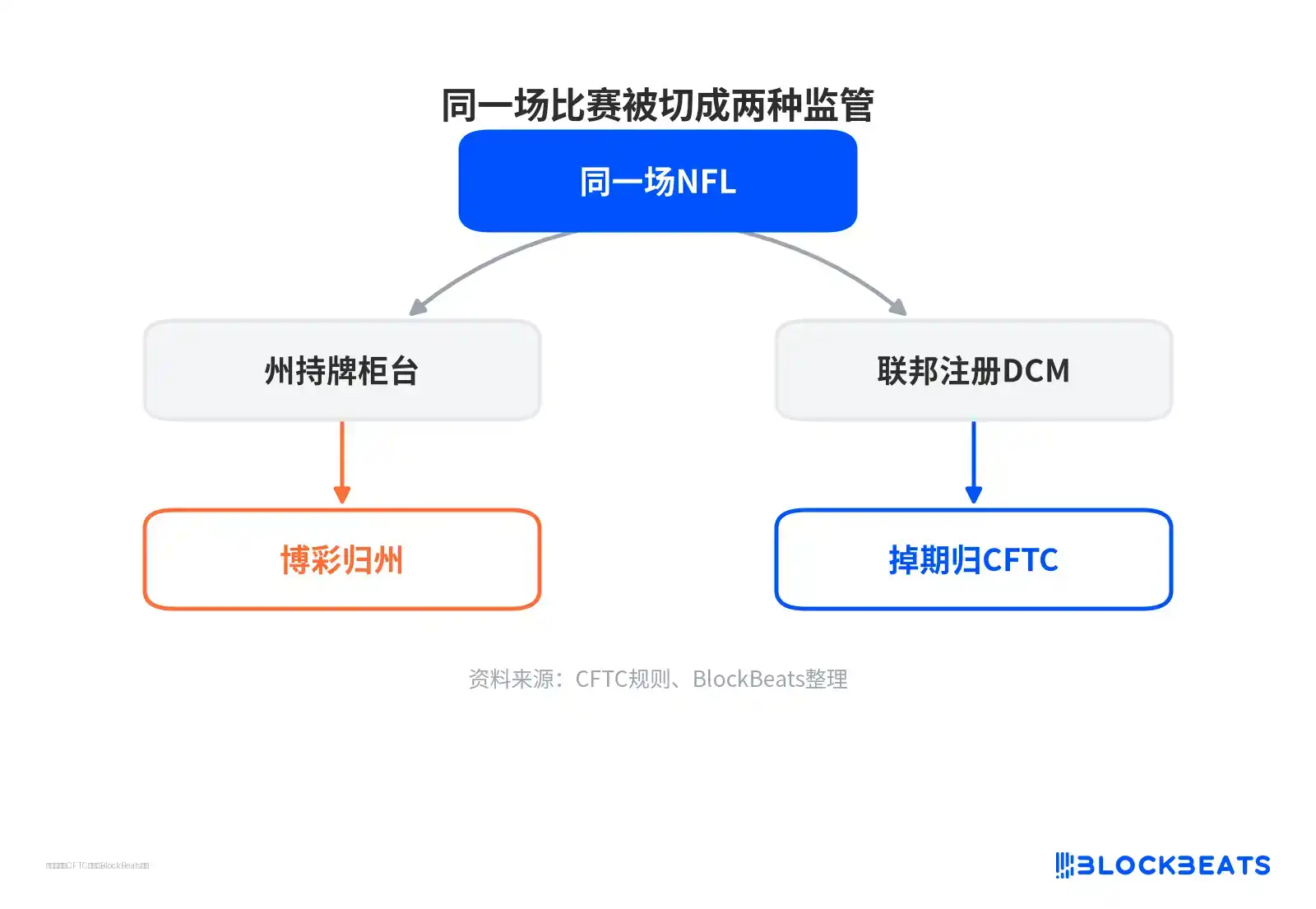
The same game is being cut into two types of regulation

Similar questions appear in the court brief filed by the American Gaming Association: if a sports bet is considered a swap, should bets placed at Las Vegas counters also have to be on a DCM?

TD Cowen policy analyst Jaret Seiberg offers another interpretation. States have repeatedly argued in lawsuits that the CFTC's definition of event contracts as swaps is too broad, potentially making wagers at state and tribal casinos federally illegal.

The interim final rule, by first carving out casino games, is precisely meant to dismantle this line of attack in court. Seiberg's judgment is that this move is mainly to improve the CFTC's legal position; whether it will be effective is another matter.

If this classification fails to hold up in court, states could potentially use the casino line to pull event contracts back under state law.

The NFL and 39 States: Who should set the rules for the same game?

A clear judicial split has already formed. New Jersey has petitioned the Supreme Court over its jurisdictional dispute with Kalshi. The NFL and 39 states plus Washington, D.C., have filed amicus briefs supporting New Jersey.

The NFL argues that sports event contracts create new risk for gambling, rather than hedging existing risk like a swap, and points out that the CFTC does not prohibit easily manipulated betting lines, nor does it cover lines related to player injuries, referees, or enforce a minimum age of 21. On the first Sunday of this season, prediction markets traded approximately $3.3 billion, with $1.8 billion related to football.

U.S. federal appeals courts are divided into circuits. Different circuit courts can issue contradictory rulings on the same legal question. When such a circuit split occurs, the Supreme Court is more likely to intervene. Three federal appellate circuits have already reached opposite conclusions this year:

Third Circuit (April this year): Held that sports contracts on DCMs are swaps and can preempt state law.

Sixth Circuit (September) and Ninth Circuit (August): Reached the opposite conclusion, holding that these contracts are not swaps and state law applies.
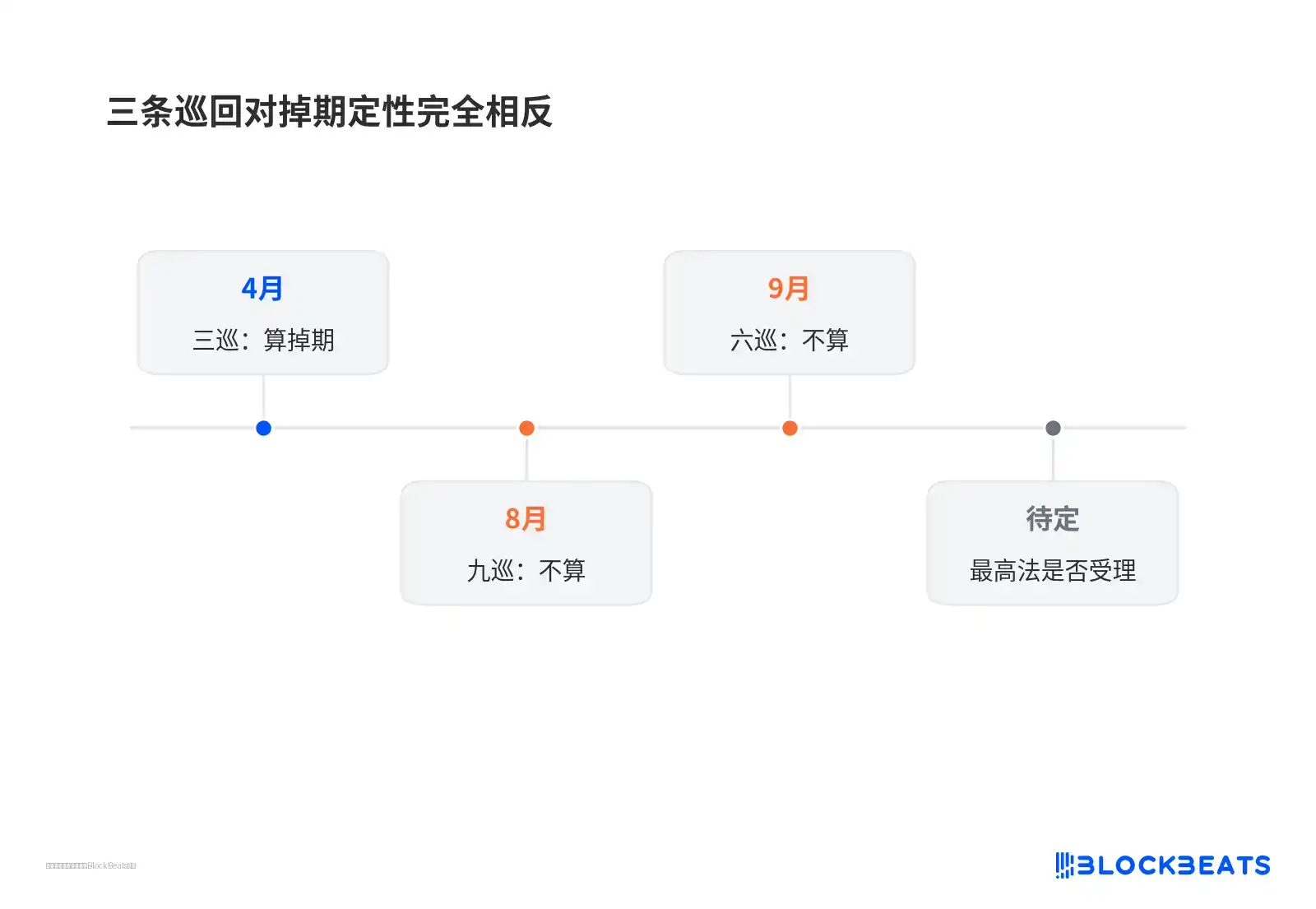
Three circuits hold completely opposite views on swap classification

With the three circuits at odds, the same contract could receive contradictory classifications in different jurisdictions. This is precisely why New Jersey wants to bring the issue to the Supreme Court. Kalshi's response deadline is November 9th, and the Supreme Court has not yet decided whether to hear the case.

Rules Not Yet in Effect; Variables Lie with Courts and Commissioner Seats

As of now, neither document has been published in the Federal Register. The comment period for the proposal begins from the publication date and lasts 30 days. The interim final rule also only takes effect upon publication. Calling them "already entered into consultation" or "already in effect" at this stage is inaccurate.

A more critical variable lies with the courts. New Jersey's petition has placed the split between the Third Circuit and the Sixth/Ninth Circuits before the nine Supreme Court justices. There is no news yet on whether they will hear the case. Administrative rules can strengthen arguments for the Third Circuit's template, but the ultimate authority to interpret the law rests with the judges.

Selig is the only sitting commissioner among the five-member commission. Pushing rules forward under a short-staffed commission may be legally tenable, but the oversight is thin. Once the commission is fully staffed, or if the courts do not adopt this definition, today's protective measures could be rewritten.

In this round of contention, the regulated parties themselves have remained quiet; Kalshi and Polymarket have yet to make any public, on-the-record statements.

Related Questions

QWhat are the two main actions taken by the CFTC on October 9th regarding event contracts, and what are their intended effects?

AThe CFTC issued two documents. One is a proposal to include event contracts for sports, politics, culture, and weather within the definition of a 'swap.' The other is an Interim Final Rule explicitly excluding licensed sports wagering and casino games from the swap definition. The intended effect is to carve out a regulatory boundary: similar sports bets offered on federally registered exchanges like Kalshi would be regulated as swaps under CFTC jurisdiction, while bets placed at state-licensed sportsbooks in places like Las Vegas would remain under state gambling law.

QWhat is the core legal and regulatory conflict at the heart of the CFTC's recent actions on prediction markets?

AThe core conflict is jurisdictional preemption. Under U.S. derivatives law, if a contract is defined as a 'swap,' it falls under the exclusive jurisdiction of the CFTC (federal preemption), overriding state gambling laws and taxes. The dispute centers on who gets to set the rules for the same event (e.g., an NFL game): state regulators for traditional sports betting or the CFTC for event contracts traded on federally registered exchanges.

QWhat contradictory rulings have emerged from U.S. federal appeals courts regarding the classification of sports event contracts, and why is this significant?

AThree U.S. Circuit Courts of Appeals have issued contradictory rulings in 2024: The Third Circuit (April) ruled that sports contracts on Designated Contract Markets (DCMs) are swaps and can preempt state law. The Sixth (September) and Ninth (August) Circuits reached the opposite conclusion, stating these contracts are not swaps and state law applies. This 'circuit split' is significant because it creates legal uncertainty, with the same contract having different statuses in different jurisdictions, making the issue ripe for potential review by the U.S. Supreme Court.

QAccording to analysts cited in the article, what is a strategic reason behind the CFTC's Interim Final Rule that excludes licensed casinos?

AAnalyst Jaret Seiberg suggests a key strategic reason is to improve the CFTC's position in ongoing court battles. State opponents argued that the CFTC's broad definition of 'swap' for event contracts would render state and tribal casino wagers federally illegal. By explicitly carving out licensed casino games via the Interim Final Rule, the CFTC aims to defuse this specific legal attack and strengthen its argument that event contracts are distinct from traditional gambling.

QWhat are the current procedural and political variables that could change the outcome of the CFTC's proposed regulatory framework for prediction markets?

AKey variables include: 1) The courts: The Supreme Court has not yet decided whether to hear New Jersey's petition highlighting the circuit split. Judicial interpretation will ultimately decide the rules. 2) The CFTC Commission: Currently, only Chairman Rostin Behnam is seated on the five-member commission. Future decisions by a fully staffed commission could rewrite or reverse the current proposals. 3) The rulemaking process: The proposals are not yet final. The comment period for the proposal and the effective date for the Interim Final Rule only begin once they are published in the Federal Register.

Related Reads

Maple Finance CEO targets up to $15B in assets by the end of 2027

Maple Finance CEO Sidney Powell aims to grow assets under management to $10–15 billion by the end of 2027, alongside a loan book of roughly $4.5–5 billion, as the onchain asset manager shifts beyond crypto-backed lending toward serving traditional financial firms. Maple reported $4.7 billion in AUM at the end of Q3, up 18% year-over-year, though its dashboard showed about $3.9 billion on Tuesday. Outstanding loans rose 12% year-over-year to $1.7 billion but fell 9% quarter-over-quarter, while quarterly revenue was flat at $4.4 million, or $17.6 million annualized. Powell expects tokenized equities to grow fivefold to tenfold in 2027, enabling loans backed by tokenized stocks rather than mainly Bitcoin and other crypto collateral, which he said is positive because such assets are not correlated with Bitcoin. Maple is also in talks with banks about warehouse facilities to fund its Bitcoin-backed lending, following its June deal supporting Kraken's crypto-backed lending program, and may pursue deals involving loans originated by TradFi institutions and brought onchain. Another priority is partnering with fintechs and digital banks seeking to offer stablecoin yield products, with announcements possible in Q1 2027. The expansion plans come amid a leadership shakeup: co-founder and executive chairman Joe Flanagan and COO Ryan O'Shea announced plans to leave over disagreements about the company's direction. Powell said the differences concerned how best to scale the business amid convergence with traditional finance, fintechs and neobanks, and that the departures were unrelated to Maple's loan book or business health. Maple's SYRUP token trades around $0.103 with a $123 million market cap, down about 46% over 30 days and 74% over the past year.

cointelegraph49m ago

Maple Finance CEO targets up to $15B in assets by the end of 2027

cointelegraph49m ago

Lighter incident exposes risks beyond withdrawal controls

A recent incident at decentralized perpetual futures exchange Lighter, in which over $10 million was siphoned out, exposes the shortcomings of focusing security solely on withdrawal controls. According to Lighter's postmortem, an attacker used compromised API keys to move funds into a public pool and redeem shares held through another account. Bitquery traced a withdrawal of 10.39 million USDC. Lighter said its protocol and smart contracts were unaffected. The exchange now requires wallet signatures for transfers into public pools, has made API-key signatures non-public, and plans IP allowlists and configurable permissions for individual keys. It has restored deposits and withdrawals and returned about $5 million in USDC to the affected trader. The incident highlights that cybersecurity reviews must look beyond smart contract vulnerabilities and consider the gap between the permissions a system grants and the financial consequences those permissions allow. The real risk of a credential depends on the balances it can reach, the transactions it can initiate, and the exposures it can create—not just whether it can withdraw assets. As Lighter put it, "A key that can trade can still lose you money if someone else holds it." Users should establish a clear mandate for each credential, specifying accessible accounts, permitted markets, order sizes, pricing tolerances, and aggregate exposure, with separate authorization required to move capital into shared pools or expand limits. The same logic applies to additional signatures: a second signature adds meaningful protection only when its approval process independently evaluates a transaction's financial effect.

cointelegraph4h ago

Lighter incident exposes risks beyond withdrawal controls

cointelegraph4h ago

Trading

Spot
活动图片