Forget Ctrl+F, a New AI Paper Tool Helps You Search for Needles in the Haystack of Full-Text Literature

marsbitPublished on 2026-10-10Last updated on 2026-10-10

Abstract

This article introduces a new AI-powered academic paper writing tool called "Open Academic Paper Gen." Unlike typical AI writing assistants that generate content and citations, this tool features a unique multi-step workflow designed to ensure the validity of references. After generating an initial draft based on a user-provided research topic, the system performs a crucial verification step: it locates and analyzes the full text of cited papers to check if the referenced claims are genuinely supported by the source material. It can even pinpoint relevant paragraphs and PDF page numbers. The tool's workflow involves nine stages: defining the research scope, literature retrieval, filtering, trend analysis, identifying research gaps, outlining, writing, citation verification, and final export. It searches databases like OpenAlex and arXiv, builds an evidence table from gathered papers, and includes an "innovation diagnosis" to assess a proposed angle against existing work. A key focus is its three-layer citation verification process: 1) ensuring citations exist in the collected literature pool, 2) cross-referencing metadata like DOI and author details with official records, and 3) using AI to analyze the source's full text (or abstract if unavailable) to confirm it supports the claim made in the draft. Unverifiable citations are flagged rather than assumed correct. The tool offers both manual review checkpoints and a fully automatic mode, requiring OpenAI or GLM API keys. The...

I'm begging you, we already have more papers than we can read, why are tools for automatically writing papers still popping up everywhere!

Recently, GitHub has once again launched a new AI paper generation tool—

Open Academic Paper Gen.

Don't swipe away just yet!

Besides being able to automatically generate a first draft with references, Open Academic Paper Gen has another feature you must pay attention to—

When it can obtain the full text of a paper, it will search the full text(underline this) for evidence to verify the cited viewpoints within the paper.

To be honest, this is super useful.

Because writing a paper often starts with a research topic, followed by continuously organizing arguments, searching for evidence, and then adjusting one's own judgments based on the literature.

With AI, it can help you brainstorm arguments and also help you search for sources of evidence.

But the problem is, sometimes the arguments or papers are real, but once you put the (AI-given) "argument" back into the full text and read it in context, you might find that the author probably didn't mean that at all.

So, to solve this problem, after obtaining the full text of a paper, Open Academic Paper Gen further locates relevant paragraphs to judge whether that paper can actually support the corresponding argument.

If there's page number information, it will also mark the corresponding PDF page number in the notes, making it easier for people to look it up later.

In other words, it not only checks "if this paper exists," but also checks "if this paper actually said that."

A Multi-Agent Workflow for Generating First Drafts of Papers

Overall, Open Academic Paper Gen is a multi-agent workflow for generating first drafts of papers, breaking down the process from topic selection to export into nine stages:

Define research scope, search for literature, clean and filter, analyze trends, find entry points, outline, write, verify, and finally export.
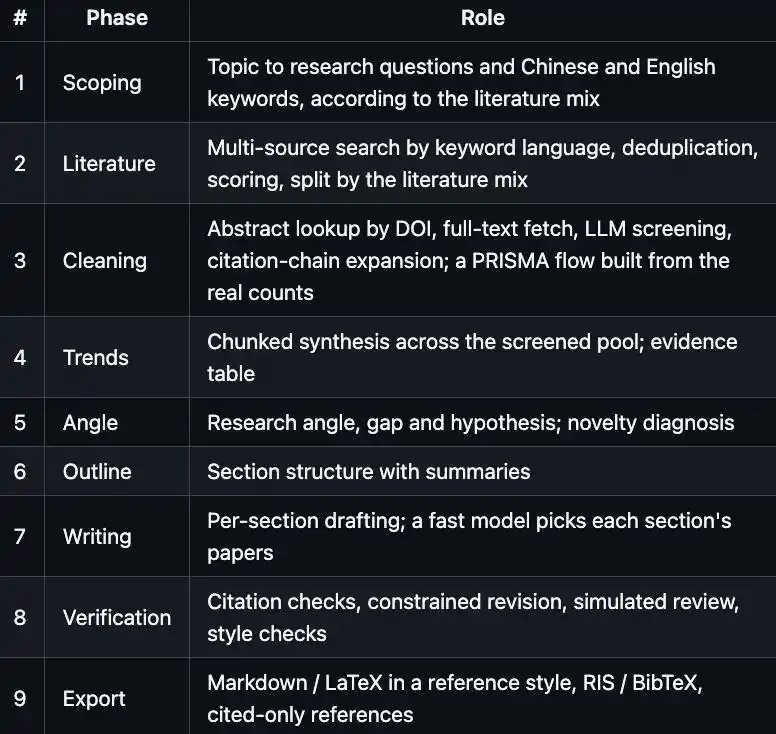
Similar to other AI paper writing tools, you give it a research topic, like "RSI in the Physical World."

It then breaks down this topic into specific research questions, generates corresponding Chinese and English keywords, and searches for papers in OpenAlex, Crossref, Semantic Scholar, and arXiv.

The retrieved literature is further deduplicated and scored, then filtered for relevance by the model. When encountering highly relevant papers, it continues searching by following their references and later studies that cite them.

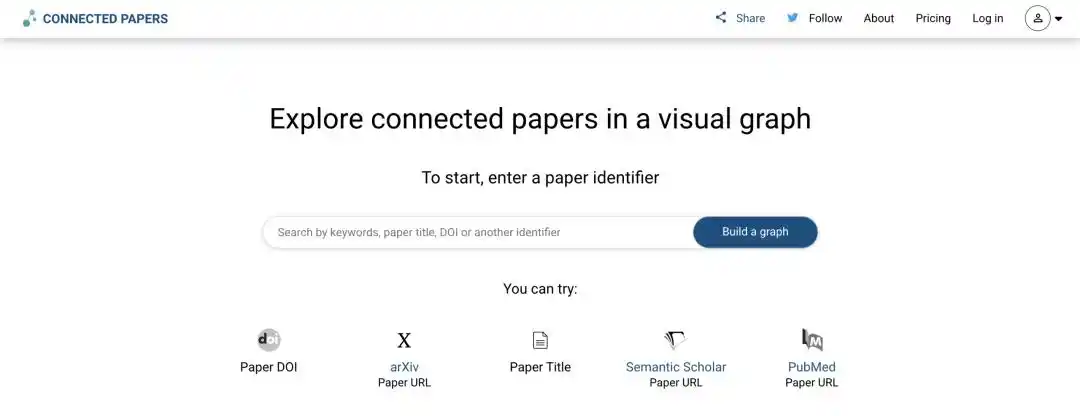
It's like grabbing one paper and then following the trail to supplement a batch. The idea is actually a bit like the old CONNECTED PAPERS.

(If you know, you know).
Next, the collected literature is organized into an evidence table, summarizing each paper's research question, method, data, conclusions, and limitations.

With these materials, the system analyzes research trends and proposes possible research angles, gaps, and hypotheses.

There's also a quite interesting step here called Innovativeness Diagnosis.

Open Academic Paper Gen evaluates the entry point from dimensions like problem, method, data, and perspective, points out the most similar existing work in the literature pool, and gives possible critiques reviewers might raise.

(This is like, when you think you've created ResNet, the AI first helps you check if someone else has already done it.)

Specifically, these judgments are based on the literature retrieved this time, but not finding it in the pool doesn't mean no one in the world has done it~

Finally, once the research angle is determined, the system continues to generate an outline and draft sections.

After the first draft is written, it enters the citation verification and simulated peer review stages, and can finally export to Markdown or LaTeX, as well as reference formats like RIS and BibTeX.

Regarding the specific operation mode, in the default mode, Open Academic Paper Gen will pause at major stages, waiting for you to review, edit, and confirm before proceeding.

If you want to test the AI's research capabilities, you can also let it run automatically by choosing the fully automatic mode.

Lastly, friends ready to give it a try should also pay attention to the model configuration:

The project currently supports OpenAI and Zhipu GLM, but for the steps of argument verification, citationless statement checking, and simulated peer review, an OpenAI API Key is still required.

How Does the Citation Check Get into the Sentence?

Honestly, automatically searching for literature, writing a first draft, and then having AI review it is already a common combination in many paper writing projects.

Some of them also incorporate citation verification and manual confirmation to minimize model hallucinations.

Within this workflow, Open Academic Paper Gen further refines the checking and modification of citations.

After all, attaching references to a first draft is one thing; proving that these references can actually support the main text is another.

Specifically, it breaks verification down into three checks.

First, check if the cited paper can be found in the literature pool.

During writing, each citation marker must correspond to a paper already collected.

If the model fabricates a non-existent citation identifier, the system will mark it for easy location and correction.

Second, verify the identity of the cited paper.

Papers with a DOI are first cross-checked with Crossref records; if not found, confirmation is sought at doi.org.

Mismatches in title, author, year, etc., will trigger corresponding warnings.

Third, check if the source text actually supports the statement.

Here, the check truly moves from "paper metadata" into "paper content."

After obtaining the full text, the system finds the paragraph(s) most relevant to the cited argument and feeds them, along with the paper's abstract, to the model to judge whether the source text can support the statement in the main text.

If the full text is unavailable, the abstract or excerpts are used. When page number data exists, warnings can also indicate the corresponding PDF page number, making it easier for people to look it up.

Of course, the model not finding sufficient evidence does not mean it has proven the statement is wrong.

According to Open Academic Paper Gen's handling, when evidence is insufficient, it can be marked as "Unable to judge."

Literature with too little text to verify at all is marked as "Not verified," rather than directly counted as passed.

So, looking at it overall, compared to "writing the paper with one click," the idea of linking literature organization, evidence location, and citation self-check is indeed clever.

Especially when facing arguments and evidence generated by AI, and feeling "it seems plausible, but I don't dare to just trust it," being able to find the corresponding original text at least provides another handle for verification.

By the way, this project is from an individual developer Cat Uncle. Besides Open Academic Paper Gen, he has previously released several projects including an AI scriptwriter and an AI researcher.
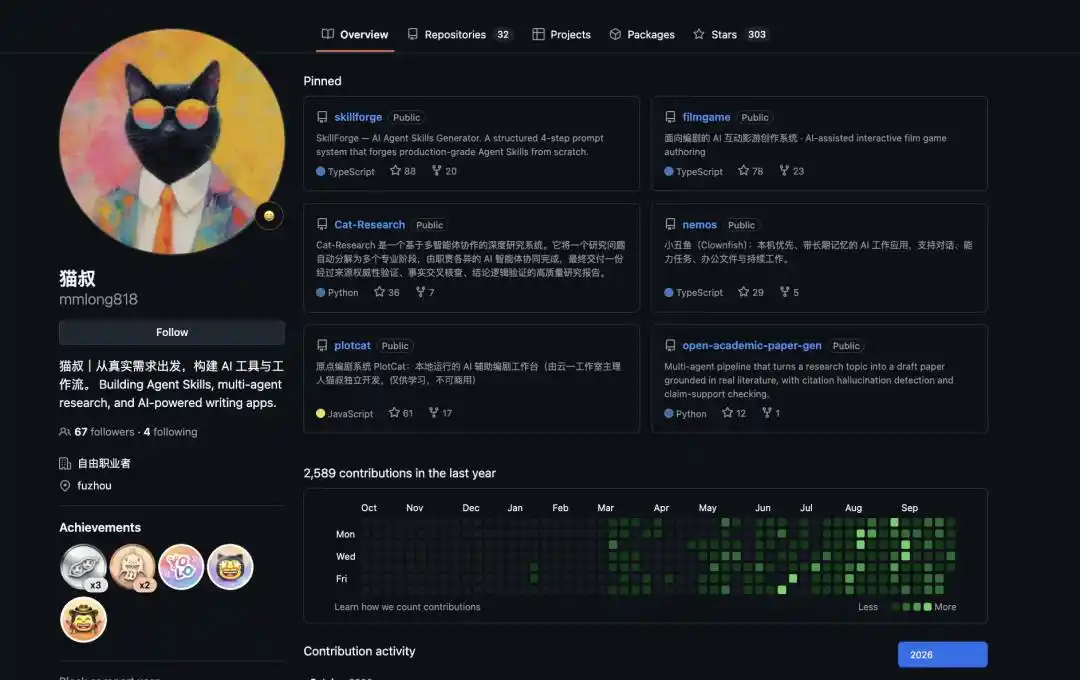
Reference Links

[1]https://github.com/mmlong818/open-academic-paper-gen

This article is from the WeChat public account "QbitAI", author: henry

Related Questions

QWhat is the name of the new AI paper writing tool introduced in the article?

AThe new AI paper writing tool is called Open Academic Paper Gen.

QWhat is the unique feature of Open Academic Paper Gen regarding literature verification?

AIn addition to generating a draft with references, Open Academic Paper Gen can verify citations by locating relevant paragraphs within the full text of a paper to check if the cited content genuinely supports the argument being made.

QHow many stages does the Open Academic Paper Gen workflow consist of?

AThe Open Academic Paper Gen workflow consists of nine stages: scoping the research, searching for literature, cleaning and filtering, analyzing trends, finding research angles, outlining, writing, verifying citations, and exporting.

QWhat databases does the tool use to search for academic papers?

AThe tool uses OpenAlex, Crossref, Semantic Scholar, and arXiv to search for academic papers based on generated keywords.

QWhat does the tool do when it cannot verify a citation due to insufficient evidence in the source?

AIf the tool finds insufficient evidence in the source material to verify a citation, it will mark the citation as 'unverifiable' or 'cannot be judged' rather than assuming it is correct.

Related Reads

The Hidden Risks Behind Anthropic's Nearly $1 Trillion Bet

Anthropic's IPO filing reveals a fragile, high-risk financing mechanism behind its AI ambitions. The company has committed to up to $895.4 billion in data center spending through 2045, with profits squeezed by rising compute costs. Rather than paying upfront for hardware, Anthropic relies on supplier-backed financing: Broadcom arranged a $63 billion equipment financing deal under which it absorbs losses if Anthropic defaults—up to roughly $43 billion once equipment is delivered. Google and AMD similarly tie funding to hardware leases or deployments. This shifts risk onto chipmakers' balance sheets, and because custom TPUs serve a narrower ecosystem than Nvidia GPUs, resale risk is higher. Analysts warn that while individual loans appear safer, risk concentration across the system is rising and harder to assess. Anthropic also can issue up to $42 billion in convertible notes to Broadcom to cover rent, with interest rates rising from 9% to 13% and conversion terms worsening if revenue targets are missed. Despite holding $146.6 billion in liquidity as of September 30, its massive forward obligations and tangled partnerships could limit access to investment-grade financing. Key concerns: whether revenue growth can outrun compute costs and cover future commitments, and whether drawing on credit lines signals distress. Anthropic's Direct initiative—separating data center leasing from chip purchases—and IPO proceeds could give it more flexibility, but ultimately debt repayment depends on end-customer revenue.

marsbit7h ago

The Hidden Risks Behind Anthropic's Nearly $1 Trillion Bet

marsbit7h ago

Google Quietly Buys Qualcomm: Mobile Chip Giant Sets Sights on Data Centers, Targets Over $15 Billion in Annual Revenue

On November 6, Alphabet disclosed a stake of about 2.977 million Qualcomm shares worth roughly $548 million as of the end of Q3 2026, a position absent from its June filing. Qualcomm shares rose over 3% premarket on the news. The investment was quickly linked to Qualcomm's push into data centers as it seeks to reduce reliance on smartphone chips. CEO Cristiano Amon reiterated plans for $5 billion in data center revenue by fiscal 2027 and over $15 billion by fiscal 2029. However, The Information reported the stake may relate to Qualcomm's acquisition of AI software startup Modular, which used Qualcomm stock as consideration; Alphabet's GV had invested in Modular, and two GV funds were listed as selling shareholders holding about 3.196 million shares—a figure that doesn't fully match Alphabet's disclosed 2.977 million. Qualcomm's smartphone business is under pressure: fiscal Q4 2026 handset chip revenue fell about 26% year-over-year to $5.14 billion, amid slowing smartphone growth and Apple's shift to in-house modems. Qualcomm has expanded into automotive, IoT, and PCs, and now sees data centers as a major opportunity. In June 2026 it unveiled its data center roadmap, including the Dragonwing portfolio (C1000 CPU, AI300 inference accelerator, and high-bandwidth compute), targeting over $15 billion in data center revenue and $40 billion in non-handset revenue by fiscal 2029. The Modular acquisition adds software—the Mojo language and MAX inference platform—to ease AI model deployment across hardware. Competition is intense: Nvidia still leads with CUDA and full systems, while AMD, Broadcom (custom ASICs), and Marvell compete, and cloud giants design their own chips—Google TPU, AWS Trainium/Inferentia, Microsoft Maia, Meta MTIA. Qualcomm announced a multi-generation custom chip deal with AWS covering AI inference and optical interconnect, reportedly allowing up to $60 billion in purchases plus warrants for up to 25 million shares; it is also working with Microsoft and Meta. Supply chain constraints remain a challenge. Google both designs TPUs and relies on partners: Broadcom co-designs TPUs under a long-term deal through 2031, and Marvell has a custom chip arrangement with potential share rights up to $12.2 billion. Google also holds Arm shares and uses Nvidia GPUs. Qualcomm's low-power and heterogeneous computing expertise could fit Google's inference needs, but no public evidence shows a data center chip deal. Existing Google-Qualcomm ties center on mobile and automotive, including expanded automotive collaboration in January 2026 and Snapdragon X Elite powering Googlebook. Whether deeper industrial links exist behind the stake remains unclear, but chip-company–tech-giant relationships are shifting as AI compute competition intensifies.

marsbit7h ago

Google Quietly Buys Qualcomm: Mobile Chip Giant Sets Sights on Data Centers, Targets Over $15 Billion in Annual Revenue

marsbit7h ago

The AI Bills of the Magnificent Seven: Who Can Still Afford to Pay?

After the U.S. midterm elections, Wall Street's optimism about AI reversed sharply. On November 5, the "Magnificent Seven" lost about $1.04 trillion in market value in a single day, with Nvidia plunging 9.26% and shedding over $440 billion—far worse than its chip buyers Microsoft, Google, and Amazon. The selloff was triggered by fears that the new Congress could tighten AI regulation and slow data center construction. Despite strong fundamentals—Nvidia's revenue doubled year-over-year, and cloud and advertising businesses kept growing—investors worry that massive AI capex has not yet translated into equivalent profits. The four major buyers (Microsoft, Google, Amazon, Meta) are spending more than their operating cash flow can support: a year ago they had a $61.7 billion surplus, but in Q3 this became a $26.4 billion deficit. Companies are increasingly relying on debt, with the five largest cloud providers issuing about $121 billion in dollar bonds in 2025—over four times the previous five-year average. Nvidia is most exposed because over 90% of its revenue depends on data centers, and 40 of 41 local data center-related ballot measures in 10 states leaned toward restricting development, with 27 restrictive proposals passing. Texas alone accounts for nearly 30% of planned 2028 U.S. computing capacity. Analysts note that projects already under construction for 2027 are largely safe, but 2028 plans face real risk. Apple is relatively insulated due to its phone and services profit base, while Tesla fell the most, also hurt by Musk's political spending. The key question remains who will pay the next massive bill—and whether buyers can keep building fast enough to sustain Nvidia's growth.

marsbit8h ago

The AI Bills of the Magnificent Seven: Who Can Still Afford to Pay?

marsbit8h ago

Trading

Spot
活动图片