Crypto Crime Escalates: Chainalysis Data Shows Over $3.4 Billion Stolen This Year

bitcoinistPublished on 2025-12-19Last updated on 2025-12-19

Abstract

Chainalysis reports that cryptocurrency theft has surged, with over $3.4 billion stolen so far in 2025, exceeding previous years. A significant shift in attack methods has occurred, with personal wallet compromises rising dramatically. Although private key compromises are less frequent, they account for the vast majority of stolen value. North Korean (DPRK) hackers were responsible for a record $2.02 billion in thefts, a 51% increase from the prior year, despite fewer attacks. Their tactics have evolved to include infiltrating crypto services and conducting fake job interviews to steal credentials. While the number of theft incidents and victims has increased, the average amount stolen per victim has decreased.

In a recent crypto crime report, blockchain intelligence firm Chainalysis has uncovered a troubling trend in crypto theft. As of now, over $3.4 billion worth of digital assets has been stolen, surpassing the total amount reported in the previous year. Notably, North Korean hackers have been implicated in the majority of these thefts.

Crypto Theft Escalates

The report, published on Thursday, highlights significant alterations in how these thefts are occurring. One alarming statistic shows that compromises of personal wallets have surged, escalating from just 7.3% of the overall stolen value in 2022 to a staggering 44% in 2024.

Even if the Bybit attack hadn’t dramatically skewed the figures, the share for 2025 would still stand at 37%. Meanwhile, centralized services are facing increasing losses due to private key compromises.

Although such compromises are comparatively infrequent, their scale often accounts for a vast majority of stolen volumes. In fact, private key compromises were responsible for an overwhelming 88% of losses in the first quarter of the year.

Chainalysis also noted a stark escalation in the scale of these attacks, with the ratio between the largest hack and the median of all incidents exceeding 1,000 times for the first time in 2025.

This implies that funds taken in the largest hacks are now 1,000 times greater than those stolen in typical incidents—a worrying trend that eclipsed even the peak activity during the 2021 bull market.

Record-Breaking Year For DPRK Theft

The Democratic People’s Republic of Korea (DPRK) continues to be the most formidable nation-state threat to cryptocurrency security, claiming a record year for digital asset theft despite a substantial decrease in the reported frequency of attacks.

In 2025, North Korean hackers reportedly stole at least $2.02 billion in cryptocurrency, signifying a 51% increase from the previous year. This is the highest value ever recorded for DPRK-related crypto theft, with these attacks contributing to a record 76% of all service compromises.
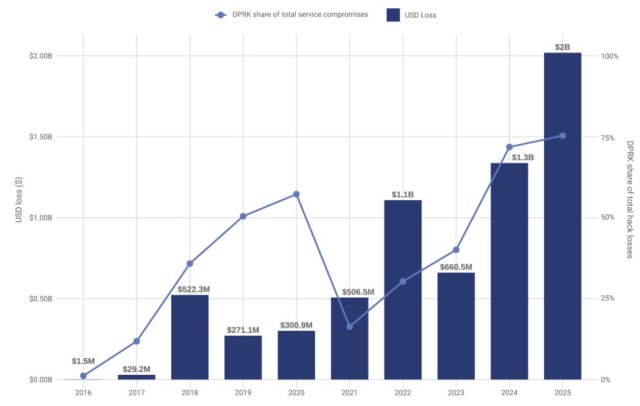
Rising thefts from DPRK hackers over the years. Source: Chainalysis

The rise in stolen funds can be attributed in part to the DPRK’s tactics. Cybercriminals linked to the regime have increasingly embedded IT workers within cryptocurrency services, allowing them privileged access to high-impact compromises.

However, a notable evolution in strategy has emerged: DPRK operatives are now impersonating recruiters for well-known Web3 and artificial intelligence (AI) firms.

This approach involves orchestrating fake hiring processes, which culminate in technical screenings intended to harvest sensitive credentials, source code, and access to systems at current employers.

158,000 Cases Logged In 2025

In a significant finding, the report indicates that personal wallet compromises in 2025 accounted for 20% of the total value stolen. This marks a decline from 44% in 2024, reflecting an evolution in the types and scales of attacks.

The number of theft incidents skyrocketed to 158,000 in 2025, a threefold increase from the 54,000 recorded in 2022, while unique victims surged from 40,000 to at least 80,000 in the same timeframe.

Despite this increase in incidents and victims, the total value stolen from individual victims has decreased from $1.5 billion in 2024 to $713 million in 2025. This suggests a shift in focus, where attackers target a larger number of users but steal smaller amounts per person.

The daily chart shows the total crypto market dropping to $2.8 trillion. Source: TOTAL on TradingView.com

Featured image from DALL-E, chart from TradingView.com
Trending Cryptos

Related Questions

QAccording to the Chainalysis report, how much has been stolen in crypto crimes so far this year, and how does it compare to the previous year?

AOver $3.4 billion worth of digital assets has been stolen this year, surpassing the total amount reported in the previous year.

QWhat significant change in the method of crypto theft does the report highlight, particularly concerning personal wallets?

AThe report highlights that compromises of personal wallets have surged, escalating from just 7.3% of the overall stolen value in 2022 to a staggering 44% in 2024.

QWhich nation-state is identified as the most formidable threat to cryptocurrency security, and what record amount did they steal in 2025?

AThe Democratic People’s Republic of Korea (DPRK) is identified as the most formidable threat. In 2025, North Korean hackers stole a record $2.02 billion in cryptocurrency.

QWhat new tactic are DPRK operatives using, according to the report?

ADPRK operatives are now impersonating recruiters for well-known Web3 and artificial intelligence (AI) firms to orchestrate fake hiring processes, which are used to harvest sensitive credentials and gain access to systems.

QDespite a large increase in the number of theft incidents and victims from 2022 to 2025, what happened to the total value stolen from individual victims?

AThe total value stolen from individual victims decreased from $1.5 billion in 2024 to $713 million in 2025, suggesting attackers are targeting more users but stealing smaller amounts per person.

Related Reads

Nobel Laureate Hassabis Delivers Another Masterpiece: AlphaGenome 2 Deciphers 98% of Human DNA 'Dark Matter'

DeepMind has unveiled AlphaGenome 2, a next-generation DNA foundation model led by Nobel laureate Demis Hassabis. While AlphaFold decoded only the 2% of the human genome that encodes proteins, AlphaGenome 2 targets the remaining 98% of non-coding "dark matter," which harbors gene-regulatory switches and over 90% of disease-causing mutations. Released alongside a 78-page technical report, the model delivers four major breakthroughs. First, it achieves single-cell resolution, trained on over 107 million single cells across 68 human tissues, doubling the rate at which it identifies pathogenic mutations—raising detection from 16% to 30% and directional accuracy from 23% to 43% on the TenK10K immune-cell benchmark. Second, it reproduces years of Nature-published research purely through computation: with zero wet-lab experiments, it correctly identified a distant regulatory mutation that over-activates ETS2 across 290,000 bases to cause inflammatory bowel disease, and precisely located the regulatory site and GATAA core sequence targeted by approved sickle-cell CRISPR therapy. Third, a new cell encoder lets the model interpret previously unseen diseases from just dozens of patient cells without retraining—identifying 41% of pathogenic mutations in unseen Parkinson's brain samples versus 17% for a specialized model, and uncovering a hidden severe-COVID mutation active only in immune-activated T cells. Finally, DeepMind released free databases covering 640 real human cell types and impact scores for nearly 7 million genetic variants across 510 cell states, with APIs and Colab tutorials open for non-commercial research. The model will soon be packaged as Skills and integrated into Google Antigravity for direct use by Gemini 4, promising to dramatically shorten the cycle of disease investigation and drug discovery.

marsbit5m ago

Nobel Laureate Hassabis Delivers Another Masterpiece: AlphaGenome 2 Deciphers 98% of Human DNA 'Dark Matter'

marsbit5m ago

Midterm Elections Settled, What Lies Ahead for the CLARITY Act?

The CLARITY Act (Digital Asset Market Clarity Act), which had already struggled before the election, now faces dim prospects after Democrats swept both chambers in the midterms. On September 15, a Senate cloture motion on the House-passed bill failed 49-50, eleven votes short of the 60-vote threshold. All 49 yes votes came from Republicans; the opposition included all Democrats present, two independents, and four Republicans (Collins, Hawley, Moran, Tillis). Even if absentee Democrat Coons had voted yes and the four Republicans had flipped, the tally would have reached only 54—still short. The bill's core compromise would make the CFTC the primary regulator for digital commodities and trading platforms while preserving clear SEC authority; jurisdictional division and added ethics provisions are the main disputes. Democrats will control both chambers when the new Congress opens January 3, 2027, leaving little incentive to cooperate during the lame-duck session. Only two theoretical paths remain before the 119th Congress ends: renegotiate the text and hold another cloture vote via Tillis's reconsideration motion, or attach crypto market structure provisions to must-pass December legislation such as government funding (expiring December 11) or the NDAA. Both are unlikely, given the tight legislative calendar and Democratic leverage. Stablecoin oversight continues separately under the GENIUS Act and OCC rulemaking. If the bill dies, it must be reintroduced in the 120th Congress, where Democrats—likely led by Elizabeth Warren and Maxine Waters—are expected to draft a very different framework expanding SEC authority and narrowing the CFTC's role. Key things to watch before January 3: any new cloture vote or revised text, any attempt to attach provisions to funding or defense bills, outstanding vote counts in Alaska, Mississippi, and House districts, and the incoming committee chair selections. Absent such developments, the CLARITY Act is effectively finished as a 2026 legislative project.

marsbit6m ago

Midterm Elections Settled, What Lies Ahead for the CLARITY Act?

marsbit6m ago

4.8 Billion Dollars: Tether's Hand Has Reached Into 13 U.S. Public Companies

Tether, the world's largest stablecoin issuer, holds roughly $4.8 billion in public-market exposure across 13 U.S.-listed companies, according to a Protos review of regulatory filings. Its holdings span a controversial video platform, gold royalty companies, a satellite firm, bitcoin miners, and a bitcoin treasury project. Key positions include a 50.3% stake (including warrants) in Rumble (RUM), though voting power is capped below 9.9%; Rumble has also acquired Tether's Northern Data and counts Tether as its most important advertising client, committed to $50 million annually for two years. Tether and Bitfinex are controlling shareholders of Twenty One Capital (XXI), with rights to nominate four of seven directors, including Tether CEO Paolo Ardoino; the company trades at about 60% of its bitcoin value. In gold, Tether holds about 27% of Elemental Royalty (ELE), 12.6% of Gold.com (GOLD), 12.6% of Versamet Royalties (VMET), 14.6% of Metalla (MTA), 14.4% of Gold Royalty (GROY), 12% of Aurelion (AURE), and about 8% of Antalpha (ANTA). It also holds 19.7% of Bitdeer (BTDR) and a stake in Adecoagro (AGRO), plus shares in Satellogic (SATL), 9.9% of SDEV (down about 99%), and a stake in VCI Global (VCIG) via Oobit. Powerlaw Corp (PWRL) claims roughly $20 million in Tether equity. The exposure is concentrated in a few large holdings—Twenty One, Rumble, and Adecoagro—showing Tether's growing role as a multi-sector financial institution that also places executives in key positions.

marsbit31m ago

4.8 Billion Dollars: Tether's Hand Has Reached Into 13 U.S. Public Companies

marsbit31m ago

Tesla and SpaceX Merger Accelerates: A $3.47 Trillion Giant, Deal Could Be Announced as Early as December

Tesla and SpaceX are reportedly advancing merger talks, with a deal potentially announced as early as December, though complex corporate structure and regulatory issues could delay it to early 2027. Based on recent market values—SpaceX at about $1.90 trillion and Tesla at about $1.57 trillion—the combined entity would be worth roughly $3.47 trillion, making it one of the largest corporate integrations in history and bringing rocket launch, satellite internet, EVs, energy storage, AI, and robotics under one roof. In October, Musk called a merger "a good idea" and confirmed both companies had formed independent director special committees. The strategic logic centers on AI infrastructure—chips, compute, and energy—with the Terafab chip manufacturing joint venture as a concrete example, expected to produce first test chips in mid-2027 and reach mass production in Q3 2028. Shareholder impact is significant: Musk holds about 40-45% economic interest in SpaceX with over 80% voting power via dual-class shares, versus nearly 20% of Tesla with equal voting rights, raising questions about control and whether Tesla shareholders would accept a new structure. Regulatory hurdles may be the hardest obstacle, given SpaceX's sensitive U.S. defense contracts and Tesla's major China operations, implicating CFIUS and Chinese regulators. The merger reflects Musk's ambition to unify his business empire around a shared technology base spanning Earth and space.

marsbit1h ago

Tesla and SpaceX Merger Accelerates: A $3.47 Trillion Giant, Deal Could Be Announced as Early as December

marsbit1h ago

Trading

Spot

Hot Articles

How to Buy INTC

Welcome to HTX.com! We've made purchasing Intel (INTC) simple and convenient. Follow our step-by-step guide to embark on your crypto journey.Step 1: Create Your HTX AccountUse your email or phone number to sign up for a free account on HTX. Experience a hassle-free registration journey and unlock all features.Get My AccountStep 2: Go to Buy Crypto and Choose Your Payment MethodCredit/Debit Card: Use your Visa or Mastercard to buy Intel (INTC) instantly.Balance: Use funds from your HTX account balance to trade seamlessly.Third Parties: We've added popular payment methods such as Google Pay and Apple Pay to enhance convenience.P2P: Trade directly with other users on HTX.Over-the-Counter (OTC): We offer tailor-made services and competitive exchange rates for traders.Step 3: Store Your Intel (INTC)After purchasing your Intel (INTC), store it in your HTX account. Alternatively, you can send it elsewhere via blockchain transfer or use it to trade other cryptocurrencies.Step 4: Trade Intel (INTC)Easily trade Intel (INTC) on HTX's spot market. Simply access your account, select your trading pair, execute your trades, and monitor in real-time. We offer a user-friendly experience for both beginners and seasoned traders.

191 Total ViewsPublished 2026.11.11Updated 2026.11.11

How to Buy INTC

What is WINBOND

Headquartered in Hsinchu Science Park, Taiwan, it is a leading global semiconductor memory solution provider specializing in specialty DRAM and flash memory products.

383 Total ViewsPublished 2026.11.11Updated 2026.11.11

What is WINBOND

Discussions

Welcome to the HTX Community. Here, you can stay informed about the latest platform developments and gain access to professional market insights. Users' opinions on the price of A (A) are presented below.

活动图片