73.8 Billion Commits in a Month: GitHub Overwhelmed by AI Code, 4 Million More Cores Still Not Enough
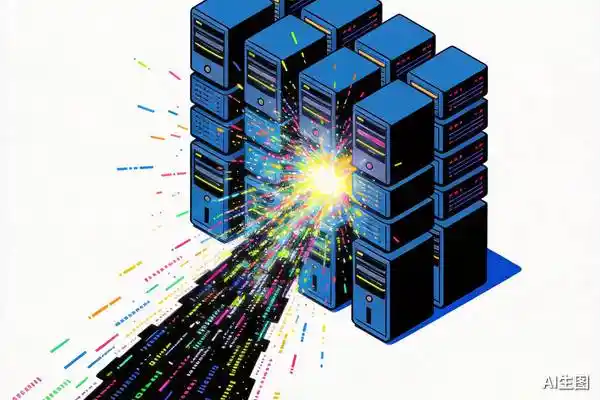
In August, GitHub suffered a major outage lasting over seven hours, which CTO Vlad Fedorov attributed to a "capacity failure" — the second such incident that month. The root cause: AI agents are flooding the platform. In September, developers and AI agents made 7.38 billion commits on GitHub, more than five times the level a year earlier, while pushes surged 4.9x to 3.35 billion per month. Unlike human programmers, AI agents "save" almost every step they take, generating huge numbers of commits per push and triggering cascades of automated tests and code scans — GitHub Actions ran 3.26 billion times in September, four times the prior year.
GitHub's legacy architecture, which keeps five full replicas of each repository across five servers, is poorly suited to this workload: every write must be acknowledged by all replicas, so throughput is limited by the slowest server, and reads and writes compete for the same resources. Merging is another bottleneck — merge volume has nearly quadrupled, and each repository processes only one write at a time, with cross-datacenter round trips of about 25 milliseconds capping agent productivity.
GitHub's first response was to add hardware: over 3 million new CPU cores and 120PB of storage by August, growing to 4 million cores and 160PB by late October. But its data centers ran out of power, prompting an accelerated migration to Azure — from 12% of workload in May to about 58% in August. Microsoft executives acknowledge that capacity alone is not enough.
The real fix is architectural: separate storage from serving. Code moves into a unified cloud repository that handles durability and backups, while front-end servers only handle requests. This separates reads from writes, eliminates unnecessary consensus steps (only branch-pointer updates need full agreement), and moves background cleanup to dedicated machines. Internal tests show up to 35x higher write throughput. The challenge is performing this "engine swap mid-flight" while GitHub stays online.
The outage had broad impact: even Cursor's services, including cloud agents, were affected for over six hours, showing that alternative code hosts don't free agent workflows from dependence on GitHub. As AI lowers the cost of writing code, the bottleneck shifts from "can it be written" to "can it be stored and merged" — and ultimately to "who approves it." GitHub's principle is that the more agents do, the more humans must review, understand, and sign off before changes reach the main branch.
marsbit2h ago