BiyaPay Market Observation|US Stocks Pull Back, Intel and AMD Surge Against the Trend, Has the AI Chip Rally Shifted Focus?

marsbitPublished on 2026-09-10Last updated on 2026-09-10

Abstract

BiyaPay Market Observations: US stocks experienced a general pullback, with major indices closing lower on September 8th. However, a notable divergence emerged within the semiconductor sector: Intel surged around 9% and AMD rose nearly 6%, while NVIDIA declined about 2%. This suggests capital is not exiting the AI and chip theme but rotating within the sector. The rotation comes amid macro pressures from rising oil prices and Treasury yields, which increase inflation concerns and pressure equity valuations. In this environment, investors are becoming more selective, shifting focus from high-flying pure-play AI stocks towards companies with clearer near-term profit recovery or new growth narratives. Intel's rally was sparked by reports of potential CPU price hikes, signaling a reassessment of its pricing power and potential profitability recovery within the broader AI infrastructure build-out. Qualcomm gained after announcing a multi-generational collaboration with Amazon for AI data center chips, opening a potential new growth avenue beyond mobile. AMD's rise appears tied to the overall positive sentiment towards alternative AI chip plays. This movement indicates the AI investment theme is maturing. The narrative is evolving from a singular focus on market leaders to a more nuanced, multi-faceted evaluation of the entire supply chain. Key factors to watch include upcoming US CPI data, the Federal Reserve's policy meeting, and further validation of order momentum and financ...

US stocks reopened after the holiday, and the market did not directly continue its previous risk appetite.

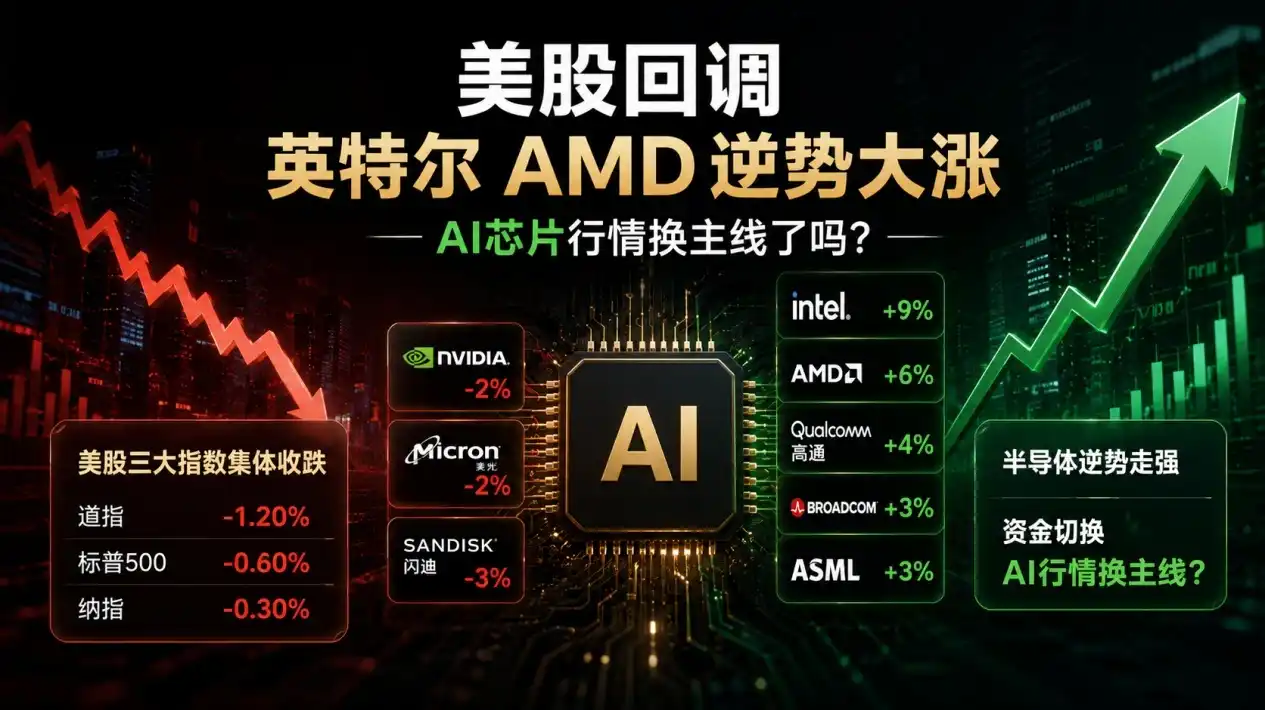
On September 8, BiyaPay market data showed that the three major US stock indices closed lower collectively, with the Dow Jones falling 1.2%, the S&P 500 Index falling 0.6%, and the Nasdaq falling 0.3%. On the surface, this appears to be a normal pullback, but the truly interesting part is that while the indices weakened, there was a clear divergence within the semiconductor sector. Intel surged approximately 9%, AMD rose nearly 6%, while Qualcomm, Broadcom, and ASML also saw varying degrees of gains. On the other hand, Nvidia fell about 2%, and storage-focused companies like Micron and SanDisk showed relative weakness.
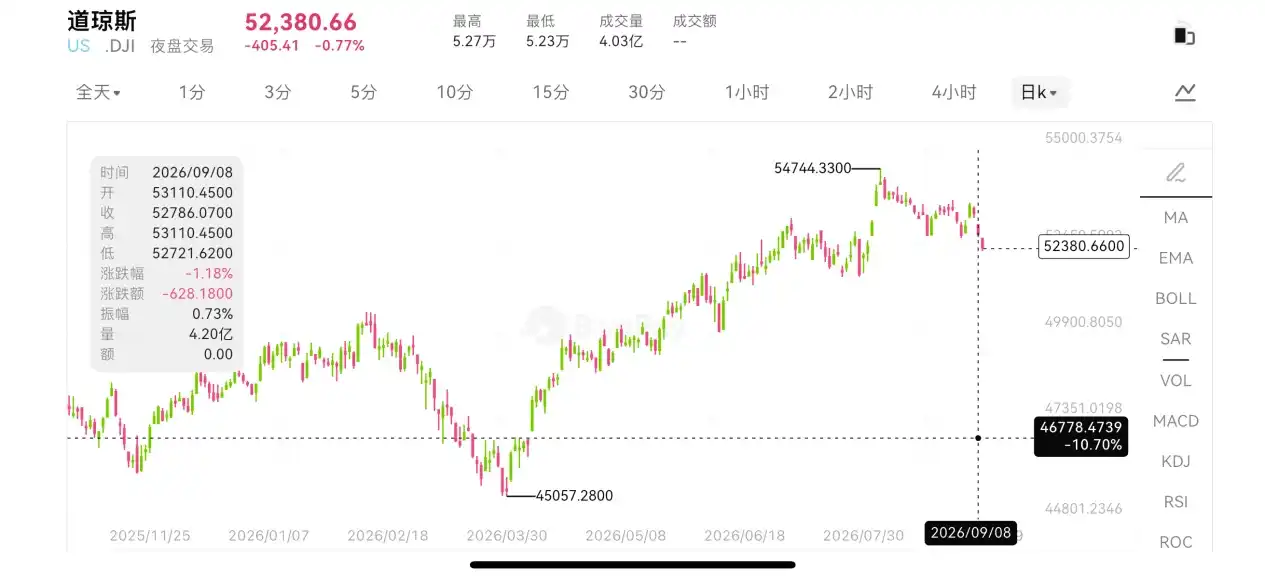
This kind of market movement is most likely to create illusions. Looking solely at the indices, one might think tech stocks are cooling down; looking only at individual stocks, one finds that capital hasn't left AI and chips but is rapidly switching between different directions. Especially when oil prices, US Treasury yields, Federal Reserve expectations, and the AI industrial chain are simultaneously impacting the market, focusing on just one market can easily cause one to miss the real signal.

When observing such market movements, it is more useful to look at several assets together. For example, within the BiyaPay App, one can simultaneously follow US stocks like Intel, AMD, Qualcomm, and Nvidia, while also monitoring changes in assets like Hong Kong stocks, BTC, ETH, gold, and crude oil. As a global all-in-one asset allocation platform, BiyaPay covers multiple asset scenarios including digital assets, US stocks, Hong Kong stocks, and fiat currency exchange, making it more suitable for observing price changes across different markets. For such high-volatility markets, the key is not to chase daily price fluctuations, but to understand what exactly the capital is trading—whether it's interest rates, inflation, AI orders, or risk appetite.

This indicates that capital has not simply withdrawn from AI and chips, but is rather choosing new directions.

Over the past period, trading in US tech stocks has been highly concentrated on keywords like Nvidia, AI servers, memory chips, and computing power capital expenditures. However, as oil prices surge again, US Treasury yields rise, and the Federal Reserve's September meeting approaches, market tolerance for high-valuation assets decreases. At such times, capital is more inclined to seek out two types of companies: those with clear orders or customer validation, and those with clearer profit recovery logic.

Intel, Qualcomm, and AMD being pulled back into the spotlight by capital this time precisely follows this logic.
Why Did Chip Stocks Rise Amid Broader Market Pressure?

The pressure on US stocks this round first came from the macro environment.

Brent crude oil once approached and briefly broke through the $100 per barrel mark, while WTI also rose above $90. Rising oil prices rekindle inflation expectations, and once inflation becomes more persistent, it becomes harder for the Fed to quickly pivot to easing. Meanwhile, the 10-year US Treasury yield rose to around 4.8%, with the 30-year yield also remaining high. For US stocks, the combined pressure from oil prices, inflation, and interest rates initially impacts valuations.

In theory, tech stocks should be more sensitive, as the valuations of many high-growth companies are based on future cash flows. The higher the interest rate, the less attractive the discounted present value of future profits becomes. However, this time the Nasdaq's decline was smaller than the Dow's, and semiconductors even strengthened against the trend, indicating the market is not broadly selling off tech, but rather undergoing a structural shift.

What capital is truly trading is which companies can continue to articulate their growth story clearly in a high-interest-rate environment, and whose price increases, orders, customers, and product roadmaps can more easily translate into profits.

Intel's Rise Is More Than Just a Sentiment Recovery

Intel's surge this time was superficially triggered by pricing and profit expectations.

DigiTimes reported that Intel may raise PC CPU prices again in October by about 10%. This news drove Intel's stock price higher, making it one of the top performers in the S&P 500 that day. It's important to note that Intel has not officially commented on this, so it cannot yet be considered confirmed company guidance. However, the market's willingness to buy in suggests that capital is paying attention to whether Intel's pricing power is returning.

This point is crucial.

Over the past few years, Intel's biggest problem wasn't a lack of revenue, but rather that profit margins, manufacturing investments, and competitive pressures have consistently weighed on its valuation. If CPU prices are now increasing, server-side demand is improving, and cost pressures are gradually being passed on, the market will reassess its profit recovery potential. Combined with AI data center demand for server CPUs, interconnects, and infrastructure, Intel is no longer just a traditional PC cyclical stock but is being re-priced within the AI infrastructure chain.

Of course, Intel's narrative hasn't completely reversed yet. What will ultimately determine how far the valuation recovery goes is not a single-day 9% gain, but whether it can prove in the coming quarters that price hikes won't significantly suppress demand, whether its data center business can continue to improve, and whether its advanced processes and foundry business can alleviate market concerns.

Qualcomm's Appeal: Transitioning from Phones to AI Data Centers

Qualcomm's strength this time leans more towards industry growth potential.

On September 8, Qualcomm officially announced a multi-generational product collaboration with Amazon, focusing on custom chips and optical interconnect solutions for large-scale AI data centers, with an emphasis on AI inference and optical connectivity capabilities up to 1.6T. The market's focus isn't just on the client name 'Amazon,' but also on whether Qualcomm can use this to open a second growth curve beyond mobile phone chips.

Qualcomm's core identity in the past has been mobile phones, basebands, and mobile computing. However, as AI enters the inference phase, data centers need not only GPUs but also more efficient inference chips, low-power computing, and high-speed interconnects. If Qualcomm can leverage the energy efficiency advantages accumulated in the mobile domain for data centers, it has an opportunity to break free from the traditional mobile phone cycle.

But here it's also necessary to see clearly that the so-called potential scale of up to $600 billion does not equate to confirmed order revenue. Some reports mention this being related to Amazon warrants and future purchasing conditions. Whether it can fully translate into Qualcomm's revenue depends on subsequent product delivery, customer purchasing cadence, and competitive landscape. The short-term market reaction—a price increase—is re-pricing Qualcomm's entry into the AI data center space, not fully confirming revenue for the next decade.

Why Was AMD Also Lifted?

AMD's rise was more driven by sentiment within the AI chip and server chain.

AMD has always occupied a nuanced position. It is not the absolute AI leader like Nvidia, but it's not without presence either. The market's focus on AMD essentially boils down to two points: first, whether its MI series AI accelerators can continue to secure orders from major customers, and second, whether its server CPU and data center business can maintain its share gains.

When Qualcomm secures a collaboration with Amazon and Intel is being re-traded for its pricing power, AMD will also be placed into the same comparative framework. Besides Nvidia, who else can capture a sufficiently large slice of the pie in the AI infrastructure expansion? This is the source of AMD's potential upside.

But AMD's challenge lies precisely here. The market is not giving it a premium for certainty, but rather a 'challenger' premium. Challenger rallies often rise quickly but are also prone to pullbacks due to order cadence, gross margins, supply chain issues, and software ecosystem concerns. Therefore, AMD's rise shouldn't be judged solely by a single-day gain; more importantly, it's about whether subsequent AI revenue share, customer expansion, and product iteration continue to materialize.

This Isn't an AI Downturn, but AI Pricing Becoming More Discerning

In this round of semiconductor divergence, the most noteworthy aspect isn't which stocks rose or fell, but that AI trading is shifting from a single-leader narrative to more granular industrial chain pricing.

In the earlier phase, the market preferred companies with the strongest certainty, hence Nvidia, TSMC, memory chips, and AI servers were the main theme. However, as valuations rise, capital begins to search for new explanatory frameworks. For instance, Intel is being traded for price and profit recovery, Qualcomm for AI inference and a new entry point into data centers, AMD for alternative potential outside of Nvidia, and ASML and semiconductor equipment for the advanced process capacity expansion cycle.

It's still AI, but the positioning is different.

This also explains why semiconductors can rise against the trend even as the broader market falls. The market isn't unconcerned about interest rates, but is seeking tech assets within the high-rate environment that can better prove their own value. As long as AI capital expenditure isn't disproven, chip stocks won't simply exit the stage; they will only rotate between different segments.

What to Really Watch Next?

In the short term, semiconductors rising against the trend have sent a signal to the market: the AI and chip theme hasn't disappeared; capital is simply seeking new pivot points away from crowded trades. Nvidia falling doesn't mean AI is receding; Intel, Qualcomm, and AMD rising don't mean the market theme has completely shifted. More accurately, the market is reallocating pricing power within the AI industrial chain.

Several variables are crucial going forward.

First is the US August CPI. According to the US Bureau of Labor Statistics schedule, the August CPI will be released on September 11. With oil prices having risen significantly, if inflation data also comes in strong, pressure on the Federal Reserve's September meeting will intensify. Second is the FOMC meeting on September 15-16. The market currently prices in a high probability of a September rate hike; the interest rate path will directly impact tech stock valuations. Third is subsequent orders within the AI industrial chain. The collaborations like Qualcomm-Amazon, Intel's price hike expectations, and AMD's server demand all need further validation in upcoming earnings reports and guidance.

Therefore, this round of semiconductor gains resembles a structural re-rating more than a simple sentiment-driven rebound.

Soaring oil prices and rising US Treasury yields should, in theory, pressure risk assets; but semiconductors strengthening against the trend indicates capital is still willing to pay for AI infrastructure, just more selectively. The companies that can continue to outperform in the future may not be the ones telling the most sensational stories, but those that can convincingly link customers, orders, pricing, and profit margins together.

The broader US stock market remains under pressure, yet AI chips show no signs of cooling down. The real question isn't whether chip stocks can still rise, but rather who in this rally will next prove that AI investments can ultimately translate into cash flow.


Trending Cryptos

Related Questions

QAccording to the article, why did major US stock indices decline while semiconductor stocks like Intel and AMD rose on September 8th?

AThe major indices declined due to macro pressures including rising oil prices, elevated US Treasury yields, and related inflation concerns ahead of the Fed's September meeting. Meanwhile, semiconductor stocks like Intel and AMD rose because capital rotated within the AI and chip sector, shifting from the previously crowded trade in names like Nvidia to companies with clearer near-term profitability, pricing power, or new AI data center growth stories.

QWhat was the specific catalyst mentioned for Intel's significant stock price increase?

AThe specific catalyst mentioned was a report from DigiTimes indicating that Intel may raise PC CPU prices by about 10% in October. While Intel did not officially confirm this, the market interpreted it as a sign of returning pricing power and potential profit margin improvement, leading to a significant re-rating of the stock.

QWhat new growth opportunity for Qualcomm is highlighted in the article?

AThe article highlights Qualcomm's multi-generational product collaboration with Amazon focusing on custom chips and optical interconnect solutions for large-scale AI data centers, including AI inference and high-speed optical connectivity up to 1.6T. This partnership represents a potential new growth avenue for Qualcomm beyond its traditional mobile phone chip business, entering the AI data center infrastructure market.

QHow does the article characterize the nature of the current AI and semiconductor market rally compared to the earlier phase?

AThe article characterizes the current phase as a shift from a broad, single-narrative (like the focus on Nvidia) to a more nuanced and selective 'structural repricing' within the AI supply chain. Capital is becoming more挑剔 (picky), focusing on specific company fundamentals like order validation, pricing power, profit recovery, and the ability to translate AI investment into cash flow, rather than just the overall AI theme.

QWhat are the three key upcoming variables mentioned in the article that could impact the market and AI chip stocks?

AThe three key upcoming variables are: 1) The release of US August CPI data on September 11th, which will provide insight into inflation trends. 2) The Federal Open Market Committee (FOMC) meeting on September 15th-16th, which will set the tone for interest rate policy. 3) Subsequent order validation and guidance from AI industry players like Qualcomm (with Amazon), Intel (price hike impact), and AMD (server demand), to see if their growth stories materialize.

Related Reads

GPT-6.1 Sol Participates in Live Brain Surgery! Three Rounds of Localization, Each More Accurate Than the Last

Exin Therapeutics CEO Gabriel Ocana-Santero reported an experiment in which GPT-6.1 Sol participated in three rounds of real mouse brain surgery positioning. The task involved locating Bregma and Lambda, two key skull landmarks used to calibrate stereotaxic coordinates for accurate targeting of brain regions. After each round, a professional surgeon corrected the model's positioning results, and the model retained its images, measurements, and expert corrections for reference in subsequent rounds. By the third round, GPT-6.1 Sol reduced landmark search time from 169 to 86 seconds, required corrections from four to two, and cut positioning error from 0.6 mm to 0.3 mm. Ocana-Santero described this as in-context learning from real-world experience. The team did not disclose how the experience records are integrated into the model or whether underlying weights are updated, so it cannot be described as autonomous training or parameter-level self-evolution. The sample is only three operations, far from proving stable surgical capability, but it demonstrates AI accumulating experience from real observations and expert feedback. This follows earlier Exin work in which AI selected gene therapy vectors, chose injection targets and coordinates, and controlled a stereotaxic device in a mouse experiment, with a licensed veterinarian supervising and safety limits in place. In a further experiment, Claude Sonnet 5, GPT-6.1 Sol, and Grok 4.7 chose different brain regions and treatment strategies for the same scientific goal, suggesting models may reason toward different experimental paths.

marsbit5h ago

GPT-6.1 Sol Participates in Live Brain Surgery! Three Rounds of Localization, Each More Accurate Than the Last

marsbit5h ago

From Drones to Nuclear Reactors: What Has Paradigm Invested in Since Leaving the Crypto World?

Paradigm, a venture capital firm known for crypto investments like Coinbase and Uniswap, is rapidly expanding into hard tech. In November, it co-led a $1.5 billion funding round for Zipline, a US drone delivery company now valued at $21.5 billion—nearly triple its valuation from January. Zipline, founded in 2014, began delivering medical supplies in Rwanda and now operates a large-scale automated logistics network, having completed 150 million miles of commercial autonomous flights. Walmart plans to add 300 new delivery sites, and Uber aims to scale their partnership to one million daily orders by 2029. Paradigm's broader portfolio now spans AI, robotics, manufacturing, semiconductors, space defense, and nuclear energy. Investments include open-source AI lab Nous Research, math-reasoning AI firm Harmonic, AI data company Idler, and GPU platform Andromeda. It also backs SendCutSend (metal parts manufacturing), Fab2 (compact semiconductor factories), True Anomaly (space defense), and Antares (micro nuclear reactors). In July, Paradigm launched a $12 billion new fund for frontier tech. This shift reflects a broader VC trend toward AI and physical technology, as crypto's path to sustained commercial revenue remains uncertain. Paradigm's bets focus on companies solving concrete industrial problems with existing markets, aiming to build a hard-tech network that transcends crypto cycles.

marsbit5h ago

From Drones to Nuclear Reactors: What Has Paradigm Invested in Since Leaving the Crypto World?

marsbit5h ago

Nomura: "Blue Wave" Hits US Data Centers, China's AI Benefits Instead

Nomura argues that the Democratic "blue wave" in the US midterms could paradoxically benefit China's AI economy. Democratic victories in key data-center states will likely tighten regulation, shift grid upgrade costs onto developers, and lengthen approval timelines, slowing US data-center expansion. Market reaction was sharp: the Nasdaq fell 5.5% in a single day, the SOX dropped nearly 15% over two days, Nvidia fell about 12%, and Micron about 24%. Because US cloud giants had been hoarding global GPU, HBM, and advanced logic chip capacity—driving black-market premiums of 200–300% at Asian logistics hubs—a US capex slowdown could collapse those speculative premiums, letting Chinese AI firms, cloud providers, and research institutions obtain GPUs, HBM modules, and advanced packaging materials more cheaply through intermediary trade hubs. China is also building a state-led national AI data-center network, with roughly RMB 2 trillion planned under the 15th Five-Year Plan to integrate regional computing by 2028, supported by low-cost renewable power in western hubs under the "East Data, West Computing" program. Morgan Stanley, meanwhile, does not see the blue wave as a real easing of US-China tensions; it expects strategic competition to persist but sees greater policy predictability. It prefers China's "self-sufficiency" AI trade—supported by both supply and demand under national policy priorities—over export chains tied to global AI capex. It also notes more balanced opportunities in Chinese equities, with valuations near historic lows.

marsbit5h ago

Nomura: "Blue Wave" Hits US Data Centers, China's AI Benefits Instead

marsbit5h ago

After GPT-6, Embodied Large Models Are Trapped in Their Own Territory! Next Year's Self-Research Budget Is Probably Up in the Air

The article discusses how the release of GPT-6 Astra (and the imminent GPT-6.2 Astra) has disrupted the embodied AI/robotics industry. General-purpose large models are now encroaching on capabilities that embodied AI companies previously developed in-house—such as in-context learning, out-of-distribution generalization, error correction, and open-vocabulary manipulation—often without task-specific post-training. On benchmarks like RoboDojo, teams combining general models with robot-use-agent techniques saw scores jump from 20–30 to 50–60, prompting many to question whether self-developing embodied foundation models still makes sense. Some companies have begun cutting algorithm roles. However, the article notes GPT-6 Astra still struggles with complex physical contact, force control, object deformation, and high-precision manipulation, and its cloud API inference latency is high (though this is not seen as a fundamental barrier). Experts argue that general models' current weaknesses shouldn't be treated as durable moats for embodied companies, since OpenAI is already hiring robotics talent and future models may absorb more robot operation data. The core argument is economic: embodied companies' opportunity lies not in building smarter models but in delivering better economic value. Stable, standardized industrial tasks may be better served by lightweight, specialized models or rule-based strategies, while open-ended tasks (e.g., home service robots) may benefit from general models. Ultimately, companies need to re-prioritize their R&D directions—leveraging general models for language understanding and task planning while focusing in-house efforts on physical interaction, embodiment-specific control, real-world adaptation, and deployment efficiency. The article concludes that the industry is moving past the demo-and-burn-investment stage, and the elimination round among the "hundred robot wars" has begun.

marsbit5h ago

After GPT-6, Embodied Large Models Are Trapped in Their Own Territory! Next Year's Self-Research Budget Is Probably Up in the Air

marsbit5h ago

Trading

Spot

Hot Articles

How to Buy CHIP

Welcome to HTX.com! We've made purchasing USD.AI (CHIP) simple and convenient. Follow our step-by-step guide to embark on your crypto journey.Step 1: Create Your HTX AccountUse your email or phone number to sign up for a free account on HTX. Experience a hassle-free registration journey and unlock all features.Get My AccountStep 2: Go to Buy Crypto and Choose Your Payment MethodCredit/Debit Card: Use your Visa or Mastercard to buy USD.AI (CHIP) instantly.Balance: Use funds from your HTX account balance to trade seamlessly.Third Parties: We've added popular payment methods such as Google Pay and Apple Pay to enhance convenience.P2P: Trade directly with other users on HTX.Over-the-Counter (OTC): We offer tailor-made services and competitive exchange rates for traders.Step 3: Store Your USD.AI (CHIP)After purchasing your USD.AI (CHIP), store it in your HTX account. Alternatively, you can send it elsewhere via blockchain transfer or use it to trade other cryptocurrencies.Step 4: Trade USD.AI (CHIP)Easily trade USD.AI (CHIP) on HTX's spot market. Simply access your account, select your trading pair, execute your trades, and monitor in real-time. We offer a user-friendly experience for both beginners and seasoned traders.

8.7k Total ViewsPublished 2026.04.21Updated 2026.06.02

How to Buy CHIP

Discussions

Welcome to the HTX Community. Here, you can stay informed about the latest platform developments and gain access to professional market insights. Users' opinions on the price of CHIP (CHIP) are presented below.

活动图片