Bitcoin ETFs Lost Nearly $390 Million Over the Week, While SOL ETFs Attracted New Capital

cryptonews.ruPublished on 2026-08-16Last updated on 2026-08-16

Abstract

Between August 10 and 14, 2026, the US spot Bitcoin ETF sector experienced a significant net outflow of $389.71 million, according to SoSoValue data. Outflows were recorded on four of the five trading days, primarily affecting major funds like Fidelity's FBTC ($153.23M outflow) and BlackRock's IBIT ($78.96M outflow). While Grayscale's BTC and Morgan Stanley's MSBT saw inflows, most Bitcoin ETFs ended the week with outflows or neutral flows. The spot Ethereum ETF sector also saw a net outflow of $2.26 million for the week, led by BlackRock's ETHA. In contrast, several altcoin-based ETFs attracted new capital. SOL-ETFs led with an inflow of $10.26 million, followed by funds tied to HYPE, XRP, LINK, and HBAR. DOGE-ETFs were an exception with a minor outflow. Activity in the Hong Kong market remained minimal. This follows a week where over $1 billion flowed into various crypto funds.

From August 10 to 14, 2026, the spot Bitcoin ETF sector in the United States recorded a total capital outflow of $389.71 million, according to data from SoSoValue.
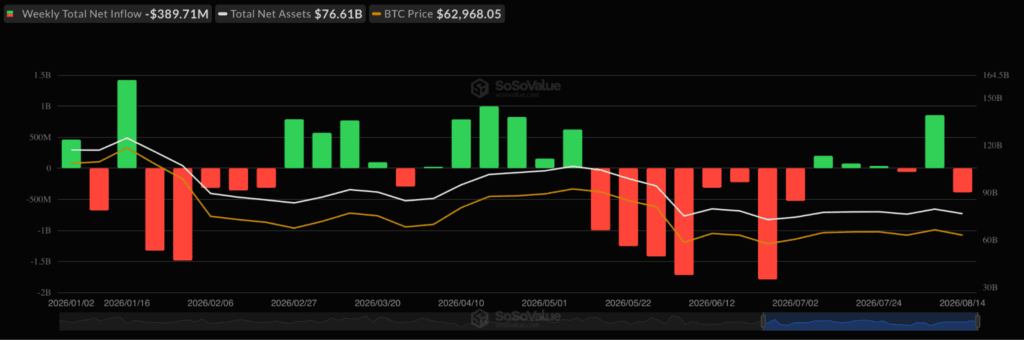
Dynamics of capital inflows/outflows from spot Bitcoin ETFs in the US. Data: SoSoValue.

Outflows were observed on four out of five trading days during the week:

  • August 10 — $144.67 million;
  • August 12 — $61.16 million;
  • August 13 — $131.13 million;
  • August 14 — $57.63 million.

The outflow during the reporting period came from BlackRock's IBIT — $78.96 million. At the same time, the largest single fund to see outflows was Fidelity's FBTC — $153.23 million.

The following funds also showed negative trends:

  • GBTC from Grayscale — $88.3 million;
  • ARKB from ARK Invest/21Shares — $70.36 million.

Only two funds recorded positive results:

  • BTC from Grayscale — $75.98 million;
  • MSBT from Morgan Stanley — $7.08 million.

Other Bitcoin ETFs also ended the week with outflows or without significant capital inflows.

Ethereum ETFs Lost $2.26 Million

The spot Ethereum ETF sector ended the week with a total outflow of $2.26 million, according to SoSoValue data.
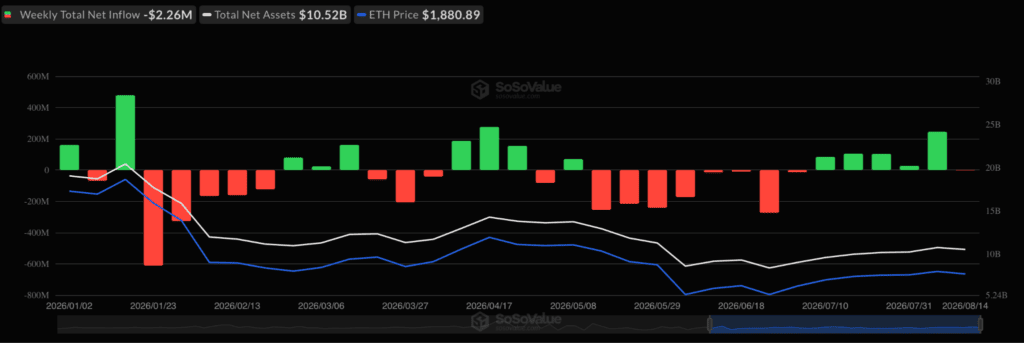
Dynamics of capital inflows/outflows from spot Ethereum ETFs in the US. Data: SoSoValue.

The largest outflow was recorded by BlackRock's ETHA — $16.39 million. Investors withdrew another $5.6 million from Fidelity's FETH.

At the same time, some of the losses were offset by:

  • $ETH from Grayscale — $15.07 million;
  • ETHB from 21Shares — $3.86 million;
  • MSSE from Morgan Stanley — $0.81 million.

Other funds based on Ethereum did not attract any assets under management during the week.

We explained what Ethereum ETFs are in a separate article:

$SOL-ETFs Became Leaders Among Altcoins

Unlike Bitcoin and Ethereum funds, some exchange-traded products based on altcoins showed positive trends.

The largest capital inflows were recorded by:

  • $SOL-ETFs — $10.26 million;
  • HYPE-ETFs — $2.74 million;
  • XRP-ETFs — $2.25 million;
  • LINK-ETFs — $1.23 million;
  • HBAR-ETFs — $0.46 million.

At the same time, DOGE-ETFs recorded an outflow of $0.56 million.

Other funds based on altcoins did not attract investments during the reporting period.

Activity remained minimal in the Hong Kong market as well: only 0.17 $ETH was added to spot Ethereum ETFs over the week.

Recall that last week, investors poured over $1 billion into various crypto funds.

end-content

Trending Cryptos

Related Questions

QWhat was the total net outflow from U.S. spot Bitcoin ETFs for the week of August 10-14, 2026?

AThe U.S. spot Bitcoin ETF sector recorded a total net capital outflow of $389.71 million for the week.

QWhich two Bitcoin ETFs were the only ones to record a positive inflow of capital during the reported week?

AThe two Bitcoin ETFs with a positive inflow were BTC from Grayscale with $75.98 million and MSBT from Morgan Stanley with $7.08 million.

QHow much capital did the U.S. spot Ethereum ETF sector lose during the same week?

AThe U.S. spot Ethereum ETF sector ended the week with a total net outflow of $2.26 million.

QAmong altcoin ETFs, which one attracted the most capital and how much was it?

AThe SOL-ETF was the leader among altcoin ETFs, attracting $10.26 million in capital.

QWhich Bitcoin ETF from a specific issuer experienced the largest single outflow of capital during the week?

AFBTC from Fidelity experienced the largest single outflow among individual Bitcoin ETFs, with $153.23 million withdrawn.

Related Reads

Conversation with Macro Analyst Jordi Visser: Micron Has 60%-80% Upside, the Longevity Economy Is a High-Confidence Main Theme

Macro analyst Jordi Visser argues that AI is the sole real driver of the economy today, with traditional GDP metrics failing to capture its value—AI-driven productivity shows up in corporate profit margins instead, as large firms grow revenue while hiring freezes. He attributes rising Treasury yields to AI-related capex and debt issuance, not Fed policy, and views credit default swap widening as a concentration-risk hedging issue rather than an AI bubble. He expects hyperscaler external financing to peak as data centers come online and free cash flow turns positive (citing Oracle's guidance). On labor, he sees Microsoft's buyout of 27% of its workforce as a template: AI-driven revenue-per-employee surges will push governments toward redistributing profits from capital to labor via tax restructuring, since personal income tax bases erode. He warns the market is discounting risks like labor turmoil, political gridlock, memory/data center bottlenecks, and cybersecurity. His key themes are agentic compute and the longevity economy. He is bullish on Eli Lilly as the purest longevity play, predicting it will become the S&P 500's largest company by 2030, and on Micron, which he re-entered around $800 with only ~10% downside and 60-80% upside, citing humanoid robot RAM demand, SpaceX's 10GW compute plan, and long-term supply agreements through 2030. He also holds crypto as his largest allocation, expecting 2027 to mark a breakout year for blockchain commercial applications and payment networks.

marsbit33m ago

Conversation with Macro Analyst Jordi Visser: Micron Has 60%-80% Upside, the Longevity Economy Is a High-Confidence Main Theme

marsbit33m ago

Michael Saylor: Four Centuries of Digital Credit Evolution

Michael Saylor traces the four-century evolution of digital credit, showing how centuries of financial infrastructure paved the way for Bitcoin-based corporate treasuries. The story begins in 1602 with the Dutch East India Company, which separated a company's capital duration from investors' holding periods through transferable shares. Preferred stock followed, exemplified by the Baltimore and Ohio Railroad's 6% perpetual preferred dividend in 1836 and Delaware's 1899 recognition of distinct share classes. Exchanges and tickers—from the 1792 Buttonwood Agreement to the 1867 stock ticker and 1971 Nasdaq—gave ownership a public market. U.S. securities and commodities law (1922–1974) established the distinction between assets a company holds and securities it issues. The 1940 Investment Company Act's "40% test" still shapes how bitcoin treasury companies use common stock, preferred stock, and debt. Tax law dating to 1921–1954 distinguishes return of capital from income, allowing preferred dividends to reduce cost basis before gains are realized. Shelf registration (Rule 415, 1982–1983) and at-the-market programs (1982, 2005) let companies prepare financing in advance and raise capital at market prices. Buybacks, recognized since 1828 with the 1982 Rule 10b-18 safe harbor, let firms manage capital in both directions. Bitcoin, launched in 2008–2009 and classified as a commodity by the CFTC in 2015, provides a new reserve asset, while companies supply capital structure, dollar liquidity, and distribution policy. Digital credit thus combines over 400 years of corporate ownership transfer, roughly 190 years of U.S. preferred stock, more than a century of tax cost-recovery rules, and four decades of modern shelf and ATM regulation into a familiar framework for investors.

marsbit2h ago

Michael Saylor: Four Centuries of Digital Credit Evolution

marsbit2h ago

The Hidden Risks Behind Anthropic's Nearly $1 Trillion Bet

Anthropic's IPO filing reveals a fragile, high-risk financing mechanism behind its AI ambitions. The company has committed to up to $895.4 billion in data center spending through 2045, with profits squeezed by rising compute costs. Rather than paying upfront for hardware, Anthropic relies on supplier-backed financing: Broadcom arranged a $63 billion equipment financing deal under which it absorbs losses if Anthropic defaults—up to roughly $43 billion once equipment is delivered. Google and AMD similarly tie funding to hardware leases or deployments. This shifts risk onto chipmakers' balance sheets, and because custom TPUs serve a narrower ecosystem than Nvidia GPUs, resale risk is higher. Analysts warn that while individual loans appear safer, risk concentration across the system is rising and harder to assess. Anthropic also can issue up to $42 billion in convertible notes to Broadcom to cover rent, with interest rates rising from 9% to 13% and conversion terms worsening if revenue targets are missed. Despite holding $146.6 billion in liquidity as of September 30, its massive forward obligations and tangled partnerships could limit access to investment-grade financing. Key concerns: whether revenue growth can outrun compute costs and cover future commitments, and whether drawing on credit lines signals distress. Anthropic's Direct initiative—separating data center leasing from chip purchases—and IPO proceeds could give it more flexibility, but ultimately debt repayment depends on end-customer revenue.

marsbit12h ago

The Hidden Risks Behind Anthropic's Nearly $1 Trillion Bet

marsbit12h ago

Trading

Spot

Hot Articles

What is $BITCOIN

DIGITAL GOLD ($BITCOIN): A Comprehensive Analysis Introduction to DIGITAL GOLD ($BITCOIN) DIGITAL GOLD ($BITCOIN) is a blockchain-based project operating on the Solana network, which aims to combine the characteristics of traditional precious metals with the innovation of decentralized technologies. While it shares a name with Bitcoin, often referred to as “digital gold” due to its perception as a store of value, DIGITAL GOLD is a separate token designed to create a unique ecosystem within the Web3 landscape. Its goal is to position itself as a viable alternative digital asset, although specifics regarding its applications and functionalities are still developing. What is DIGITAL GOLD ($BITCOIN)? DIGITAL GOLD ($BITCOIN) is a cryptocurrency token explicitly designed for use on the Solana blockchain. In contrast to Bitcoin, which provides a widely recognized value storage role, this token appears to focus on broader applications and characteristics. Notable aspects include: Blockchain Infrastructure: The token is built on the Solana blockchain, known for its capacity to handle high-speed and low-cost transactions. Supply Dynamics: DIGITAL GOLD has a maximum supply capped at 100 quadrillion tokens (100P $BITCOIN), although details regarding its circulating supply are currently undisclosed. Utility: While precise functionalities are not explicitly outlined, there are indications that the token could be utilized for various applications, potentially involving decentralized applications (dApps) or asset tokenization strategies. Who is the Creator of DIGITAL GOLD ($BITCOIN)? At present, the identity of the creators and development team behind DIGITAL GOLD ($BITCOIN) remains unknown. This situation is typical among many innovative projects within the blockchain space, particularly those aligning with decentralized finance and meme coin phenomena. While such anonymity may foster a community-driven culture, it intensifies concerns about governance and accountability. Who are the Investors of DIGITAL GOLD ($BITCOIN)? The available information indicates that DIGITAL GOLD ($BITCOIN) does not have any known institutional backers or prominent venture capital investments. The project seems to operate on a peer-to-peer model focused on community support and adoption rather than traditional funding routes. Its activity and liquidity are primarily situated on decentralized exchanges (DEXs), such as PumpSwap, rather than established centralized trading platforms, further highlighting its grassroots approach. How DIGITAL GOLD ($BITCOIN) Works The operational mechanics of DIGITAL GOLD ($BITCOIN) can be elaborated on based on its blockchain design and network attributes: Consensus Mechanism: By leveraging Solana’s unique proof-of-history (PoH) combined with a proof-of-stake (PoS) model, the project ensures efficient transaction validation contributing to the network's high performance. Tokenomics: While specific deflationary mechanisms have not been extensively detailed, the vast maximum token supply implies that it may cater to microtransactions or niche use cases that are still to be defined. Interoperability: There exists the potential for integration with Solana’s broader ecosystem, including various decentralized finance (DeFi) platforms. However, the details regarding specific integrations remain unspecified. Timeline of Key Events Here is a timeline that highlights significant milestones concerning DIGITAL GOLD ($BITCOIN): 2023: The initial deployment of the token occurs on the Solana blockchain, marked by its contract address. 2024: DIGITAL GOLD gains visibility as it becomes available for trading on decentralized exchanges like PumpSwap, allowing users to trade it against SOL. 2025: The project witnesses sporadic trading activity and potential interest in community-led engagements, although no noteworthy partnerships or technical advancements have been documented as of yet. Critical Analysis Strengths Scalability: The underlying Solana infrastructure supports high transaction volumes, which could enhance the utility of $BITCOIN in various transaction scenarios. Accessibility: The potential low trading price per token could attract retail investors, facilitating wider participation due to fractional ownership opportunities. Risks Lack of Transparency: The absence of publicly known backers, developers, or an audit process may yield skepticism regarding the project's sustainability and trustworthiness. Market Volatility: The trading activity is heavily reliant on speculative behavior, which can result in significant price volatility and uncertainty for investors. Conclusion DIGITAL GOLD ($BITCOIN) emerges as an intriguing yet ambiguous project within the rapidly evolving Solana ecosystem. While it attempts to leverage the “digital gold” narrative, its departure from Bitcoin's established role as a store of value underscores the need for a clearer differentiation of its intended utility and governance structure. Future acceptance and adoption will likely depend on addressing the current opacity and defining its operational and economic strategies more explicitly. Note: This report encompasses synthesised information available as of October 2023, and developments may have transpired beyond the research period.

4.9k Total ViewsPublished 2025.05.14Updated 2025.05.14

What is $BITCOIN

Discussions

Welcome to the HTX Community. Here, you can stay informed about the latest platform developments and gain access to professional market insights. Users' opinions on the price of BTC (BTC) are presented below.

活动图片