"White Hat" Hackers from Liquid Return $270M Worth of Bitcoin as Network Prepares for Restart

cryptonews.ruPublished on 2026-09-08Last updated on 2026-09-08

Abstract

"White hat" hackers have returned approximately 3,400 Bitcoin, worth around $270 million, to the Liquid federation wallet after a security incident on the Bitcoin sidechain. The hack, which occurred on Sunday, saw about 4,000 BTC withdrawn from a wallet holding roughly 4,200 BTC. The return followed on-chain negotiations between Blockstream, the company behind Liquid, and the perpetrators, who claimed the "white hat" label. Samson Mow of JAN3 stated the funds were returned after Blockstream confirmed updates to the affected bridge nodes. However, about 598 BTC remain unrecovered. Blockstream deployed updated software, and federation members are preparing for a coordinated network restart. Liquid issues L-BTC tokens backed by Bitcoin held in custody, so the return of about 85% of the withdrawn funds restores a significant portion of the lost collateral. Initial investigations pointed to an exploit via SideSwap's Peg-out authorization key, though both Liquid and SideSwap asserted the key itself was not compromised. SideSwap attributed the involved L-BTC to a bug in the open-source Elements software underlying the Liquid Network. Ledger's CTO, Charles Guillemet, questioned the "white hat" claim, suggesting the retained 600 BTC appeared more like extortion than a typical bug bounty if it was a pre-arranged reward. Neither Blockstream nor Liquid has publicly confirmed the unrecovered Bitcoin as a bounty or disclosed the return terms. Users are advised not to send Bitcoin to Liq...

Allegedly, "white hat" hackers have returned 3,400 Bitcoin, worth approximately $270 million, to the Liquid federation wallet after withdrawing around $320 million from the reserves of the Bitcoin sidechain.

On Monday, Samson Mow, CEO of JAN3 and former Blockstream executive, stated that the fund return followed Blockstream's confirmation of updated affected bridge nodes. According to him, about 598 $BTC remain unrecovered, and Blockstream continues to engage with the threat actors.

The fund return follows a security incident on Sunday during which hackers withdrew around 4,000 $BTC from a wallet containing approximately 4,200 $BTC. On-chain ledger data shows that exactly 3,400 $BTC were transferred back to the federation wallet address.

Blockstream reported that the updated software has been deployed, and federation members were preparing for a coordinated restart. Liquid issues L-$BTC backed by Bitcoin held by the federation, so the return of about 85% of the withdrawn Bitcoin restores a significant portion of the collateral lost in the incident, as the suspended network prepares to resume operations.

Bitcoin Return Followed On-Chain Negotiations

The initial withdrawal was conducted via SideSwap company's Peg-out authorization key, although both Liquid and SideSwap stated the key itself was not compromised. SideSwap reported that the L-$BTC involved originated from a bug in Elements — the open-source software underlying Liquid.

Blockstream contacted the threat actors via signed messages embedded in Bitcoin transactions. The threat actors, calling themselves "white hats," stated they would return most of the funds after the vulnerability was patched and the fix installed on each node.

Read also: Bitcoin From Satoshi Era Awakens After 16 Years of Inactivity: 600 $BTC Moved

Mow stated that Liquid remained suspended as Blockstream and federation members deployed additional fixes and security enhancements, resolved a chain split, and prepared for a safe restart. He urged users not to send Bitcoin to Liquid peg-in addresses until network restart is confirmed, adding that no other action is required from users.

Ledger CTO Charles Guillemet questioned the threat actors' claim of being "white hats" following the partial return. He said if the approximately 600 $BTC remaining under their control constituted a reward agreed upon through encrypted on-chain communications, this arrangement "looks more like extortion than a 'white hat' hack."

Neither Blockstream nor Liquid has publicly called the unrecovered Bitcoin a reward or disclosed the terms of the return. Cointelegraph contacted both companies for comment but did not receive a response by the time of publication.

Magazine: "White Hats" Took 4,000 $BTC From Liquid, ETFs See Best 2026 Inflows: Hodler's Digest

end-content

Related Questions

QWhat is the main event reported in this article regarding the Liquid sidechain and Bitcoin?

AThe article reports that hackers, who claim to be "white hats," returned 3,400 Bitcoins worth approximately $270 million to the Liquid federation wallet. This happened after they initially withdrew around 4,000 BTC from the wallet, and the Liquid network is preparing to restart following security updates.

QWho is Samson Mow, and what statement did he make regarding the situation?

ASamson Mow is the CEO of JAN3 and the former head of Blockstream. He stated that the return of funds followed confirmation from Blockstream about updating the affected bridge nodes. He also mentioned that about 598 BTC remained unreturned and that Blockstream continued to interact with the hackers.

QWhat was the alleged cause of the security incident that allowed the hackers to withdraw funds?

AAccording to the article, the incident involved an error in Elements, the open-source software underlying the Liquid sidechain. The hackers used a Peg-out authorization key from SideSwap to conduct the initial withdrawal, though both Liquid and SideSwap stated that the key itself was not compromised.

QHow did Blockstream communicate with the hackers, and what claim did the hackers make about themselves?

ABlockstream communicated with the hackers through signed messages embedded in Bitcoin transactions. The hackers claimed to be "white hats" and stated they would return most of the funds after the vulnerability was fixed and a patch was installed on every node.

QWhat criticism did Ledger's CTO, Charles Guillemet, raise about the hackers' actions?

ACharles Guillemet questioned the hackers' claim of being "white hats." He suggested that if the approximately 600 BTC remaining under their control was an agreed-upon reward negotiated via on-chain encrypted communications, it looked 'more like extortion than a white-hat hack.'

Related Reads

Strategy stock sheds 5% amid MSCI index removal, Bitcoin sell-off

Strategy (Michael Saylor's Bitcoin treasury company) fell 6.49% on Thursday to close at $114.41, after MSCI confirmed the company's removal from its global equity indexes, compounded by a broader crypto market sell-off. The removal takes effect after the Nov. 30 market close and could trigger selling by index-tracking funds; JPMorgan previously estimated roughly $2.8 billion in potential selling pressure. Ryan Kirkley, CEO of Global Settlement Network, said the decision could distinguish Bitcoin treasury companies from traditional operating businesses and limit indirect crypto exposure for passive investors, noting that index inclusion had given ordinary passive investors leveraged Bitcoin exposure they never chose. He added it raises questions about whether such companies should be classified alongside traditional operating businesses, arguing that buying and holding an asset isn't an operating business but rather a fund that doesn't follow fund rules. In its Aug. 31 response to MSCI's proposed rules, Strategy called the changes a pretext for targeting digital asset treasury companies and downplayed the impact, saying MSCI-linked funds held about 13 million of its shares, just 3.1% of basic shares outstanding. The decline coincided with a broader crypto sell-off, with Bitcoin near $71,340, down 4.3% in 24 hours, and total crypto market capitalization down 3% to about $2.49 trillion.

cointelegraph1h ago

Strategy stock sheds 5% amid MSCI index removal, Bitcoin sell-off

cointelegraph1h ago

US Justice Department, business groups and DeFi firms challenge Illinois crypto tax

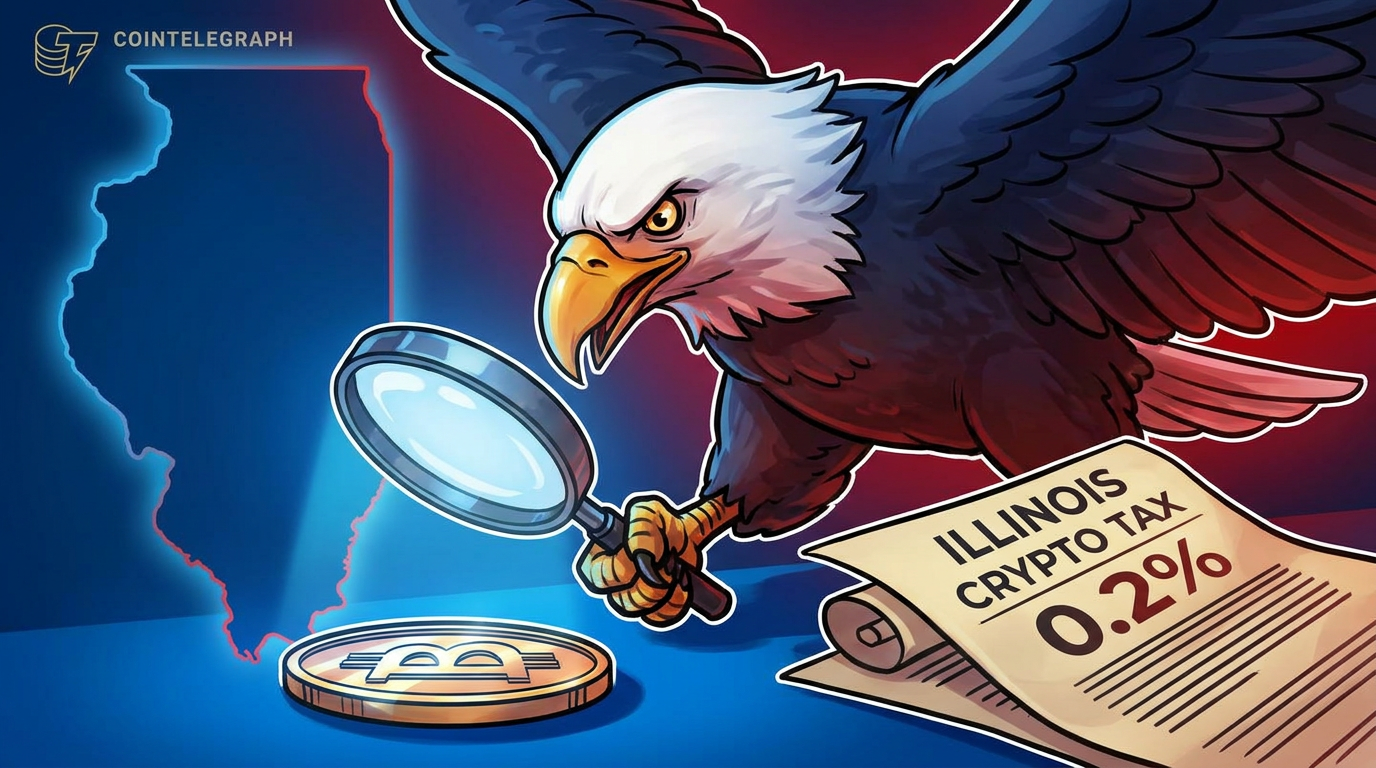
The US Department of Justice, business and financial industry groups, and a coalition of DeFi firms have backed a legal challenge to Illinois' 0.2% digital asset tax, arguing it unfairly targets crypto transactions and could impose taxes even without profit. The Justice Department filed a statement of interest, while the US Chamber of Commerce and SIFMA submitted an amicus filing. A coalition including Andreessen Horowitz, Paradigm, Uniswap and Aave Labs also filed a brief. The law, enacted in June, taxes the value of digital assets exchanged, transferred or stored regardless of profit. The Digital Chamber sued Illinois officials in July, followed by a separate challenge from the Blockchain Association and Crypto Council for Innovation in August. Originally set for Jan. 1, 2027, the tax was delayed to July 1, 2027. Illinois projected $60 million in fiscal year 2027 revenue. SIFMA and the Chamber warned the tax would affect banks, broker-dealers, custodians and asset managers nationwide, exposing them to compliance costs and burdening customers—someone who loses money owes the same tax as someone who profits, and moving assets between accounts could trigger tax without a sale or gain. They argued it discriminates against digital assets and may violate federal internet tax protections and constitutional interstate commerce requirements. The DOJ said the tax undermines federal efforts to promote crypto innovation, citing the Strategic Bitcoin Reserve and GENIUS Act. The DeFi coalition warned the rules could impose obligations on software developers and blockchain participants lacking customer information or control over funds.

cointelegraph2h ago

US Justice Department, business groups and DeFi firms challenge Illinois crypto tax

cointelegraph2h ago

DTCC Plans Solana Expansion as Wallet Rules Limit Access

DTCC plans to connect its tokenization service to Solana in the second half of 2027, allowing certain securities held by its DTC subsidiary to be converted into digital tokens on the network. Analysts say the move could attract more traditional financial institutions to Solana, which is known for fast transactions and low fees and had about $4.94 billion in total value locked as of Nov. 12. However, the impact may be limited by US regulatory rules. Alex Lin of Reforge noted that Solana's experience handling memecoin trading served as a public stress test, giving the network credibility to handle retail-scale volume reliably. Still, under a December 2025 SEC no-action letter, DTC participants must register wallets to hold tokenized securities, and tokens can only be transferred between registered wallets. Lin said the near-term impact is overstated because the tokens remain in a walled garden, inaccessible to permissionless retail and DeFi liquidity until regulators allow these assets to function as true onchain collateral. DTCC launched its tokenization service on the Canton Network and its private Besu network on Oct. 28, with 20 DTC participants signed on, though it has not said whether any plan to use Solana. Kha Nguyen of Birdeye said Solana has already seen growing demand for tokenized stocks, with trading volume reaching around $4.9 billion in H1 2026 and over 1 million accounts holding tokenized stocks by late September. However, broader Solana activity has slowed, with transactions down nearly 40%, DEX volume down 34.4%, and fees down 39%, while tokenized RWA value rose almost 7% to $4.76 billion. Nguyen said DTCC's integration would need banks, brokers, and issuers to actively issue, trade, and settle on Solana, with enough liquidity for large trades. He stressed that assets must be active rather than idle—traded around the clock, used as collateral, and earning yield. Lin agreed that long-term impact depends on where assets are used for secondary trading and collateral activity, not where they are issued.

cointelegraph3h ago

DTCC Plans Solana Expansion as Wallet Rules Limit Access

cointelegraph3h ago

Trading

Spot
活动图片