Anatomy of the Helium Short Squeeze: A 5.7x Surge in Two Weeks While Revenue Plummets 82%, Who's Swimming Naked?

marsbitPublished on 2026-09-04Last updated on 2026-09-04

Abstract

"Helium HNT Surge Analysis: A 570% Pump Amidst 82% Revenue Drop" The Helium (HNT) token experienced a dramatic 570% price surge from its August low, driven by a combination of catalysts and a major short squeeze. Key triggers included the passing of governance proposal HIP-150—aimed at redirecting subDAO emissions to network operators—and a partnership with the city of Celina, Texas, for public WiFi coverage. However, on-chain data reveals a stark contradiction: while data usage on the Mobile network grew 2.4x year-over-year, actual protocol revenue from paid data credits plummeted 82% from its March peak. This revenue crash is attributed to the removal of subsidies from Nova Labs, providing a clearer picture of organic operator demand. The recent governance changes are designed to restore operator incentives after subsidy cuts. Yet, valuation metrics remain challenging. Annualized revenue stands around $3.1 million against a $95 million market cap, and operator-driven token burns are currently a fraction of new monthly emissions created by growth subsidies. The explosive price move was significantly amplified by market positioning. Deeply negative funding rates and over $1.6 million in short liquidations over a weekend indicate the rally was fueled by a short squeeze finding a narrative catalyst. The surge has repriced HNT as a growth bet, where future value depends entirely on operator data burn accelerating fast enough to outpace new token issuance.

Author:0xResearch

Compiled by: Deep Tide TechFlow

Deep Tide Introduction: The Helium token surged 5.7x from its bottom in two weeks. The apparent catalysts were city partnerships and governance proposal approvals, but on-chain data shows revenue actually plummeted by 82%. This article dissects the real causes of the short squeeze, helping investors distinguish between genuine demand and position squeezes to avoid buying at an emotional peak.

Good morning and happy Thursday!

Strong ETF inflows from institutions, coupled with on-chain breakthroughs by players on the Robinhood Chain, continue to paint a constructive picture for on-chain fundamentals, capital flows, and price action.

Below, we break down HNT's 5.7x rally, separating the true fundamental catalysts from the positioning dynamics that turned it into a short squeeze. The key question now is whether the burn from operator data offload can accelerate enough to outpace issuance and validate this valuation reset.

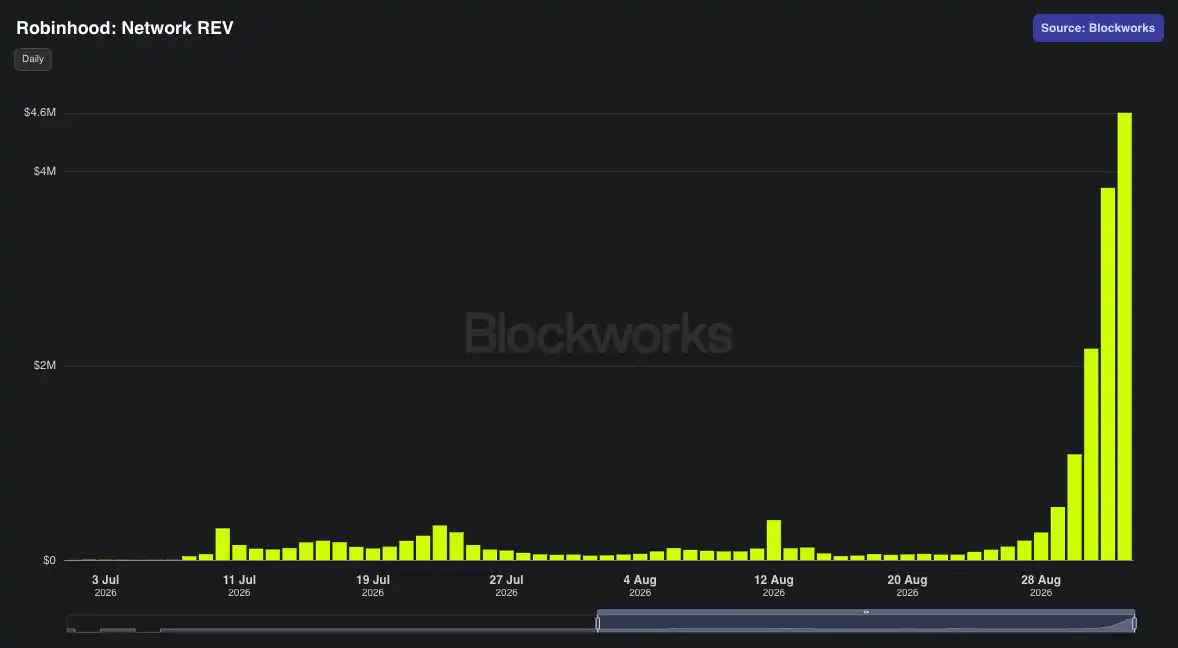
Block space demand on the Robinhood Chain is recovering, with REV breaking $4.6 million yesterday. This marks 11 consecutive days of rising demand on this young L2, bringing it to 97% of total L2 profits and 42% of all on-chain network revenue. One can't help but annualize that number and imagine even greater implications for HOOD stock and the network's applications.
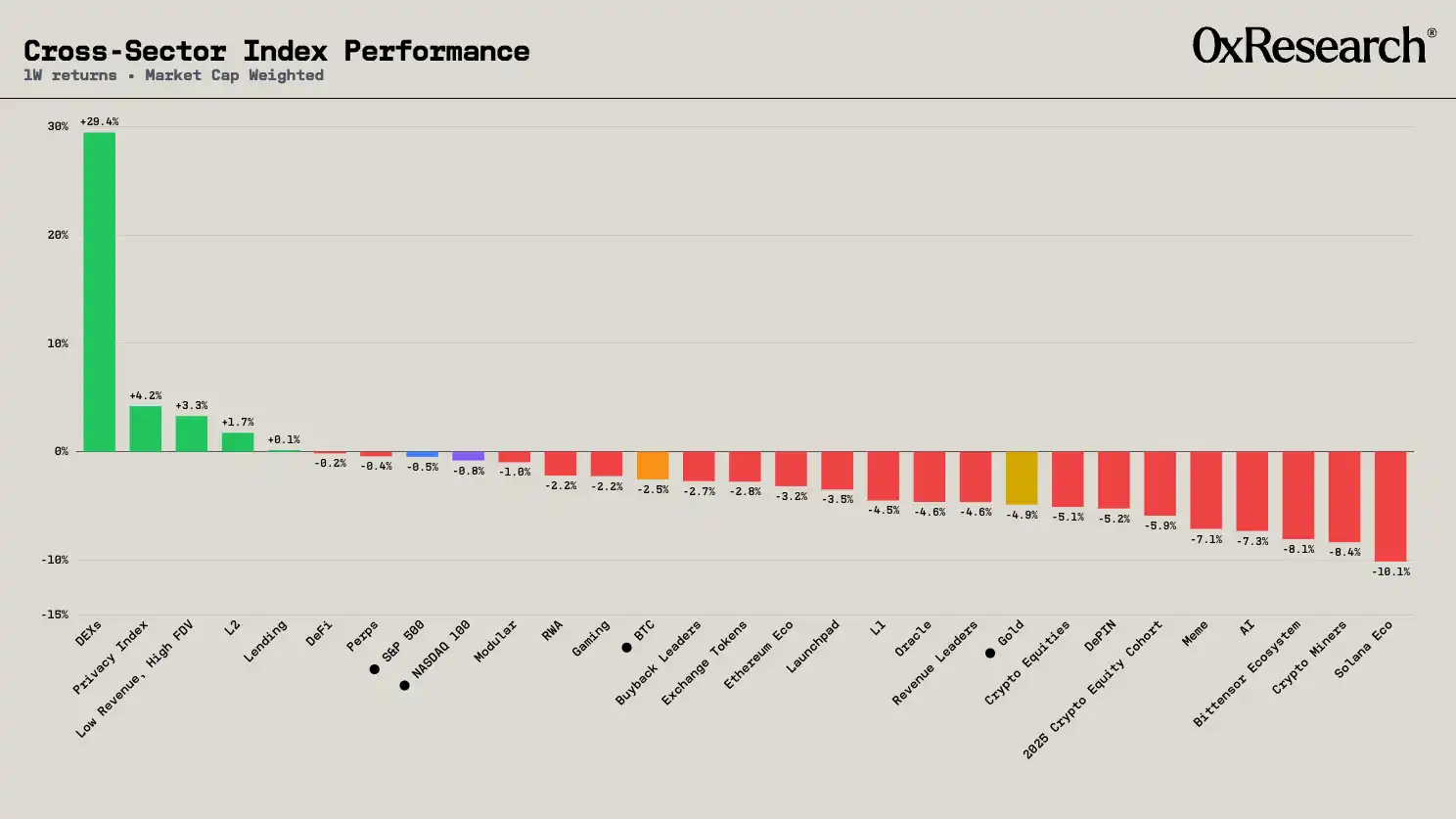
Uniswap is one such winner, being the largest DEX on the Robinhood Chain. Recent token incentive adjustments and a breakthrough deployment on Robinhood drove the token up 33% this week, leading index gains during a week of sideways movement for major coins and a stock market dip. Index data confirms this, with the DEX sector up 29% this week, a clear divergence from overall price action. UNI drove that outperformance.
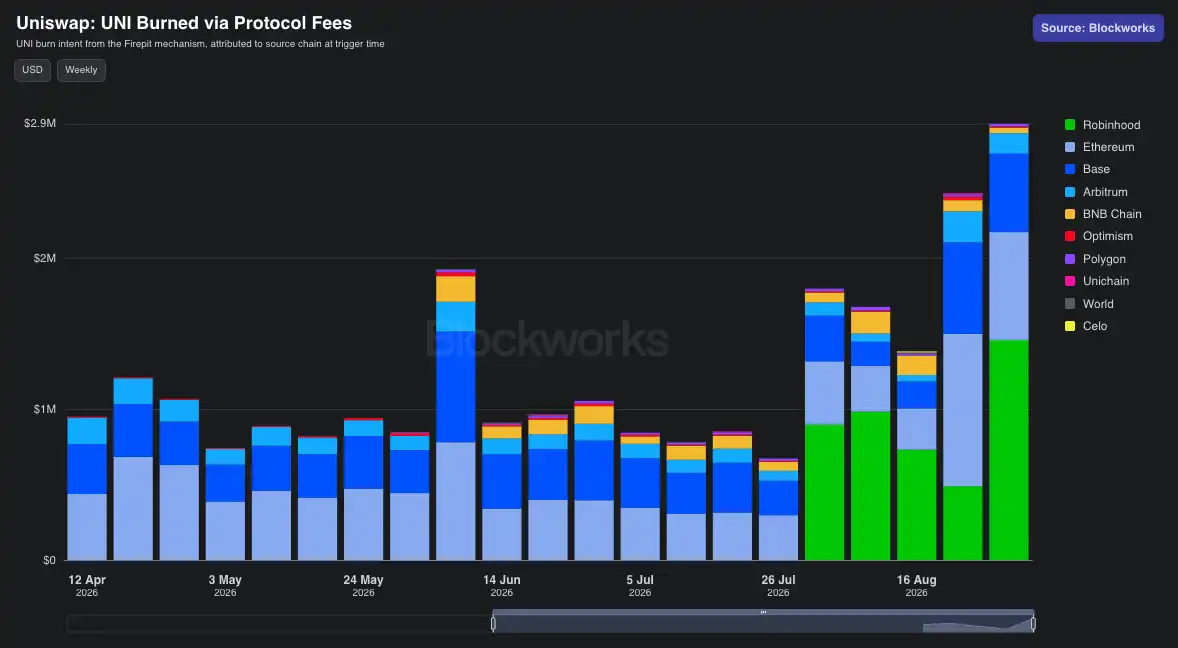
The launch of Robinhood Chain represents a "growing the pie" scenario. It's not taking volume from existing platforms but bringing incremental demand to the entire on-chain economy. For Uniswap, this is evident in the UNI burned via protocol fees, which are at weekly highs, with over 50% of the burn originating from Robinhood Chain. Similarly, over the past 30 days, Robinhood Chain accounted for more than 50% of all on-chain Uniswap total volume. Looking at recent activity, deployment volume on Robinhood exceeded the combined activity of all other chain deployments, including the ETH mainnet.
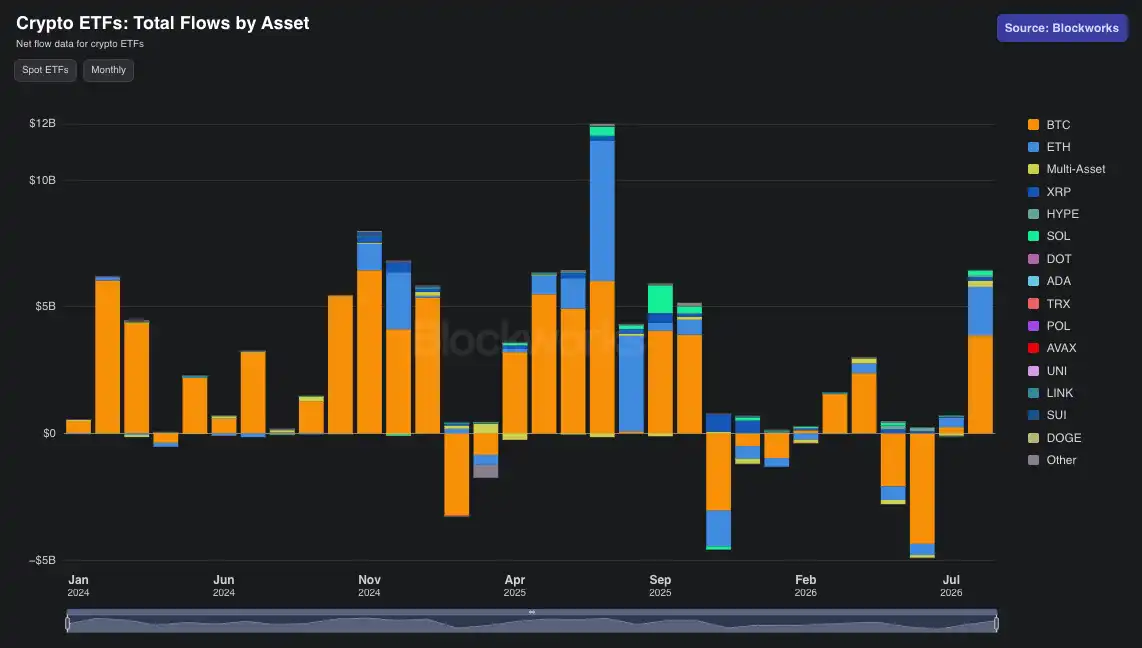
Beyond the on-chain battlefield, ETFs appear to be bottoming in AUM, suggesting major tokens might be forming a higher time frame low. In August, BTC ETFs added $3.871 billion, and ETH ETFs added $1.911 billion. SOL and HYPE products also saw demand, albeit far less than their predecessors.
Taken together, flows, fundamentals, and price action all support an optimistic outlook for year-end and beyond.

Anatomy of the Helium Short Squeeze

HNT hit a multi-year low of $0.167 on August 15, with a market cap nearing $31 million. Two weeks later, the token touched $0.96 intraday, a 5.7x rally from trough to peak. As of this morning, it trades around $0.50, still up over 125% this week with a market cap of about $95 million. This rally warrants dissection because the catalysts were real, positioning amplified them, and the on-chain record is more interesting than either narrative.

The news unfolded in four steps. Helium published HIP-150 on August 21, proposing to redirect Mobile subDAO issuance to deployers carrying paid data traffic. On August 28, Helium announced Celina, Texas had switched its public Wi-Fi to operator coverage on the network. Shorts got crushed over that weekend, the community passed HIP-150 on August 31 with 96.2% voting power in favor, and Helium followed on Tuesday with the launch of HeliumOS, a B2B platform giving operators and MVNOs tools to lease coverage rather than build it themselves.

The US Census Bureau listed Celina as the fastest-growing US city among those with over 20,000 residents. The city layered Helium's operator offload onto its existing Wi-Fi in public libraries, senior centers, and downtown stores, with phones connecting via Passpoint credentials on their SIM cards. Helium's oracle showed the entire Mobile network transmitted 78,000 GB on the day of the announcement, with Celina accounting for roughly 0.1%.
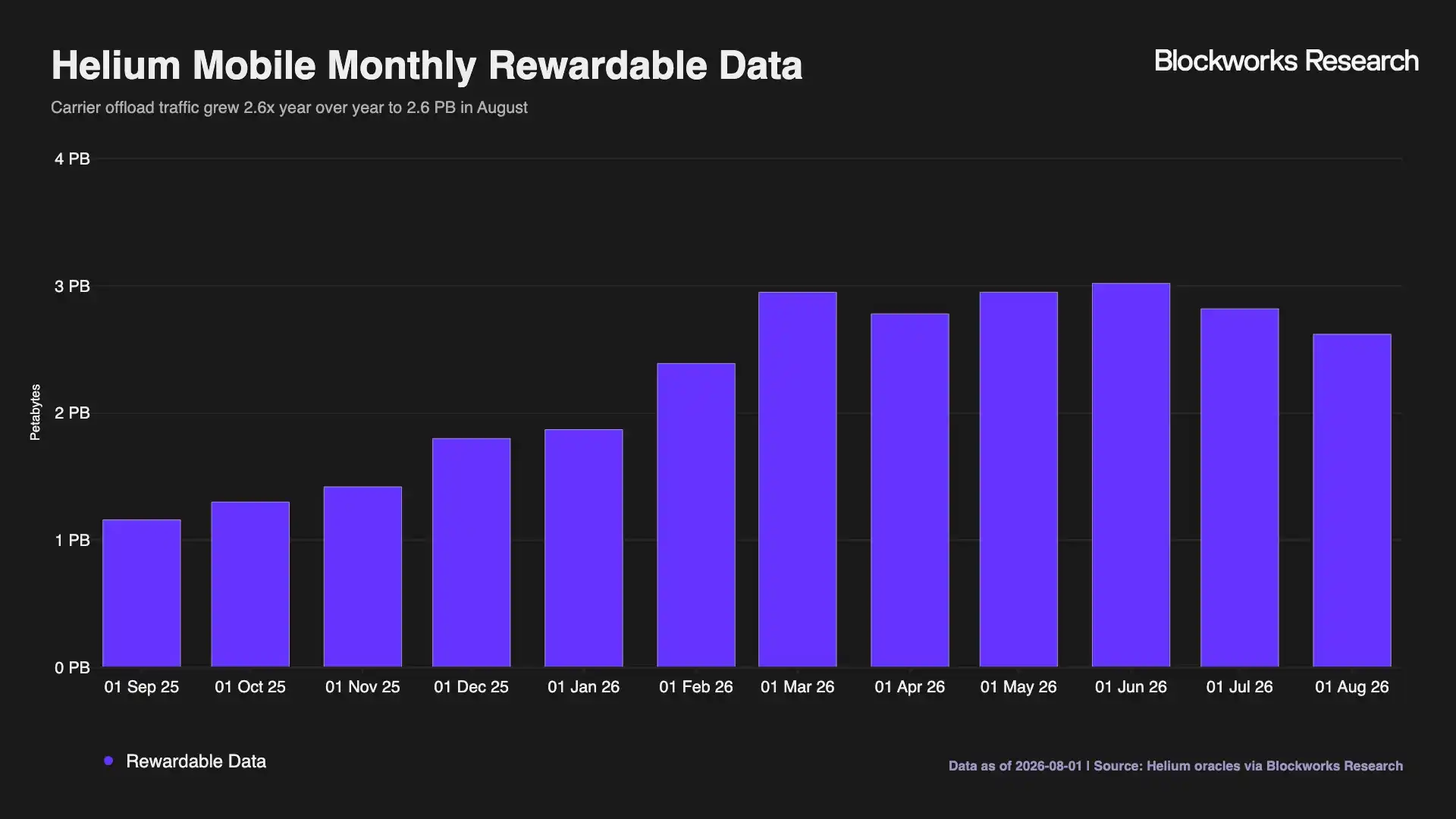
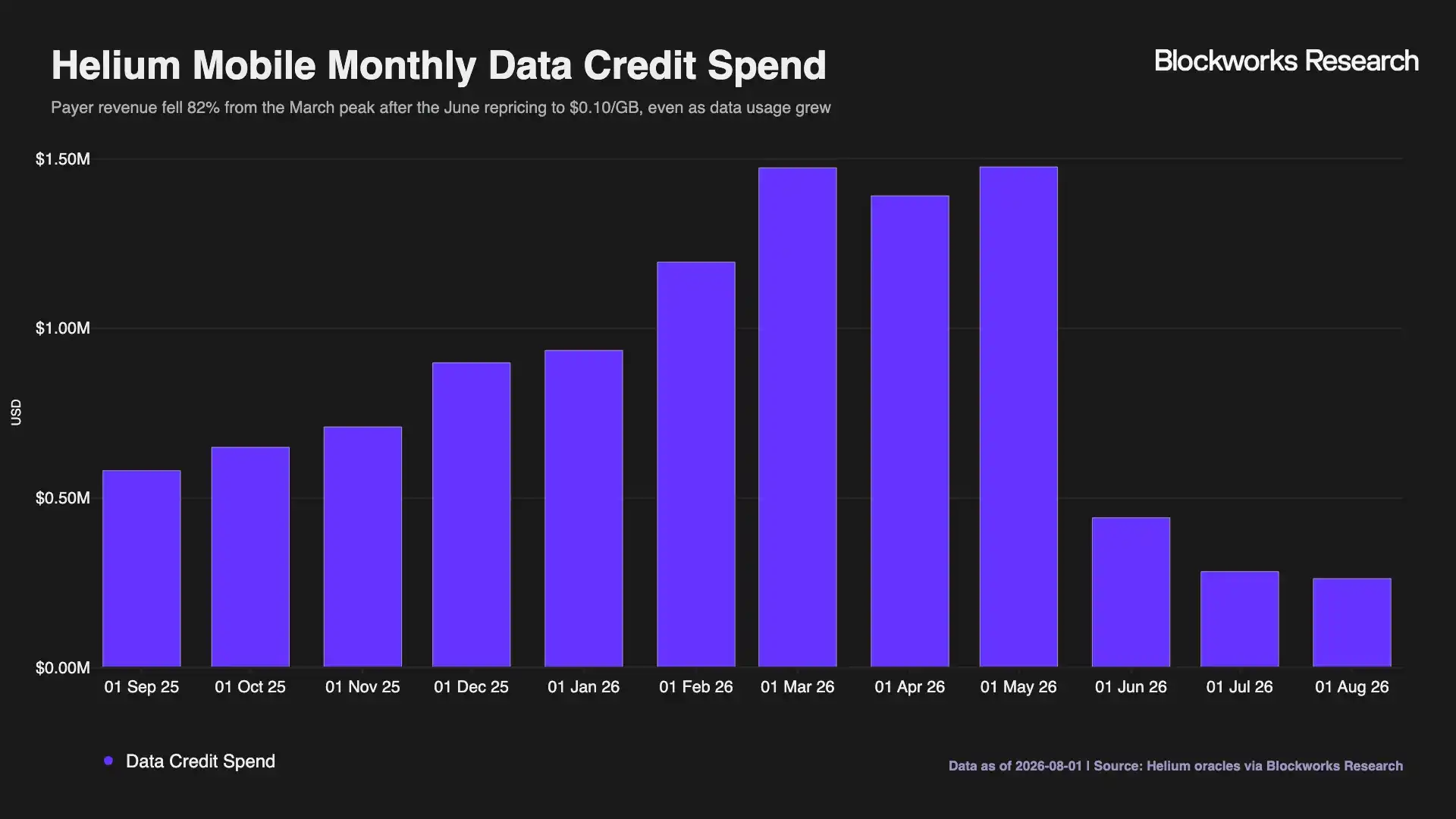
Zooming out, fundamentals diverge in two directions. Usage looks strong, with rewardable operator offload data up 2.4x year-over-year from 1.26 PB in August 2025 to 3.06 PB last month, and daily traffic holding the trend through the rally without an inflection. Revenue goes the other way. Payors spent $263,000 in Data Credits on mobile traffic in August, down 82% from a $1.47 million peak in March.

As we reported in June, the $0.50/GB rate behind that peak was subsidized by Nova Labs, burning its own HNT as a stopgap while operators negotiated location-based pricing ranging from zero in low-value sites to over $0.50 in airports. HIP-143 brought the nominal rate to about $0.10/GB, a level operators could accept at scale, and oracle data shows the subsidy tapered off in June. The March peak measured Nova's balance sheet as much as operator demand. August's DC burn is the first clean read of operators' organic spend.
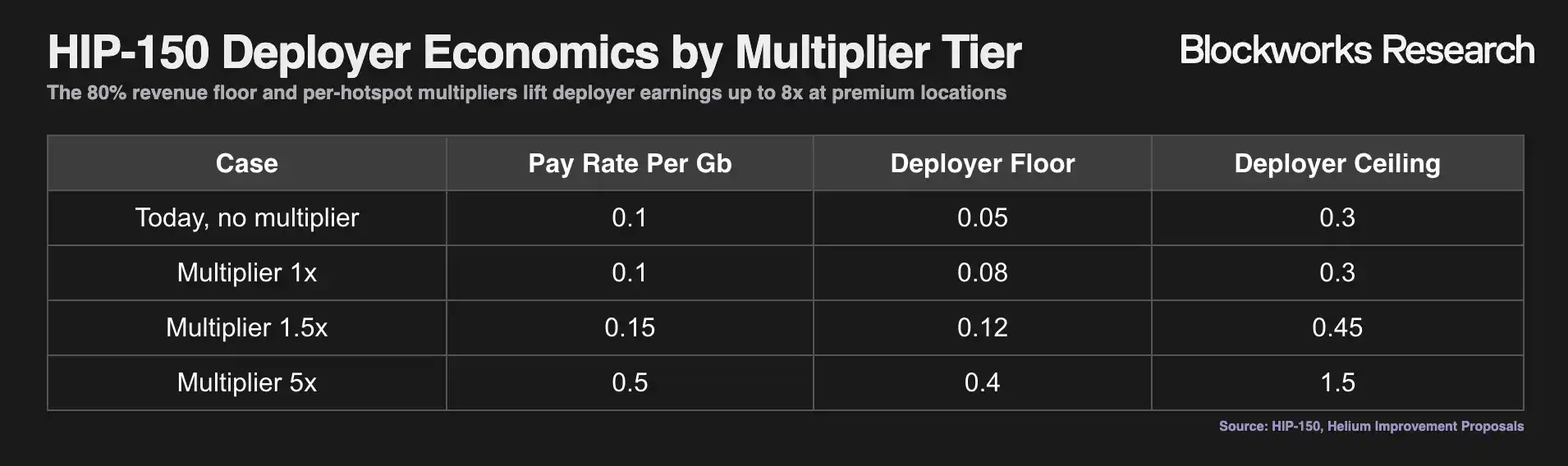
The subsidy's removal explains the urgency of HIP-150. HIP-149, passed in July, set deployer floor prices at 50% of the new operator rate, or $0.05/GB. August's proposal restored their economic incentive, raising floors to 80% ($0.08/GB) with multipliers up to 5x per hotspot, formalizing location-based pricing that operators had already negotiated off-chain, while redirecting Backstop mints directly to the deployer data rewards pool, plugging a leak where the DAO minted $1.60 worth of HNT for every $1.00 that reached deployers. Nova Labs will provide its service provider rewards through July 2027, raising the Mobile data bucket's share of the subDAO from 70% to 94%.
The valuation math remains harsh. August's Data Credit spend annualizes to ~$3.1 million against a $95 million market cap, or about 30x payor revenue, and the supply side works against holders.

HIP-149's growth subsidy mints ~5.96 million HNT per month for the first year into a Nova-managed treasury. That lifts the effective max supply from 206 million to 347 million tokens. So at current rates, operator burn runs at less than a tenth of monthly issuance.

Positioning filled the gap. HNT perpetual funding rates dropped below -1.2%, with $1.6 million in short liquidations over the weekend against less than $200,000 for longs. Volume hit $248 million on August 30, exceeding the entire market cap.

The tape describes a short squeeze that found a good story.

This squeeze has repriced HNT to a level where growth bets must pay off.

Nova sold the consumer business, ended the subsidy, and now funds operator expansion via the HIP-149 treasury. So value accrual can only come from operator offload burn growth, at a pace that exceeds new issuance.

Management set its own target in June: an inflection point at 7 to 10x current traffic. That's when Helium's roaming share from partner operators reaches double digits and pricing leverage flips.

HIP-150 keeps deployers solvent on the way there. HeliumOS is the platform layer promised in Di Dio's roadmap, though its launch customer Affinity Ventures owns Noble Mobile and recently acquired Helium Mobile.


Related Questions

QWhat is the main contradiction identified in Helium's (HNT) recent price surge?

AThe main contradiction is that while the HNT token price surged 5.7 times in two weeks, driven by news catalysts and a short squeeze, the network's actual revenue from data credits plummeted by 82% during the same period.

QWhat were the four key news events that drove the recent price action for HNT?

AThe four key events were: 1) The proposal of HIP-150 to redirect Mobile subDAO emissions to deployers carrying paid data traffic (August 21). 2) The announcement that Celina, Texas switched its public Wi-Fi to Helium network coverage (August 28). 3) The community passage of HIP-150 with 96.2% voting approval (August 31). 4) The launch of HeliumOS, a B2B platform for operators and MVNOs (September 3).

QHow did the change in Data Credit (DC) pricing and subsidies contribute to the drop in revenue?

AThe peak revenue in March was artificially high due to subsidies from Nova Labs, which burned its own HNT to set a rate of ~$0.50/GB. HIP-143 later adjusted the nominal rate to ~$0.10/GB, a level sustainable for operators. The subsidies were phased out by June. The August DC burn of $263k represents the first clean reading of organic operator spending, explaining the 82% drop from the subsidized peak.

QWhat role did market positioning and derivatives play in the HNT price surge?

AMarket positioning, particularly a high level of short interest, amplified the price surge into a short squeeze. HNT perpetual funding rates fell below -1.2%, and over a weekend, short liquidations reached $1.6 million compared to less than $200k for longs. Trading volume on August 30th exceeded the entire market cap, indicating intense speculative activity.

QAccording to the article, what must happen for Helium's current valuation to be justified?

AFor the current valuation to be justified, the growth from operator data offload burn must accelerate significantly to outpace the new token emissions. Management's target is for a tipping point at 7 to 10 times the current traffic, where Helium achieves a double-digit share of roaming partners' traffic and gains pricing leverage. The recent proposals aim to keep deployers solvent until that scale is reached.

Related Reads

Mercado Bitcoin begins post-hack reopening without a timeline for withdrawals

Mercado Bitcoin, one of Brazil's largest crypto exchanges, began restoring read-only access to customer accounts in phases on Monday, a week after attackers drained an estimated $49 million from the platform. Access started at 19:00 UTC, with all accounts expected to be viewable by 21:00 UTC, showing holdings as they stood on Nov. 2, the day of the hack. The exchange has yet to say when customers will be able to withdraw funds. Fabricio Tota, vice president of new business, said the exchange hoped read-only access would reassure customers that their assets were still recorded on the platform. He explained that the company opted for "a more conservative approach" to reactivating accounts "to ensure our return happens with the utmost security." The caution follows concerns from blockchain security analysts that attackers were able to access addresses, draining funds through standard transfers rather than a smart contract exploit. Blockchain analysts traced some of the stolen funds to customer deposit addresses, but Mercado Bitcoin says customers won't bear the losses. Tota said the vast majority of assets were never even touched by anyone and were not involved in the incident. On Nov. 4, Mercado Bitcoin pledged to cover all losses with company funds, bolstered by a $20 million investment from stablecoin issuer Tether in July. Tota highlighted that a portion of the stolen funds were also frozen in the hours after the company announced the attack. The next phase of recovery will require users to confirm their registration details before they can move funds. The exchange plans to restore withdrawals via Pix, Brazil's instant payment system, initially allowing customers to withdraw only to accounts in their own name. Tota gave no date for either step. Mercado Bitcoin has yet to explain how the attackers gained access to its wallets. Blockchain data company Bitquery found that as of Nov. 4, wallets linked to the attacker held most of the stolen funds that had escaped freezes, including 106.07 BTC.

cointelegraph1h ago

Mercado Bitcoin begins post-hack reopening without a timeline for withdrawals

cointelegraph1h ago

Avalanche’s AVAX leads crypto gains following NYSE tokenization deal

Avalanche's AVAX token rose as much as 10% on Monday, becoming the top gainer among the 100 largest cryptocurrencies, after the New York Stock Exchange announced plans to use Avalanche's blockchain to settle trades on a new platform for trading tokenized stocks around the clock. AVAX later eased to $8.86, still up over 8% on the day, with a market cap of around $3.95 billion and $439.7 million traded in the past 24 hours. Avalanche's total value locked stands at $633 million, up 4% over the past day. NYSE's head of digital issuance, Dennis Lee, said the exchange is examining how blockchain technology can expand its equities offerings and is picking the right technology for each job. The deal underscores Wall Street's growing effort to use blockchain to make stock trading faster and enable trading outside regular market hours; traditional US markets are open 9:30 am to 4:00 pm EST on weekdays, with trades often taking at least one business day to settle. The NYSE first announced plans for the platform in January, and Ava Labs revealed in September that the exchange had spent about a year testing Avalanche, though the final selection was not confirmed until Monday. Avalanche will record stock trades and help complete transactions on the platform, which will let investors buy and sell digital versions of stocks across different blockchains. Lee said the settlement ledger needs to be fast, reliable, permissioned, cost-predictable, and backed by a large developer community—all of which Avalanche meets. The platform could launch before the end of 2026 pending regulatory approval. Ava Labs chief business officer John Nahas said first conversations with the NYSE began nearly a year ago and called it an important step toward blockchain becoming foundational financial infrastructure. The news comes as other major firms invest in blockchain for faster, round-the-clock trading: Nasdaq plans to invest $100 million in Kraken's parent Payward to launch tokenized stocks by Q2 2027, and the DTCC launched a service in October allowing firms to turn traditional securities into digital tokens. The NYSE deal follows other efforts to bring traditional assets onto Avalanche, including Progmat moving over 452 billion yen in digital securities onto a dedicated Avalanche blockchain in July and Aave Labs' plans for a lending service using tokenized assets as collateral.

cointelegraph2h ago

Avalanche’s AVAX leads crypto gains following NYSE tokenization deal

cointelegraph2h ago

Can using a chip for two more years really help get through the cold winter?

The smartphone industry is grappling with rising memory chip costs that are driving up device prices, forcing manufacturers to find ways to stay competitive. A recent leak about a chip called "SM7635" with a 2.96GHz peak CPU frequency and Adreno 810 GPU suggests Qualcomm may be reusing its Snapdragon 7s Gen3 (originally launched in 2024 at 2.5GHz) yet again. The chip already spawned a 2025 variant (SM7635-AC, renamed Snapdragon 7s Gen4) with a 2.7GHz clock, and the new 2.96GHz version will likely become the Snapdragon 7s Gen5—marking a third generation from one original design. This practice of reusing and overclocking mid-range SoCs is not new. MediaTek's Helio X20/X23/X25/X27 and Dimensity 1100/1200/1300, as well as Qualcomm's Snapdragon 615/616/617, 765/765G/768G, and 778G/778G+/782G, followed similar patterns. Previously, however, this was mainly done to widen the gap between flagship and non-flagship products and give flagship buyers more perceived value—not primarily to cut costs. Mid-range buyers were assumed not to care much about chip model numbers. Now the situation is different. One brand recently launched a mid-to-low-end phone with the Snapdragon 7s Gen4 priced at 3699 yuan—a price that a year ago could buy a flagship with a fifth-generation Snapdragon 8 Elite, roughly three to four times more powerful. While SoC isn't the only cost component, consumers clearly get less value for the same money today. Counterpoint Research reports global smartphone SoC shipments fell 21% year-over-year in Q3 2026. Even flagship lines show signs of chip reuse—the Dimensity 9600M appears to be an overclocked Dimensity 9500. With few flagships using fully-specced memory and storage, rumors suggest next year's devices may widely reuse current-generation flagship SoCs while upgrading memory and storage instead. This helps control costs but may further dampen consumers' willingness to upgrade, making such reuse an unsustainable strategy. Restoring market confidence will require both chipmakers and device brands to offer consumers more tangible benefits.

marsbit6h ago

Can using a chip for two more years really help get through the cold winter?

marsbit6h ago

Trading

Spot
活动图片