Ethereum’s first ZK-rollup, ZKsync Lite, to be retired in 2026

cointelegraphXuất bản vào 2025-12-08Cập nhật gần nhất vào 2025-12-08

Tóm tắt

ZKsync Lite, the first zero-knowledge rollup on Ethereum, will be retired in 2026 as part of a planned phase-out. Launched in 2020 by Matter Labs, it served as a proof-of-concept for fast transfers and NFT minting but did not support smart contracts. The team confirmed that user funds remain safe and withdrawals will continue uninterrupted. Development shifted to ZKsync Era, a zkEVM with smart contract support, in early 2023. ZKsync Lite currently holds nearly $50 million in assets but has seen minimal recent activity. The deprecation does not affect other ZKsync products, and migration details will be shared soon.

ZKsync Lite, the first-ever zero-knowledge (ZK) rollup network to launch on Ethereum, will be deprecated next year, its team says, as it has fulfilled its purpose.

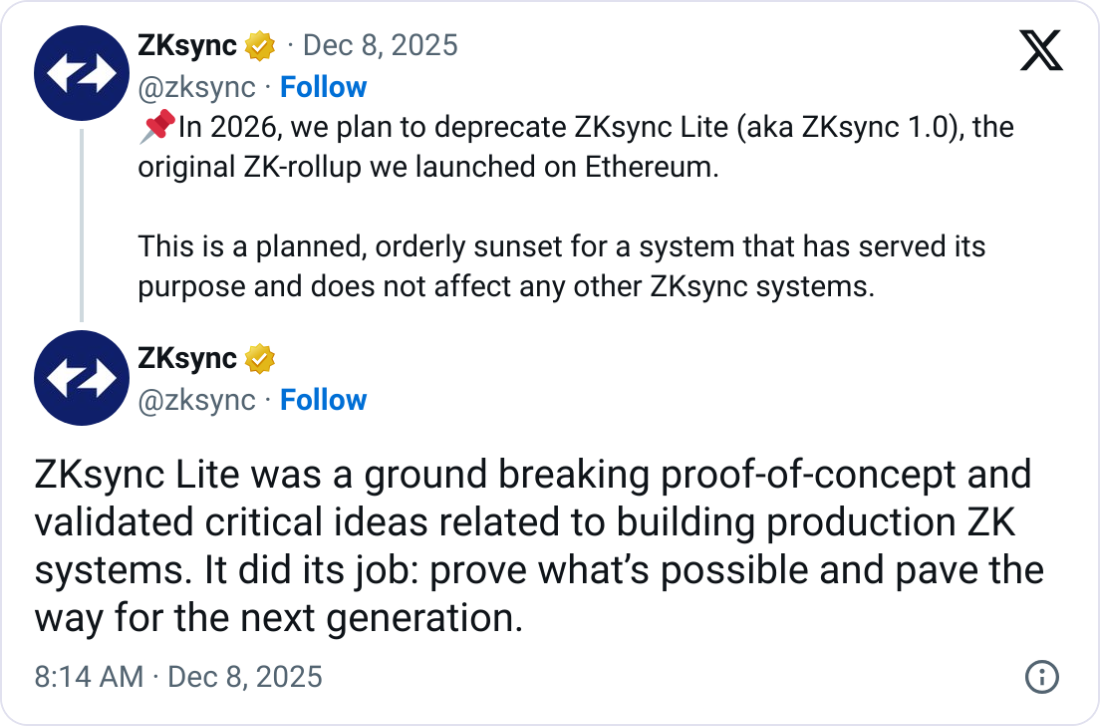
“In 2026, we plan to deprecate ZKsync Lite (aka ZKsync 1.0), the original ZK-rollup we launched on Ethereum,” ZKsync wrote to X on Sunday. “This is a planned, orderly sunset for a system that has served its purpose and does not affect any other ZKsync systems.”

It added that ZKsync Lite “was a groundbreaking proof-of-concept and validated critical ideas related to building production ZK systems.”

“It did its job: prove what’s possible and pave the way for the next generation.”

Technology company Matter Labs launched ZKsync Lite in 2020, designed for fast transfers and minting non-fungible tokens (NFTs). However, it didn’t support smart contracts, which limited its use.
Source: ZKsync

The network was the first to use validity proofs that instantly proved if a transaction was valid, before transactions were bundled up and sent to the Ethereum mainnet for final validation.

Matter Labs stopped development on ZKsync Lite in early 2023 after launching its zero-knowledge Ethereum Virtual Machine (zkEVM) that supported smart contracts, ZKsync Era.

ZKsync said that no immediate action was required from ZKsync Lite users, and the network is operating as usual. “Funds remain safe, and withdrawals to L1 will keep working through the process,” it added.

Its other products are similarly unaffected, and the team said it would share “concrete details, dates, and migration guidance soon” for ZKsync Lite.

Related: Privacy tools are rising behind institutional adoption, says ZKsync dev

Just under $50 million is currently bridged to the network, according to DefiLlama, but L2BEAT data shows it has only seen just over 330 user operations in the past day.

By comparison, ZKsync Era has a total value locked of $36.4 million and has seen over 22,000 user operations over the past day.

It comes as the blockchain could be undergoing more changes. Last month, ZKsync co-creator Alex Gluchowski proposed overhauling its ZKsync (ZK) governance token to prioritize “economic utility,” tying the token to the network’s fees.

Magazine: What are native rollups? Full guide to Ethereum’s latest innovation
Nội dung Liên quan

Giám đốc điều hành Nvidia Jensen Huang vừa lật ngược cuộc tranh luận về tiêu thụ năng lượng của Bitcoin — Và điều này thay đổi mọi thứ

Giám đốc điều hành NVIDIA, Jensen Huang, đã đảo ngược cuộc tranh luận về tiêu thụ năng lượng của Bitcoin bằng cách mô tả nó như một cơ chế biến năng lượng dư thừa thành tài sản kỹ thuật số có thể chuyển đi toàn cầu. Ông so sánh hoạt động khai thác Bitcoin với một quá trình chuyển đổi kinh tế, nơi năng lượng bị mắc kẹt hoặc dư thừa - như khí đốt bị đốt bỏ ở các mỏ dầu hoặc thủy điện dư ở vùng sâu vùng xa - được định giá và phân phối lại thông qua mạng phi tập trung. Điều này đặt lại vấn đề từ một chỉ trích lâu nay về việc "lãng phí" điện năng thành một lập luận ủng hộ: Bitcoin không phá hủy năng lượng mà biến nó thành giá trị. Nhận xét của Huang, đến từ một nhà lãnh đạo công nghệ có ảnh hưởng mà không phải là người truyền giáo cho tiền mã hóa, đã mang lại sức nặng mới cho lập luận rằng mạng lưới Bitcoin ngày càng dựa vào các nguồn năng lượng tái tạo hoặc năng lượng không có người mua thay thế. Ông lập luận rằng Bitcoin hoạt động như một người mua cuối cùng cho nguồn điện này, khuyến khích sự đổi mới trong các lưới điện vi mô và ổn định lưới điện địa phương. Mặc dù không giải quyết được hoàn toàn cuộc tranh luận, quan điểm này buộc các nhà hoạch định chính sách và nhà phân tích phải xem xét lại các giả định cũ về vai trò của Bitcoin trong nền kinh tế năng lượng toàn cầu.

ccn.com11 phút trước

Giám đốc điều hành Nvidia Jensen Huang vừa lật ngược cuộc tranh luận về tiêu thụ năng lượng của Bitcoin — Và điều này thay đổi mọi thứ

ccn.com11 phút trước

Giao dịch

Giao ngay
Hợp đồng Tương lai
活动图片