A-Share Retail Investors' 'Automatic Market Monitoring': No Cost, No Staring at Screens – What Makes Sequoia-X Worth 6,800 Saves?

marsbitPublished on 2026-09-08Last updated on 2026-09-08

Abstract

This article introduces Sequoia-X, a GitHub project with over 6,800 stars that provides A-share retail investors with an automated, free post-market stock screening tool. It solves the problems of manually screening thousands of stocks and accessing data by building a fully automated pipeline using Python. The system has three layers: * **Data Layer:** Uses the free, unlimited baostock API to incrementally update a local SQLite database with daily K-line data. * **Strategy Layer:** Core feature with 7 built-in quantitative strategies (including a modified Turtle Trading breakout strategy adapted for A-shares) that screen the entire market using vectorized pandas computations for speed. * **Notification Layer:** Sends results daily via Feishu (Lark) bot webhooks after the market closes. Key advantages highlighted are its use of free data sources, transparent and modifiable strategy logic, and fully automated workflow requiring only 2-3 minutes to run daily after initial setup. The author's engineering approach treats stock screening as a reliable message-passing system. The article emphasizes that the tool generates a "watchlist," not buy signals, and is presented as a modern Python engineering template that helps investors maintain discipline by automating repetitive screening tasks.

At 3:00 PM, the A-share market closes, freezing the K-line charts of over five thousand stocks. Retail investors open their trading software, flipping through K-lines, comparing patterns, and monitoring trading volumes, trying to pick out a few worthy of a second glance tomorrow from the pool of over five thousand candidates. But after checking five hundred, the remaining four and a half thousand are left to chance. The human brain is naturally ill-suited for processing vast amounts of information, and even worse at maintaining discipline when fatigued—and stock selection happens to require both.

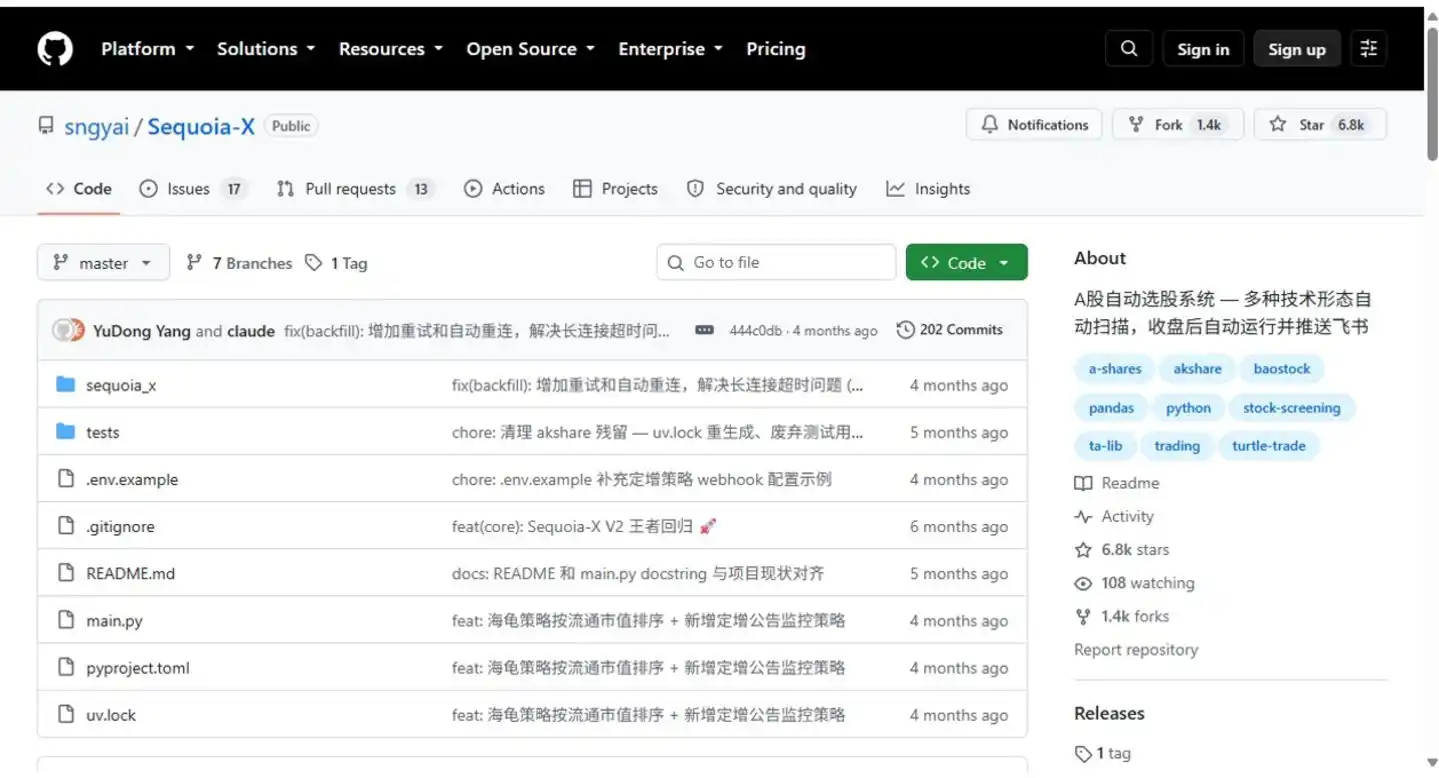
Someone decided not to battle their own eyes any longer. They wrote the entire "post-market stock screening" process into code, threw it on GitHub, and named it Sequoia-X. In half a year, the project's stars grew from 3,000 to over 6,800, even hitting GitHub Trending in early September. What makes a Python tool for "automated post-market stock screening and Lark push notifications" attract so much attention? This article breaks it down: what problem it solves, how it works, the origin of its strategies, and how to get started quickly.

(Project Address: https://github.com/sngyai/Sequoia-X)
What You Need Isn't More Software, But an Assembly Line for Stock Selection

Retail investors face three major difficulties in stock selection. The first is quantity: manually covering over five thousand A-share stocks is an impossible task. The second is data: free APIs are either incomplete or rate-limited; paid ones cost thousands or tens of thousands; trying to scrape it yourself, East Money's anti-scraping mechanisms can drive your scripts mad. The third is time: monitoring technical patterns requires continuous attention, which office workers simply don't have. By the time they open their software after work, the patterns to watch have already played out.

Sequoia-X offers an engineering solution: transforming the entire process into an unattended assembly line. It uses baostock as the data source—free, no registration required, no rate limits; historical K-line data is pulled and stored in a local SQLite database, so the data is entirely yours; it runs automatically once after the market closes each day, scanning the entire market with 7 built-in technical pattern strategies, and pushes results to group chats via Lark Webhook. The next morning before the market opens, you just need to glance at your phone.

This model takes about 12 minutes for the initial backfill, and only 2-3 minutes for daily runs on subsequent trading days.

The project author, YangYuDong, has an interesting background. His GitHub showcases MQTT middleware, instant messaging services—a row of underlying infrastructure projects, all emphasizing "massive data, stability first". His approach to A-share quantitative trading is to design stock selection like a messaging system: data in, results out, all engineering in between. Sequoia-X has also undergone a complete rewrite: V1 primarily relied on akshare, feature-rich but dependent on web interfaces, plagued by constant anti-scraping and missing fields, often breaking mid-run; V2 switched to baostock and was rewritten to modern engineering standards—the "King's Return" at the beginning of the README is exactly that.

Dismantling the Production Line: Data, Strategy, Push
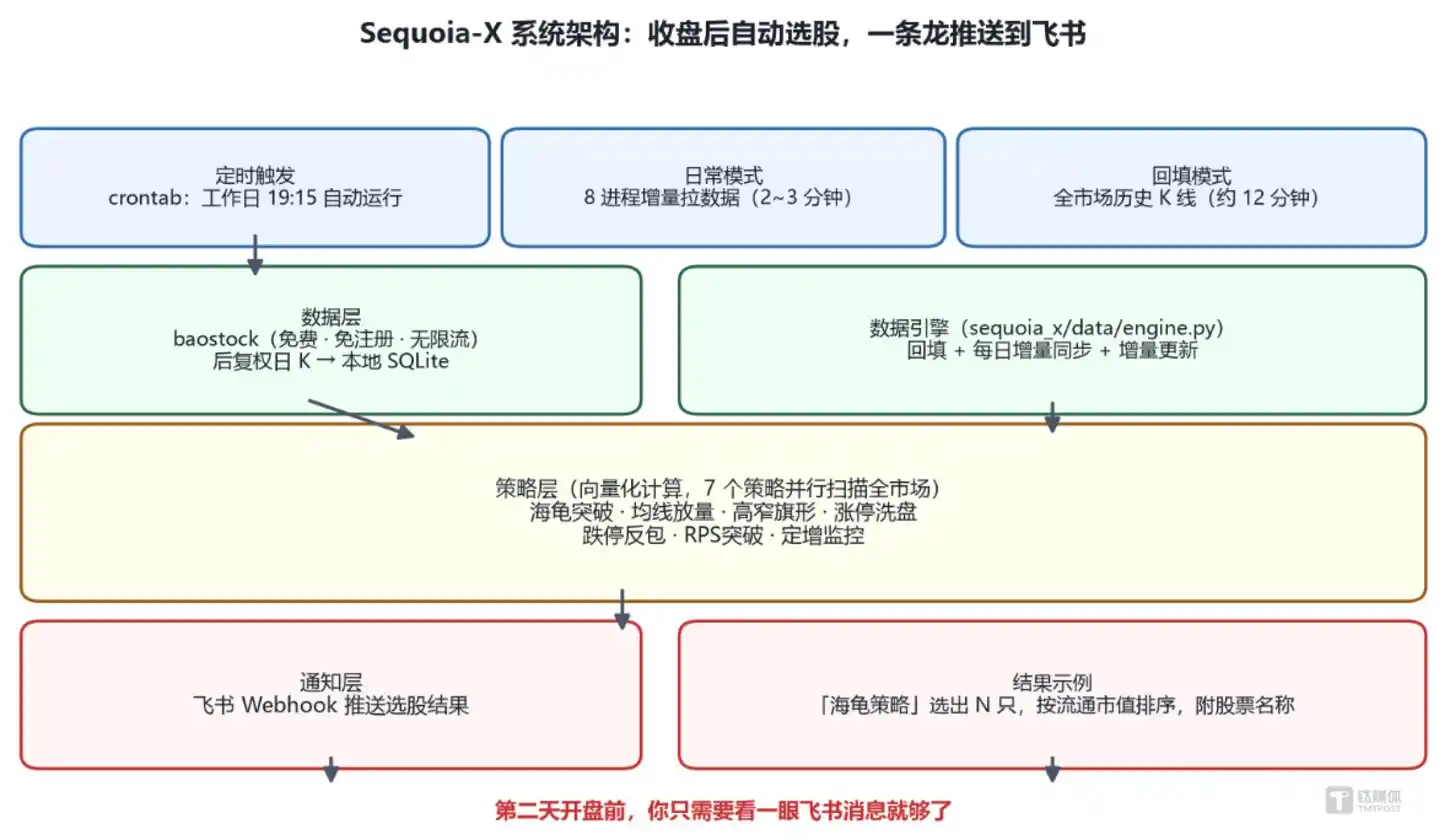
▲ System Architecture: The complete assembly line from data to push

The entire system is divided into three layers:

The data layer is the foundation. It pulls post-adjusted daily K-lines from baostock. Post-adjusted prices are benchmarked to the latest price; after rights and dividends adjustments, historical prices are proportionally adjusted. The benefit: when appending a new day's K-line, the new data maintains the same price basis as existing data in the database, avoiding isolated daily jumps. Thus, each day only requires adding the single new K-line, without re-pulling history: 8 processes run in parallel, incremental updates for the entire market take only 2-3 minutes. For comparison: a full re-pull takes over ten minutes; incrementally adding just one line per stock reduces data volume by a factor of over a hundred. "Initial full load, daily incremental" is the standard approach for local quantitative systems.

The strategy layer is the core. All 7 strategies perform vectorized calculations, using pandas' rolling windows for batch processing instead of looping through K-lines one by one. The code even explicitly prohibits "iterrows" as a performance red line. The reason for such rigor is simple: with over a million rows of data for the entire market, line-by-line Python loops would be agonizingly slow, while underlying C-language batch operations are dozens of times faster. Different coding approaches lead to vastly different performance—this is the hidden value of engineering capability in quant.

The notification layer handles the last mile. Each strategy can be bound to an independent Lark robot; Turtles push to the "Turtle" group, RPS pushes to the "RPS" group, each on its own track. The details are thoughtful: when pushing, the system queries baostock to retrieve the stock name—many similar projects only push a string of codes, leaving you to search for the company yourself. This kind of "finish the job" attention to detail is precisely the source of its reputation.

Choosing SQLite for storage is also pragmatic: a single-file database requiring no service installation, easy backup and migration—this "one person can maintain" lightweight approach fits personal projects perfectly.
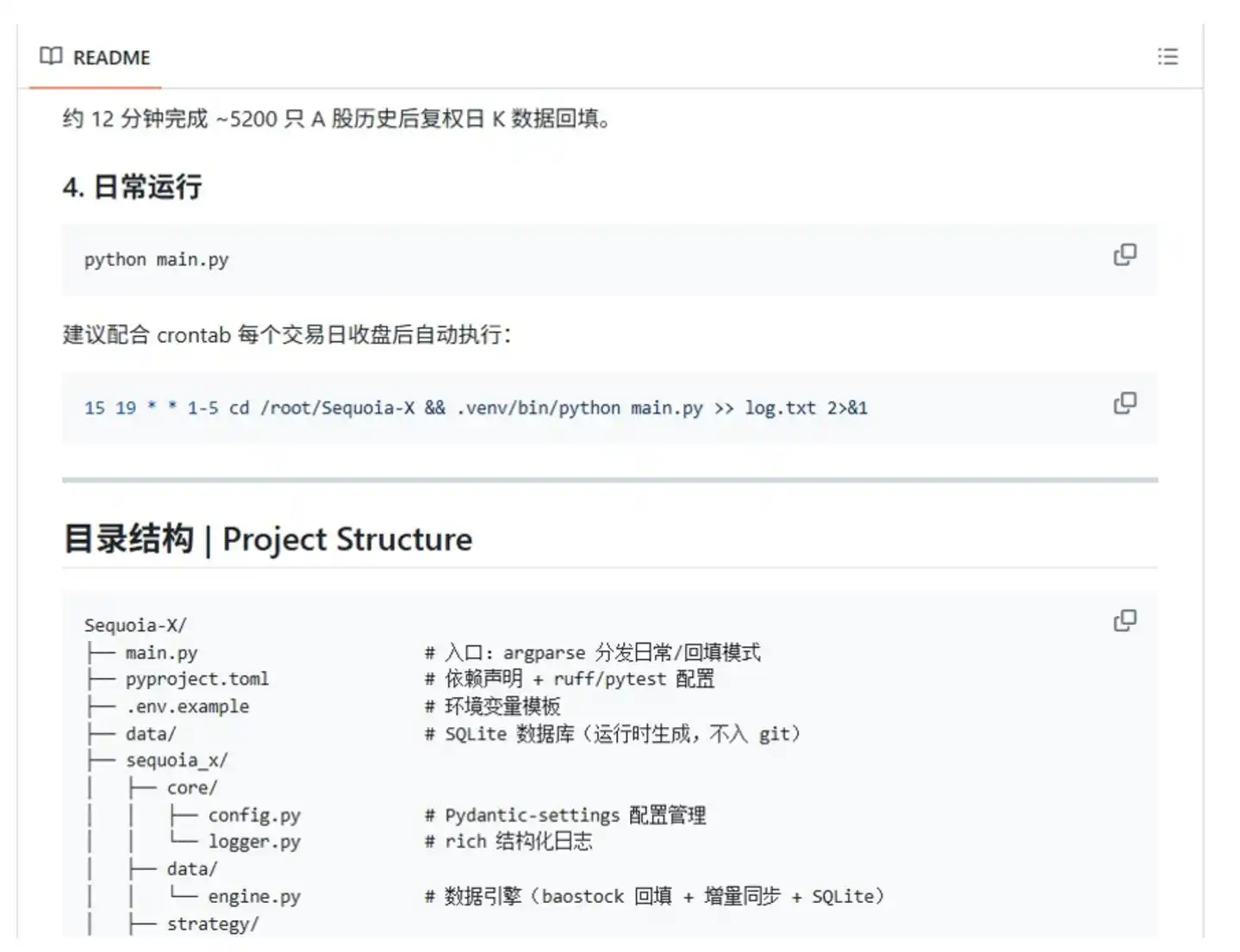
▲ README directory structure

The A-Share Adapted Version of Classic Tactics

Architecture is the skeleton; strategy is the soul.

First, the flagship strategy: Turtle Breakout. In 1983, legendary trader Richard Dennis made a bet: can trading ability be trained? Starting with $400, he built a fortune worth hundreds of millions during a commodity bull market. He recruited 13 people with diverse backgrounds—professional gamblers and complete novices—from ads in the Wall Street Journal, trained them for two weeks, and gave each a real trading account worth millions.

Four years later, the "Turtles" achieved an average annual return of around 80%, proving that great traders could be trained with rules. The secret: enter when the price breaks above the highest point of the past 20 days, exit when it falls below the lowest point of the past 10 days. No prediction, just following. In 2007, student Curtis Faith wrote "The Complete TurtleTrader," becoming an introductory text for countless quants.
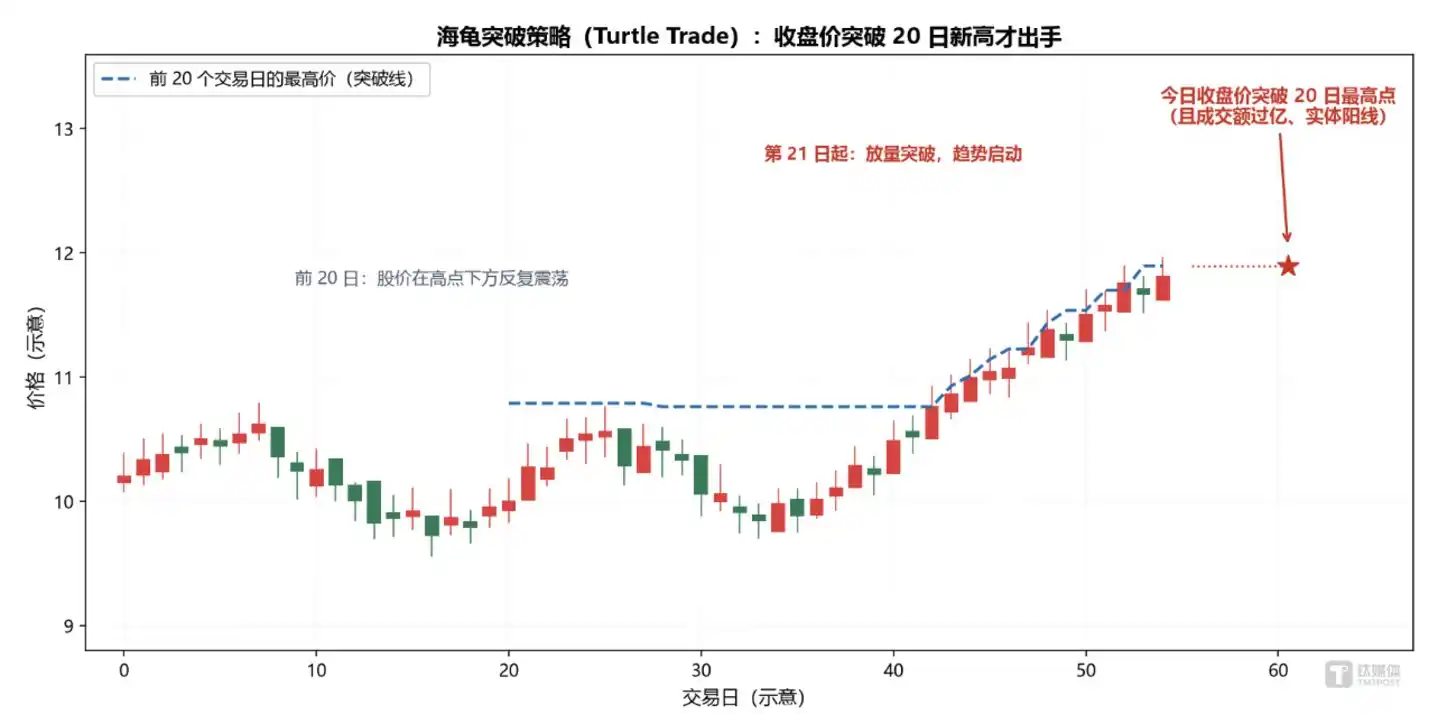
▲ Turtle Breakout: Closing price above the highest point of the past 20 days

Sequoia-X transplants these rules into the A-share market, adding three "defensive moves": Trading volume must exceed 100 million, ensuring liquidity; the daily candle must be a solid bullish candle, rejecting large bearish candles that gap up and close down; today's closing price must be higher than yesterday's, filtering out "false bullish candles" that surge intraday but fall back. Finally, sort by circulating market cap from largest to smallest, prioritizing large caps to reduce the risk of manipulation by hot money.

The code comments happen to record the origin of these defenses: "【New defensive condition】Reject Zhengzhou Coal & Electric-style large bearish candles that gap up and close down!"—clearly having been burned in practice, they wrote the lesson into the rule. Strategies aren't designed; they're forged by stepping on landmines.
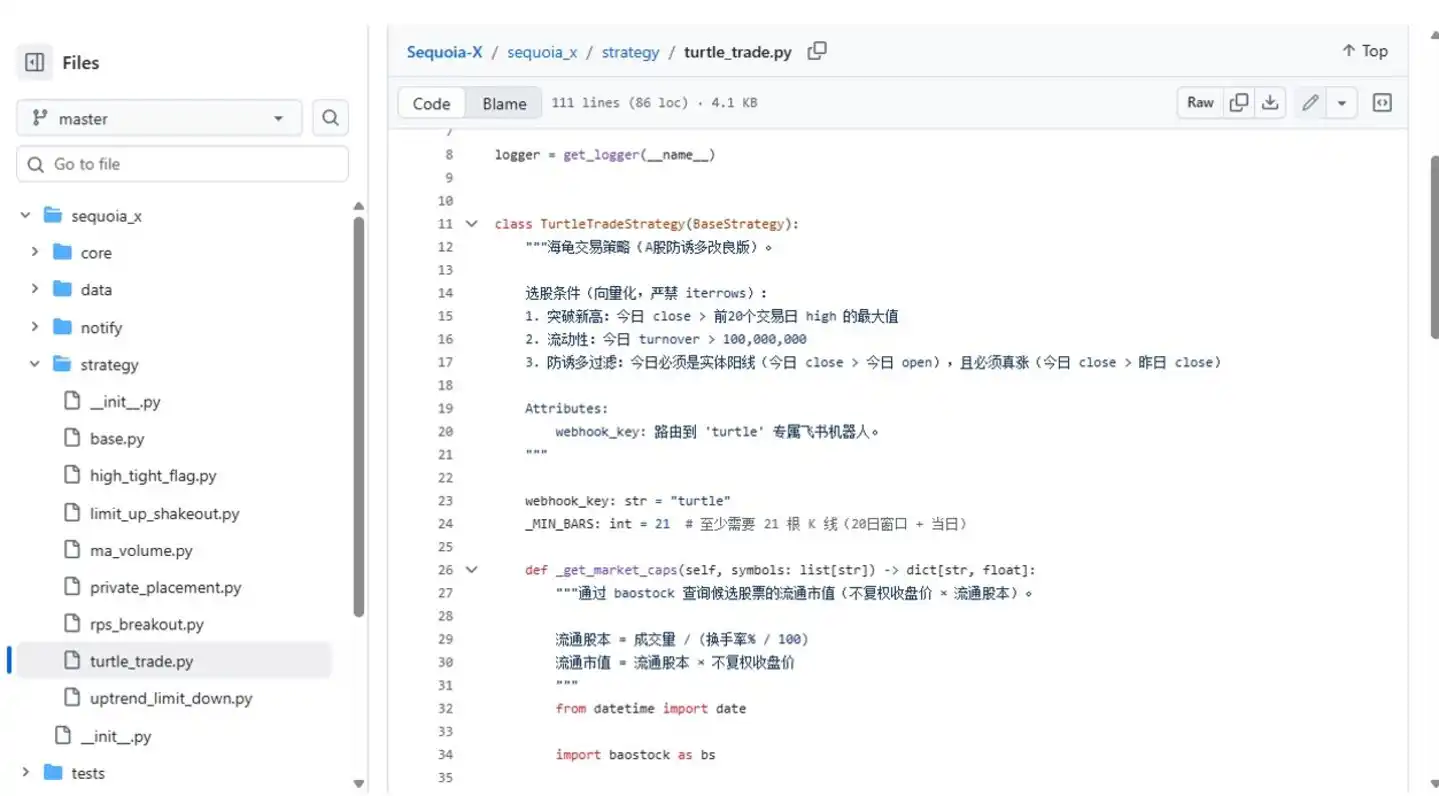
▲ Turtle strategy source code: Three core selection conditions

The remaining 6 strategies can be understood at a glance with this table:
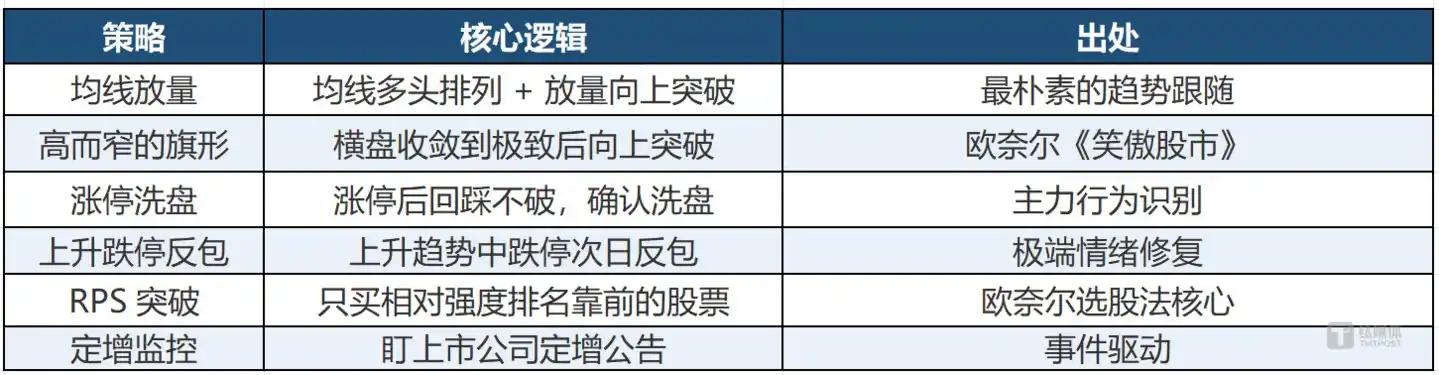
Among them, RPS Breakout is worth mentioning: originating from William O'Neil's "How to Make Money in Stocks," it only buys stocks with high relative strength rankings—those outperforming the market tend to continue doing so, embodying momentum thinking. Private Placement Monitoring, however, is not a technical pattern at all, but event-driven: watching announcements for signals. The 7 strategies cover four dimensions: trend, pattern, sentiment, and events, ensuring if one area is dim, another might shine.

You'll notice a pattern: none of these strategies predict "whether it will rise tomorrow"; they only answer one question—"who should we focus our attention on right now." Replacing "guess" with "filter" is precisely the fundamental difference between quantitative methods and trading based on gut feeling.

Three Steps to Get It Running: For Those Who Want to Get Hands-On

The entry barrier is lower than imagined; the only environment requirement is Python 3.10 or higher.

Step one, install dependencies. uv is recommended, one command does it:

Step two, configure push notifications. Copy .env.example to .env, fill in the Lark robot's Webhook address.

Step three, backfill data. Run python main.py --backfill to backfill historical data, then run python main.py daily to see results. Add a crontab scheduled task, and you won't even need to execute it manually:

Want to add your own strategy? It's not difficult either: inherit the BaseStrategy base class, implement a run() method that returns a stock list, then register it with one line in main.py, and you're done. The skeleton for data fetching, logging, and exception handling is all set up for you by the base class.

For industry insiders, it's also a "modern Python engineering exemplar": Configuration managed with Pydantic-settings, logging with rich for structured output, property-based testing with hypothesis, quality gates with ruff and pytest, dependencies locked with uv. AI's presence is even visible in the commit history—many commits are authored by claude. An experienced programmer plus an AI assistant sustains a 6,800-star project.

If you don't understand the code, that's okay too: data stored locally, strategies run automatically daily, results pushed to Lark—just think of it as a "stock screening assistant who works the night shift for you every day."

The popularity of Sequoia-X is less a victory of "stock selection" and more the convergence of three trends.

Trend one: The democratization of quant. Algorithmic trading is no longer exclusive to institutions; an ordinary computer and a free data source are enough to get started.

Trend two: The awakening of data sources. Free, unlimited APIs like baostock finally free individual developers from being repeatedly exploited over data.

Trend three: AI-assisted development becoming the norm. The collaborative division between the author and Claude exemplifies "one person being a whole team," and the over 6,800 Stars are votes of trust in this model.

Returning to the initial question: Why did it become popular? There are plenty of stock screening tools out there, each with its own rationale. But Sequoia-X offers a rare combination: free data source, transparent strategy logic, fully automated workflow, and source code you can modify yourself. It doesn't make decisions for you; it supplies the "information gap" and "discipline" needed to make decisions—and for retail investors, these two things are precisely the most expensive.

Finally, a practical word: Sequoia-X is a tool, not a money-printing machine. Technical patterns are games of probability; any strategy has periods of ineffectiveness. What it outputs is a "watchlist," not a "buy order." It's best to validate it with small positions for a while before increasing investment.

And discipline is precisely the scarcest resource in the hands of retail investors. ((This article was first published on Titanium Media APP, author | Silicon Valley Tech-news, editor | Jiao Yan))

Related Questions

QWhat is the core problem Sequoia-X aims to solve for A-share retail investors, and what is its primary solution?

ASequoia-X aims to solve three main difficulties for A-share retail investors: the overwhelming number of stocks (over 5000), the difficulty in accessing complete and reliable free market data, and the lack of time to continuously monitor technical patterns. Its primary solution is an automated, unattended 'assembly line' workflow. This system pulls free market data from baostock, stores it locally, runs seven technical pattern strategies on the entire market after the daily close, and automatically pushes the results via a Feishu (Lark) Webhook, requiring only a glance at the phone before the market opens.

QDescribe the three-layer system architecture of Sequoia-X as explained in the article.

AThe three-layer system architecture of Sequoia-X consists of: 1. **Data Layer (Foundation)**: Uses baostock to fetch and store adjusted daily K-line data in a local SQLite database. It employs an 'initial full-load, daily incremental' approach for efficient updates. 2. **Strategy Layer (Core)**: Implements seven quantitative technical strategies using vectorized calculations with pandas (avoiding slow row-by-row loops) for processing over a million rows of data efficiently. 3. **Notification Layer (Last Mile)**: Delivers results by pushing stock codes and names (looked up via baostock) to separate Feishu (Lark) chat groups configured for each specific strategy.

QWhat are the key defensive modifications made to the classic 'Turtle Trading' strategy in Sequoia-X for the A-share market?

AThe A-share adapted 'Turtle Trading' strategy in Sequoia-X adds three key defensive filters: 1. **Liquidity Check**: The daily trading volume must exceed 100 million RMB. 2. **Positive Candle**: The day's candlestick must be a solid bullish (yang) line, rejecting large bearish candles with high opens and low closes (specifically mentioned to avoid patterns like 'Zhengzhou Coal & Electric Power'). 3. **Upward Momentum**: Today's closing price must be higher than yesterday's, filtering out 'fake bullish' lines where prices intraday high but close lower. The final list is also sorted by market capitalization (largest first) to reduce manipulation risk.

QAccording to the article, what are the three underlying trends that contributed to Sequoia-X's popularity?

AThe article attributes Sequoia-X's popularity to the convergence of three trends: 1. **Democratization of Quantitative Trading**: Programmatic trading is no longer exclusive to institutions; a regular computer and free data sources are sufficient to start. 2. **Awakening of Data Sources**: The availability of free, unlimited-flow data interfaces like baostock prevents individual developers from being repeatedly exploited for data costs. 3. **AI-Assisted Development as the Norm**: The project exemplifies the 'one-person team' model, with the author collaborating with Claude (an AI assistant), and its 6800+ GitHub stars represent a vote of confidence in this development paradigm.

QWhat practical advice and disclaimer does the article provide regarding the use of Sequoia-X?

AThe article provides the practical advice that Sequoia-X is a tool, not a money-printing machine. It emphasizes that technical patterns are probabilistic, and any strategy has periods of ineffectiveness. The results generated by Sequoia-X are an 'observation list,' not a 'buy order.' Users are advised to validate the strategy with small positions first before increasing investment. The key value offered is in reducing the 'information gap' and enforcing 'discipline,' which are the most valuable yet scarce resources for retail investors.

Related Reads

GPT-6.1 Sol Participates in Live Brain Surgery! Three Rounds of Localization, Each More Accurate Than the Last

Exin Therapeutics CEO Gabriel Ocana-Santero reported an experiment in which GPT-6.1 Sol participated in three rounds of real mouse brain surgery positioning. The task involved locating Bregma and Lambda, two key skull landmarks used to calibrate stereotaxic coordinates for accurate targeting of brain regions. After each round, a professional surgeon corrected the model's positioning results, and the model retained its images, measurements, and expert corrections for reference in subsequent rounds. By the third round, GPT-6.1 Sol reduced landmark search time from 169 to 86 seconds, required corrections from four to two, and cut positioning error from 0.6 mm to 0.3 mm. Ocana-Santero described this as in-context learning from real-world experience. The team did not disclose how the experience records are integrated into the model or whether underlying weights are updated, so it cannot be described as autonomous training or parameter-level self-evolution. The sample is only three operations, far from proving stable surgical capability, but it demonstrates AI accumulating experience from real observations and expert feedback. This follows earlier Exin work in which AI selected gene therapy vectors, chose injection targets and coordinates, and controlled a stereotaxic device in a mouse experiment, with a licensed veterinarian supervising and safety limits in place. In a further experiment, Claude Sonnet 5, GPT-6.1 Sol, and Grok 4.7 chose different brain regions and treatment strategies for the same scientific goal, suggesting models may reason toward different experimental paths.

marsbit1h ago

GPT-6.1 Sol Participates in Live Brain Surgery! Three Rounds of Localization, Each More Accurate Than the Last

marsbit1h ago

From Drones to Nuclear Reactors: What Has Paradigm Invested in Since Leaving the Crypto World?

Paradigm, a venture capital firm known for crypto investments like Coinbase and Uniswap, is rapidly expanding into hard tech. In November, it co-led a $1.5 billion funding round for Zipline, a US drone delivery company now valued at $21.5 billion—nearly triple its valuation from January. Zipline, founded in 2014, began delivering medical supplies in Rwanda and now operates a large-scale automated logistics network, having completed 150 million miles of commercial autonomous flights. Walmart plans to add 300 new delivery sites, and Uber aims to scale their partnership to one million daily orders by 2029. Paradigm's broader portfolio now spans AI, robotics, manufacturing, semiconductors, space defense, and nuclear energy. Investments include open-source AI lab Nous Research, math-reasoning AI firm Harmonic, AI data company Idler, and GPU platform Andromeda. It also backs SendCutSend (metal parts manufacturing), Fab2 (compact semiconductor factories), True Anomaly (space defense), and Antares (micro nuclear reactors). In July, Paradigm launched a $12 billion new fund for frontier tech. This shift reflects a broader VC trend toward AI and physical technology, as crypto's path to sustained commercial revenue remains uncertain. Paradigm's bets focus on companies solving concrete industrial problems with existing markets, aiming to build a hard-tech network that transcends crypto cycles.

marsbit1h ago

From Drones to Nuclear Reactors: What Has Paradigm Invested in Since Leaving the Crypto World?

marsbit1h ago

Nomura: "Blue Wave" Hits US Data Centers, China's AI Benefits Instead

Nomura argues that the Democratic "blue wave" in the US midterms could paradoxically benefit China's AI economy. Democratic victories in key data-center states will likely tighten regulation, shift grid upgrade costs onto developers, and lengthen approval timelines, slowing US data-center expansion. Market reaction was sharp: the Nasdaq fell 5.5% in a single day, the SOX dropped nearly 15% over two days, Nvidia fell about 12%, and Micron about 24%. Because US cloud giants had been hoarding global GPU, HBM, and advanced logic chip capacity—driving black-market premiums of 200–300% at Asian logistics hubs—a US capex slowdown could collapse those speculative premiums, letting Chinese AI firms, cloud providers, and research institutions obtain GPUs, HBM modules, and advanced packaging materials more cheaply through intermediary trade hubs. China is also building a state-led national AI data-center network, with roughly RMB 2 trillion planned under the 15th Five-Year Plan to integrate regional computing by 2028, supported by low-cost renewable power in western hubs under the "East Data, West Computing" program. Morgan Stanley, meanwhile, does not see the blue wave as a real easing of US-China tensions; it expects strategic competition to persist but sees greater policy predictability. It prefers China's "self-sufficiency" AI trade—supported by both supply and demand under national policy priorities—over export chains tied to global AI capex. It also notes more balanced opportunities in Chinese equities, with valuations near historic lows.

marsbit1h ago

Nomura: "Blue Wave" Hits US Data Centers, China's AI Benefits Instead

marsbit1h ago

After GPT-6, Embodied Large Models Are Trapped in Their Own Territory! Next Year's Self-Research Budget Is Probably Up in the Air

The article discusses how the release of GPT-6 Astra (and the imminent GPT-6.2 Astra) has disrupted the embodied AI/robotics industry. General-purpose large models are now encroaching on capabilities that embodied AI companies previously developed in-house—such as in-context learning, out-of-distribution generalization, error correction, and open-vocabulary manipulation—often without task-specific post-training. On benchmarks like RoboDojo, teams combining general models with robot-use-agent techniques saw scores jump from 20–30 to 50–60, prompting many to question whether self-developing embodied foundation models still makes sense. Some companies have begun cutting algorithm roles. However, the article notes GPT-6 Astra still struggles with complex physical contact, force control, object deformation, and high-precision manipulation, and its cloud API inference latency is high (though this is not seen as a fundamental barrier). Experts argue that general models' current weaknesses shouldn't be treated as durable moats for embodied companies, since OpenAI is already hiring robotics talent and future models may absorb more robot operation data. The core argument is economic: embodied companies' opportunity lies not in building smarter models but in delivering better economic value. Stable, standardized industrial tasks may be better served by lightweight, specialized models or rule-based strategies, while open-ended tasks (e.g., home service robots) may benefit from general models. Ultimately, companies need to re-prioritize their R&D directions—leveraging general models for language understanding and task planning while focusing in-house efforts on physical interaction, embodiment-specific control, real-world adaptation, and deployment efficiency. The article concludes that the industry is moving past the demo-and-burn-investment stage, and the elimination round among the "hundred robot wars" has begun.

marsbit1h ago

After GPT-6, Embodied Large Models Are Trapped in Their Own Territory! Next Year's Self-Research Budget Is Probably Up in the Air

marsbit1h ago

Trading

Spot
活动图片