For years, various blockchain projects were rumored to be future “Ethereum killers,” projects that would unseat Ether from its throne and usurp its title as the top digital asset. That day seems to have come, though it appears it was an inside job. Lido-staked Ethereum (stETH) and other liquid staking derivatives are primed to render Ether (ETH), as an asset, obsolete.
⠀
The transition from proof-of-work (PoW) to proof-of-stake (PoW) allows everyday decentralized finance (DeFi) users to benefit from rewards previously reserved for miners simply by holding stETH or any other ETH liquid-staking derivative. This has given way to a wave of interest across the industry, from individuals to institutions across centralized finance (CeFi) and DeFi. In the past month, the ETH liquid staking derivatives have received a ton of attention, and titans of the industry — including Coinbase and Frax — have released ETH liquid staking derivatives.
⠀
Liquid staking derivatives offer all the benefits of regular ETH while also being a yield-generating asset. That means holders are able to gain exposure to ETH’s price action and maintain liquidity while harnessing staking benefits. Wallets holding stETH will see their holdings gradually increase as staking yields are regularly added to the initial sum.
⠀
While most staking strategies require locking up funds in a validator, liquid staking derivatives allow users to maintain liquidity while still benefiting from the staking yield. ETH locked up in staking validators isn’t available for withdrawal until an ambiguous time in the future, likely with the Shanghai update. While stETH still trades at a slight discount compared to ETH, this gap is expected to close permanently once withdrawals are enabled. Simply put, ETH liquid staking tokens are just more capital efficient than standard ETH or more traditional staking practices.
⠀
From a user perspective, there’s little reason to hold regular ETH, where the only potential upside would be an increase in price when they could hold a liquid staking derivative that would boost their prospective profits via staking yield. Project founders have adopted a similar mentality. From DeFi to nonfungible token (NFT) projects, teams across Web3 have integrated stETH into their protocols, with behemoths such as Curve and Aave making it even easier for DeFi users to integrate stETH into their investment strategies.
⠀
⠀
For lending protocols, stETH offers the ability to increase yield collateral without having to make risky investment decisions to keep users satisfied. NFT projects are able to establish a source of revenue through their mint proceeds rather than being left with a finite lump sum. By making it easier for Web3 projects to stay afloat and keep their community happy, ETH liquid staking derivatives free up project leaders to move beyond money worries and shepherd true innovation.
⠀
Beyond being far more capital efficient, ETH liquid staking derivatives help in maintaining the Ethereum network. stETH and other derivatives represent Ether, which has been deposited into an Ethereum validator to help provide network security.
⠀
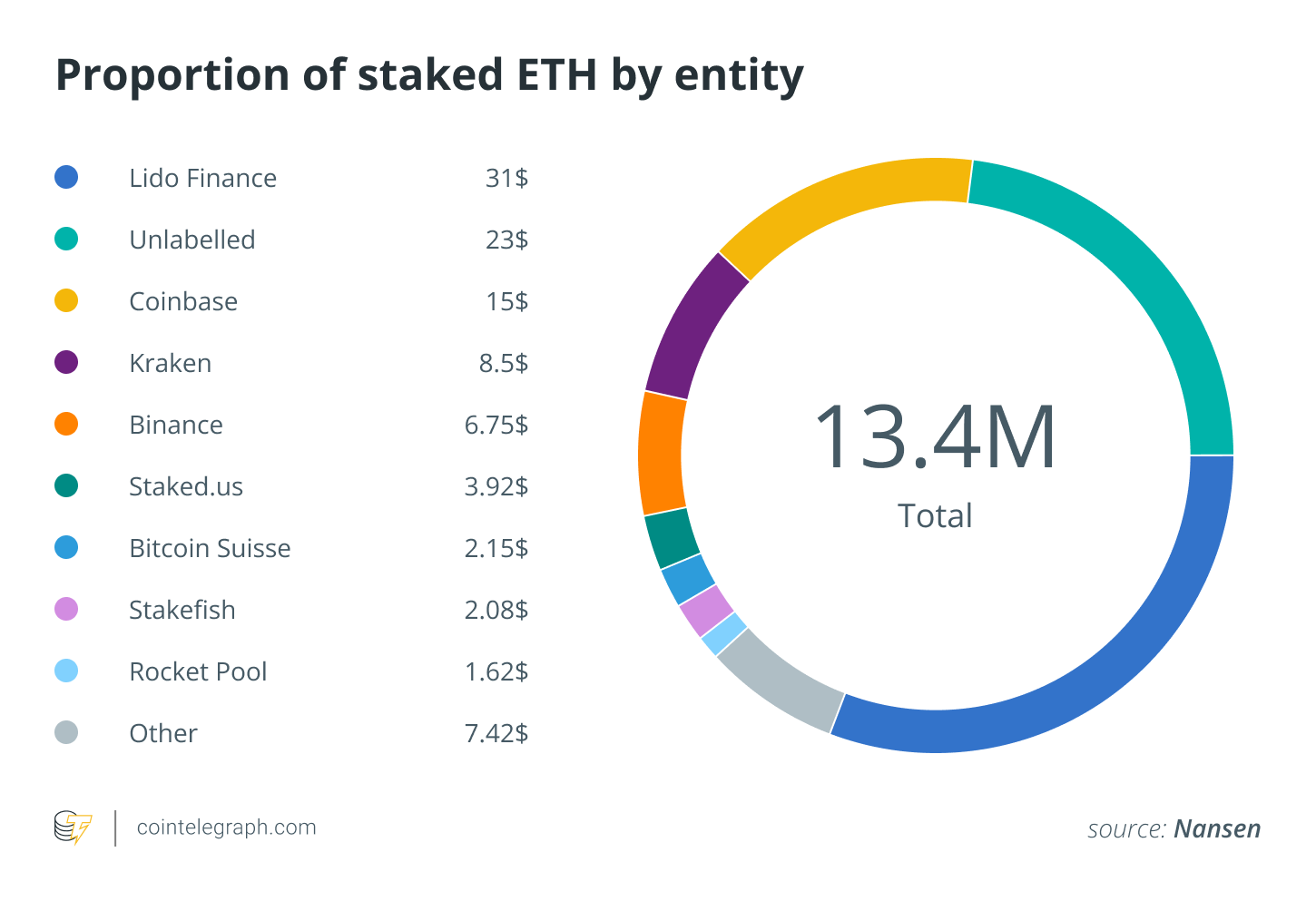
The centralization of the staked ETH has been a major criticism of the PoS consensus model, with Lido accounting for more than 80% of the market share of liquid staking derivatives while controlling over 30% of staked ETH. However, the recent proliferation of alternatives is poised to quell such worries as the market share becomes spread between various organizations. Swapping ETH for liquid staking derivatives is a means for users to support decentralization while padding their bags.
⠀
As the benefits of staking continue to be covered in the press, liquid staking derivatives are sure to become a central part of even the simplest of DeFi strategies. Coinbase providing “cbETH” means even retail investors will be familiar with the strategy. We’re likely to see a steep upshoot in protocols accepting liquid staking derivatives as users begin to flock to the essentially free yield. Soon, many DeFi users may only hold ETH to cover their gas fees.
⠀
The proliferation of liquid staking derivatives will help to bolster the amount of ETH deposited into various validator systems, enhancing network security while providing yield to provide financial benefits for supporters. The days of ETH seem to be numbered. Beyond a nominal gas allowance, any ETH not converted to a liquid staking derivative will just be money left on the table. The long foretold ETH killer appears to have finally emerged, though it looks like it will only boost Ethereum’s security and its supporters’ bags.