Maple Finance tăng 20% sau hợp tác với Kraken – Liệu SYRUP có tiếp tục tăng?

ambcryptoPublished on 2026-06-27Last updated on 2026-06-27

Abstract

Maple Finance (SYRUP) đã tăng mạnh khoảng 20% sau khi thông báo hợp tác với sàn giao dịch tiền mã hóa Kraken để cung cấp dịch vụ cho vay được bảo đảm bằng tài sản tiền mã hóa. Động thái này thu hút làn sóng giao dịch đáng kể, đặc biệt từ các nhà đầu tư Mỹ. Sức mạnh của giao thức càng được củng cố khi Tổng giá trị bị khóa (TVL) tăng thêm 201 triệu USD, đạt khoảng 2,05 tỷ USD, đồng thời doanh thu quý II cũng ở mức cao. Chương trình mua lại token đang ở mức cao thứ hai từ trước đến nay, hỗ trợ tích cực cho giá. Trên thị trường phái sinh, lãi suất funding dương cho thấy tâm lý lạc quan chiếm ưu thế, nhưng ở mức độ vừa phải, tránh được nguy cơ thanh lý hàng loạt. Nhìn chung, triển vọng ngắn hạn cho SYRUP vẫn khá tích cực với khả năng tiếp tục tăng giá.

Maple Finance [SYRUP] đã chứng kiến một đợt tăng giá mạnh mẽ, di chuyển theo nhịp hồi phục của thị trường tổng thể, mặc dù chính những phát triển của giao thức mới là nền tảng cho hiệu suất mới nhất của nó.

Một trong những yếu tố chính thúc đẩy đà tăng là quan hệ hợp tác gần đây của Maple Finance với Kraken, một sàn giao dịch tiền mã hóa có trụ sở tại Hoa Kỳ, để cung cấp tài chính có tài sản đảm bảo trên chuỗi.

Thỏa thuận này cho phép nhà đầu tư tiếp cận thanh khoản dựa trên danh mục tiền mã hóa của họ, từ đó làm sâu sắc thêm mối liên kết giữa tài chính truyền thống và thị trường trên chuỗi.

Sau thông báo, SYRUP, token gốc của Maple Finance, đã tăng mạnh khoảng 20%—một trong những mức tăng trong một ngày lớn nhất trên thị trường tiền mã hóa. Chỉ riêng các nhà đầu tư Hoa Kỳ đã tạo ra khoảng 2,4 triệu USD khối lượng giao dịch SYRUP sau động thái này.

Hệ sinh thái trên chuỗi của SYRUP được củng cố

Trên chuỗi, giao thức đã thu hút một lượng vốn chảy vào lành mạnh, được phản ánh qua Tổng giá trị bị khóa (TVL) của Maple.

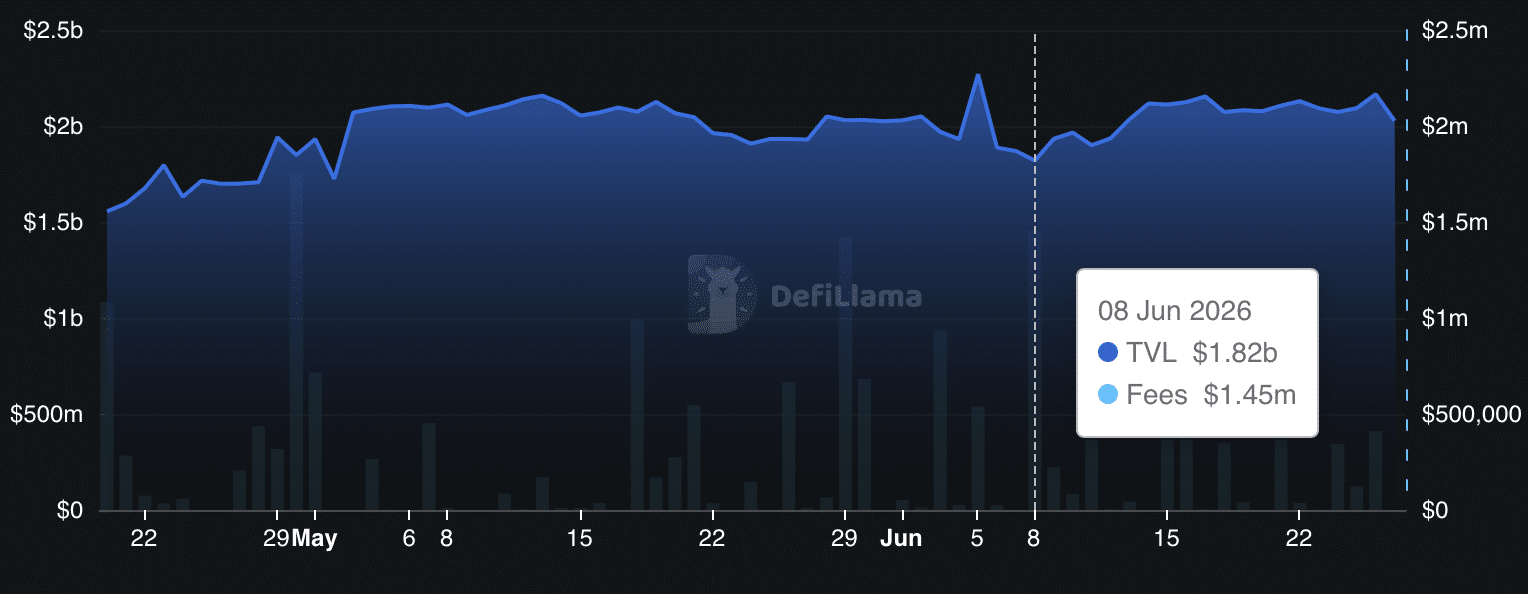
Tại thời điểm báo cáo, dữ liệu cho thấy TVL đã tăng 201 triệu USD từ ngày 8 tháng 6 đến thời điểm hiện tại, nâng con số này lên khoảng 2,05 tỷ USD, theo DeFiLlama.

Một đợt tăng với quy mô như vậy ngụ ý rằng các nhà đầu tư có cái nhìn tích cực về cả tài sản và giao thức nói chung. Tính đến nay trong quý 2, tổng doanh thu của giao thức đã đạt 24,16 triệu USD—quý có doanh thu cao thứ ba kể từ khi ra mắt vào quý 1/2023.
Nguồn: CoinGlass

Bổ sung vào bức tranh này là chương trình mua lại mà Maple Finance đã khởi động để giảm nguồn cung lưu hành của token.

Tại thời điểm báo cáo này, việc mua lại đã đạt mức cao thứ hai từ trước đến nay, với khoảng 746.460 USD đánh dấu mức mua lại theo quý cao thứ hai kể từ khi chương trình bắt đầu vào quý 4/2025.

Các đợt mua lại, theo thiết kế, có xu hướng hỗ trợ hiệu suất của token, đặc biệt là trong thời kỳ nhu cầu tăng mạnh.

Hợp đồng vĩnh cửu bổ sung vào triển vọng

Hoạt động giao dịch trên thị trường vĩnh cửu đã củng cố dòng vốn và đà tăng mạnh của tài sản.

Các hợp đồng vĩnh cửu của Maple đã thu hút một dòng vốn ổn định, với Lãi Mở tăng mạnh lên khoảng 20,7 triệu USD tại thời điểm báo cáo này—tăng 46% chỉ trong ngày qua.

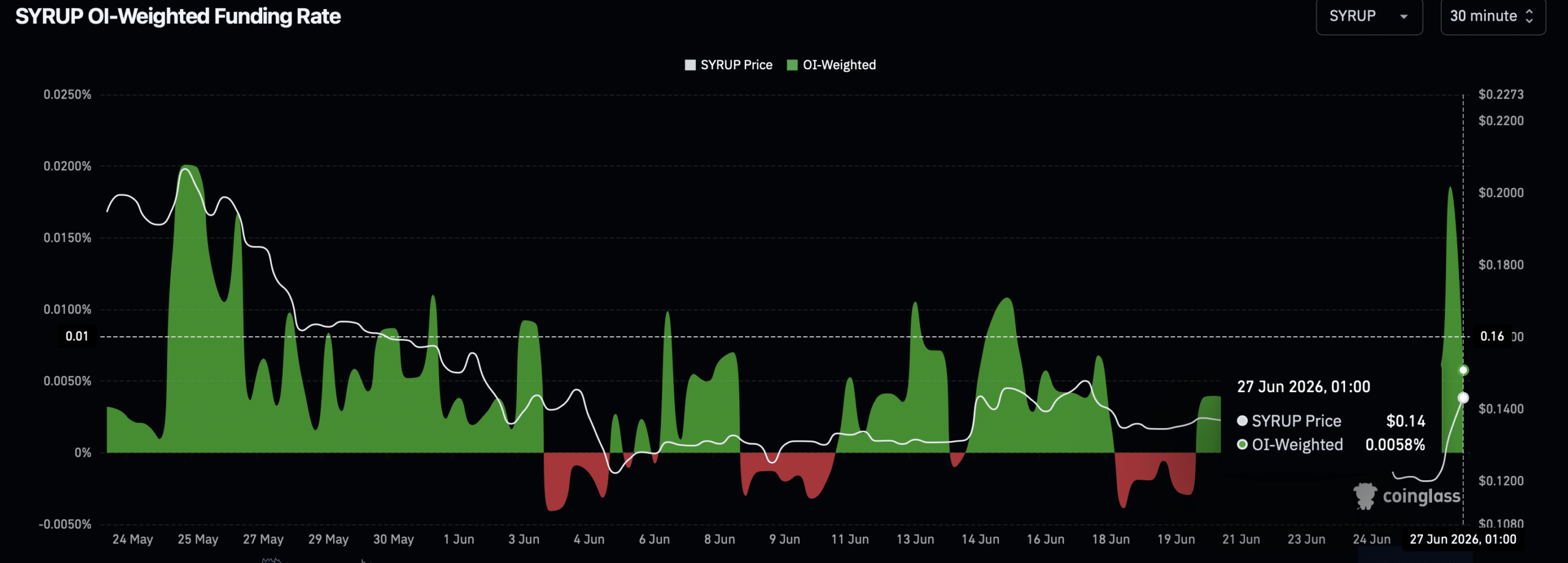
Chỉ riêng Lãi Mở không nói lên toàn bộ câu chuyện, vì vậy Tỷ lệ Tài trợ (Funding Rate) bổ sung ngữ cảnh về việc dòng vốn đó nghiêng về phe tăng giá hay giảm giá.
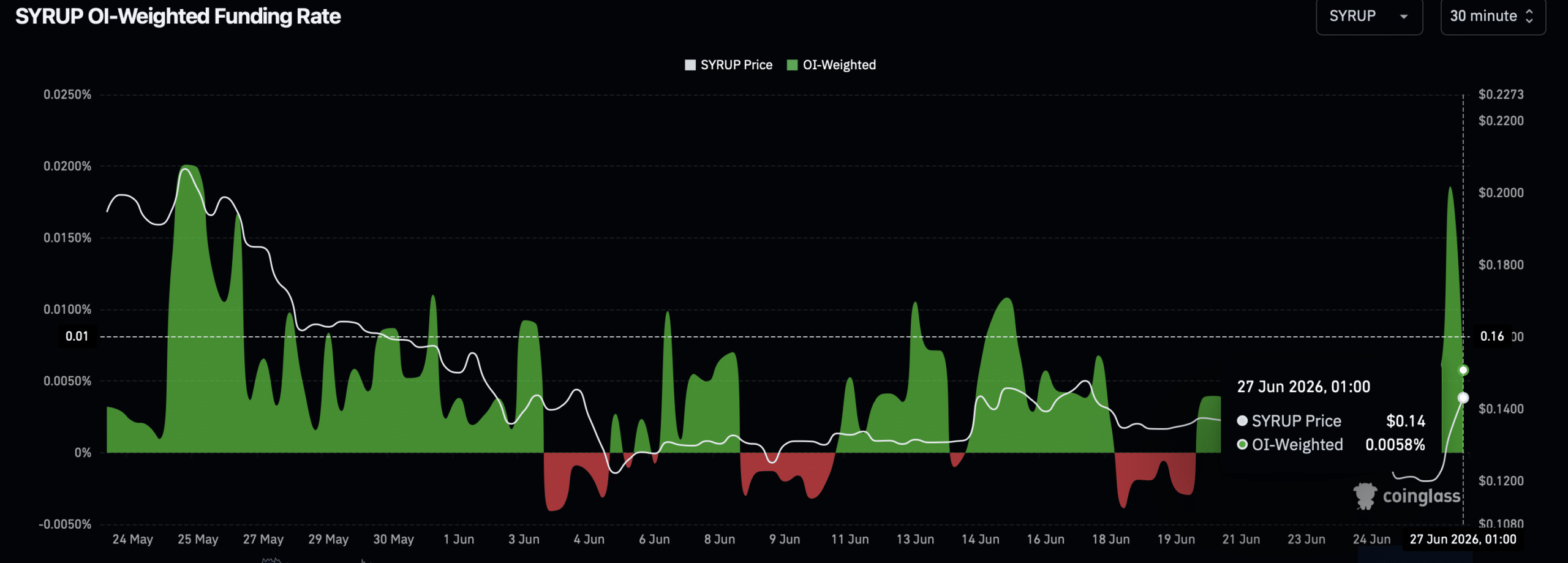
Nguồn: CoinGlass

Tỷ lệ Tài trợ đã chuyển sang dương tại thời điểm viết bài, ở mức 0,0058%, điều này ngụ ý rằng phần lớn vốn đang đặt cược vào phe mua (long) trong kỳ vọng một đợt tăng giá.

Đáng chú ý, dữ liệu tài trợ chỉ hơi nghiêng về phe tăng giá, điều này thường báo hiệu tốt cho việc SYRUP duy trì hiệu suất của mình. Bởi vì các trader không bị phơi nhiễm quá mức, tình huống này tránh được kịch bản thanh lý hàng loạt buộc vốn phải xoay vòng ra khỏi thị trường, ngay cả ở phía giao ngay.

Nhìn chung, triển vọng vẫn tích cực, và SYRUP có cơ hội mạnh mẽ để ghi nhận thêm lợi nhuận, ít nhất là trong ngắn hạn.


Tóm tắt cuối cùng

  • SYRUP đã tăng khoảng 20% sau khi Maple Finance hợp tác với Kraken để cung cấp dịch vụ cho vay có bảo đảm bằng tiền mã hóa, với các nhà đầu tư Hoa Kỳ chiếm phần lớn hoạt động giao dịch.
  • Tiền tiếp tục chảy vào giao thức, và các đợt mua lại token đang diễn ra đang giúp hỗ trợ giá.

Trending Cryptos

Related Questions

QYếu tố chính nào khiến token SYRUP của Maple Finance tăng giá khoảng 20%?

AYếu tố chính là việc Maple Finance công bố quan hệ đối tác với sàn giao dịch Kraken (Hoa Kỳ) để cung cấp dịch vụ cho vay có tài sản thế chấp bằng tiền mã hóa trên chuỗi, cho phép nhà đầu tư tiếp cận thanh khoản từ danh mục nắm giữ của họ.

QTổng giá trị bị khóa (TVL) của giao thức Maple Finance đã thay đổi như thế nào sau thông báo quan hệ đối tác?

ATheo DeFiLlama, TVL của Maple Finance đã tăng 201 triệu USD, từ mức vào ngày 8 tháng 6 lên khoảng 2,05 tỷ USD tại thời điểm báo cáo.

QChương trình mua lại token (buyback) của Maple Finance đang ở mức nào và tác động của nó là gì?

AChương trình mua lại đã đạt mức cao thứ hai kể từ khi bắt đầu vào Q4/2025, với giá trị khoảng 746.460 USD. Việc mua lại này nhằm giảm nguồn cung lưu hành của token SYRUP và thường có tác dụng hỗ trợ giá của token, đặc biệt trong giai đoạn nhu cầu tăng cao.

QChỉ số Tỷ lệ Tài trợ (Funding Rate) trong thị trường perpetual của SYRUP cho thấy điều gì về tâm lý nhà giao dịch?

ATỷ lệ Tài trợ (Funding Rate) dương, ở mức 0.0058% tại thời điểm viết bài, cho thấy phần lớn vốn đang đặt cược vào giá tăng (long position) trong kỳ vọng SYRUP sẽ tiếp tục tăng giá.

QTriển vọng ngắn hạn đối với token SYRUP được bài viết đánh giá như thế nào?

ABài viết đánh giá triển vọng vẫn tích cực. SYRUP có cơ hội mạnh mẽ để ghi nhận thêm lợi nhuận, ít nhất là trong ngắn hạn, nhờ dòng vốn liên tục, chương trình mua lại và tâm lý thị trường không quá kỳ vọng (tránh được kịch bản thanh lý hàng loạt).

Related Reads

Nomura Research Report Interpretation: US Stock ETFs Absorb $6.9 Billion in a Single Week, Stock-Bond Divergence Continues to Intensify

Nomura's FX Insights report, dated November 16, 2026, notes that although foreign inflows into U.S. equity ETFs and mutual funds rose to $6.9 billion in the week of November 9–13, up from $5.4 billion the prior week, the dip-buying momentum slowed somewhat in the latter half of the week. Nearly 39% of the weekly total (about $2.5 billion) flowed in on November 9 alone, extending the bargain-hunting seen after the previous week's selloff, when $2.1 billion entered on November 6. Daily buying stayed above $1 billion (November 11: $1.6 billion; November 12: $1.4 billion), but Nomura says the overall pace has begun to ease slightly. Divergence between equities and bonds is intensifying. U.S. bond ETFs and mutual funds saw $287 million of net outflows during the week, extending the prior week's $182 million outflow. Emerging-market thematic ETF inflows fell to $1.4 billion from $2.2 billion, with the split again favoring equities: $1.9 billion into stock funds versus $425 million of net outflows from bond funds. Asia-Pacific cross-border flows showed clear signs of braking. Net purchases of U.S. portfolio assets by previously active Korean retail investors plunged to $768 million from $2.6 billion, driven mainly by a sharp contraction in Korean retail buying of U.S. stocks. Taiwanese investors continued selling dollar assets, offloading another $439 million of USD-denominated bonds after net sales of $697 million the prior week.

marsbit36m ago

Nomura Research Report Interpretation: US Stock ETFs Absorb $6.9 Billion in a Single Week, Stock-Bond Divergence Continues to Intensify

marsbit36m ago

Goldman Sachs Research Report Interpretation: S&P 500 Seen Rising to 8,700 by End of Next Year, AI Investment Shift Spawns Four Major Themes

Goldman Sachs' 2027 US equity outlook, dated November 17, 2026, argues the bull market isn't over but has entered its middle phase. Healthy economic fundamentals and sustained AI investment should lift the S&P 500 to 8,700 by end-2027, implying roughly 17% upside. However, as AI capex growth peaks, market focus shifts from infrastructure spending to practical monetization. Earnings growth will cool: S&P 500 EPS growth slows from about 30% in 2026 to 11% in 2027 (core growth around 18% excluding tech giants' investment income). Valuation looks relatively safe—the 12-month forward P/E contracted 19% in 2026 to about 18x, near the 10-year average. The 8,700 target is derived from 2028 earnings estimates at 18x P/E; with high rates and AI uncertainty, systemic multiple expansion is unlikely, so gains must be earnings-driven. The AI relay baton is passing. Hyperscaler capex contributed 12 percentage points of 2026 index earnings growth, but its year-over-year growth is expected to plunge from 105% to 73% in 2027, with depreciation pressure eroding profits—by 2028, cloud capex could be a 5-point net drag on S&P 500 earnings. Goldman favors companies that can genuinely monetize AI or use it to boost productivity, especially asset-heavy, physical-economy productivity beneficiaries. Corporate leverage is rising: investment-grade and high-yield issuance could reach $2.8 trillion in 2027, with cloud providers borrowing heavily on and off balance sheet. Buyback growth stalled in Q3, with the buyback yield at 1.4%—a 20-year low outside recessions. "Buyback aristocrats" with strong free cash flow and sustained share reduction are scarce assets. With earnings growth near single digits, style tilts toward self-sustaining growth. Goldman likes secular growth stocks, favoring energy infrastructure (rare earnings acceleration) and transportation (cyclical upside). Defense matters too: high earnings concentration is a risk, so cheap healthcare and some consumer staples offer protection, while mid-caps—with underextended earnings and low P/Es—help diversify mega-cap risk. This is a summary of third-party research; ratings, targets and forecasts are the analyst's views, not investment advice. Markets carry risk; decisions should be independent.

marsbit46m ago

Goldman Sachs Research Report Interpretation: S&P 500 Seen Rising to 8,700 by End of Next Year, AI Investment Shift Spawns Four Major Themes

marsbit46m ago

Gold Rush 2027: Wall Street Giants Predict Bull Market Endures, Opportunities Hidden in Structural Trends

Global markets enter 2027 at a crossroads, balancing AI-driven FOMO against bubble fears, lingering inflation, and geopolitical risk. Major Wall Street outlooks converge on one theme: AI remains the dominant investment thesis, but storytelling alone no longer justifies valuations. Morgan Stanley upgraded global equities to overweight with an S&P 500 target of 8,700 by end-2027, citing EPS growth from $369 to $420. Goldman Sachs sees roughly 16% total return for the S&P 500 over 12 months, though it warns of a "Great Halving" in earnings growth—S&P 500 EPS growth falling from 36% to 11%. Stocks can still rise because tech valuations have compressed to the 20th percentile of the past two decades. AI capex is projected at $1.8 trillion in 2027, but hyperscaler spending growth is peaking and depreciation pressures are mounting, challenging AI "shovel sellers." China assets are being re-rated, with Goldman overweight Hong Kong and Morgan Stanley preferring A-shares. Energy and infrastructure emerge as hard constraints: the world faces a $106 trillion infrastructure gap, and grid upgrades, transformers, and storage are high-conviction plays. Oil could fall to $78/barrel, but Middle East escalation is the biggest tail risk. In asset allocation, the Beta era is ending. Goldman favors "growth scarcity"—overweight US and Japan, underweight Europe. Morgan Stanley stresses quality and recommends overweight US Treasuries as a hedge. Bonds are back, with global aggregate yields at 5.3%, a two-decade high, and negative stock-bond correlation likely to return. Alternatives gain ground; JPMorgan estimates 30% in diversified alternatives lifts expected returns to 7.5% and Sharpe ratios by 21%. It also quantified Bitcoin for the first time—10% base-case annualized return, 55% volatility—but excluded it from strategic allocation. Overall, 2027 rewards discipline: dancing with volatility and locking in genuine value as growth becomes scarce.

marsbit56m ago

Gold Rush 2027: Wall Street Giants Predict Bull Market Endures, Opportunities Hidden in Structural Trends

marsbit56m ago

All Four Lines of Defense Broken: How Many Cards Does Bitcoin Have Left to Play?

Bitcoin fell from $74,000 to $61,900 in five days, triggering over $300,000 liquidations and wiping more than $100 billion from total crypto market value. The fear index hit 10, a level last seen in June. The selloff was triggered by October CPI at 0.4% month-over-month versus 0.3% expected, pushing December rate-hike odds to nearly 90%. Bad news piled up: BlackRock's IBIT saw its longest outflow streak, MSCI announced removing Strategy from US indexes (potentially $2.8 billion in passive selling), Nvidia's CEO resigned, and Middle East tensions escalated. The Fed's September rate cut cycle has reversed into tightening, with officials warning of further hikes, while the Bank of Japan may raise rates again in December, risking yen carry-trade unwinds. All four major cost baselines are broken: ETF average cost ~$81,500, market average ~$77,500, short-term holder cost ~$75,600, and Strategy's ~$75,400. About 4 million BTC bought between $85,000 and $118,000 are underwater. MVRV fell to ~1.2, still above the below-1.0 level historically seen at bear-market bottoms. Both 2018 and 2022 saw lower second bottoms. Galaxy's base case targets $40,000–46,000. However, mid-sized wallets and Strategy keep accumulating, spot volume rose 24.5%, and some argue leverage has cleared with most macro bad news priced in. December brings the Fed meeting, BOJ meeting, and Deribit options expiry; ETF flows, stablecoin supply, and MVRV will determine direction.

marsbit1h ago

All Four Lines of Defense Broken: How Many Cards Does Bitcoin Have Left to Play?

marsbit1h ago

Trading

Spot

Hot Articles

How to Buy SYRUP

Welcome to HTX.com! We've made purchasing Maple Finance (SYRUP) simple and convenient. Follow our step-by-step guide to embark on your crypto journey.Step 1: Create Your HTX AccountUse your email or phone number to sign up for a free account on HTX. Experience a hassle-free registration journey and unlock all features.Get My AccountStep 2: Go to Buy Crypto and Choose Your Payment MethodCredit/Debit Card: Use your Visa or Mastercard to buy Maple Finance (SYRUP) instantly.Balance: Use funds from your HTX account balance to trade seamlessly.Third Parties: We've added popular payment methods such as Google Pay and Apple Pay to enhance convenience.P2P: Trade directly with other users on HTX.Over-the-Counter (OTC): We offer tailor-made services and competitive exchange rates for traders.Step 3: Store Your Maple Finance (SYRUP)After purchasing your Maple Finance (SYRUP), store it in your HTX account. Alternatively, you can send it elsewhere via blockchain transfer or use it to trade other cryptocurrencies.Step 4: Trade Maple Finance (SYRUP)Easily trade Maple Finance (SYRUP) on HTX's spot market. Simply access your account, select your trading pair, execute your trades, and monitor in real-time. We offer a user-friendly experience for both beginners and seasoned traders.

8.3k Total ViewsPublished 2025.05.08Updated 2026.06.02

How to Buy SYRUP

Discussions

Welcome to the HTX Community. Here, you can stay informed about the latest platform developments and gain access to professional market insights. Users' opinions on the price of SYRUP (SYRUP) are presented below.

活动图片