Crypto Market Infrastructure Is Unprecedentedly Perfect, So Why Has the Investment Environment Hit Rock Bottom?

比推Xuất bản vào 2026-01-28Cập nhật gần nhất vào 2026-01-28

Tóm tắt

The crypto market infrastructure and regulatory environment are more robust than ever, yet the investment climate is arguably at its worst. Arca CIO Jeff Dorman critiques the industry's failed attempt to position cryptocurrencies as broad macro trading tools, which has led to extreme correlation among all crypto assets, eroding differentiation. While assets like gold and silver have recently outperformed Bitcoin, the industry continues to neglect token subtypes that function like equities—such as DePIN, DeFi, and CeFi tokens—which generate actual cash flows and could appeal to traditional investors managing over $600 trillion in assets. Dorman calls for a return to fundamental analysis, emphasizing that tokens are merely a "wrapper" and that their underlying value drivers, sectors, and economic models should be the focus, rather than treating all cryptocurrencies as a single asset class. The current high correlation and lack of dispersion in returns have made the investment landscape dull compared to the healthier, more nuanced market of 2020-2021.

Author: Jeff Dorman (Arca CIO)

Compiled by: Deep Tide TechFlow

Original title: The Crypto Market Five Years Ago Was Actually Healthier Than Now


Deep Tide Introduction:

Is the crypto market becoming increasingly dull? Arca Chief Investment Officer Jeff Dorman writes that although infrastructure and regulatory environments have never been stronger, the current investment environment is the "worst in history."

He sharply criticizes industry leaders' failed attempts to forcibly transform cryptocurrencies into "macro trading tools," leading to extreme convergence in correlations among various assets. Dorman calls for a return to the essence of "tokens as securities packaging," focusing on equity-like assets such as DePIN and DeFi that have cash flow generation capabilities.

At a time when gold is surging while Bitcoin is relatively weak, this in-depth reflective article provides an important perspective for re-examining Web3 investment logic.

Full text below:

Bitcoin is facing an unfortunate situation

Most investment debates exist because people are on different time horizons, so they often "talk past each other," even though technically both sides are correct. Take the debate between gold and Bitcoin as an example: Bitcoin enthusiasts tend to say that Bitcoin is the best investment because its performance over the past 10 years has far exceeded that of gold.
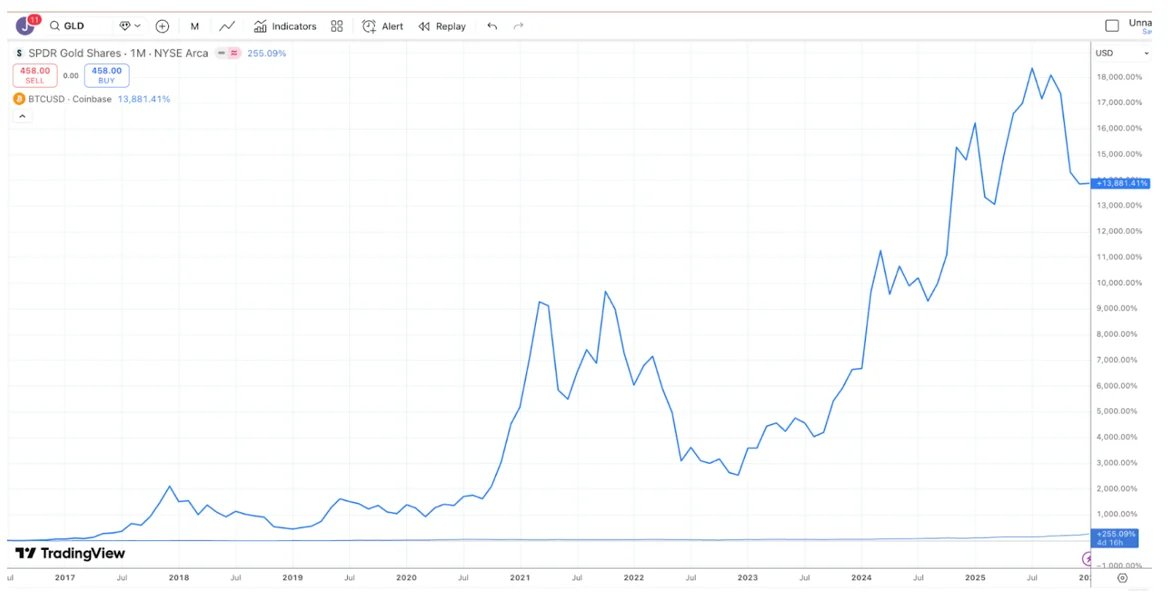
Caption: Source TradingView, comparison of Bitcoin (BTC) vs. gold (GLD) returns over the past 10 years

Gold investors, on the other hand, tend to believe that gold is the best investment and have recently been "mocking" Bitcoin's weakness, as gold has significantly outperformed Bitcoin over the past year (the same goes for silver and copper).
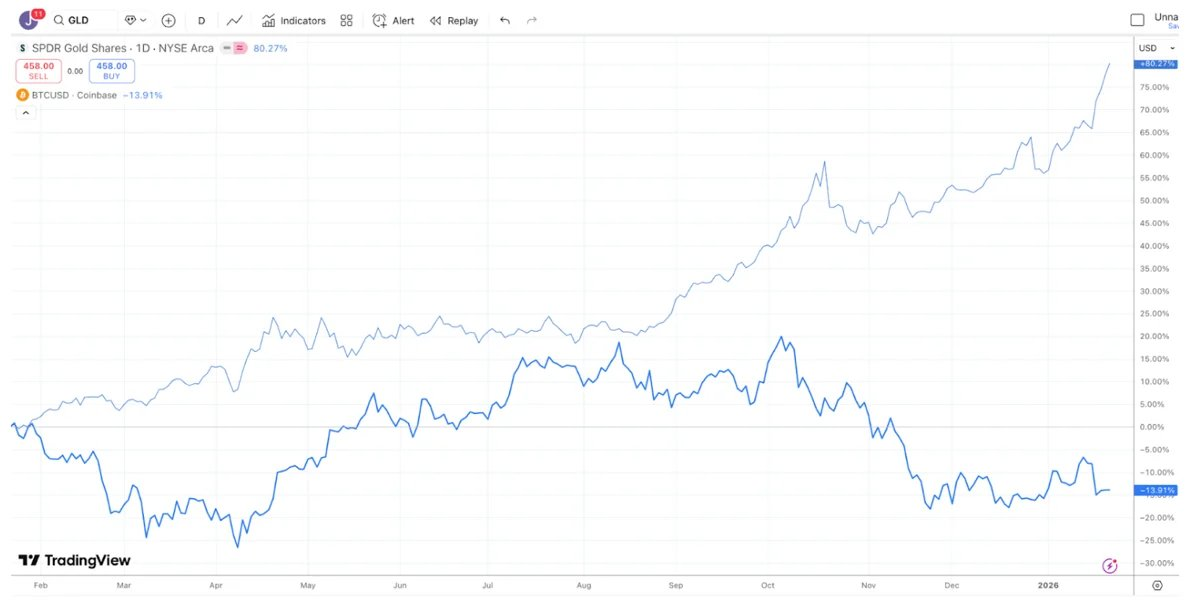
Caption: Source TradingView, comparison of Bitcoin (BTC) vs. gold (GLD) returns over the past 1 year

Meanwhile, over the past 5 years, the returns of gold and Bitcoin have been almost identical. Gold tends to do nothing for long periods, then skyrocket when central banks and trend followers buy; Bitcoin tends to have sharp rallies followed by significant crashes but ultimately moves higher.
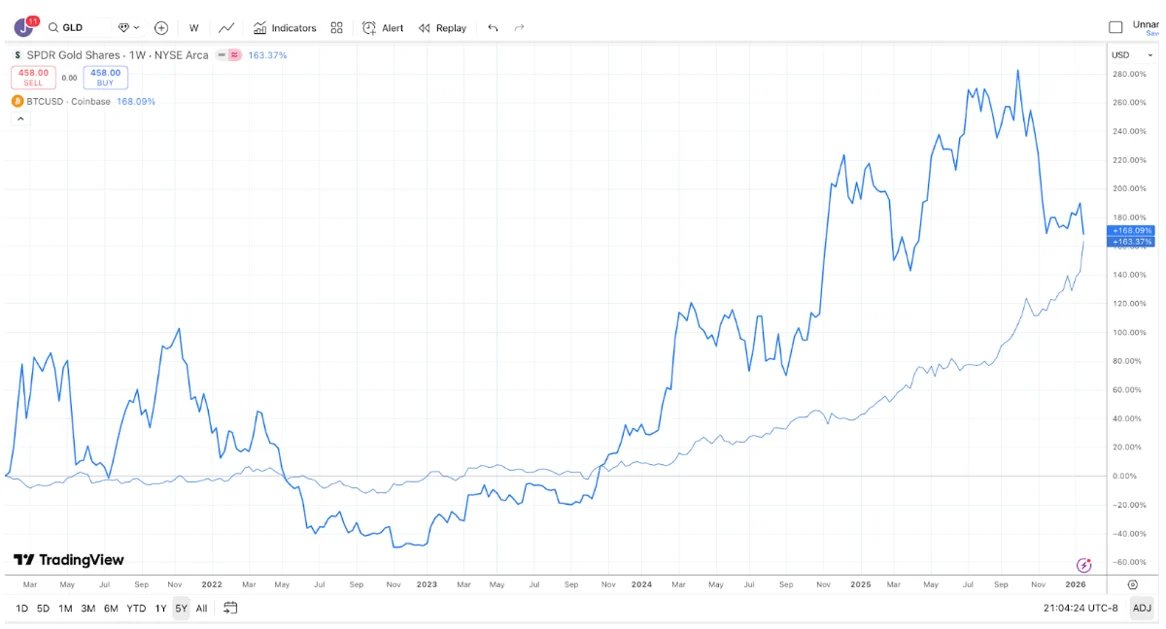
Caption: Source TradingView, comparison of Bitcoin (BTC) vs. gold (GLD) returns over the past 5 years

Therefore, depending on your investment horizon, you can almost win or lose any argument about Bitcoin vs. gold.

Even so, it's undeniable that recently gold (and silver) have shown strength relative to Bitcoin. To some extent, this is somewhat ironic (or pathetic). The largest companies in the crypto industry have spent the past 10 years trying to cater to macro investors rather than true fundamental investors, and now these macro investors are saying, "Never mind, we'll just buy gold, silver, and copper instead." We have long called for a shift in the industry's thinking. There are over $600 trillion in entrusted assets, and the buyers of these assets are a much stickier investor base. There are many digital assets that look more like bonds and stocks, issued by companies that generate revenue and conduct token buybacks, yet market leaders have, for some reason, decided to ignore this token sub-sector.

Perhaps Bitcoin's recent poor performance relative to precious metals will be enough for large brokers, exchanges, asset managers, and other crypto leaders to realize that their attempt to turn cryptocurrencies into an all-encompassing macro trading tool has failed. Instead, they might start focusing on and educating that $600 trillion pool of investors who prefer to buy cash-flow generating assets. It's not too late for the industry to start paying attention to those quasi-equity tokens that carry cash-flow generating tech businesses (like various DePIN, CeFi, DeFi, and token issuance platform companies).

Then again, if you just keep moving the "finish line," Bitcoin is still king. So, more likely than not, nothing will change.

Asset Differentiation

The "good old days" of crypto investing seem like a thing of the past. Back in 2020 and 2021, it seemed like every month brought a new narrative, sector, use case, and new type of token, with positive returns coming from all corners of the market. Although the growth engines of blockchain have never been stronger (thanks to legislative progress in Washington, stablecoin growth, DeFi, and RWA tokenization), the investment environment has never been worse.

A sign of market health is dispersion and low cross-market correlation. You want healthcare and defense stocks to move differently from tech and AI stocks; you want emerging market stocks to move independently of developed markets. Dispersion is generally seen as a good thing.

2020 and 2021 are largely remembered as "everything goes up" markets, but that wasn't entirely true. It was rare to see the entire market move in lockstep. More commonly, one sector would rise while another fell. Gaming surged while DeFi might have been falling; DeFi surged while "Dino" L1 tokens fell; Layer-1s surged while the Web3 sector fell. A diversified crypto portfolio actually smoothed returns and often lowered the overall portfolio's beta and correlation. Liquidity came and went as interest and demand shifted, but performance was diverse. This was very exciting. The massive inflow into crypto hedge funds in 2020 and 2021 made sense because the investable universe was expanding and returns were differentiated.

Fast forward to today, and the returns of all "crypto-wrapped" assets look identical. Since the flash crash on October 10th, the declines across sectors are almost indistinguishable. No matter what you hold, or how the token captures economic value, or what the project's trajectory is... the returns are largely the same. This is very frustrating.
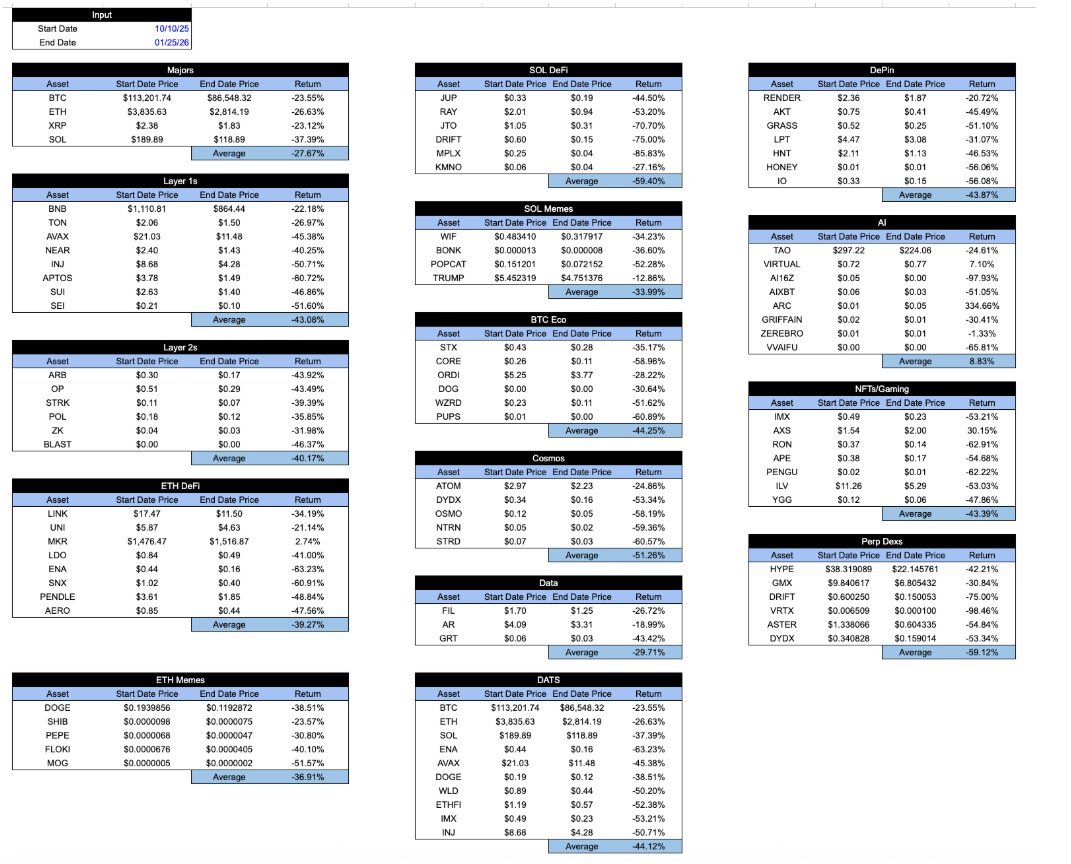
Caption: Arca internal calculations and CoinGecko API data for a sample of representative crypto assets

During market booms, this table looks slightly more encouraging. "Good" tokens tend to outperform "bad" tokens. But a healthy system should actually be the opposite: you want good tokens to perform better during bad times, not just during good times. Here is the same table from the low on April 7th to the high on September 15th.
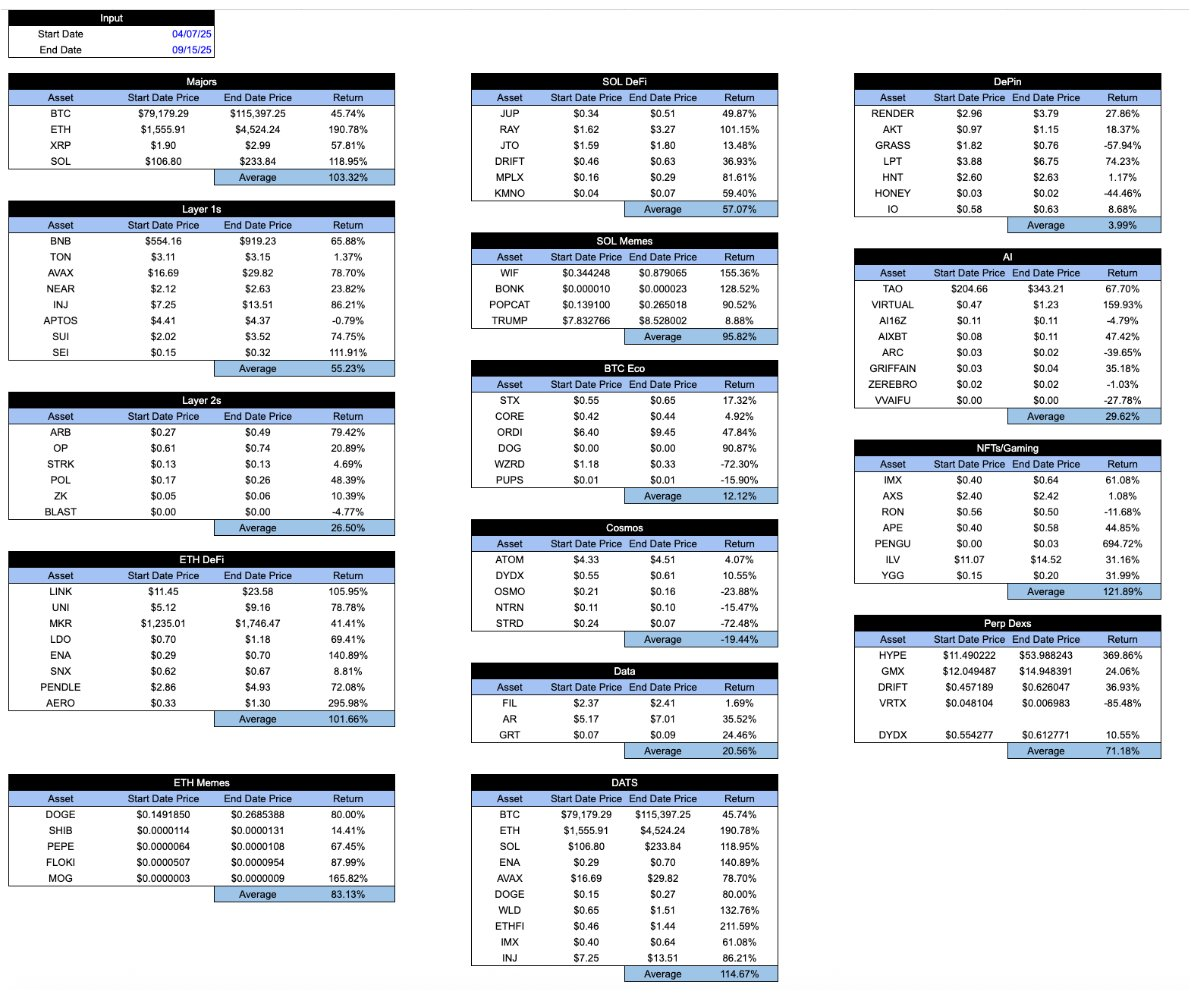
Caption: Arca internal calculations and CoinGecko API data for a sample of representative crypto assets

Interestingly, when the crypto industry was in its infancy, market participants worked very hard to differentiate between different types of crypto assets. For example, I published an article in 2018 where I categorized crypto assets into 4 types:

  1. Cryptocurrencies/money

  2. Decentralized protocols/platforms

  3. Asset-backed tokens

  4. Pass-through securities

At the time, this classification method was quite unique and attracted many investors. Importantly, crypto assets were evolving, from just Bitcoin, to smart contract protocols, asset-backed stablecoins, to equity-like pass-through securities. Researching different growth areas was a major source of alpha, and investors wanted to understand the various valuation techniques required to assess different asset types. Most crypto investors back then didn't even know when unemployment data was released or when FOMC meetings were held, and rarely looked to macro data for signals.

After the 2022 crash, these different types of assets still exist. Nothing has fundamentally changed. But there has been a huge change in how the industry markets itself. The "gatekeepers" decided that Bitcoin and stablecoins were the only things that mattered; the media decided they didn't want to write about anything except TRUMP tokens and other memecoins. Over the past few years, not only has Bitcoin outperformed most other crypto assets, but many investors have even forgotten these other asset types (and sectors) exist. The business models of the underlying companies and protocols haven't become less relevant, but the assets themselves have become more correlated due to investor flight and market makers dominating price action.

This is why Matt Levine's recent article about tokens was so surprising and well-received. In just 4 short paragraphs, Levine accurately described the differences and nuances between various tokens. It gives me some hope that this kind of analysis is still possible.
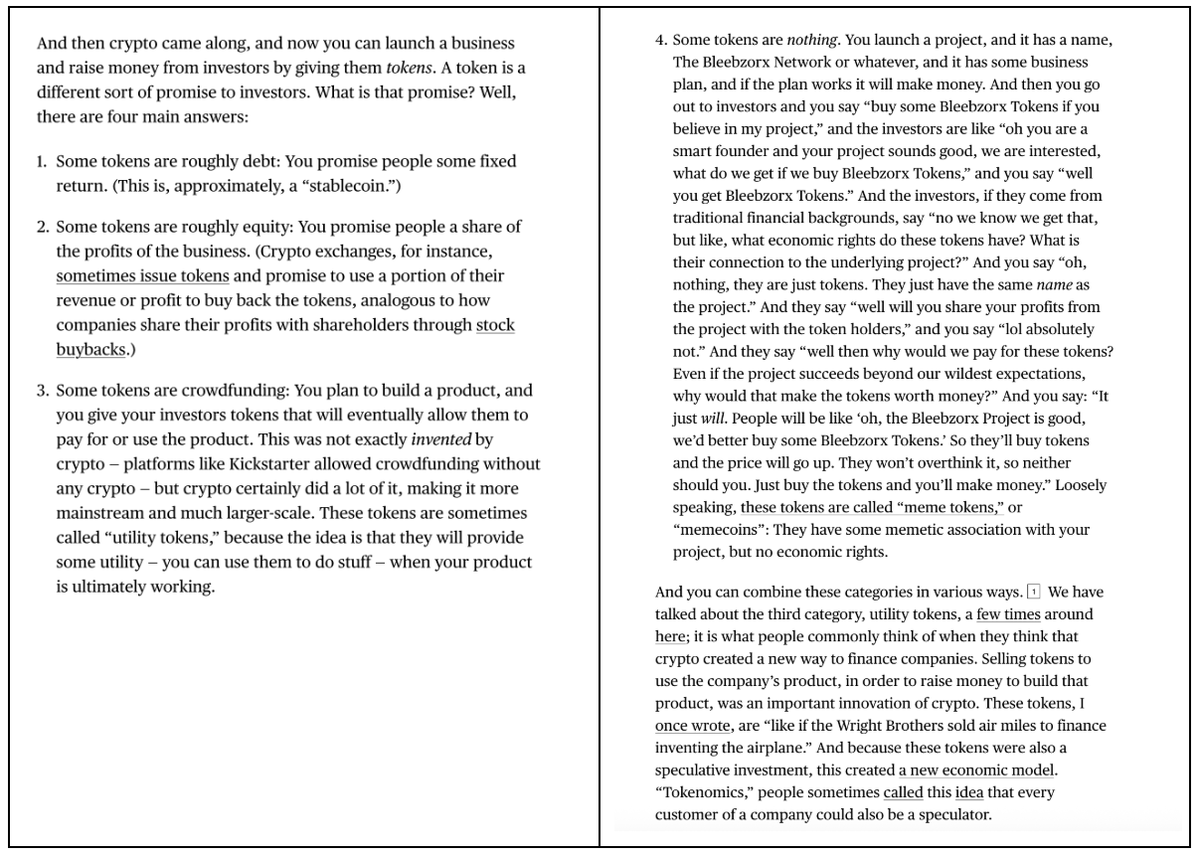
The leading crypto exchanges, asset managers, market makers, OTC desks, and pricing services still call everything besides Bitcoin an "altcoin" and seem to only write macro research, bundling all "cryptocurrencies" together as one giant asset. Take Coinbase, for example – they seem to have only a very small research team led by one primary analyst (David Duong) whose focus is primarily on macro research. I have nothing against Mr. Bitcoin (Mr. Duong) – his analysis is excellent. But who goes to Coinbase specifically for macro analysis?

Imagine if leading ETF providers and exchanges only wrote generically about ETFs, saying things like "ETFs are down today!" or "ETFs react negatively to inflation data." They would be laughed out of business. Not all ETFs are the same just because they use the same "wrapper," and those selling and promoting ETFs understand this. What's inside the ETF matters most, and investors seem to be able to intelligently differentiate between ETFs, mainly because industry leaders help their clients understand this.

Similarly, a token is just a "wrapper." As Matt Levine eloquently described, what's inside the token matters. The type of token matters, the sector matters, its properties (inflationary or amortizing) matter.

Perhaps Levine isn't the only one who understands this. But he does a better job explaining the industry than those who actually profit from it.


Twitter:https://twitter.com/BitpushNewsCN

Bitpush TG Discussion Group:https://t.me/BitPushCommunity

Bitpush TG Subscription: https://t.me/bitpush

Original link:https://www.bitpush.news/articles/7606655

Câu hỏi Liên quan

QWhy does the author believe the current crypto investment environment is the 'worst ever' despite strong infrastructure and regulation?

AThe author believes the investment environment is poor because all crypto assets have become highly correlated and move in lockstep, eliminating dispersion and differentiation. Market leaders have focused excessively on marketing crypto as a macro tool rather than educating investors about fundamental differences between asset types, causing a loss of alpha opportunities and making diversified portfolios ineffective.

QWhat is the main criticism the author has against crypto industry's attempt to appeal to macro investors?

AThe main criticism is that the industry's attempt to position crypto as a broad macro trading tool has failed, as macro investors are instead choosing traditional assets like gold and silver. The author argues the industry should instead focus on educating the massive $600 trillion pool of investors who prefer cash-flow generating, quasi-equity tokens that resemble stocks and bonds.

QHow does the author contrast the market behavior of 2020-2021 with the current market?

AIn 2020-2021, the market had healthy dispersion where different sectors (e.g., Gaming, DeFi, Layer-1s) moved independently, allowing for diversified portfolios to smooth returns. Today, all crypto assets are highly correlated and move uniformly, regardless of their fundamentals or value capture mechanisms, making the market monotonous and frustrating for investors.

QWhat does the author suggest is the key to improving the investment landscape for crypto assets?

AThe author suggests returning to the essence of tokens as 'securities wrappers' and focusing on fundamental analysis of what is inside the token—such as cash-flow generating businesses in DePIN, DeFi, or token issuance platforms—rather than treating all crypto as a homogeneous macro asset. Industry leaders should educate investors on these nuances.

QWhy does the author reference Matt Levine's article on tokens?

AThe author references Matt Levine's article because it accurately describes the differences and nuances between various token types in just a few paragraphs, highlighting that what matters is the content inside the token wrapper. This gives hope that nuanced analysis is still possible and needed, contrasting with the industry's current homogenized approach.

Nội dung Liên quan

Kraken Lên Kế Hoạch Cung Cấp Hợp Đồng Tương Lai Vĩnh Viễn Được CFTC Quy Định Cho Nhà Giao Dịch Chuyên Nghiệp Hoa Kỳ

Kraken đang chuẩn bị ra mắt hợp đồng tương lai vĩnh viễn được CFTC quản lý cho các nhà giao dịch chuyên nghiệp đủ điều kiện tại Hoa Kỳ. Sản phẩm sẽ được cung cấp thông qua sàn phái sinh Bitnomial mà Kraken đã mua lại và dự kiến tích hợp vào nền tảng Kraken Pro. Hợp đồng tương lai vĩnh viễn là sản phẩm phái sinh crypto lớn toàn cầu, cho phép giao dịch không ngày đáo hạn. Tại Mỹ, các hạn chế quy định trước đây khiến nhà giao dịch có ít lựa chọn trong nước. Động thái của Kraken nhằm thu hẹp khoảng cách này, cung cấp một con đường được quản lý để tiếp cận sản phẩm chi phối khối lượng giao dịch crypto ở nước ngoài. Việc ra mắt sẽ tập trung vào các nhà giao dịch chuyên nghiệp đủ điều kiện. Các yếu tố cần theo dõi bao gồm điều khoản về tính đủ điều kiện, thiết kế hợp đồng, tài sản được hỗ trợ và quan trọng nhất là thanh khoản khi ra mắt. Thành công của sản phẩm có thể mở đường cho nhiều sản phẩm tương lai vĩnh viễn được quản lý khác tại thị trường Mỹ, đưa sản phẩm phái sinh chủ chốt này tiến gần hơn đến cơ sở hạ tầng thị trường nội địa được quản lý.

bitcoinist4 giờ trước

Kraken Lên Kế Hoạch Cung Cấp Hợp Đồng Tương Lai Vĩnh Viễn Được CFTC Quy Định Cho Nhà Giao Dịch Chuyên Nghiệp Hoa Kỳ

bitcoinist4 giờ trước

Sự Ra Mắt Của Warsh: Chủ Tịch Fed Hiểu Crypto Nhất Lịch Sử Sẽ Mang Đến Bất Ngờ Hay Cú Sốc Cho Thị Trường?

Tân Chủ tịch Cục Dự trữ Liên bang Kevin Warsh, người được mệnh danh là chủ tịch FED "hiểu rõ về Crypto nhất trong lịch sử", sắp có buổi họp báo chính sách đầu tiên trong bối cảnh thử thách ba mặt: lạm phát quay trở lại, áp lực giảm lãi suất từ Tổng thống Trump và kỳ vọng thị trường về việc tăng lãi suất. Khác với người tiền nhiệm, Warsh có cái nhìn sâu sắc về tài sản số, từng coi Bitcoin như "cảnh sát tốt cho chính sách" và nhấn mạnh giá trị sản xuất của ngành công nghiệp blockchain. Tuy nhiên, ông cũng nổi tiếng là người theo chủ nghĩa diều hâu về lạm phát. Sự kết hợp giữa "lãi suất chặt chẽ" và "quy định thân thiện" từ ông có thể trở thành yếu tố cốt lõi định giá tài sản mã hóa. Bài viết phân tích tác động từ ba khía cạnh: 1. **Chuyển đổi khuôn mẫu kỳ vọng quy định:** Từ phòng thủ sang tích hợp và đổi mới, có thể thúc đẩy các khung pháp lý rõ ràng hơn, hỗ trợ ổn định do khu vực tư nhân phát hành. 2. **Định giá lại lộ trình lãi suất và phần bù rủi ro:** Một chủ tịch hiểu biết và giao tiếp rõ ràng có thể giảm bớt phí bảo hiểm bất định, có lợi về cấu trúc cho thị trường. 3. **Tái phân bổ dòng vốn toàn cầu:** Kinh nghiệm đầu tư cá nhân của Warsh truyền tải tín hiệu về sự chấp nhận chính thống, có thể thúc đẩy các quỹ thể chế truyền thống phân bổ tài sản số. Hai kịch bản chính được đưa ra: * **Ngạc nhiên thú vị:** Nếu Warsh thể hiện thái độ ôn hòa và công nhận giá trị của tài sản số, thị trường có thể được tiếp thêm sức mạnh. * **Cú sốc:** Nếu ông phát tín hiệu tăng lãi suất mạnh mẽ, tài sản rủi ro, bao gồm crypto, có thể chịu áp lực bán. Mặc dù Warsh đã bán các khoản nắm giữ liên quan đến crypto để tuân thủ quy tắc đạo đức, nhưng sự hiểu biết thực sự của ông về công nghệ blockchain được kỳ vọng sẽ đặt nền tảng cho việc chính thống hóa tài sản số về lâu dài, vượt ra ngoài các phản ứng thị trường ngắn hạn.

marsbit4 giờ trước

Sự Ra Mắt Của Warsh: Chủ Tịch Fed Hiểu Crypto Nhất Lịch Sử Sẽ Mang Đến Bất Ngờ Hay Cú Sốc Cho Thị Trường?

marsbit4 giờ trước

XRP Ledger Ra Mắt Rebrand XRPLd Cùng Với Bản Nâng Cấp Phiên Bản 3.2.0

Phiên bản 3.2.0 của XRP Ledger đã chính thức ra mắt, đánh dấu một bước nâng cấp quan trọng cho cơ sở hạ tầng blockchain cốt lõi. Lần này, các nhà phát triển đã đổi tên phần mềm vận hành mạng từ "rippled" thành "xrpld" để phù hợp hơn với toàn bộ hệ sinh thái của dự án. Bản cập nhật tập trung chủ yếu vào các cải tiến back-end và hiệu suất thay vì tính năng người dùng mới. Các tối ưu hóa bộ nhớ được giới thiệu có khả năng tiết kiệm tới 40% lượng bộ nhớ máy chủ, đồng thời chuẩn bị kiến trúc phần mềm cho việc mở rộng quy mô trong tương lai. Về mặt bảo mật, bản sửa đổi `fixCleanup3_2_0` mang lại nhiều cải thiện cho các mô-đun như kho lưu ký tài sản đơn, giao thức cho vay, sàn giao dịch phi tập trung và mã thông báo đa năng. Các kiểm tra bất biến mới được thêm vào để đảm bảo tính toàn vẹn của sổ cái khi tài khoản bị xóa. Một khả năng mới cho nhà phát triển là ứng dụng có thể truy xuất thông tin định nghĩa giao thức và máy chủ XRP Ledger mà không cần kết nối trực tiếp, hỗ trợ đáng kể việc phát triển ví, công cụ khám phá chuỗi khối và API. Các thay đổi về khả năng mở rộng và ổn định bao gồm kích thước khối có thể cấu hình, hỗ trợ lưu trữ cơ sở dữ liệu hiệu quả qua nuDB, và việc hỗ trợ máy chủ gRPC cho TLS/mutual TLS trở thành tùy chọn. Cổng kết nối ngang hàng mặc định cũng được đổi từ 51235 sang 2459. Các tính năng kiểm tra bất biến giao dịch tạm thời bị vô hiệu hóa trong phiên bản 3.2.0 do ảnh hưởng đến hiệu suất, nhưng không gây rủi ro bảo mật.

TheNewsCrypto4 giờ trước

XRP Ledger Ra Mắt Rebrand XRPLd Cùng Với Bản Nâng Cấp Phiên Bản 3.2.0

TheNewsCrypto4 giờ trước

AGI không phải là điểm kết thúc, nghiên cứu mới của DeepMind: Hướng tới ASI, tiến bộ AI thực sự mới chỉ bắt đầu

DeepMind mới đây công bố nghiên cứu cho rằng AGI (Trí tuệ nhân tạo phổ quát) không phải là điểm cuối. AI sẽ tiếp tục phát triển vượt qua khả năng của các nhóm chuyên gia con người hàng đầu, hướng tới ASI (Trí tuệ siêu nhân tạo). Báo cáo phân biệt ba khái niệm: AGI (năng lực nhận thức tương đương mức trung bình của con người), ASI (vượt trội con người trong hầu hết lĩnh vực quan tâm), và UAI (giới hạn lý thuyết tối thượng). Nghiên cứu đề xuất bốn con đường tiềm năng để chuyển từ AGI sang ASI: 1. Mở rộng quy mô tính toán, mô hình và dữ liệu. 2. Tiến hóa thuật toán, có thể thay đổi mô hình mới. 3. Tự cải thiện đệ quy, tạo phản hồi tích cực. 4. Điều phối đa tác tử và trí tuệ tập thể. Đồng thời, báo cáo chỉ ra sáu điểm nghẽn chính: giới hạn dữ liệu chất lượng cao, áp lực tài nguyên và kinh tế, hạn chế của mô hình mạng nơ-ron hiện tại, nghiên cứu ngày càng khó khăn, rào cản trừu tượng, cùng các vấn đề quản lý và phản ứng xã hội. Khi AI vượt con người, các phương pháp đánh giá truyền thống sẽ mất ý nghĩa. Cần xây dựng hệ thống đánh giá mới cho thời kỳ hậu AGI. ASI không phải là hệ thống toàn năng, vẫn chịu ràng buộc bởi các quy luật vật lý, độ phức tạp tính toán, dữ liệu, tài nguyên và tốc độ phản hồi thực tế. Tương lai phát triển của AI vẫn chứa nhiều bất định, đòi hỏi một nỗ lực liên ngành quy mô lớn để theo dõi và ứng phó.

marsbit6 giờ trước

AGI không phải là điểm kết thúc, nghiên cứu mới của DeepMind: Hướng tới ASI, tiến bộ AI thực sự mới chỉ bắt đầu

marsbit6 giờ trước

Kraken Ra Mắt Hợp Đồng Perpetual Trước IPO Cho OpenAI Và Anthropic Với Đòn Bẩy Lên Đến 5x

Kraken đã ra mắt hợp đồng tương lai vĩnh viễn (perps) tiền IPO cho hai công ty trí tuệ nhân tạo hàng đầu là OpenAI và Anthropic. Các hợp đồng này cho phép các nhà giao dịch đủ điều kiện mở vị thế mua (long) hoặc bán (short) đối với các công ty tư nhân được theo dõi sát sao này trước khi họ lên sàn chứng khoán, với đòn bẩy lên tới 5x. Sản phẩm này đánh dấu một bước tiến trong việc mở rộng cơ sở hạ tầng phái sinh tiền mã hóa sang các tài sản ngoài chuỗi, cung cấp cho các nhà giao dịch một cách tiếp cận thay thế để có thể tiếp xúc với các công ty tư nhân vốn thường khó tiếp cận. Tuy nhiên, hợp đồng tiền IPO có những rủi ro đặc thù. Khác với các hợp đồng vĩnh viễn cho tiền mã hóa có giá cả minh bạch, định giá công ty tư nhân phụ thuộc vào nhiều yếu tố như các vòng gọi vốn, giao dịch thứ cấp và kỳ vọng về thời điểm IPO. Điều này khiến việc định giá và quản lý rủi ro trở nên phức tạp hơn. Việc sử dụng đòn bẩy cao có thể khuếch đại lợi nhuận nhưng cũng làm gia tăng đáng kể rủi ro thua lỗ và thanh lý. Do đó, các nhà giao dịch cần hiểu rõ bản chất của sản phẩm mới và các rủi ro độc đáo của thị trường tư nhân trước khi tham gia.

bitcoinist6 giờ trước

Kraken Ra Mắt Hợp Đồng Perpetual Trước IPO Cho OpenAI Và Anthropic Với Đòn Bẩy Lên Đến 5x

bitcoinist6 giờ trước

Giao dịch

Giao ngay
Hợp đồng Tương lai

Bài viết Nổi bật

Làm thế nào để Mua ROCK

Chào mừng bạn đến với HTX.com! Chúng tôi đã làm cho mua Rock Dao (ROCK) trở nên đơn giản và thuận tiện. Làm theo hướng dẫn từng bước của chúng tôi để bắt đầu hành trình tiền kỹ thuật số của bạn.Bước 1: Tạo Tài khoản HTX của BạnSử dụng email hoặc số điện thoại của bạn để đăng ký tài khoản miễn phí trên HTX. Trải nghiệm hành trình đăng ký không rắc rối và mở khóa tất cả tính năng. Nhận Tài khoản của tôiBước 2: Truy cập Mua Crypto và Chọn Phương thức Thanh toán của BạnThẻ Tín dụng/Ghi nợ: Sử dụng Visa hoặc Mastercard của bạn để mua Rock Dao (ROCK) ngay lập tức.Số dư: Sử dụng tiền từ số dư tài khoản HTX của bạn để giao dịch liền mạch.Bên thứ ba: Chúng tôi đã thêm những phương thức thanh toán phổ biến như Google Pay và Apple Pay để nâng cao sự tiện lợi.P2P: Giao dịch trực tiếp với người dùng khác trên HTX.Thị trường mua bán phi tập trung (OTC): Chúng tôi cung cấp những dịch vụ được thiết kế riêng và tỷ giá hối đoái cạnh tranh cho nhà giao dịch.Bước 3: Lưu trữ Rock Dao (ROCK) của BạnSau khi mua Rock Dao (ROCK), lưu trữ trong tài khoản HTX của bạn. Ngoài ra, bạn có thể gửi đi nơi khác qua chuyển khoản blockchain hoặc sử dụng để giao dịch những tiền kỹ thuật số khác.Bước 4: Giao dịch Rock Dao (ROCK)Giao dịch Rock Dao (ROCK) dễ dàng trên thị trường giao ngay của HTX. Chỉ cần truy cập vào tài khoản của bạn, chọn cặp giao dịch, thực hiện giao dịch và theo dõi trong thời gian thực. Chúng tôi cung cấp trải nghiệm thân thiện với người dùng cho cả người mới bắt đầu và người giao dịch dày dạn kinh nghiệm.

Tổng lượt xem 286Xuất bản vào 2024.12.13Cập nhật vào 2026.06.02

Làm thế nào để Mua ROCK

Thảo luận

Chào mừng đến với Cộng đồng HTX. Tại đây, bạn có thể được thông báo về những phát triển nền tảng mới nhất và có quyền truy cập vào thông tin chuyên sâu về thị trường. Ý kiến ​​của người dùng về giá của ROCK (ROCK) được trình bày dưới đây.

活动图片