Crypto market’s weekly winners and losers – LDO, PUMP, LIT, PI

ambcryptoPublicado a 2026-07-19Actualizado a 2026-07-19

Resumen

The crypto market saw mixed performance this week, with technical rallies and profit-taking driving action. Weekly winners were led by Lido DAO (LDO), up 16% and approaching a key resistance zone. Pump.fun (PUMP) followed with a 13% gain but remains below critical resistance. Venice Token (VVV) posted a 12.3% relief rally after a prolonged downtrend. Notable altcoin gainers included IOTA (SN9) and Akedo (AKE). On the losing side, Lighter (LIT) fell 16%, entering a cooldown phase after a strong rally. Pi Network (PI) declined 2.7%, breaking below key support to a new all-time low. Arbitrum (ARB) dropped as bulls failed to reclaim the $0.10 resistance. Other significant losers included Cash Cat (CASHCAT) and LAB. Overall, the week featured sharp swings, with recovery attempts in some assets and extended declines in others, highlighting ongoing market rotation and volatility.

This week, the crypto market was mixed.

Bitcoin traded sideways while several altcoins saw strong price swings. A handful of tokens posted solid weekly gains, while others extended their losses after failing to hold key support levels.

Overall, the week was driven by technical rallies, profit-taking, and continued rotation into select altcoins.

Weekly winners

Lido DAO [LDO] nears a key resistance zone

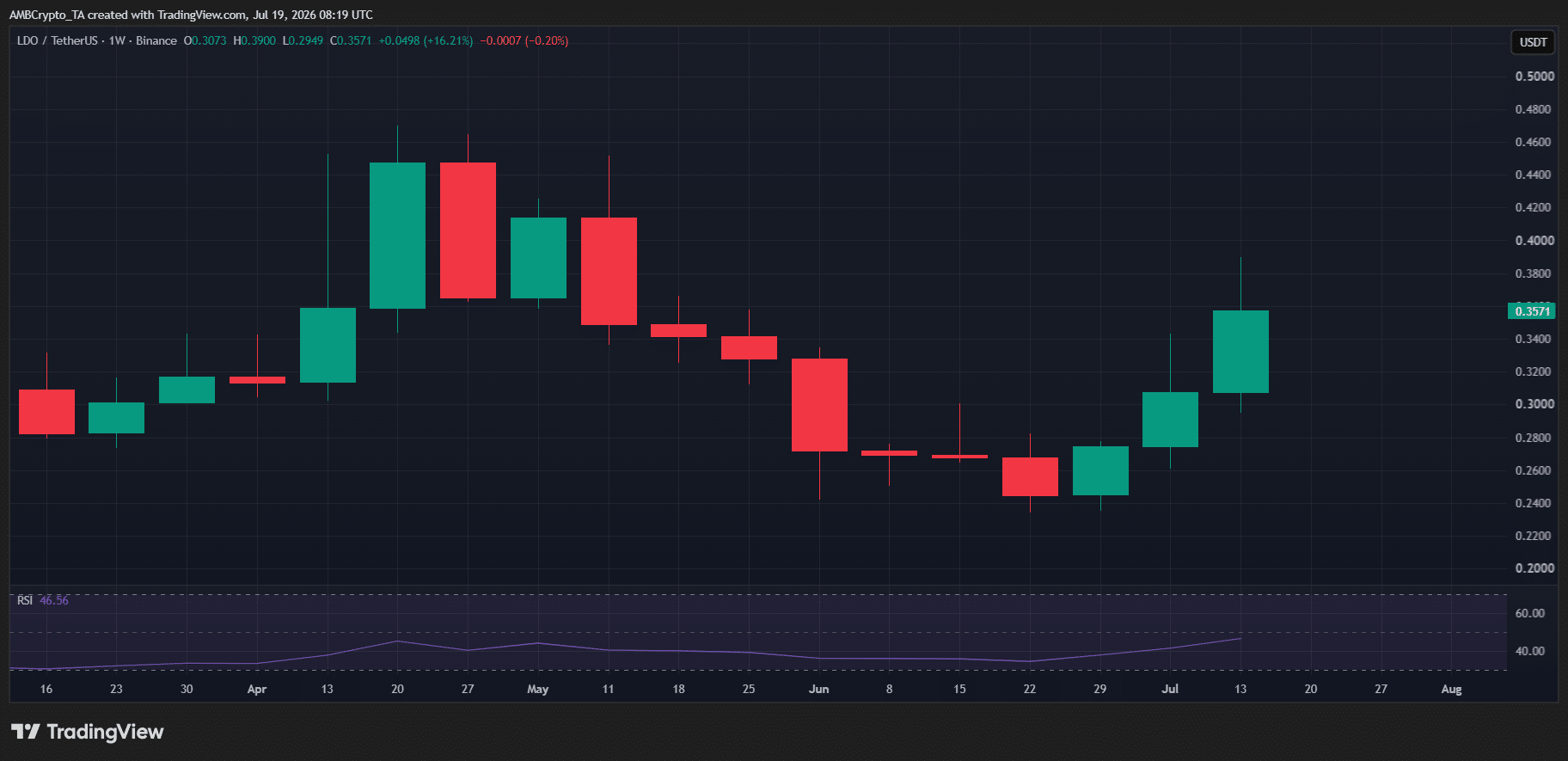
Lido DAO [LDO] led this week’s movers with a 16% rally. Notably, this comes after two straight weeks of upside, pushing LDO’s total gains to 25%. In just 21 days, the token has delivered a solid 40%+ recovery.

Why does this matter? Despite the recent move higher, LDO’s RSI is still far from the extreme overbought zone. This shows the rally has not yet entered a crowded phase, leaving room for further upside if momentum continues.

Technically, this suggests LDO’s move is more than just a random pump. The rally follows a sharp June sell-off, where LDO dropped toward $0.20 and broke below its Q1 lows. The current recovery shows buyers are stepping back in and attempting to reverse the previous downtrend.
Source: TradingView (LDO/USDT)

If this momentum continues, a breakout toward the $0.40 resistance zone could be on the table.

For context, LDO faced heavy selling pressure around this level during Q1, making it a critical area for bulls to reclaim. A successful breakout could strengthen the recovery narrative, while another rejection may trigger a period of consolidation as traders reassess the next move.

Is Pump.fun [PUMP] still far from reaching full FOMO?

Pump.fun [PUMP] emerged as the second-biggest weekly winner with a 13% rally. While the RSI remains neutral and PUMP has seen strong trading volume in recent sessions, calling this a full-fledged breakout setup may still be too early.

For over two months, PUMP has been trading below the key $0.002 resistance zone, making this the most important level for bulls to reclaim. However, every weekly push higher has so far been followed by a sharp cooldown phase, showing that accumulation is still not strong enough to support a larger breakout.

In short, though, PUMP is showing early signs of recovery, the structure still needs confirmation. Until buyers can consistently defend higher levels and break through the $0.002 resistance, the token remains in a consolidation phase rather than a confirmed breakout trend.

Venice Token [VVV] sees a much-needed weekly relief rally

Venice Token [VVV] took the third spot this week with a 12.3% rally. For VVV, this could be one of its most significant weeks since mid-Q2. From a technical standpoint, VVV has been stuck in a consistent downtrend over the past eight weeks, with every weekly close ending in the red.

However, this week’s gains have clearly pushed VVV back into the spotlight. More importantly, the recovery came right after VVV broke below the key $10 support level, suggesting buyers stepped in at a critical zone. In this context, the rally looks more strategic, with bulls attempting to defend lower levels and build a recovery base.

If this trend holds, VVV could have started its recovery phase. The next key challenge sits around $15, which will determine whether this rebound can turn into a stronger reversal or remain just a short-term relief rally.

Other notable winners

Outside the majors, altcoin movers also stole the spotlight this week.

IOTA [SN9] led the market with a staggering 5,267% gain, followed by Akedo [AKE], which surged 874%, while TENDIES [TENDIES] climbed 615%, rounding out the week’s top performers.

Weekly losers

Lighter [LIT] enters a textbook cooldown phase

Lighter [LIT] led this week’s losses with a 16% decline. While LIT has seen similar pullbacks after strong weekly rallies since its mid-May breakout, this correction could be slightly different.

Notably, LIT’s drop comes after three straight weeks of upside, where the token rallied over 60% and reached a new all-time high of $2.70. More importantly, the breakout followed a successful retest of the $2 resistance zone, showing bulls were stepping in at key levels, a trend that has supported LIT’s Q2 rally.

However, this time, the RSI had climbed above 70, signaling an overheated move. The pullback toward 52 shows momentum has cooled, but it also suggests the market is resetting rather than losing strength.
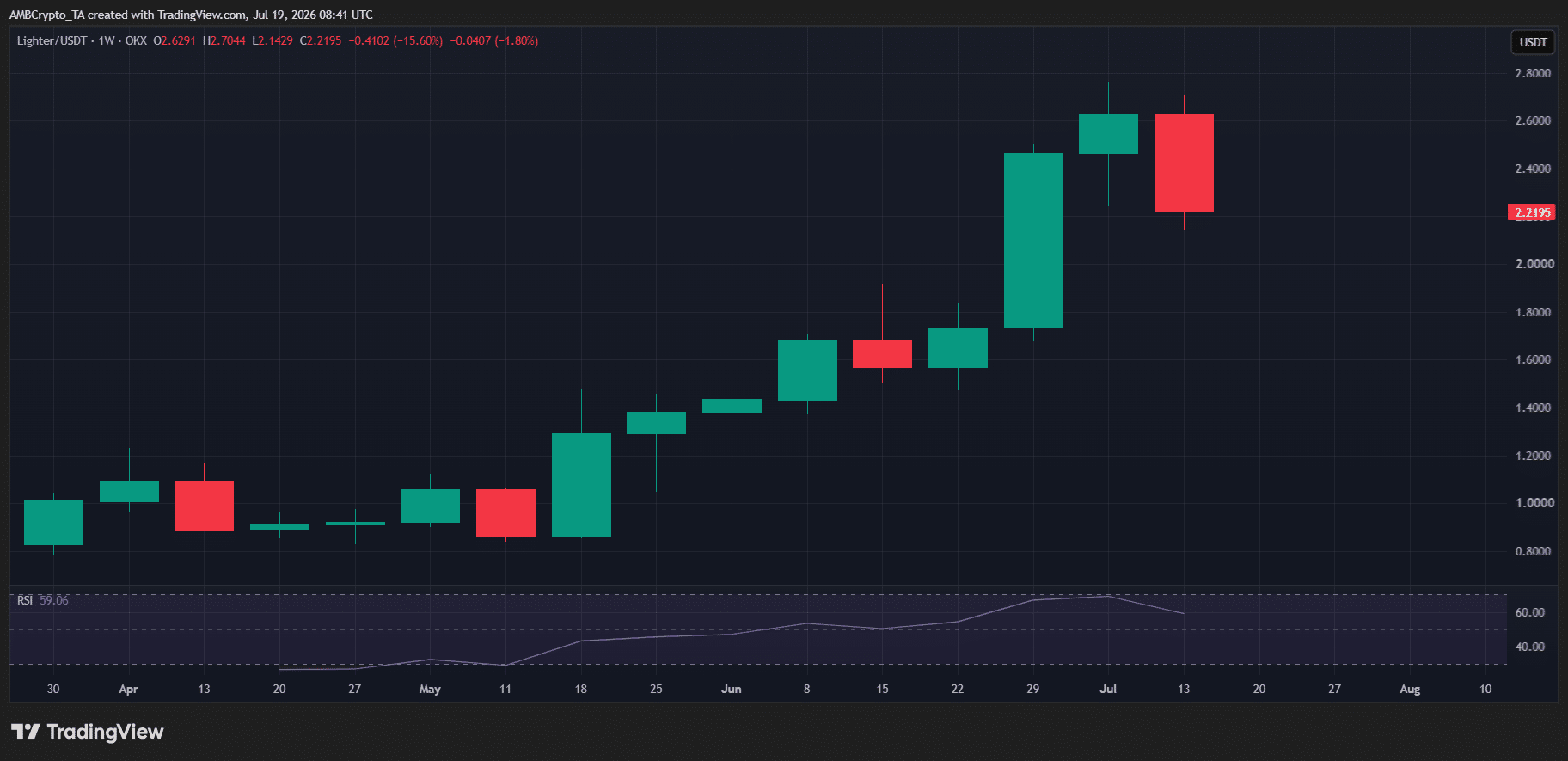
Source: TradingView (LIT/USDT)

Technically, however, this marks LIT’s strongest RSI pullback since its Q2 rally. In essence, this cooldown could become an important setup for LIT’s next move. If buyers step back in and the RSI starts recovering, this reset could fuel another upside attempt.

Otherwise, this could be the first real sign that LIT has formed a local top.

Pi Network [PI] broke below a key support zone

Pi Network [PI] emerged as the second-biggest loser this week with a 2.7% decline. While the drop looks modest compared to Lighter’s double-digit losses, PI’s chart looks much weaker, pointing to a stronger bearish bias.

Notably, this marks PI’s fourth straight week of losses. More importantly, the token broke below the key $0.10 support level, putting any near-term bounce under renewed selling pressure and printing a fresh all-time low.

Technically, PI remains firmly in a bearish structure. While the RSI has dropped into oversold territory, that alone doesn’t guarantee a recovery. Unless buyers reclaim the $0.10 level, any bounce could simply be a short-term relief rally rather than the start of a trend reversal, keeping PI as one of the weaker charts in the market right now.

Are Arbitrum [ARB] bulls losing their upper hand?

Arbitrum [ARB] took the third spot among this week’s biggest losers. Unlike PI, however, ARB’s chart hasn’t fully shifted into a bearish structure. The pullback comes after two straight weeks of gains, during which the token rallied more than 25%.

However, this week’s decline followed ARB’s failure to break above the key $0.10 resistance zone, a level that has capped price since the early May cycle. The rejection shows bulls are still struggling to reclaim this area, allowing sellers to regain short-term control.

Technically, ARB is at an important inflection point. If bulls can reclaim the $0.10 resistance zone, the recent pullback could turn into a healthy retest. Otherwise, continued rejection at this level may keep ARB stuck in a broader consolidation phase and hand bears the upper hand in the near term.

Other notable losers

In the broader market, downside volatility hit hard.

Cash Cat [CASHCAT] led the losers with a 72% decline, followed by LAB [LAB], which fell 66.5%, while ETHGas [GWEI] dropped 53.3% as bearish momentum intensified.

Conclusion

This week was a rollercoaster for crypto. Big pumps, sharp dips, and nonstop action. As always, stay sharp, do your own research, and trade smart.


Final Summary

  • Lido DAO [LDO], Pump.fun [PUMP], and Venice token [VVV] led the week in gains.
  • Lighter [LIT], Pi network[PI], and Arbitrum [ARB] saw significant declines.

Criptos en tendencia

Preguntas relacionadas

QWhich token led this week's biggest gainers, and what was its price performance?

ALido DAO [LDO] led this week's biggest gainers with a 16% rally. Over the last three weeks, it has gained 25%, and in the past 21 days, it has recovered over 40%.

QWhat is the key technical challenge for Lighter [LIT] following its pullback this week?

AFollowing its 16% pullback, the key technical challenge for Lighter [LIT] is whether the cooldown phase resets the market for another upside attempt or confirms a local top. The RSI has cooled from above 70 to around 52.

QWhy is the $0.002 level significant for Pump.fun [PUMP]?

AThe $0.002 level is a key resistance zone for Pump.fun [PUMP]. It has capped the token's price for over two months, and buyers need to consistently break through this level to confirm a breakout trend rather than remaining in consolidation.

QWhat factor makes Pi Network [PI]'s chart structure particularly weak despite its modest weekly loss?

APi Network [PI]'s chart structure is weak because it broke below the key $0.10 support level, printing a fresh all-time low. This marks its fourth consecutive week of losses, and the RSI being oversold does not guarantee a recovery without reclaiming that level.

QAccording to the article, what were the primary drivers of the crypto market's activity this week?

AThe primary drivers of the crypto market's activity this week were technical rallies, profit-taking, and continued rotation into select altcoins.

Lecturas Relacionadas

"Money Is Useless"? Why Musk's 2036 Prediction Could Completely Reshape Bitcoin's Fate

Elon Musk Predicts "Money Will Be Irrelevant" by 2036, Potentially Reshaping Bitcoin's Future In a recent interview with The Economist, billionaire Elon Musk, CEO of SpaceX and Tesla, made a startling prediction: money will become "irrelevant" within a decade as the world transitions to a state of "unbelievable abundance." He argues that if robots and AI can provide goods and services exceeding all human consumption, the purpose of money would vanish. This prediction coincides with a critical juncture for Bitcoin. While the cryptocurrency has been trading sideways and below its all-time highs, it is approaching what some see as a major turning point. Musk's views are closely watched due to his past statements equating "energy" with true currency—a concept that resonates with Bitcoin proponents, as Bitcoin's security model is deeply tied to energy-intensive mining. His companies, SpaceX and Tesla, collectively hold nearly $2 billion worth of Bitcoin. Although Musk's public enthusiasm for crypto has moderated since its peak, he maintains support for Bitcoin and his favored Dogecoin. He has criticized government-issued fiat currencies as "hopeless" and suggested a preference for Bitcoin. His latest prophecy, envisioning a post-scarcity future driven by AI and robotics, refocuses attention on Bitcoin's potential role as a value anchor in a world where traditional money may lose its meaning.

Foresight NewsHace 15 min(s)

"Money Is Useless"? Why Musk's 2036 Prediction Could Completely Reshape Bitcoin's Fate

Foresight NewsHace 15 min(s)

Storj Labs Files for Bankruptcy Protection: Can Token Holders Exchange for Company Equity?

Storj Labs, parent company of decentralized cloud storage platform Storj, filed for Chapter 11 bankruptcy protection on July 26 in the U.S. District Court for the Northern District of West Virginia. The company stated its network will operate normally and token functions will be unaffected. Notably, Storj plans to propose a mechanism in its reorganization plan allowing STORJ token holders a path to equity in the restructured company—an unprecedented offer in the crypto industry. However, its feasibility depends on whether any residual value remains after creditor repayments, as token holders are low in the legal priority hierarchy. Founded in 2014, Storj is an early decentralized infrastructure project. It reported a 7x increase in Annual Recurring Revenue (ARR) to approximately $30 million in 2024. In October 2025, it was acquired by Inveniam Capital Partners. Less than a year later, the merged entity entered bankruptcy proceedings. Storj attributed the filing to historical debts from past operations and acquisitions, stating they were too large to be absorbed by business growth. The company also plans to refocus on its core decentralized storage business, likely divesting Valdi, a GPU computing company acquired in 2024. The proposed token-to-equity conversion faces significant legal hurdles. Under U.S. bankruptcy law, creditors are paid before equity holders, and utility token holders are not automatically recognized as equity members. The details—such as eligibility, allocation ratio, and mechanics—are yet to be determined and require court approval. Another factor is token concentration, with Storj Labs itself holding roughly 30% of the total 425 million STORJ supply. In the broader decentralized storage landscape, Storj is a smaller player compared to giants like Filecoin and Arweave. Its key advantage is faster retrieval speeds for "hot" data. The bankruptcy process introduces risks, including potential client and node operator migration to competitors. STORJ price fell roughly 11.2% following the news. Key points for token holders to watch are the specific terms of the equity conversion plan, court approval progress, the treatment of the company's own token stash, and whether the refocused core business can sustain value post-reorganization.

Foresight NewsHace 18 min(s)

Storj Labs Files for Bankruptcy Protection: Can Token Holders Exchange for Company Equity?

Foresight NewsHace 18 min(s)

Perpetual Futures 'Landing in the US' Hits Roadblock: Why is CME Suing the CFTC in Court?

Perpetual crypto futures, which dominate global crypto derivatives trading, are entering the U.S. market. The CFTC approved KalshiEX to launch a true Bitcoin perpetual contract (BTCPERP) and issued rules allowing licensed exchanges to convert expiring crypto futures into perpetual ones. This move was challenged when CME Group sued the CFTC, arguing that perpetuals should be regulated as "swaps" under stricter rules, not as futures. The lawsuit's outcome will significantly impact the legal foundation of the nascent U.S. perpetuals market. Currently, two legal structures exist in the U.S.: true perpetuals (like Kalshi's) and long-dated futures (like Coinbase's) that mimic perpetuals via frequent funding rate settlements. These funding rates, paid between longs and shorts, keep contract prices anchored to spot. The proliferation of U.S. perpetuals creates fragmented liquidity across platforms (Kalshi, Coinbase, CME), with different rules on leverage, margining, and clearing. This fragmentation reduces capital efficiency, as collateral cannot be shared across products. Key competitive battlegrounds will be cross-product margin efficiency and the response of these new markets to extreme volatility. A pending Coinbase proposal to allow USDC stablecoin as futures margin could improve capital efficiency. Ultimately, the market's evolution hinges on two factors: how U.S. perpetuals behave during sharp Bitcoin price moves, and the court's ruling on whether they are futures or swaps.

Foresight NewsHace 19 min(s)

Perpetual Futures 'Landing in the US' Hits Roadblock: Why is CME Suing the CFTC in Court?

Foresight NewsHace 19 min(s)

Trading

Spot

Artículos destacados

Cómo comprar PUMP

¡Bienvenido a HTX.com! Hemos hecho que comprar Pump.fun (PUMP) sea simple y conveniente. Sigue nuestra guía paso a paso para iniciar tu viaje de criptos.Paso 1: crea tu cuenta HTXUtiliza tu correo electrónico o número de teléfono para registrarte y obtener una cuenta gratuita en HTX. Experimenta un proceso de registro sin complicaciones y desbloquea todas las funciones.Obtener mi cuentaPaso 2: ve a Comprar cripto y elige tu método de pagoTarjeta de crédito/débito: usa tu Visa o Mastercard para comprar Pump.fun (PUMP) al instante.Saldo: utiliza fondos del saldo de tu cuenta HTX para tradear sin problemas.Terceros: hemos agregado métodos de pago populares como Google Pay y Apple Pay para mejorar la comodidad.P2P: tradear directamente con otros usuarios en HTX.Over-the-Counter (OTC): ofrecemos servicios personalizados y tipos de cambio competitivos para los traders.Paso 3: guarda tu Pump.fun (PUMP)Después de comprar tu Pump.fun (PUMP), guárdalo en tu cuenta HTX. Alternativamente, puedes enviarlo a otro lugar mediante transferencia blockchain o utilizarlo para tradear otras criptomonedas.Paso 4: tradear Pump.fun (PUMP)Tradear fácilmente con Pump.fun (PUMP) en HTX's mercado spot. Simplemente accede a tu cuenta, selecciona tu par de trading, ejecuta tus trades y monitorea en tiempo real. Ofrecemos una experiencia fácil de usar tanto para principiantes como para traders experimentados.

268 Vistas totalesPublicado en 2024.12.12Actualizado en 2026.07.09

Cómo comprar PUMP

Discusiones

Bienvenido a la comunidad de HTX. Aquí puedes mantenerte informado sobre los últimos desarrollos de la plataforma y acceder a análisis profesionales del mercado. A continuación se presentan las opiniones de los usuarios sobre el precio de PUMP (PUMP).

活动图片