The live price of Overnight USDC+ (USDC+) is $0.00327 USD and its current market capitalization is $-- USD.
Get real-time USDC+/USD updates on HTX. Stay informed with the latest data and market trends to make smart trading decisions. HTX, your trusted source for accurate cryptocurrency price information.
Overnight USDC+ Key Stats
24h Volume (USD)
$--
Price Change Today
-5.66%
Circulating Supply (USDC+)
--
Sign up and trade to win rewards worth up to 1,500 USDT.Join Now
USDC+ Price Performance
Track Overnight USDC+ price movements with chart views spanning 1 day, 30 days, 60 days, 90 days, 1 year, and the period since it was listed on HTX.View more data for the Overnight USDC+ prices
Time
Change
Change%
Highest Price
Lowest Price
No data
USDC+ Market Information
Get the latest Overnight USDC+ price details on HTX: 24-hour high and low, all-time high (ATH), and daily price change percentage.
24h Low
$0
24h High
$0
All-Time High
$0
Market Cap
$0.00
24h Volume (USD)
$--
Circulating Supply
--
What is USDC+?
Overnight USDC+ positions itself as a yield-driven stablecoin operating within the DeFi framework. Its primary objective is to provide a unique solution that encompasses the benefits of stability while offering opportunities for yield generation. Unlike typical stablecoins, Overnight USDC+ is fully backed by collateral, ensuring that every unit of USD+ maintains a peg of 1:1 with USDC.
Key Features of Overnight USDC+
Full Backing and Pegging: Each USD+ token is fully collateralized, significantly reducing the risk for users. The project guarantees that users can mint and redeem USD+ for USDC at a 1:1 ratio anytime.
Yield Generation: The innovative design of Overnight USDC+ allows users to earn interest through various DeFi strategies, often involving lending on reputable platforms. This yield is actionable daily via a mechanism referred to as rebase, opening opportunities for passive income generation without jeopardizing the coin’s stability.
Future Insurance Mechanisms: The team behind Overnight USDC+ envisions introducing insurance provisions that will further enhance the security and reliability of the stablecoin, a crucial factor for users in the financial ecosystem.
Based on the historical performance of Overnight USDC+, our prediction tool estimates that the price of Overnight USDC+ (USDC+) could reach -- by --.
Predicted USDC+ Price in --
Our most recent forecast indicates the price of Overnight USDC+ (USDC+) will increase to -- by --, with a price change of --% and a cumulative ROI of approximately --%.
Buy your first USDC+ on HTXSign Up
USDC+ FAQs
QWhat is the Overnight USDC+ (USDC+) price today?
AThe current price of Overnight USDC+ (USDC+) is $0.00327 USD.
QWhat is the Overnight USDC+ (USDC+) market cap?
AThe current market capitalization of Overnight USDC+ (USDC+) is $0.00 USD, calculated by multiplying its circulating supply by its current price.
QWhat is the Overnight USDC+ (USDC+) circulating supply?
AThe current circulating supply of Overnight USDC+ (USDC+) is -- USDC+.
QWhat is the Overnight USDC+ (USDC+) all-time high?
AAs of 2026-07-23, the all-time high of Overnight USDC+ (USDC+) is $0 USD.
Circle's Q1 2026 financial report shows total revenue and reserve income of $6.94 billion, slightly below expectations, with net profit at $550 million, down 15% year-over-year. The company attributes the slowdown in revenue growth to declining reserve asset yields following a Federal Reserve rate cut. However, other revenue streams reached a record $420 million, indicating a diversification away from interest dependence.
Key operational highlights include USDC's circulating supply reaching 77 billion, a 28% annual increase, while its on-chain transaction volume surged 263% to $21.5 trillion, showing significantly higher usage frequency. Circle's core RLDC Margin improved to 41%, reflecting better cost control.
Looking beyond interest rate reliance, Circle is expanding into new areas. Its Arc Network completed a $2.22 billion ARC token presale at a $30 billion valuation. The company also launched Agent Stack, an infrastructure suite for AI Agent economies, and its Circle Payments Network (CPN) shows an estimated annual transaction volume of $83 billion.
The report suggests Circle's strategy is evolving from merely issuing a stablecoin to building USDC into a foundational dollar network for the internet, targeting cross-border payments, enterprise settlement, and the emerging AI-driven economy.
Better Mortgage, in partnership with Coinbase, is launching a U.S. home loan product that accepts Bitcoin and USDC as collateral, with a nationwide rollout planned for summer 2026. The first loan has already been issued to a couple in Michigan. A key distinction from earlier crypto-backed loans is the involvement of Fannie Mae, which provides a conforming guarantee, effectively treating digital assets as valid collateral. The product also differs by not subjecting the crypto collateral to liquidation if its value declines; the assets remain in custody for the loan's entire term. Better projects an initial loan volume of $250 million based on early sign-ups and plans to expand to other digital assets like tokenized stocks.
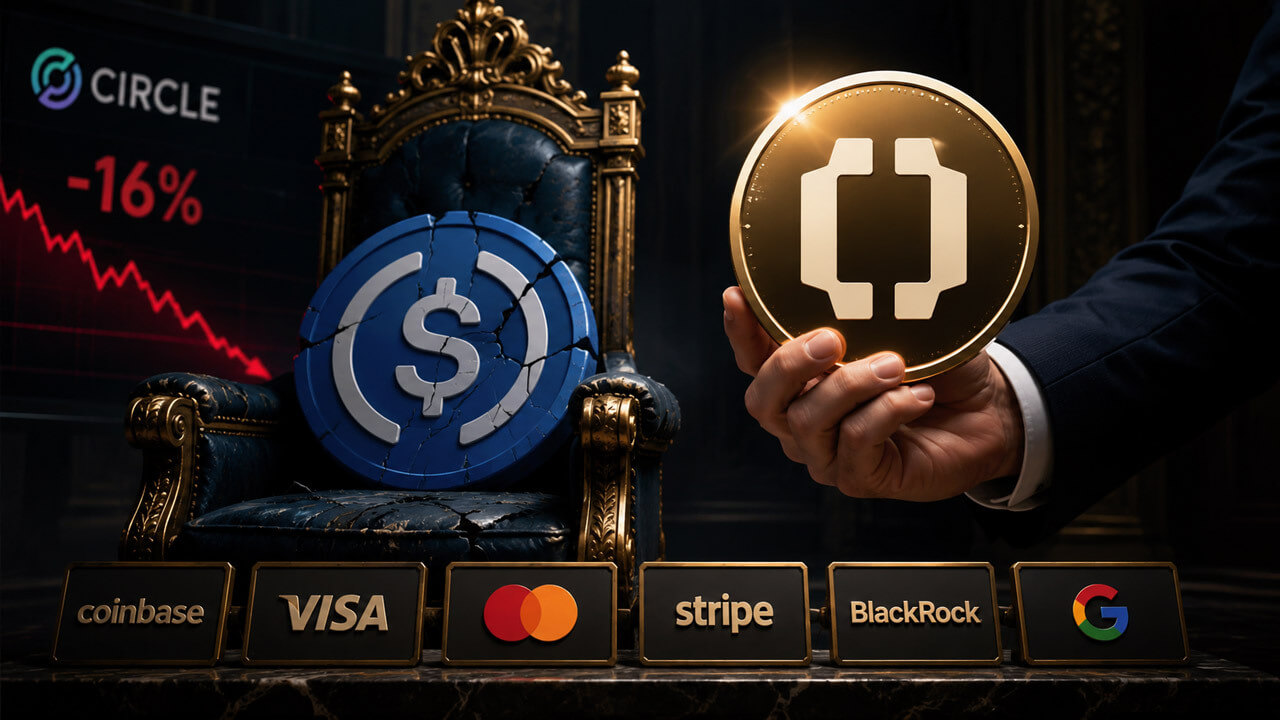
Coinbase, a key distributor of the dominant stablecoin USDC, has joined over 140 major companies—including Visa, Mastercard, and BlackRock—as a founding member of the Open USD (OUSD) alliance, a move that directly challenges the current stablecoin economic model. The new project aims to upend the established profit structure by offering zero minting and redemption fees and allocating the majority of reserve interest earnings to distribution partners, rather than the issuer. This shift highlights a growing power struggle in the $320+ billion stablecoin market, where platforms with massive user bases are demanding a larger share of the revenue generated from the underlying reserves.
Circle, the issuer of USDC, saw its stock plummet 16% on the day of the OUSD announcement, reflecting investor concern over the potential strain on its crucial partnership with Coinbase. While Coinbase earned over $900 million from its USDC partnership in 2024, its support for a competing model gives it significant leverage as its revenue-sharing agreement with Circle nears expiration in August 2026.
Circle CEO Jeremy Allaire defended the USDC model, emphasizing its decade-long development, deep liquidity, and extensive ecosystem integration, which he argues cannot be easily replicated by a large, potentially slow-moving consortium. He also questioned the sustainability of a zero-fee model and warned that diverting all reserve interest would leave issuers without funds for critical compliance and operational infrastructure.
Analysts remain skeptical of OUSD's prospects, citing the "cold start" problem of building liquidity, potential governance challenges within a large alliance, and heightened regulatory scrutiny. The emergence of OUSD signals a broader industry bifurcation, where stablecoins are increasingly viewed as backend settlement tools. The core competition is shifting from technology to a direct negotiation over how profits from the network are distributed between issuers and the powerful distribution channels.
Goldman Sachs published a summary of its meeting with Circle Internet Group (issuer of USDC) on July 5th. The core takeaway is that stablecoins, led by USDC, are evolving from a crypto-native tool into foundational infrastructure for traditional finance and the AI economy. USDC's use cases are rapidly expanding beyond crypto trading into cross-border payments, e-commerce, capital market settlements, and notably, payments for AI agents.
Circle's management emphasized that stablecoin growth is now decoupled from crypto market cycles, driven by this diversification. They outlined five key application layers and highlighted USDC's network effects, global liquidity depth, and regulatory compliance as competitive moats. Circle distinguishes USDC from bank-issued tokenized deposits, arguing the former is an open, internet-native system without bank credit risk.
Strategically, Circle is building a broader fintech platform with its Arc Layer 1 blockchain, the Circle Payments Network for cross-border transfers, and an "Agentic Stack" to serve AI agent economies, where USDC already dominates.
Regarding regulation, Circle views potential U.S. legislation like the CLARITY Act as a catalyst for growth rather than a constraint, expecting it to encourage broader institutional adoption and active usage.
Goldman Sachs maintains a Neutral rating on Circle with a $96 price target, noting the company's shift from a pure stablecoin issuer to a financial infrastructure provider. Key risks include competition from USDT and potential earnings pressure from declining interest rates on its reserve assets.
Recent weeks have seen significant developments for four key US-listed crypto-related stocks—Circle (CRCL), Robinhood (HOOD), Coinbase (COIN), and MicroStrategy (MSTR)—with their core investment theses diverging.
For **Circle (CRCL)**, its stock price is increasingly realigning with the fundamental driver of **USDC circulation**. After IPO exuberance faded, CRCL's performance now correlates closely with changes in USDC supply, which is heavily influenced by DeFi activity and risk appetite. The recent contraction in USDC, linked to events like the KelpDAO incident, has pressured the stock. A sustainable recovery signal for CRCL would require a confluence of recovering DeFi TVL, stablecoin demand, and consecutive weeks of USDC net issuance.
**Robinhood (HOOD)** gained market attention with the launch of its **Robinhood Chain**, an Ethereum L2. While not an immediate threat to Coinbase's dominant Base network in terms of scale or developer ecosystem, it represents a strategic encroachment. Robinhood's path—leveraging its traditional retail brokerage user base and assets to build a chain-based financial system—challenges Coinbase's narrative as the sole listed company integrating crypto-native infrastructure with traditional finance. This could dilute COIN's long-term scarcity premium.
**MicroStrategy (MSTR)** made a notable shift by **selling Bitcoin** for the first time in a meaningful way (3,588 BTC), breaking its long-standing "buy-only" posture. The sales, used to fund dividends and replenish USD reserves, signal a move towards active capital management. While not indicative of a bearish turn on Bitcoin, it introduces new complexity for MSTR investors. The stock must now be evaluated not just as a leveraged Bitcoin proxy, but also considering fixed cash obligations from preferred dividends and debt, alongside its capital allocation strategy between holding BTC and maintaining liquidity.
In summary, the investment narratives for these stocks are evolving beyond simple crypto market beta. Key variables now include stablecoin fundamentals, competition in chain-based financial ecosystems, and the balance between asset accumulation and corporate capital structure management.
marsbit13天前
Related Questions
Welcome to the Crypto FAQ. Users' questions and answers on Overnight USDC+ (USDC+) are presented below.