The reference exchange rate is for reference only and is not locked in. The final rate will be determined by the actual execution price.
Real-Time G Stats
The live price of Gravity (G) is $0.0042 USD and its current market capitalization is $-- USD.
Get real-time G/USD updates on HTX. Stay informed with the latest data and market trends to make smart trading decisions. HTX, your trusted source for accurate cryptocurrency price information.
Gravity Key Stats
24h Volume (USD)
$--
Price Change Today
--
Circulating Supply (G)
--
Sign up and trade to win rewards worth up to 1,500 USDT.Join Now
G Price Performance
Track Gravity price movements with chart views spanning 1 day, 30 days, 60 days, 90 days, 1 year, and the period since it was listed on HTX.View more data for the Gravity prices
Time
Change
Change%
Highest Price
Lowest Price
No data
G Market Information
Get the latest Gravity price details on HTX: 24-hour high and low, all-time high (ATH), and daily price change percentage.
24h Low
$0
24h High
$0
All-Time High
$0
Market Cap
$0.00
24h Volume (USD)
$--
Circulating Supply
--
What is G?
Gravity is a Layer 1 blockchain designed for mass adoption and an omnichain future. Its approach abstracts the technical complexities of multichain interactions, integrating advanced technologies like Zero-Knowledge Proofs, state-of-the-art consensus mechanisms, and restaking-powered architecture to ensure high performance, enhanced security, and cost efficiency.
It's super easy to buy G on HTX. Simply click here to view a complete guide to buying Gravity with ease.
Real-Time G Markets
View real-time Gravity prices on HTX's spot markets. Switch between spot and futures markets to instantly compare live prices and 24-hour price changes.
Based on the historical performance of Gravity, our prediction tool estimates that the price of Gravity (G) could reach -- by --.
Predicted G Price in --
Our most recent forecast indicates the price of Gravity (G) will increase to -- by --, with a price change of --% and a cumulative ROI of approximately --%.
Buy your first G on HTXSign Up
G FAQs
What is the Gravity (G) price today?
The current price of Gravity (G) is $0.0042 USD.
What is the Gravity (G) market cap?
The current market capitalization of Gravity (G) is $0.00 USD, calculated by multiplying its circulating supply by its current price.
What is the Gravity (G) circulating supply?
The current circulating supply of Gravity (G) is -- G.
What is the Gravity (G) all-time high?
As of 2026-08-21, the all-time high of Gravity (G) is $0 USD.
What is the Gravity (G) 24h trading volume?
The 24-hour trading volume of Gravity (G) is -- USD on HTX.
Can I buy Gravity (G) on HTX?
Yes, HTX offers industry-leading trading fees and deep liquidity, ensuring a smooth and secure Gravity (G) purchase experience.
The price of Solana (SOL) has dropped below $65, reaching its lowest level since late 2023 as the broader crypto market faces bearish pressure. Analysis of on-chain data, specifically the UTXO Realized Price Distribution, reveals that a key support level around $77 has been lost. Crypto analyst Ali Martinez identifies the next major support zone at approximately $53, with further potential floors near $35 and $24 if selling pressure intensifies. As of the report, SOL is trading around $63.23, reflecting a significant 24-hour decline. The outlook suggests continued downward momentum unless renewed demand emerges in the spot market to initiate a recovery.
A paper on prompt engineering, titled "Verbalized Sampling (VS)," has been accepted by the prestigious machine learning conference ICML 2026, sparking significant debate online.
The paper addresses the problem of "mode collapse" in large language models (LLMs), where models tend to produce repetitive, safe, and homogeneous outputs. Instead of proposing new training algorithms or model architectures, the authors introduce a simple yet effective prompt-based method. The core technique, Verbalized Sampling, instructs the model to generate multiple responses (e.g., five jokes) while also outputting a possible probability value for each. This prompt adjustment alone was shown to significantly increase output diversity by 1.6x to 2.1x in creative writing tasks, without compromising factual accuracy or safety.
The authors argue that the root cause of mode collapse lies not in optimization algorithms but in the "typicality bias" present in human preference data used for alignment. Human annotators naturally favor familiar and fluent text, which steers models toward conservative outputs. The VS method aims to counteract this by leveraging the model's inherent pre-training distribution during inference.
The paper's acceptance has led to polarized reactions. Critics argue that prompt engineering lacks the theoretical depth and algorithmic innovation expected from top-tier conferences like ICML, questioning its novelty, generalizability across models, and experimental scale. Some draw parallels to reproducibility crises in other fields, citing a potential over-reliance on empirical results.
Supporters, including an author who responded online, defend the work's rigor. They emphasize its comprehensive problem analysis, theoretical grounding, mathematical derivation, and extensive quantitative experiments. Proponents compare VS to seminal techniques like Chain-of-Thought (CoT) prompting, suggesting that inference-stage methods are becoming a core part of ML research capable of expanding model capabilities without retraining.
The research was conducted by a team from Northeastern University, Stanford University, and West Virginia University, with Jiayi Zhang, Simon Yu, and Derek Chong as co-first authors.
In a new benchmark for evaluating large language models, Andrej Karpathy proposes replacing the once-popular "pelican riding a bicycle" SVG test with a more complex challenge: generating a 3D scene from the opening text of *The Lord of the Rings*. Using Anthropic's Opus 5 model and the Three.js library, the task consumed approximately 1 million tokens, 2 hours, and 5,500 lines of code to produce a rudimentary, low-polygon animation of the Shire. While the output is visually crude with notable glitches like floating characters, it demonstrates the model's ability to parse narrative text and translate it into a functional, programmatic 3D world with defined objects, cameras, lighting, and basic animation.
This "Lord of the Rings benchmark" is argued to test a model's capacity for long-horizon project planning, spatial reasoning, and maintaining consistency across thousands of code lines—capabilities not fully captured by simpler single-output tests. The initiative has sparked community experimentation, with users generating other 3D worlds like a low-poly San Francisco, a data-driven New York City model, and even a virtual Kanye West concert. Karpathy suggests a future pipeline where code-generated scenes provide the structural "bones" for video-to-video models to enhance visual fidelity.
While some debate the computational cost and specificity to Three.js, proponents see it as a test of a model's general ability to structure its understanding of the world into an executable form. The shift signals a move towards evaluating how well models can not only generate code or images but also comprehend and construct interactive, multi-element digital environments.
A $6.4 billion plan to create a publicly-listed CRO treasury company, announced a year ago by Trump Media & Technology Group (DJT), Crypto.com, and SPAC Yorkville, has been terminated. The ambitious deal, which aimed to accumulate approximately 6.3 billion CRO tokens (nearly 20% of supply at the time), never progressed beyond a framework agreement. Related plans for a prediction market integrated into Truth Social and ETF custody services by Crypto.com were also shelved, scaled back to a simple marketing partnership.
The collaboration followed significant political alignment, with Crypto.com donating to Trump's inauguration and a pro-Trump super PAC, and its CEO meeting with Trump. The SEC also closed an investigation into the exchange shortly before the deal was announced, raising conflict-of-interest concerns.
Officially, the termination was attributed to an unfavorable market environment. CRO's price has fallen roughly 70% since the announcement, and the broader market for publicly-traded digital asset treasuries has cooled significantly, with Bitcoin nearly halving from its late-2025 peak.
The only completed transaction from the 2025 agreements remains intact: Trump Media's ~$105 million CRO purchase and Crypto.com's $50 million purchase of DJT stock. The termination aligns with DJT's strategic pivot away from crypto; the company is now pursuing a multi-billion dollar all-stock merger with nuclear fusion firm TAE Technologies, shifting its focus to clean energy.
From Speculation to Risk Management: Predictive Markets Filling the Commercial Insurance Gap
The emergence of AI risk management tools like Blanket is exploring the potential of predictive markets as a genuine insurance tool for businesses. These markets, with their simple contract structure—paying $1 if an event occurs, $0 if not—allow the real-time market price to reflect collective probability assessments. Businesses can use them to hedge against operational risks (e.g., abnormal weather, energy price fluctuations) that are often not covered by traditional business interruption insurance, which typically requires physical damage.
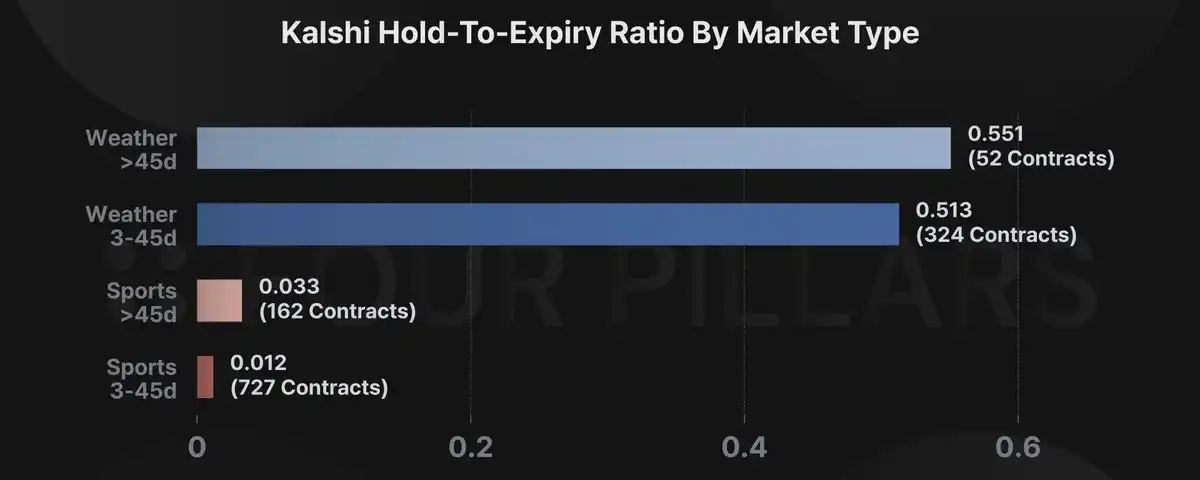
A key question is whether these markets are genuinely used for hedging or remain primarily speculative. Analysis of Kalshi markets from August 2025 to August 2026 compared weather contracts (a potential hedge instrument) against sports contracts (largely speculative) and traditional CME grain futures. Three behavioral metrics were examined:
1. **Daily Turnover Rate:** Weather contracts showed the lowest rate (0.210), lower than corn futures (0.266) and significantly lower than sports contracts (0.315), suggesting longer holding periods.
2. **Hold-to-Expiry Ratio:** Weather contracts had a much higher ratio (over 0.5) compared to near-zero ratios for sports contracts, indicating a stronger tendency to hold positions until settlement, consistent with hedging behavior.
3. **Position Buildup Timing:** Weather market positions reached 50% of their peak much earlier in their lifecycle than sports market positions, aligning with the early risk-locking behavior seen in traditional futures hedging markets.
The data indicates that the Kalshi weather market exhibits transaction patterns distinct from pure speculation and more aligned with hedging markets, suggesting real hedging demand exists alongside speculative activity. Crucially, speculation provides the essential liquidity and pricing mechanism that enables the hedging function. The future growth of predictive markets as viable risk management infrastructure depends not on eliminating speculation, but on building real enterprise hedging demand atop this existing liquidity base.
marsbit4天前
Threads
Welcome to the HTX Community. Here, you can stay informed about the latest platform developments and gain access to professional market insights. Users' opinions on the price of Gravity (G) are presented below.
Related Questions
Welcome to the Crypto FAQ. Users' questions and answers on Gravity (G) are presented below.