The reference exchange rate is for reference only and is not locked in. The final rate will be determined by the actual execution price.
Real-Time FLOW Stats
The live price of Flow (FLOW) is $0.02 USD and its current market capitalization is $-- USD.
Get real-time FLOW/USD updates on HTX. Stay informed with the latest data and market trends to make smart trading decisions. HTX, your trusted source for accurate cryptocurrency price information.
Flow Key Stats
24h Volume (USD)
$--
Price Change Today
--
Circulating Supply (FLOW)
1.68B
Sign up and trade to win rewards worth up to 1,500 USDT.Join Now
FLOW Price Performance
Track Flow price movements with chart views spanning 1 day, 30 days, 60 days, 90 days, 1 year, and the period since it was listed on HTX.View more data for the Flow prices
Time
Change
Change%
Highest Price
Lowest Price
No data
FLOW Market Information
Get the latest Flow price details on HTX: 24-hour high and low, all-time high (ATH), and daily price change percentage.
24h Low
$0
24h High
$0
All-Time High
$0
Market Cap
$0.00
24h Volume (USD)
$--
Circulating Supply
--
What is FLOW?
Flow is a fast, decentralized, and developer-friendly blockchain, designed as the foundation for a new generation of games, apps, and the digital assets that power them. Flow is the only layer-one blockchain originally created by a team that has consistently delivered great consumer blockchain experiences: CryptoKitties, Dapper Wallet, NBA Top Shot. Flow is a blockchain designed from the ground up for mainstream adoption and is the only blockchain that builds usability improvements into the protocol layer. Top developers and some of the world's largest brands are already building on Flow, enabling completely new experiences with top-tier content. Flow has a rich ecosystem comprised of top entertainment brands, development studios, and venture-backed startups. Flow ecosystem partners include global IP brands like Warner Music, Ubisoft, NBA and UFC; leading game developers, including Animoca Brands, Sumo Digital and nWay; leaders in crypto, such as Circle and Binance; as well as several noteworthy projects among the next generation of high-growth startups, including Opensea.
Based on the historical performance of Flow, our prediction tool estimates that the price of Flow (FLOW) could reach -- by --.
Predicted FLOW Price in --
Our most recent forecast indicates the price of Flow (FLOW) will increase to -- by --, with a price change of --% and a cumulative ROI of approximately --%.
Buy your first FLOW on HTXSign Up
FLOW FAQs
What is the Flow (FLOW) price today?
The current price of Flow (FLOW) is $0.02 USD.
What is the Flow (FLOW) market cap?
The current market capitalization of Flow (FLOW) is $0.00 USD, calculated by multiplying its circulating supply by its current price.
What is the Flow (FLOW) circulating supply?
The current circulating supply of Flow (FLOW) is -- FLOW.
What is the Flow (FLOW) all-time high?
As of 2026-08-14, the all-time high of Flow (FLOW) is $0 USD.
What is the Flow (FLOW) 24h trading volume?
The 24-hour trading volume of Flow (FLOW) is -- USD on HTX.
Can I buy Flow (FLOW) on HTX?
Yes, HTX offers industry-leading trading fees and deep liquidity, ensuring a smooth and secure Flow (FLOW) purchase experience.
Q2 2026 Crypto Market Recap: Bitcoin's Gains Erased Amid Shift to AI and On-Chain Activity
The second quarter of 2026 saw a significant reversal for the cryptocurrency market. Bitcoin gave back all its April gains, ending Q2 down approximately 11%, while major stock indices posted strong gains. This divergence was driven by a hawkish shift in Fed rate expectations, capital rotation into AI stocks, and weakening liquidity channels into crypto.
Key demand pillars deteriorated simultaneously. Spot Bitcoin ETFs recorded net outflows of $4.08 billion for the quarter, with outflows dominating June. Crypto treasury entity Strategy's bitcoin accumulation slowed markedly, and the total stablecoin market cap contracted by ~$4.2 billion. This created a tighter liquidity environment.
Exchange data reflected the downturn. Spot trading volumes fell 28% quarter-over-quarter. The market underwent significant deleveraging, with $8.35 billion in long liquidations for BTC and ETH, primarily in late May/early June. Open interest and order book liquidity also declined.
Despite the bearish price action, structural developments point to an expanding on-chain ecosystem. These include the rise of tokenized stocks with full legal rights, the growth of RWA (real-world asset) perpetual contracts for trading stocks and commodities 24/7, and the use of crypto markets for price discovery ahead of major events like the SpaceX IPO. On-chain vaults are also emerging as a core layer for institutional capital allocation.
After six years and raising approximately 3.2 billion yuan through two private placements, Luxshare Technology has officially terminated its two major SiC wafer projects. Only about 7.75% of the raised funds were actually invested in SiC construction and R&D, with the remaining 90% redirected to replenish working capital and repay loans. Despite previous ambitious plans for a 10-billion-yuan SiC industrial park and public assurances of progress, the company's actual SiC capacity remains unclear, with its subsidiary recording significant losses.
The article details a pattern of chasing market trends, from electric vehicles and photovoltaics to the current focus on SiC. However, its SiC entry was late; while peers like Tianke Heda and Tianyue Advanced have moved from mass-producing 6-inch to 8-inch and even 12-inch wafers, Luxshare is still struggling with its 6-inch plans and now promises to develop larger sizes with its own funds. Key concerns include unclear disclosures about the status of its chief scientist, Chen Zhizhan, and significantly lower R&D investment compared to competitors.
Financially, since its 2011 IPO, the company has raised over 7 billion yuan but generated only 221 million yuan in cumulative net profit. Meanwhile, the controlling shareholder family has cashed out nearly 2 billion yuan since 2018. The article positions Luxshare as a case study of a listed company focused more on financing and capital operation around hot topics than on substantive industrial development.
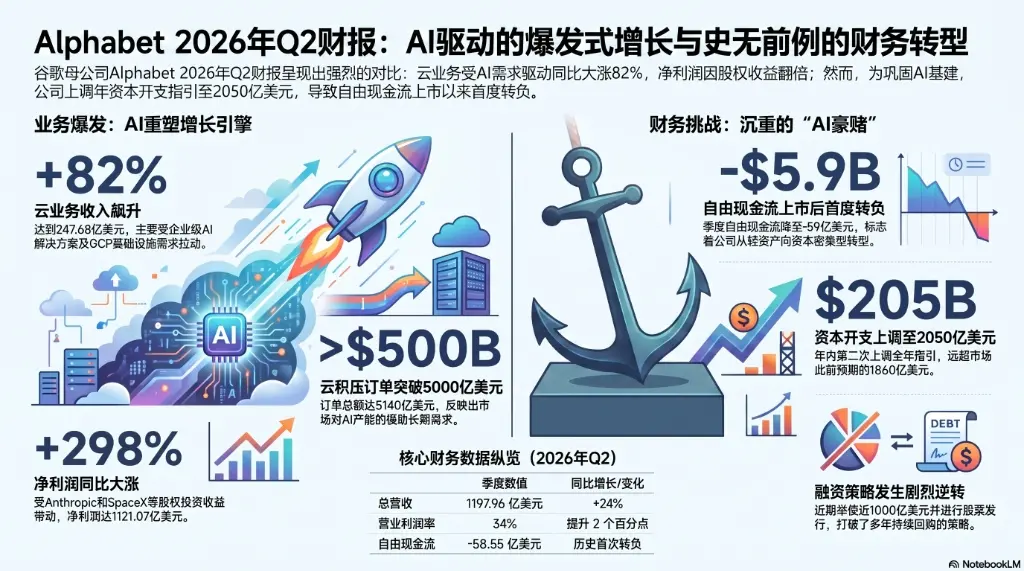
Alphabet (Google's parent) reported its Q2 2026 results. Revenue grew 24% to $119.8B, with Google Cloud revenue surging 82% to $24.8B, significantly exceeding expectations. Cloud backlog also surpassed $500B for the first time. However, the company's capital expenditures soared to $44.9B, leading to negative free cash flow (-$5.86B) for the first time in its history as a public company. Alphabet raised its full-year capex guidance to a range of $195B-$205B, its second upward revision this year. This massive spending on AI infrastructure fueled investor concerns about returns, causing the stock to fall. Despite the cash flow pressure, the results highlight a dual narrative: strong commercial returns from AI in the cloud, but significant financial strain from the ongoing investment race. CEO Sundar Pichai emphasized focus on the next-generation Gemini 4 model and stated that AI is reshaping the entire company.
Chip Design: The "Cash Flow Reconstruction" and "Capability Leap Window" of Institutional Rents
The first half of 2026 saw extreme divergence in China's chip design sector. While companies like Jiangbolong and GigaDevice reported massive profit surges, others like StarPower saw sharp declines. This disparity stems not from market cycles, but from a fundamental "institutional rent" transfer—profits were systematically shifted from downstream manufacturers (the payers) to upstream design firms (the recipients) due to supply constraints and policy-driven "domestic substitution" mandates.
For decades, China's chip design industry was trapped in a vicious cycle: no revenue without customers, no R&D without revenue, and no competitive products without sustained R&D, leading to perpetual cash flow crises. Crucially, this institutional rent, though distorting short-term competition, has inadvertently broken this deadlock. It has created a "cash flow reconstruction," funneling steady, policy-backed income to design houses for the first time.
This generates a critical "capability leap window"—a structural, long-term opportunity (potentially lasting over five years due to prolonged chip shortages and tightening export controls) for companies to invest rents into long-cycle R&D (e.g., automotive-grade, AI chips) rather than short-term speculation. Policy is also evolving from simple procurement subsidies to "ecosystem binding," forcing adoption and integration of domestic chips.
Conversely, rent-paying downstream firms face a painful but necessary "market clearing," forced into genuine competition and efficiency drives, which may spur deeper industry collaboration. Importantly, companies like Montage Technology and Fudan Microelectronics show growth based on real technological breakthroughs and market demand, not just policy rents, signaling the potential for independent capability growth.
The conclusion is that institutional rent is not an end but a means. The core investment thesis shifts from betting on rent persistence to identifying companies that successfully transform this reconstructed cash flow into proprietary technology and autonomous market viability. While a shakeout is imminent as certain mechanisms reverse, a new generation of technologically independent firms is quietly emerging under the cover of this rent-fueled window.
The mid-week session saw another shift in cryptocurrency ETF flow dynamics. Bitcoin once again lost ground due to resurgent share redemptions in two of the market's largest funds, while Ethereum quietly attracted fresh capital. Smaller altcoin categories remained unchanged.
Bitcoin ETFs recorded a net outflow of $61.16 million, entirely attributable to Fidelity and BlackRock. Fidelity's FBTC saw a larger outflow of $46.82 million, and BlackRock's IBIT added $14.34 million to the outflow. No other Bitcoin ETF reported a net inflow. This offset a modest inflow from the previous day, exacerbating the volatile demand pattern seen throughout the week.
In contrast, Ethereum ETFs finished the session with a net inflow of $7.38 million. Fresh capital primarily went into BlackRock's ETHA fund, providing a net gain after two days of weak or negative flows earlier in the week. The modest inflow occurred during a session where Bitcoin funds faced renewed pressure from the two major issuers.
Activity in other segments was muted. ETFs for Solana, XRP, and HYPE recorded zero net flows for the day. The data indicated institutional demand for cryptocurrencies remained selective and restrained, with Bitcoin experiencing the most volatility, Ethereum attracting some incremental capital, and the altcoin ETF market largely on the sidelines.
cryptonews.ru1天前
Threads
Welcome to the HTX Community. Here, you can stay informed about the latest platform developments and gain access to professional market insights. Users' opinions on the price of Flow (FLOW) are presented below.
Related Questions
Welcome to the Crypto FAQ. Users' questions and answers on Flow (FLOW) are presented below.