The reference exchange rate is for reference only and is not locked in. The final rate will be determined by the actual execution price.
Real-Time AMD Stats
The live price of Advanced Micro Devices Inc (Derivatives) (AMD) is $0.00000000000547 USD and its current market capitalization is $-- USD.
Get real-time AMD/USD updates on HTX. Stay informed with the latest data and market trends to make smart trading decisions. HTX, your trusted source for accurate cryptocurrency price information.
Get the latest Advanced Micro Devices Inc (Derivatives) price details on HTX: 24-hour high and low, all-time high (ATH), and daily price change percentage.
24h Low
$0
24h High
$0
All-Time High
$0
Market Cap
$0.00
24h Volume (USD)
$--
Circulating Supply
--
What is AMD?
Advanced Micro Devices Inc (Derivatives) (AMD) is a cryptocurrency . Advanced Micro Devices Inc (Derivatives) has a current supply of 0. The last known price of Advanced Micro Devices Inc (Derivatives) is 465.96983447 USD and is up 0.10 over the last 24 hours. It is currently trading on 76 active market(s) with $0.00 traded over the last 24 hours.
Based on the historical performance of Advanced Micro Devices Inc (Derivatives), our prediction tool estimates that the price of Advanced Micro Devices Inc (Derivatives) (AMD) could reach -- by --.
Predicted AMD Price in --
Our most recent forecast indicates the price of Advanced Micro Devices Inc (Derivatives) (AMD) will increase to -- by --, with a price change of --% and a cumulative ROI of approximately --%.
Buy your first AMD on HTXSign Up
AMD FAQs
What is the Advanced Micro Devices Inc (Derivatives) (AMD) price today?
The current price of Advanced Micro Devices Inc (Derivatives) (AMD) is $0.00000000000547 USD.
What is the Advanced Micro Devices Inc (Derivatives) (AMD) market cap?
The current market capitalization of Advanced Micro Devices Inc (Derivatives) (AMD) is $0.00 USD, calculated by multiplying its circulating supply by its current price.
What is the Advanced Micro Devices Inc (Derivatives) (AMD) circulating supply?
The current circulating supply of Advanced Micro Devices Inc (Derivatives) (AMD) is -- AMD.
What is the Advanced Micro Devices Inc (Derivatives) (AMD) all-time high?
As of 2026-08-25, the all-time high of Advanced Micro Devices Inc (Derivatives) (AMD) is $0 USD.
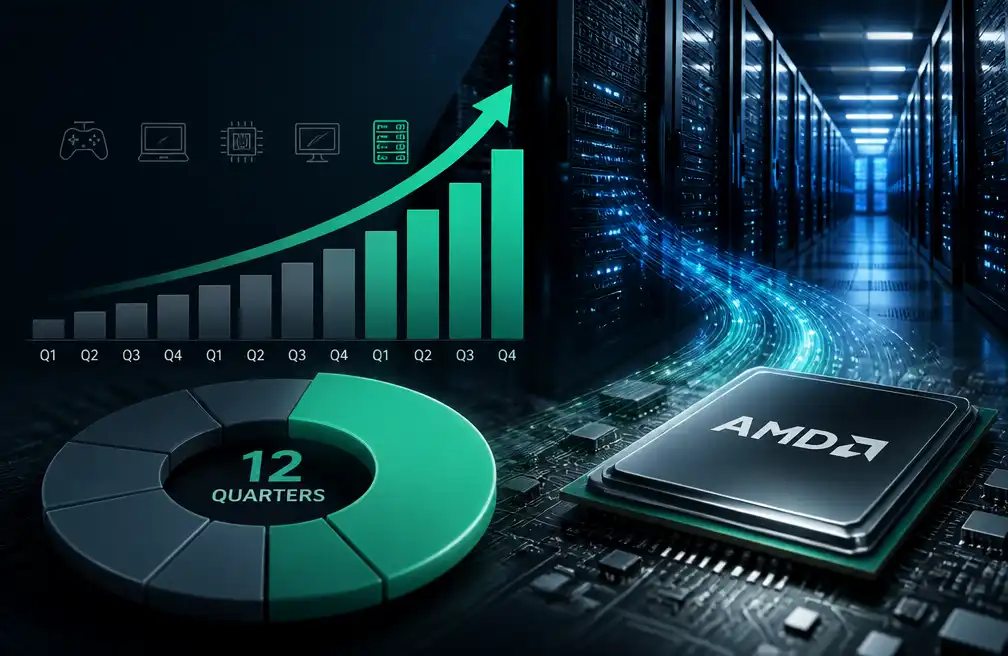
AMD's second-quarter earnings highlight a significant shift in its revenue composition over the past twelve quarters. While total company revenue grew substantially, the data center segment emerged as the dominant driver, now accounting for over half (58.2%) of AMD's total revenue. This segment reached $6.718 billion in Q2, a 107% year-over-year increase, and became AMD's largest revenue division in Q4 2025. Conversely, the gaming segment revenue declined to $779 million, down 31%, primarily due to lower semi-custom sales. The analysis shows the company's overall revenue base expanded, indicating growth was not a simple zero-sum resource transfer from gaming to data centers. A comparative view with NVIDIA and Intel reveals AMD's data center revenue growth trajectory is steep, though from a significantly smaller absolute base than NVIDIA's. The report confirms data center's rise as AMD's primary revenue focus, but public segment data alone cannot definitively attribute this shift to a direct internal reallocation of resources from the gaming business.
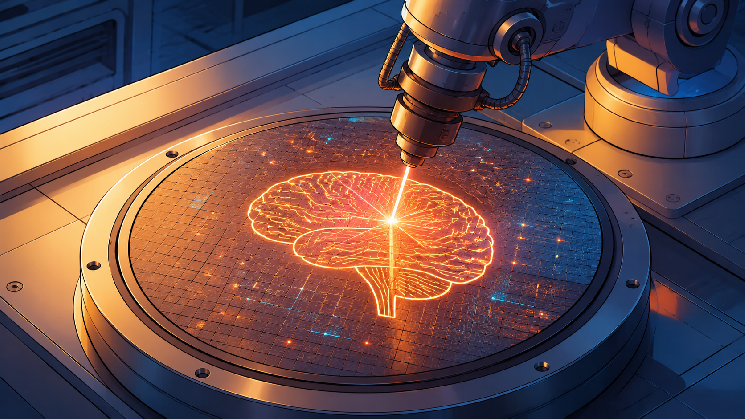
AMD has agreed to acquire Toronto-based startup Taalas, which tackles a key bottleneck in AI inference: the constant need to transfer model weights from memory to the processor for each generated token. Taalas's chips eliminate this operation by permanently embedding the model weights into the transistors themselves. This data transfer is what currently limits inference speed and has made high-bandwidth memory (HBM) a scarce commodity.
Taalas's first test chip, fabricated on TSMC's 6nm process, reportedly generated tokens for Meta's Llama 3.1 8B model at speeds 48 times faster than comparable Nvidia GPUs. Its architecture features a mask ROM section for fixed weights and SRAM for adaptable components. However, this design comes with a significant trade-off: each chip is permanently dedicated to a single model. Switching models requires a partial redesign and fabrication, a process taking about two months.
While the acquisition is seen as part of AMD's rivalry with Nvidia in inference, its broader implication lies in challenging the assumption of a permanent HBM memory shortage. The AI memory market is currently booming, with HBM supply sold out through 2026. Yet, Taalas's technology demonstrates that the memory bottleneck is an engineering challenge, not an absolute physical constraint. This aligns with industry-wide efforts from companies like Nvidia (through model compression) and memory makers like Samsung and SK hynix (developing new packaging and storage technologies) to reduce dependency on scarce HBM.
AMD's move suggests that the current high prices for memory, driven by AI demand, may not be sustainable. It highlights a growing engineering push against the premise of perpetual memory scarcity, reminding investors that memory has historically been a cyclical business.
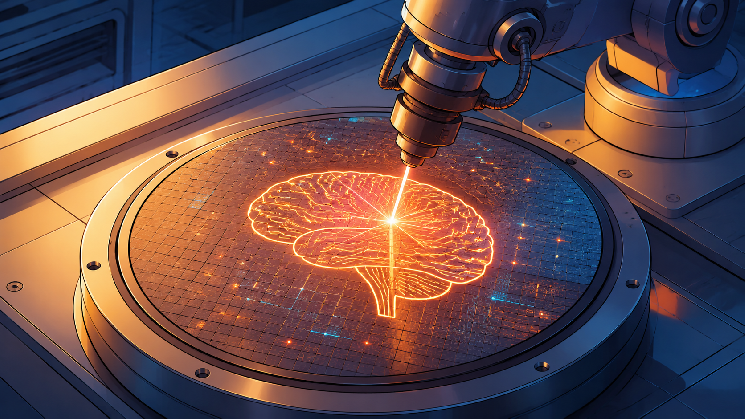
AMD has agreed to acquire Toronto-based startup Taalas, which addresses a major bottleneck in AI inference: the need to constantly transfer a neural network's model weights from memory to the processor for each token generated. Taalas's chips eliminate this operation by embedding the model weights directly into the transistors themselves. This data transfer is what currently limits inference speed and has made high-bandwidth memory (HBM) a critically scarce resource.
Taalas, founded in 2023, has developed application-specific integrated circuits (ASICs). Its first test chip, fabricated on TSMC's 6nm process, reportedly ran Meta's Llama 3.1 8B model at speeds 48 times faster than Nvidia GPUs. The architecture features a mask ROM section for permanently stored weights and SRAM for adaptable components. AMD plans to integrate these chips into its Helios racks alongside its Instinct accelerators.
However, this approach comes with a significant trade-off: each chip is permanently hardwired for a single model. Switching models requires a partial chip redesign, a process taking about two months even with Taalas's accelerated method. This limits its applicability to stable, widely-used models.
The acquisition highlights a broader challenge in the semiconductor industry: the current memory shortage. HBM is sold out through 2026, and DRAM prices have surged. Yet, Taalas's technology demonstrates that this memory bottleneck is an engineering challenge, not an absolute physical limit. The industry is actively working on solutions, from Nvidia's model compression to Samsung's zHBM and new high-speed flash memory standards, all aimed at reducing reliance on scarce HBM.
From an investment perspective, the deal challenges the assumption that AI-driven memory demand will keep prices permanently high. It serves as a reminder that memory has historically been a cyclical business, and current high prices are funding the very innovations designed to reduce future demand.
cryptonews.ru15天前
Related Questions
Welcome to the Crypto FAQ. Users' questions and answers on Advanced Micro Devices Inc (Derivatives) (AMD) are presented below.