Volume Shows Big Players Are Reloading On Solana As They Push For 4-Month Highs

bitcoinistОпубліковано о 2026-05-14Востаннє оновлено о 2026-05-14

Анотація

Institutional investors are showing renewed bullish interest in Solana (SOL), driven by significant inflows into Solana ETFs. Since the beginning of the month, these ETFs have seen total net inflows of $90 million, including a single-day high of $26 million on May 11. This activity has pushed SOL to a four-month high near $97 and boosted total ETF net assets to $1.02 billion. While derivative data presents mixed signals—with a long/short ratio below 1 indicating some bearishness—trading volume has surged significantly. However, broader market pressure persists due to geopolitical tensions and inflation concerns. Bullish fundamentals for SOL include the upcoming major "Alpenglow" network upgrade, Western Union's launch of its USDPT stablecoin on Solana, and potential regulatory clarity from the advancing CLARITY Act. Technical analysis suggests a strong buy sentiment with key resistance at $95, a breakout above which could target $100. Despite these positive factors, SOL's price was trading around $90 at the time of writing, reflecting a 5% daily decline.

Solana is seeing renewed interest from institutional investors, who appear to have flipped bullish on SOL again. This follows the record inflows that the SOL ETFs have recorded since the start of this month, which have pushed the altcoin to a four-month high.

Solana Sees Fresh Inflows From Institutional Investors

According to SoSoValue data, Solana ETFs have recorded a total net inflow of $90 million since the start of the month, higher than their net inflows over the past three months. Notably, these funds saw total inflows of $26 million on May 11, which is the highest daily net inflow since February 25.

The Solana ETFs now boast total net assets of $1.02 billion, which represents almost 2% of SOL’s market cap. Meanwhile, renewed inflows into these funds pushed SOL to a four-month high of around $97, with the altcoin now eyeing a push toward the psychological $100 level. However, derivatives data paint a mixed signal about the sentiment towards SOL at the moment.

CoinGlass data show that the long/short ratio is currently below 1, suggesting that more traders remain bearish on Solana. However, SOL’s derivative trading volume has surged by 33%, reaching $12.81 billion. Options volume is up 116%, reaching $37.75 million, while the options open interest has climbed 22% to $125 million.

It is worth noting that Solana and the broader crypto market remain under bearish pressure as U.S.-Iran peace talks appear to have stalled. This has raised concerns that the war could begin again, which is bearish for crypto prices. At the same time, recent inflation data show that inflation is steadily rising due to the war in Iran.

Other Bullish Fundamentals For SOL

In addition to renewed inflows into Solana ETFs, there are other bullish fundamentals for SOL, including the Alpenglow upgrade going live on the community test cluster. This comes ahead of the planned rollout on the mainnet in the third quarter of this year. This upgrade is notably the biggest consensus change in Solana’s history, and it aims to make the network 100x faster.

Meanwhile, Western Union just launched its USDPT stablecoin on the Solana network, boosting the network’s adoption. The CLARITY Act is also set to advance, which would provide regulatory clarity for SOL once the Senate eventually passes the crypto bill. From a technical analysis perspective, crypto researcher Senior noted that technicals signal a strong buy sentiment, with the immediate resistance for SOL at $95. His accompanying chart indicated that SOL could easily rally to $100 if it successfully breaks above this resistance.
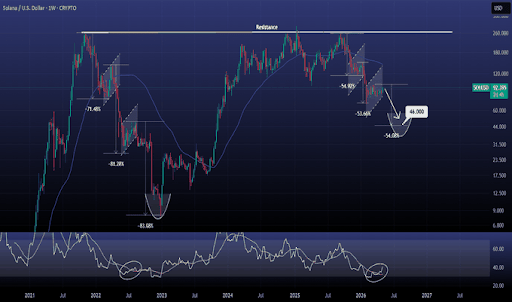
Source: Chart from Senior on X

At the time of writing, the Solana price is trading at around $90, down over 5% in the last 24 hours, according to data from CoinMarketCap.

SOL trading at $90 on the 1D chart | Source: SOLUSDT on Tradingview.com

Пов'язані питання

QAccording to the article, what is the key reason behind Solana reaching a four-month high price?

AThe key reason is renewed interest and record inflows into Solana ETFs from institutional investors. Since the start of the month, these ETFs have recorded a total net inflow of $90 million, pushing SOL to a four-month high of around $97.

QWhat does the data from CoinGlass show about trader sentiment towards SOL in the derivatives market?

ACoinGlass data shows a mixed signal. The long/short ratio is currently below 1, suggesting more traders are bearish on Solana. However, derivative trading volume surged by 33%, options volume is up 116%, and options open interest has climbed 22%, indicating heightened market activity.

QWhat is the Alpenglow upgrade, and why is it significant for Solana?

AThe Alpenglow upgrade is a major consensus change that has gone live on Solana's community test cluster, ahead of its planned mainnet rollout in Q3. It is significant because it is described as the biggest consensus change in Solana's history and aims to make the network 100x faster.

QBesides ETF inflows, what are two other bullish fundamentals for SOL mentioned in the article?

ATwo other bullish fundamentals mentioned are: 1) Western Union launching its USDPT stablecoin on the Solana network, boosting adoption. 2) The potential advancement of the CLARITY Act, which would provide regulatory clarity for SOL if the Senate passes the crypto bill.

QWhat is the immediate technical resistance level for SOL according to the crypto researcher Senior, and what could happen if it breaks above that level?

AAccording to crypto researcher Senior, the immediate technical resistance level for SOL is at $95. His analysis indicates that if SOL successfully breaks above this resistance level, it could easily rally to $100.

Пов'язані матеріали

a16z: How Tokenization is Transforming the Nature of Assets in 7 Charts

"Tokenized Assets: How Tokenization Changes the Nature of Assets" by a16z Crypto The market for tokenized assets, excluding stablecoins, has grown from under $3 billion two years ago to over $340 billion today. US Treasury bonds are the primary growth driver, allowing investors to hold yield-bearing assets digitally and enabling more efficient settlement. Other key sectors include private credit (growing fastest), commodities (dominated by gold), and niche financial assets. However, the market remains concentrated in tokenized US Treasuries and gold. A critical insight is that most tokenized assets currently lack "composability." While the total market is large, only a small fraction is actively used within DeFi protocols. For instance, only about 5% of tokenized bonds and a low percentage of tokenized gold are utilized on-chain. In contrast, assets like reinsurance and private credit tokens show much higher on-chain usage rates (84% and 33%, respectively). This highlights a divide: many tokenized assets are merely digital records on a blockchain without enabling new, programmable financial applications. The Pantera Capital Token Native Index indicates over 70% of tokenized assets have minimal on-chain native functionality. Ethereum remains the dominant blockchain for tokenized assets (over $150B), but the ecosystem is diversifying across chains like BNB Chain, Solana, and Stellar, based on factors like cost and compliance. Major institutions forecast massive future growth, with predictions for the tokenized asset market ranging from $2 trillion to over $30 trillion by the early 2030s. However, compared to the global financial system (e.g., ~$140T bonds, multi-trillion dollar gold market), tokenized assets currently represent a tiny fraction (0.01% or less). The conclusion is that while tokenization has begun by digitizing and streamlining settlement for simpler assets, the next phase involves bringing more complex financial instruments on-chain and deeply integrating them into composable, internet-native financial infrastructure.

Odaily星球日报29 хв тому

a16z: How Tokenization is Transforming the Nature of Assets in 7 Charts

Odaily星球日报29 хв тому

The Revived Codex, Carrying OpenAI's Hopes for IPO

This article analyzes the intense recent development of OpenAI's Codex, positioning it as a crucial component for OpenAI's impending IPO. Over the past two months, Codex has seen a rapid series of major updates focused on integrating into real enterprise workflows. Key new features include enhanced context capture (Appshots, file previews, built-in browser), long-running task execution ("Goal Mode"), remote operation (phone control, lock-screen access), and enterprise management tools (plugin sharing, access tokens, automated risk review). These updates aim to make Codex a comprehensive AI workbench that can "see the scene, push tasks, and manage risks." The author argues that while ChatGPT proves OpenAI's massive user base and API provides foundational revenue, Codex represents OpenAI's clearest path to demonstrating tangible, high-value commercial viability. It targets developers and engineering teams—a segment already accustomed to paying for efficiency gains in costly software development cycles. This is critical because, despite higher overall revenue, OpenAI's adjusted operating margins remain deeply negative, highlighting the challenge of outrunning immense compute costs. The pressure is amplified by competitor Anthropic's success with Claude Code, which has shown that a focused approach on high-value enterprise and developer workflows can lead to a path toward profitability. Codex's aggressive evolution is thus seen as OpenAI's strategic move to capture a similar enterprise-ready, revenue-generating narrative essential for its market debut. In essence, "ChatGPT proved OpenAI has users. Codex needs to prove OpenAI is a business that can make money."

marsbit1 год тому

The Revived Codex, Carrying OpenAI's Hopes for IPO

marsbit1 год тому

a16z: 7 Charts to Understand How Tokenization Is Changing the Nature of Assets

a16z: 7 Charts on How Tokenization is Transforming the Nature of Assets Tokenized Assets, often referred to as "real-world assets" (RWA), are altering the form, flow, and structure of the financial system. The market recently surpassed $30 billion (excluding stablecoins), driven largely by tokenized U.S. Treasuries. These offer investors digital, yield-bearing assets with efficient settlement. Growth varies significantly by asset class. Asset-backed credit leads in speed, followed by niche financial assets, while venture capital and active strategies took longer to scale. U.S. Treasuries and commodities dominate, holding about two-thirds of the current market share. Within commodities, gold tokenization dominates entirely due to its standardization and historical appeal in crypto. The ecosystem is spread across multiple blockchains. Ethereum holds over half the market, with others like BNB Chain, Solana, and Stellar holding significant shares. However, a key insight is that most tokenized assets currently lack "composability." While the total market is large, only a small fraction (e.g., 5% of tokenized bonds) is used within DeFi protocols. Many tokens are simply digital records of off-chain assets, not natively programmable financial building blocks. In contrast, smaller categories like reinsurance tokens see very high on-chain usage. Looking ahead, forecasts for the tokenized asset market by 2030 range from $2 trillion to over $30 trillion, representing immense potential growth from today's ~$340 billion base. Yet, relative to global markets (e.g., $140T+ in bonds), tokenization's penetration remains minuscule (<0.02%). The current phase focuses on digitizing straightforward assets for efficiency. The next major challenge is bringing more complex financial instruments on-chain and integrating tokenized assets into truly composable, internet-native financial infrastructure.

marsbit1 год тому

a16z: 7 Charts to Understand How Tokenization Is Changing the Nature of Assets

marsbit1 год тому

Data Theft at Will! Major Vulnerability Exposed in This Popular AI Programming Tool

A critical vulnerability in Anthropic's Claude Code AI programming tool allowed attackers to bypass its network sandbox for over five months, enabling potential data exfiltration. Independent researcher Aonan Guan discovered a second complete bypass exploiting a null-byte injection in the SOCKS5 proxy. This flaw, present since the sandbox's launch in October 2025, let processes inside the sandbox access any host, contrary to user-configured domain whitelists. The attack chain involved manipulating hostnames (e.g., `attacker.com\x00.google.com`). JavaScript's `endsWith()` check would pass `.google.com`, while the underlying C `getaddrinfo()` function would only parse `attacker.com` due to the null byte, creating a parser discrepancy. Combined with a previously disclosed prompt injection method, this could leak API keys, credentials, and internal data. Anthropic silently fixed the issue in April 2026 without a security advisory, CVE, or user notification. The researcher noted that Claude Code itself confirmed the vulnerability's severity when tested. This incident highlights broader industry issues, as similar vulnerabilities found in Google's Gemini CLI and GitHub's Copilot Agent also lacked public disclosures. The report criticizes the false sense of security created by a broken sandbox and emphasizes the need for defense-in-depth and transparency in AI tool security.

marsbit5 год тому

Data Theft at Will! Major Vulnerability Exposed in This Popular AI Programming Tool

marsbit5 год тому

Торгівля

Спот
Ф'ючерси

Популярні статті

Як купити 4

Ласкаво просимо до HTX.com! Ми зробили покупку 4 (4) простою та зручною. Дотримуйтесь нашої покрокової інструкції, щоб розпочати свою криптовалютну подорож.Крок 1: Створіть обліковий запис на HTXВикористовуйте свою електронну пошту або номер телефону, щоб зареєструвати обліковий запис на HTX безплатно. Пройдіть безпроблемну реєстрацію й отримайте доступ до всіх функцій.ЗареєструватисьКрок 2: Перейдіть до розділу Купити крипту і виберіть спосіб оплатиКредитна/дебетова картка: використовуйте вашу картку Visa або Mastercard, щоб миттєво купити 4 (4).Баланс: використовуйте кошти з балансу вашого рахунку HTX для безперешкодної торгівлі.Треті особи: ми додали популярні способи оплати, такі як Google Pay та Apple Pay, щоб підвищити зручність.P2P: Торгуйте безпосередньо з іншими користувачами на HTX.Позабіржова торгівля (OTC): ми пропонуємо індивідуальні послуги та конкурентні обмінні курси для трейдерів.Крок 3: Зберігайте свої 4 (4)Після придбання 4 (4) збережіть його у своєму обліковому записі на HTX. Крім того, ви можете відправити його в інше місце за допомогою блокчейн-переказу або використовувати його для торгівлі іншими криптовалютами.Крок 4: Торгівля 4 (4)Легко торгуйте 4 (4) на спотовому ринку HTX. Просто увійдіть до свого облікового запису, виберіть торгову пару, укладайте угоди та спостерігайте за ними в режимі реального часу. Ми пропонуємо зручний досвід як для початківців, так і для досвідчених трейдерів.

386 переглядів усьогоОпубліковано 2025.10.20Оновлено 2025.10.20

Як купити 4

Обговорення

Ласкаво просимо до спільноти HTX. Тут ви можете бути в курсі останніх подій розвитку платформи та отримати доступ до професійної ринкової інформації. Нижче представлені думки користувачів щодо ціни 4 (4).

活动图片