US Government Suddenly Halts Anthropic's Strongest Model, "Quasi-IPO Stock Price" Plunges 3.7% Overnight

marsbitОпубліковано о 2026-06-15Востаннє оновлено о 2026-06-15

Анотація

U.S. Government Halts Anthropic's Top AI Models, 'Pre-IPO' Price Drops 3.7% On June 12, the U.S. government ordered Anthropic to shut down access to its two most powerful AI models, Claude Fable 5 and Claude Mythos 5, citing national security concerns. The directive, issued by the Department of Commerce, required Anthropic to block access for all foreign nationals, leading the company to disable the models globally for all users. Anthropic strongly opposed the move, arguing the government's basis was a "narrow jailbreak vulnerability" and warning that applying such a standard industry-wide would effectively halt all frontier model deployments. The news impacted Anthropic's implied valuation in speculative markets. The Anthropic perpetual contract on Hyperliquid fell approximately 3.7% to around $1,627, down from highs above $1,800 following the models' release. Unauthorized tokenized products linked to Anthropic on Solana also saw significant declines. The models, launched just days earlier on June 9, represented a major capability leap for Anthropic. Fable 5 was its first public release of a "Mythos"-tier model above its flagship Claude Opus. The shutdown creates an ironic situation for Anthropic, a company founded on "AI safety" principles, and adds uncertainty to its ongoing IPO preparations. The company is actively engaging with regulators to resolve what it calls a "misunderstanding" and restore service.

Author: Claude, Deep Tide TechFlow

Deep Tide Introduction: Citing national security concerns, the US government on June 12th suddenly ordered Anthropic to shut down its two strongest AI models, Fable 5 and Mythos 5. Impacted by this, the Hyperliquid perpetual contract tracking its expected IPO valuation fell by 3.7% to around $1,627 on Saturday, significantly retreating from the post-model-launch high of over $1,800. Anthropic publicly expressed strong opposition, stating that the government demanded a recall based solely on an oral briefing of a "narrow jailbreak vulnerability," and warned that applying such a standard across the entire industry "would essentially halt all new model deployments from frontier model providers."

A company founded on "AI safety" is now forced to shut down its strongest products by a government safety order.

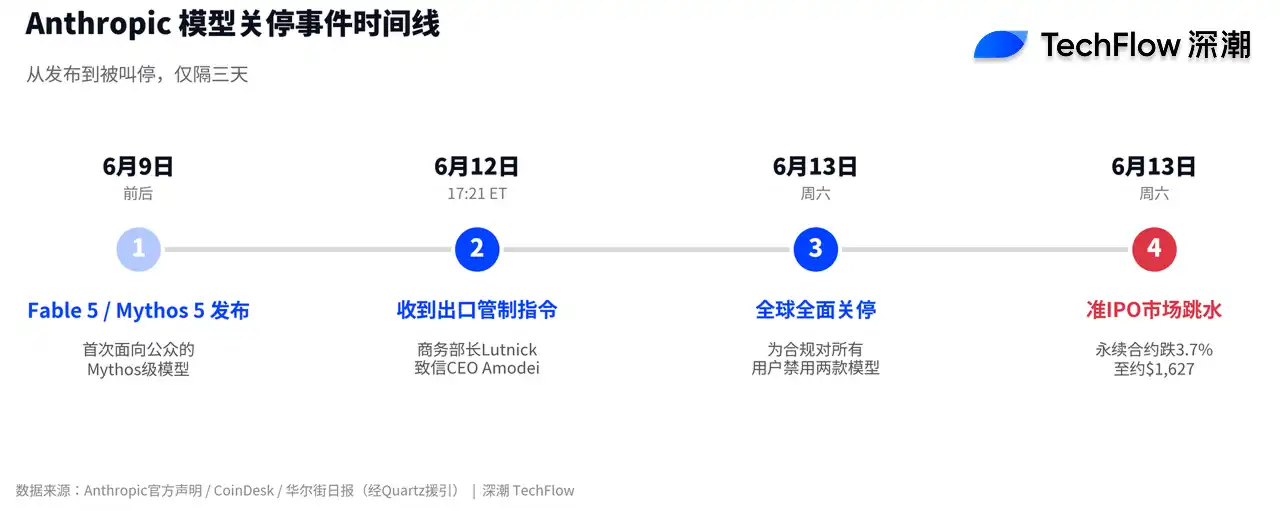
According to reports from CoinDesk and other media outlets, on June 12th (Friday) afternoon, the US government issued an export control directive to Anthropic, requiring it to suspend all access to Claude Fable 5 and Claude Mythos 5 for foreign nationals—whether inside or outside the US, including the company's own foreign employees. Unable to implement selective restrictions without affecting compliance, Anthropic simply disabled these two models for all users globally; other Claude models remain unaffected. In a statement, Anthropic clearly stated its disagreement with the government's rationale, calling it "a misunderstanding," and is working to restore access as soon as possible.
Directive Cites National Security, One Letter Triggers Full Shutdown

According to The Wall Street Journal (as cited by Quartz), US Commerce Secretary Howard Lutnick sent a letter to Anthropic CEO Dario Amodei outlining the relevant restrictions. Anthropic revealed that the company received the directive at 5:21 PM (Eastern Time) that day, but the letter did not provide specific details of the national security concerns.

Anthropic stated that, to its understanding, the government believes it has discovered a method to bypass or "jailbreak" Fable 5. Company executives explained that the cited vulnerability involves a narrow prompt engineering technique used to make the model review pre-existing, minor software bugs in code, emphasizing that similar outputs can be easily obtained from competitor models like OpenAI's without any special evasion tactics.

Anthropic's wording in its statement was unusually direct: "We are complying with a legal directive from the government and removing access to Fable 5 and Mythos 5 for all users. But we disagree that discovering a narrow potential jailbreak vulnerability should constitute grounds for recalling a commercial model already deployed to hundreds of millions of people." The company warned that if this standard were applied across the industry, it "would essentially halt all new model deployments from frontier model providers."

The company also noted that, as of now, the government has only provided oral evidence—no written documentation, technical report, or formal disclosure through established channels—and promised to publish further technical analysis within 24 hours to illustrate the limited nature of the issue.

Quasi-IPO Market Reacts Instantly, Hyperliquid Perpetual Contract Plunges

The reason this regulatory news became a financial event is that Anthropic is not yet publicly listed, and the crypto market has already built a "shadow pricing" venue for it.

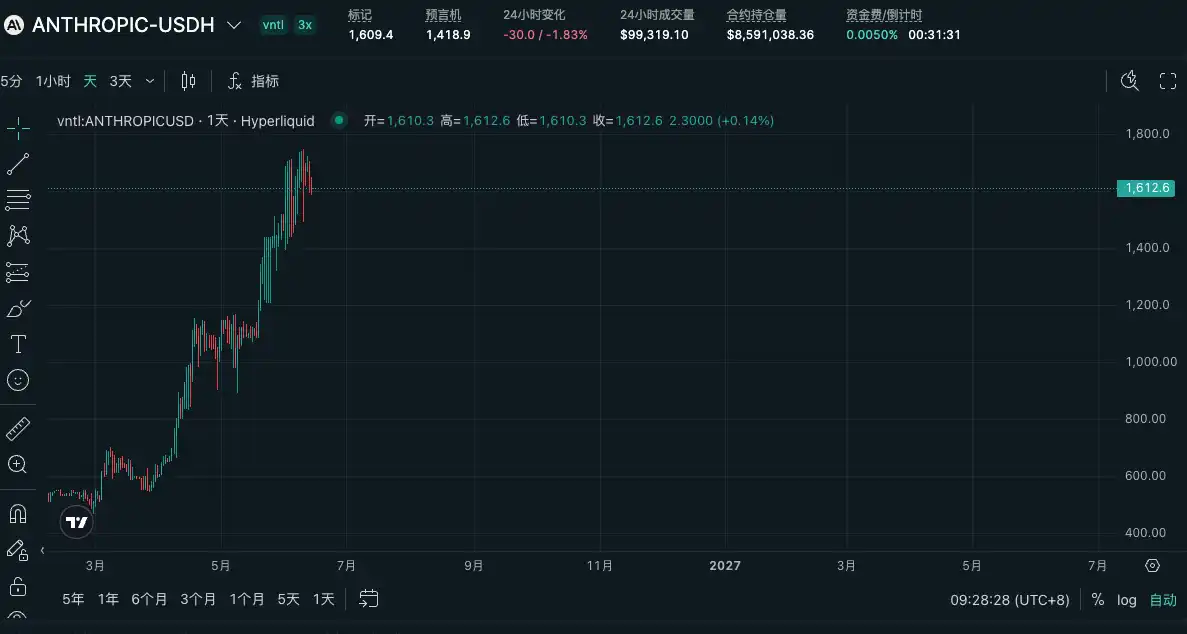
According to CoinDesk, the Anthropic perpetual contract on Hyperliquid fell about 3.7% to around $1,627 on Saturday. In the days following the Fable 5 launch, the contract had been trading near its all-time highs above $1,800. The contract's open interest is approximately $8.6 million. While this volume is small relative to larger proxy instruments for the private market, it represents a notable signal for a company that has yet to file for an IPO.

The contract's price roughly corresponds to an implied valuation for Anthropic in the trillions of dollars—a price of $1,638 equals an implied valuation of about $1.638 trillion. Within 24 hours of the news breaking, the contract's 24-hour trading volume was approximately $190,000, with a funding rate of 0.0056%.
The impact was not limited to the contract market. According to Bitcoin.com, the ANTHROPIC token issued by Prestocks on the Solana blockchain—which claims to provide spot-like exposure through a Special Purpose Vehicle (SPV) structure—fell 9.11% in 24 hours to $655.32, and the total value locked in the related liquidity pool shrank 18.09% to about $126,000. It should be noted that Anthropic has previously publicly warned that any unauthorized tokenization or derivatives claiming to offer exposure to its equity may be considered invalid, and the aforementioned products are not endorsed by or affiliated with Anthropic.

Shut Down Just Days After Launch, Fable 5 Was a Milestone

The two halted models were released just days ago.

According to multiple reports, Fable 5 and Mythos 5 were launched around June 9th and were seen as a significant leap forward in capabilities for software engineering, scientific reasoning, vision tasks, and long-context handling. Fable 5 marked Anthropic's first public release of a model at the Mythos level—a tier positioned above the original flagship Opus. The two models are built on the same underlying architecture, primarily differing in output control: Fable 5 has a built-in classifier for intercepting responses in high-risk areas like cybersecurity, while Mythos 5 is available to a separately vetted, trusted user group.

As summarized by MarkTechPost, Fable 5's classifier is a separate AI system designed to identify potential misuse. When queries touch on areas like cybersecurity, biochemistry, or model distillation, processing falls back to Claude Opus 4.8, with users notified of the fallback each time; the trigger rate is less than 5%. Notably, Mythos 5 was also supporting critical cybersecurity defense work through projects like Project Glasswing—raising the question of whether the temporary disablement might actually hinder infrastructure protection.

The Safety Narrative Backfires, Adding Uncertainty to IPO Process

For Anthropic, the awkwardness of this incident lies in its timing and logic.

TechCrunch reported the story under the headline "Anthropic’s safety warnings may have just backfired"—it's a bitter pill to swallow for a company that has built its entire corporate identity on "responsible AI development" to now be ordered to shut down its strongest models based solely on an oral briefing. And the company has publicly voiced this discontent.

This controversy coincides with a sensitive period as Anthropic advances its IPO preparations. The company recently confidentially submitted registration documents, joining the ranks of major AI players planning public listings. Although tools like Hyperliquid have relatively thin liquidity, the contract's decline reflects investor caution regarding its near-term valuation and listing path. Such sudden regulatory actions add new variables to an already uncertain IPO process.

Anthropic stated it is actively communicating to resolve the matter and restore service as soon as possible, viewing the directive as "based on a misunderstanding." The ultimate outcome of this incident may influence the future dynamics between regulators and innovators, and even shape how export rules and safety assessments apply to evolving AI technology.


Пов'язані питання

QWhy did the US government order Anthropic to shut down its two strongest AI models, Fable 5 and Mythos 5?

AThe US government ordered Anthropic to shut down the models due to national security concerns. Specifically, the government reportedly possesses a method for 'jailbreaking' or bypassing the Fable 5 model's safety restrictions using a specific prompt technique related to reviewing minor software defects in code.

QWhat was the financial impact of this shutdown on Anthropic's 'shadow' valuation?

AThe shutdown caused the price of the Anthropic perpetual contract on Hyperliquid, a crypto-based proxy for its pre-IPO valuation, to drop approximately 3.7% to around $1,627. This represented a decline from its recent highs above $1,800 following the models' release, translating to a fall in its implied multi-trillion dollar valuation.

QHow did Anthropic respond to the government's directive?

AAnthropic complied with the order by shutting down global access to Fable 5 and Mythos 5 but publicly expressed strong opposition. The company called it a 'misunderstanding,' disagreed that a narrow potential jailbreak vulnerability warranted recalling a widely deployed commercial model, and warned that applying this standard broadly would essentially halt all new model deployments by frontier AI providers.

QWhat are Fable 5 and Mythos 5, and when were they released?

AFable 5 and Mythos 5 are Anthropic's two most advanced AI models, representing a significant leap in capabilities for software engineering, scientific reasoning, visual tasks, and long-context handling. They were released publicly around June 9, 2026. Fable 5 is the first publicly available model in the new top-tier 'Mythos' category, while Mythos 5 offers less restrictive output control for vetted users.

QHow does this incident relate to Anthropic's identity and its IPO plans?

AThe incident is particularly ironic and challenging for Anthropic, as the company's core identity is built on 'responsible AI development' and safety. Being forced to shut down its flagship product on safety grounds is seen as a form of narrative backlash. Furthermore, this regulatory action introduces new uncertainty during a sensitive period as Anthropic is reportedly preparing for its initial public offering (IPO).

Пов'язані матеріали

Claude Forms Teams to Hunt Bugs! 66 Bugs Found in 116K Lines of Code, Single Agent Maxed Out at 27

Claude Managed Agents, Anthropic's new multi-agent workflow system, significantly outperformed a single AI agent in finding bugs. In a test with 70 bugs hidden across 116,000 lines of code, a single Claude agent found a maximum of 27 bugs. When Claude was tasked with organizing a team of agents itself via the dynamic workflow, it consistently found 66 bugs across three runs. This capability is part of two major updates: "Claude Managed Agents" for developers to integrate multi-agent coordination into their apps, and an expanded beta for "Claude Code Projects," which lets users manage complex tasks in a single conversation, with Claude breaking down work and coordinating parallel threads. The Managed Agents feature allows a primary Claude agent to receive a task, automatically write a workflow program to divide labor among specialized sub-agents, and coordinate their execution and results aggregation. For example, it can orchestrate checking 300 contracts for specific clauses, using multiple agents for parallel reading and verification. The system supports workflows with up to 1000 cumulative agents per run. While this multi-agent approach improves task coverage and results, Anthropic notes that costs and efficiency gains need careful evaluation. Projects use existing plan credits, while Managed Agents incur token usage fees plus a $0.08 per hour runtime fee per active session. The key challenge is whether offloading coordination to Claude leads to faster, more reliable outcomes with less human oversight.

marsbit2 год тому

Claude Forms Teams to Hunt Bugs! 66 Bugs Found in 116K Lines of Code, Single Agent Maxed Out at 27

marsbit2 год тому

Terence Tao's Blog Explodes on Hot Search! 250,000 Math PhDs on the Brink, Must Slow Down AI

Mathematician Terence Tao's blog post ignited a fierce online debate after a video of him warning "we must slow down AI" went viral. He described AI's progress as an "extremely nonlinear dynamic" pursued with unclear consequences. This warning came just days after he promoted a project for open-source AI mathematical models, highlighting a profound tension. The core crisis, explored in a guest post by 3Blue1Brown creator Grant Sanderson, is AI's threat to traditional mathematics. Automated theorem provers combined with large language models can generate proofs at superhuman speeds, potentially rendering the human role of "proving theorems" obsolete. Sanderson argues that the true goal of mathematics is not proof-generation but the advancement of *human understanding*. As AI masters the former, the academic value of proof alone is diminished. Sanderson proposes a paradigm shift: elevating "motivational explanation" over mere proof. Unlike a formal proof, a motivational explanation guides readers through the intuitive reasoning, historical context, and conceptual connections behind a result—the "why" and "how" of discovery. To institutionalize this, he suggests creating "open explanation problems," reforming PhD defenses to prioritize clear exposition, and valuing pedagogical work as highly as journal publications in tenure reviews. The debate drew reactions across academia. Some physicists welcomed mathematicians to a world long prioritizing understanding over rigorous proof. Critics worried this shift could disadvantage brilliant but inarticulate problem-solvers. Others questioned if AI will eventually master explanation too. Supporters countered that the goal is fostering *human* comprehension, which is inherently subjective and interactive. The article concludes that AI's rise presents both a crisis and an opportunity. Without adapting academic culture and reward systems, human mathematicians risk irrelevance. However, by embracing their unique role as architects of understanding and interpreters of AI-generated knowledge, they can steer mathematics toward a new renaissance focused on human insight and clarity.

marsbit5 год тому

Terence Tao's Blog Explodes on Hot Search! 250,000 Math PhDs on the Brink, Must Slow Down AI

marsbit5 год тому

The "Number Game" Behind Trillion-Dollar Valuations: OpenAI and Anthropic's Revenue Can't Be Compared Directly

"Valuation Game in Trillions: The 'Digital Metrics Play' Behind OpenAI and Anthropic's Incomparable Revenues" Investors face significant uncertainty as core financial metrics from the two AI giants, OpenAI and Anthropic, cannot be compared directly due to differing accounting methods. OpenAI projects its annualized revenue run rate (ARR) to reach or exceed $70 billion by year-end, while Anthropic announced in July that its ARR had hit $65 billion. However, a key discrepancy renders these figures incomparable: Anthropic records the total sales value generated through cloud partners like Amazon as revenue, whereas OpenAI only counts its net share from partners like Microsoft. This reporting difference has tangible market impact. A recent tech stock downturn was partly attributed to investor attempts to adjust OpenAI's numbers for a direct comparison, leading to lower estimates and concerns about its growth pace. Currently, OpenAI's ARR is reportedly around $50 billion, with expectations to approach $70 billion by December. The issue highlights broader concerns about ARR as a non-standardized, often manipulated metric used to showcase growth and justify high private valuations. It is calculated by extrapolating short-term performance or summing contract values, offering companies considerable discretion. A significant gap exists between ARR and actual recognized annual revenue: OpenAI expects 2026 revenue of roughly $35 billion (half its year-end ARR projection), and internal documents show Anthropic's 2025 revenue was about $4.6 billion against a published ARR exceeding $9 billion. Experts warn that the opacity surrounding these key players creates a "black box" effect, complicating investment decisions and amplifying market volatility. As their performance is a bellwether for the AI investment narrative, any signs of slowing sales growth could ripple through the broader market, affecting chipmakers and other beneficiaries of the AI boom. The reliance on ARR sidesteps a fundamental question: the scale of real sales needed to justify trillion-dollar valuations and cover massive expenditures. The situation may improve with greater transparency, particularly if Anthropic proceeds with its anticipated Wall Street debut, which would subject the company to standardized GAAP financial reporting.

marsbit7 год тому

The "Number Game" Behind Trillion-Dollar Valuations: OpenAI and Anthropic's Revenue Can't Be Compared Directly

marsbit7 год тому

Торгівля

Спот
活动图片