Tiger Research: One Year into the Trump Administration, the Transformation of the U.S. Crypto Industry

marsbitPublished on 2025-12-25Last updated on 2025-12-25

Abstract

Under the Trump administration's second term, the U.S. has aggressively shifted toward pro-cryptocurrency policies, aiming to integrate the industry into the existing financial regulatory framework rather than suppress it. Over the past year, key agencies including the SEC, CFTC, and OCC have implemented significant changes: the SEC moved from enforcement-heavy approaches to creating clearer rules for token classification; the CFTC recognized Bitcoin and Ethereum as commodities and allowed their use as collateral; the OCC granted national trust bank charters to major crypto firms like Circle and Ripple, enabling federal-level operations. Congress passed the GENIUS Act, establishing strict reserve requirements for stablecoins. Despite internal tensions—such as debates over privacy tools like Tornado Cash—the U.S. is advancing a cohesive strategy to absorb crypto into traditional finance, reducing uncertainty while supporting innovation and aiming to position itself as the global center for the industry.

This report is authored by Tiger Research. In 2025, the U.S. government is pursuing a policy supportive of cryptocurrency, with a clear and concise goal: to have the existing cryptocurrency industry operate under the same regulatory framework as the traditional financial sector.

Key Takeaways

  • The U.S. is working to integrate cryptocurrency into its existing financial infrastructure, rather than simply absorbing the entire industry.
  • Over the past year, Congress, the Securities and Exchange Commission (SEC), and the Commodity Futures Trading Commission (CFTC) have introduced and adjusted rules to gradually bring cryptocurrency into this system.
  • Despite tensions among regulators, the U.S. continues to refine the regulatory framework while supporting industry growth.

1. The U.S. Absorption of the Cryptocurrency Industry

Following President Trump's re-election, the administration launched a series of aggressive pro-cryptocurrency policies. This marks a sharp turn from previous stances—where the cryptocurrency industry was primarily seen as an object of regulation and control. The U.S. has entered a once-unimaginable phase, absorbing the cryptocurrency industry into its existing system at a pace approaching unilateral decision-making.

Shifts in the positions of the SEC and CFTC, along with traditional financial institutions increasingly engaging in cryptocurrency-related businesses, signal that broad structural changes are underway.

Notably, all this has occurred just one year since President Trump's re-election. What specific changes have taken place in U.S. regulation and policy so far?

2. A Year of Change in the U.S. Cryptocurrency Stance

In 2025, with the Trump administration taking office, U.S. cryptocurrency policy reached a major turning point. The executive branch, Congress, and regulatory agencies acted in concert, focusing on reducing market uncertainty and integrating cryptocurrency into the existing financial infrastructure.

2.1. The Securities and Exchange Commission (SEC)
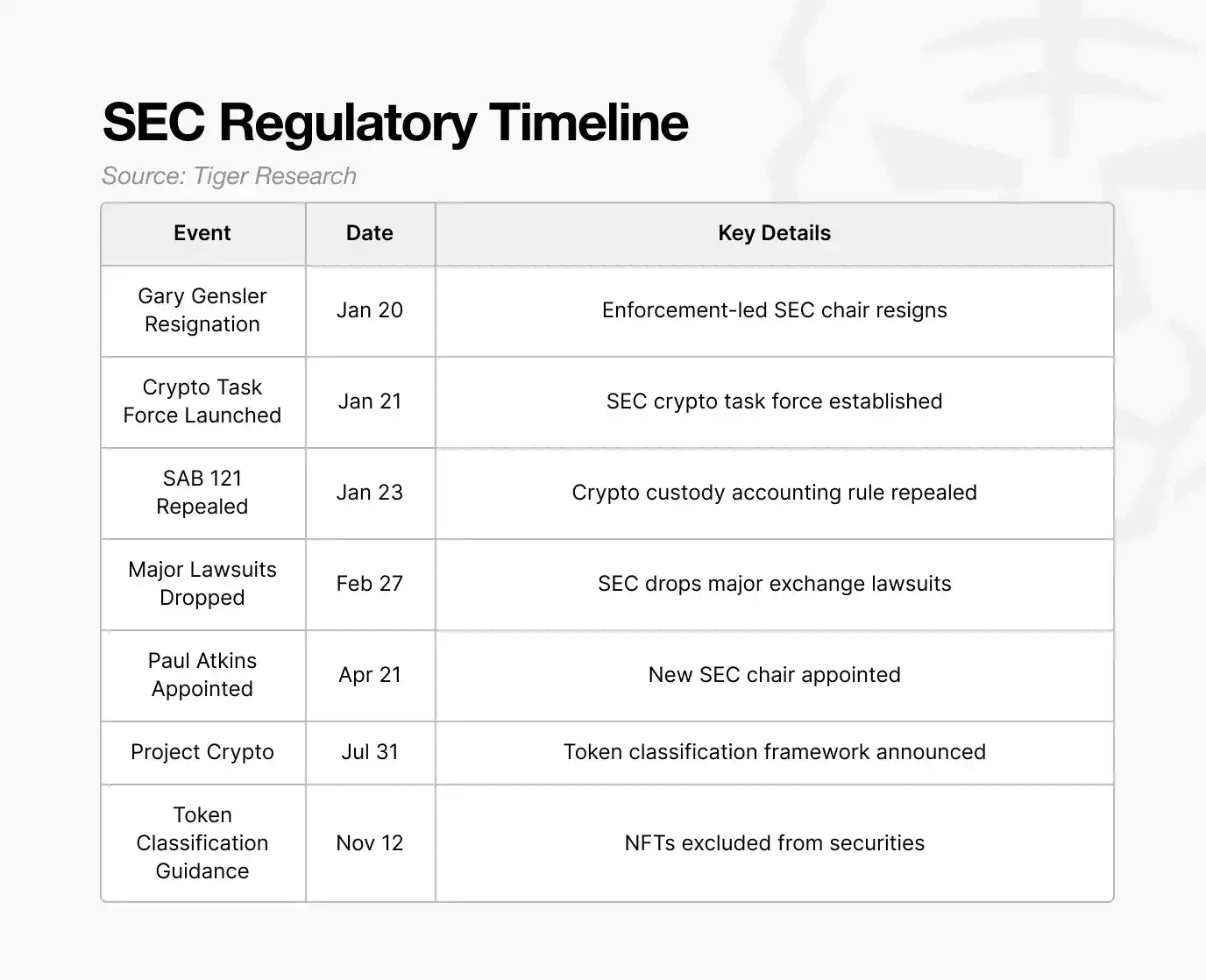
Previously, the SEC primarily relied on enforcement actions to address cryptocurrency-related activities. In major cases involving Ripple, Coinbase, Binance, and Kraken's staking services, the SEC filed lawsuits without providing clear standards for the legal attributes of tokens or which activities were permitted, often interpreting rules after the fact. This led cryptocurrency companies to focus more on managing regulatory risks than on business expansion.

This stance began to change after the resignation of Chairman Gary Gensler, who held a conservative view of the cryptocurrency industry. Under the leadership of Paul Atkins, the SEC shifted to a more open approach, beginning to build foundational rules aimed at bringing the cryptocurrency industry into the regulatory framework, rather than relying solely on litigation for oversight.

A key example is the announcement of the "Crypto Project." Through this project, the SEC signaled its intent to establish clear standards for determining which tokens are securities and which are not. This once directionless regulator is beginning to reshape itself into a more inclusive agency.

2.2. The Commodity Futures Trading Commission (CFTC)
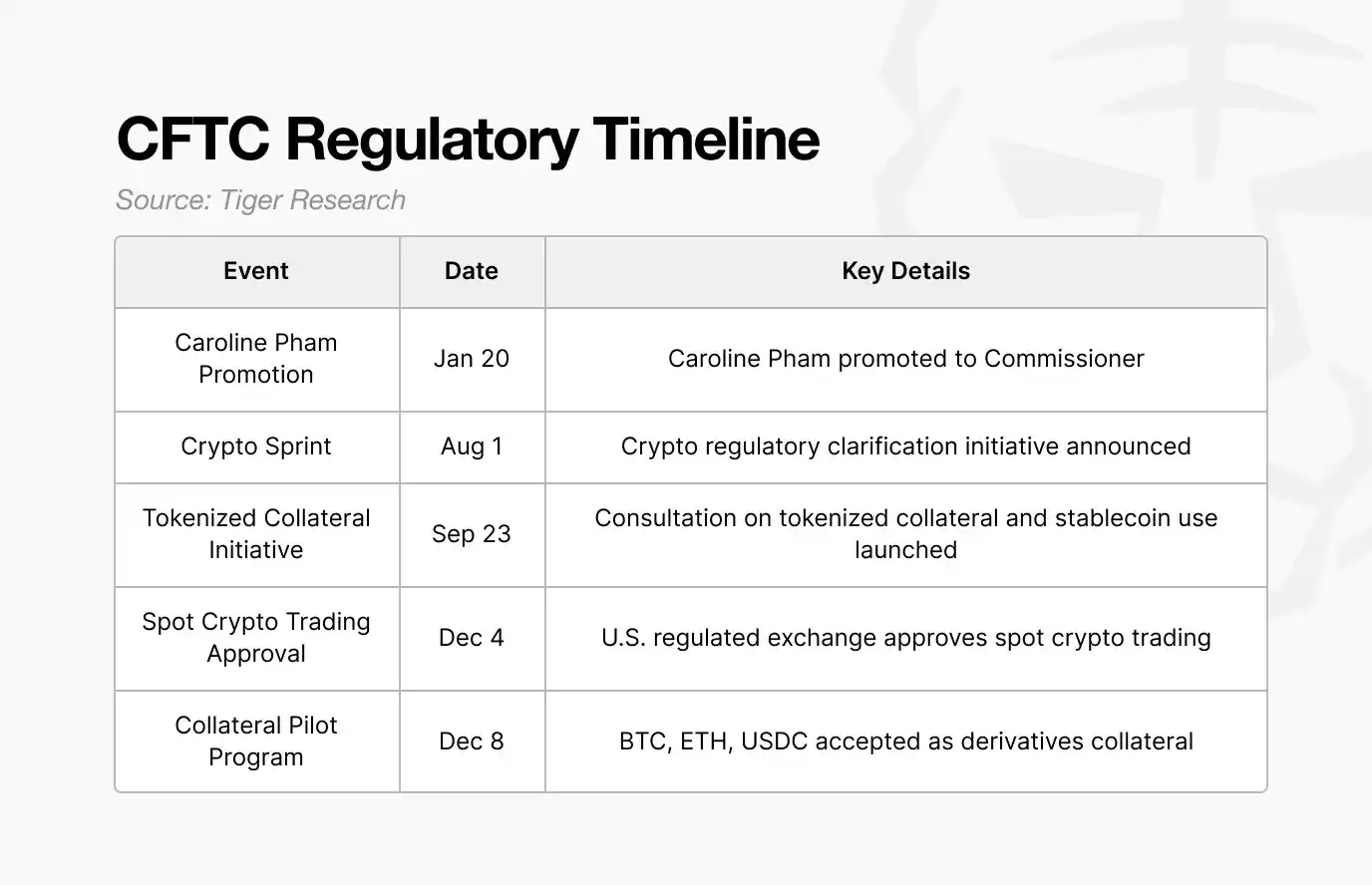
In the past, the CFTC's involvement with cryptocurrency was largely limited to derivatives market regulation. This year, however, it adopted a more proactive stance, formally recognizing Bitcoin and Ethereum as commodities and supporting their use by traditional institutions.

The "Digital Asset Collateral Pilot Program" is a key initiative. Through this program, Bitcoin, Ethereum, and USDC were approved as collateral for derivatives trading. The CFTC applied haircut ratios and risk management standards, treating these assets in the same manner as traditional collateral.

This shift indicates that the CFTC no longer views crypto assets purely as speculative instruments but has begun to recognize them as stable collateral assets on par with traditional financial assets.

2.3. The Office of the Comptroller of the Currency (OCC)
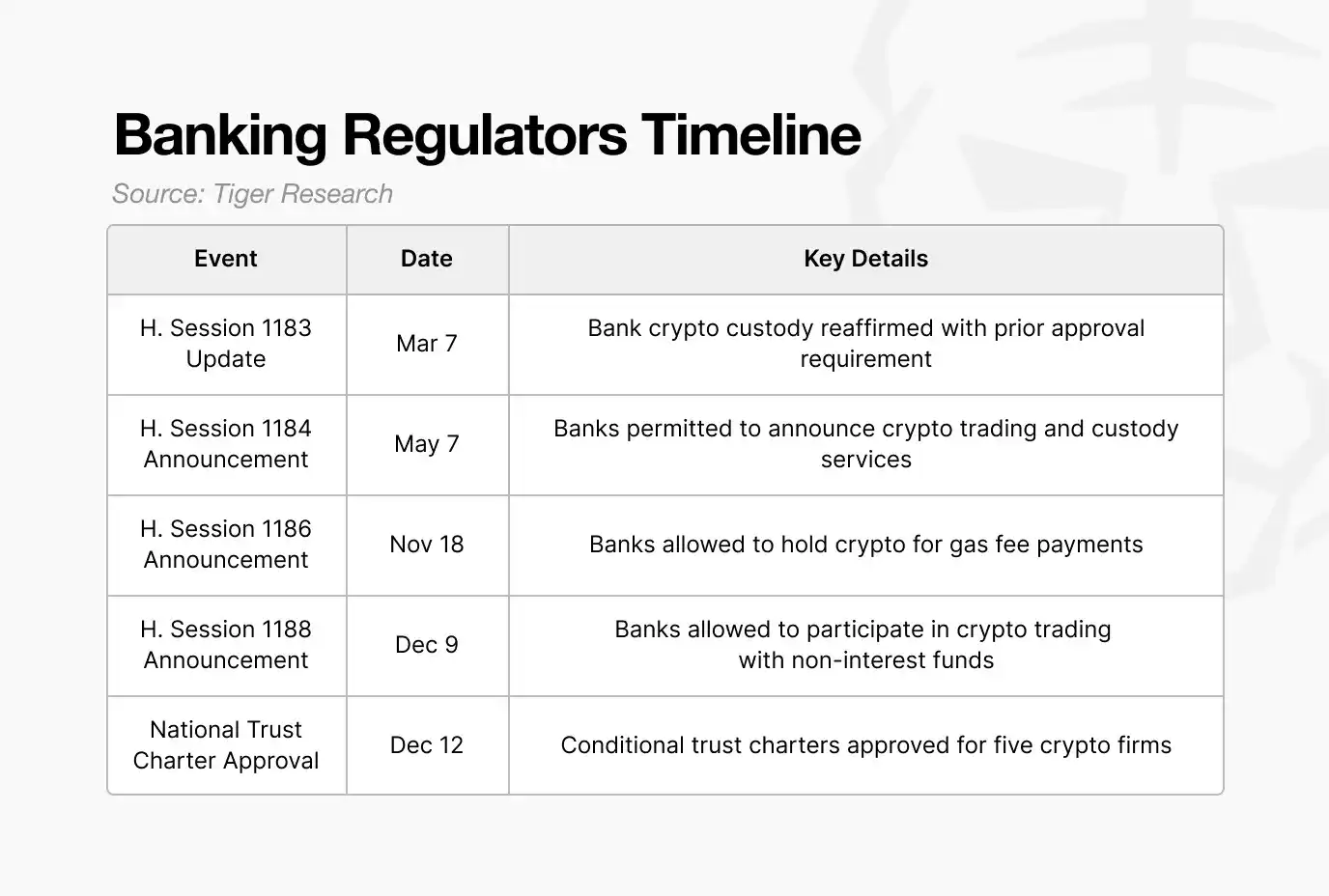
Previously, the OCC kept its distance from the cryptocurrency industry. Crypto companies had to apply for licenses state by state, making it difficult to enter the federal banking regulatory system. Their business expansion was limited, and structural barriers hindered connections with the traditional financial system, forcing most to operate outside the regulated framework.

This approach has now changed. The OCC has chosen to bring cryptocurrency companies into the existing bank regulatory framework rather than exclude them from the financial system. It issued a series of interpretive letters (formal documents clarifying whether specific financial activities are permitted), gradually expanding the scope of allowed businesses to include crypto asset custody, trading, and even banks paying on-chain transaction fees.

This series of changes culminated in December: the OCC conditionally approved national trust bank charters for major companies like Circle and Ripple. This move is significant because it grants these crypto companies status equal to that of traditional financial institutions. Under single federal oversight, they can operate nationwide, and transfers that previously required intermediary banks can now be handled directly, just like traditional banks.

2.4. Legislation and Executive Orders
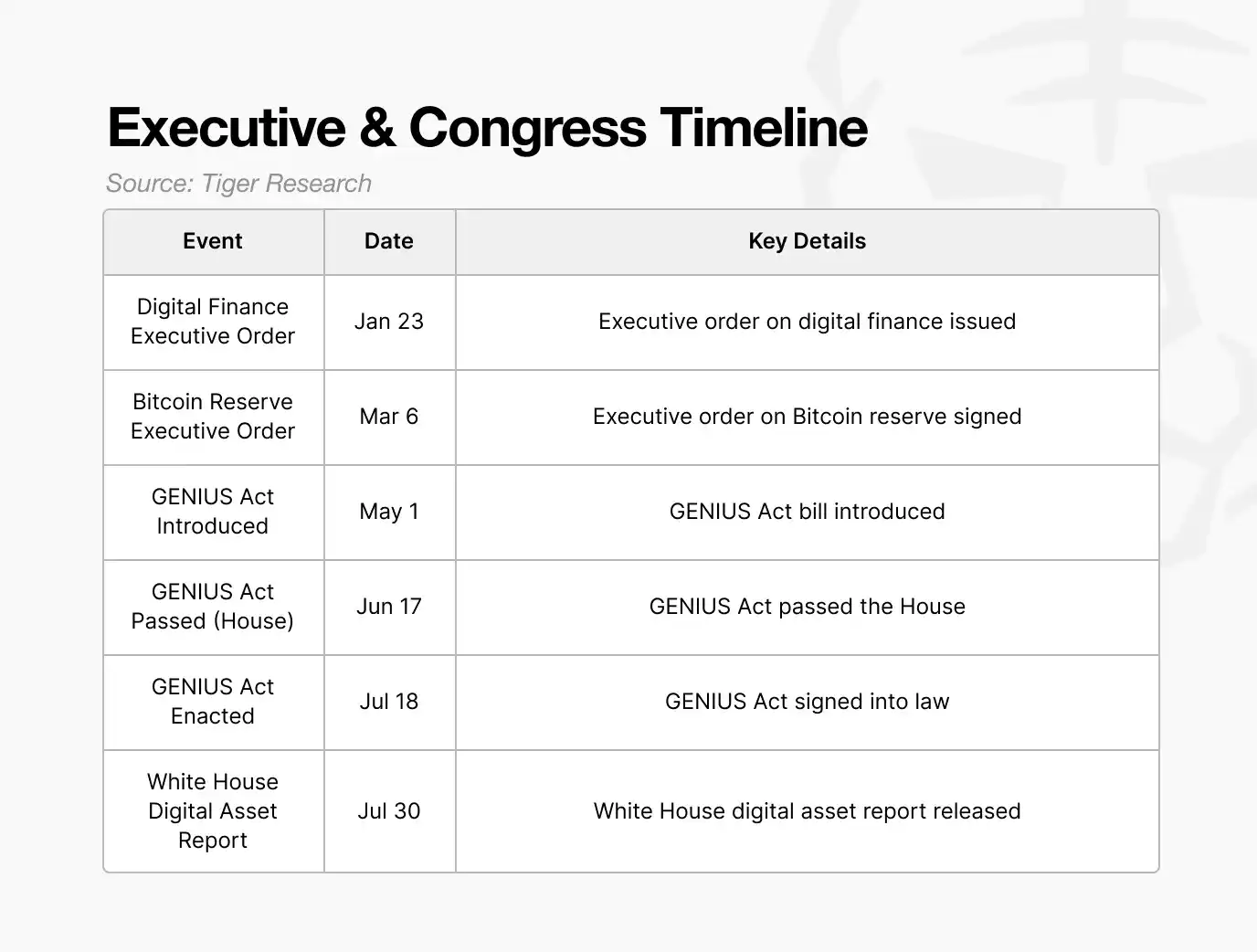
Previously, although stablecoin legislation had been brewing in the U.S. since 2022, repeated delays created a regulatory vacuum. There was a lack of clear standards regarding reserve composition, regulatory authority, and issuance requirements. Investors could not reliably verify whether issuers held sufficient reserves, raising concerns about the transparency of some issuers' reserves.

The "GENIUS Act" addressed these issues by clearly defining stablecoin issuance requirements and reserve standards. It requires issuers to hold reserves equivalent to 100% of the issued amount, prohibits the re-hypothecation of reserve assets, and consolidates regulatory authority under federal financial regulators.

Thus, stablecoins have become digital dollars with legally recognized payment capabilities.

3. Direction Set, Competition and Checks and Balances Coexist

Over the past year, the direction of U.S. cryptocurrency policy has been clear: to integrate the cryptocurrency industry into the formal financial system. However, this process is not uniform and frictionless.

Divergent views still exist within the U.S. The debate surrounding the privacy-mixing service Tornado Cash is a typical example: the executive branch actively enforces laws to block illicit fund flows, while the SEC chairman publicly warns against excessive suppression of privacy. This indicates that perceptions of cryptocurrency within the U.S. government are not entirely unified.

But these differences do not equate to policy instability; they are more akin to inherent features of the U.S. decision-making system. Agencies with different responsibilities interpret issues from their own perspectives, sometimes publicly disagreeing, moving forward through checks, balances, and persuasion. The tension between strict enforcement and protecting innovation may cause short-term friction, but in the long run, it helps make regulatory standards more specific and precise.

The key is that this tension has not stalled progress. Even amidst debate, the U.S. continues to advance on multiple fronts: the SEC's rulemaking, the CFTC's infrastructure integration, the OCC's institutional absorption, and Congressional legislation establishing standards. It does not wait for complete consensus but allows competition and coordination to proceed simultaneously, driving the system forward continuously.

Ultimately, the U.S. has neither given cryptocurrency free rein nor attempted to suppress its development. Instead, it has simultaneously reshaped regulation, leadership, and market infrastructure. By transforming internal debate and tension into momentum, the U.S. has chosen a strategy to draw the global cryptocurrency industry center towards itself.

Original Source: Tiger Research

The past year has been crucial precisely because this direction has moved beyond declarations and been concretely translated into specific policies and execution.

Trending Cryptos

Related Questions

QWhat is the core objective of the US government's current cryptocurrency policy as described in the article?

AThe core objective is to integrate the cryptocurrency industry into the existing financial infrastructure, regulating it in the same way as the traditional finance industry.

QHow did the SEC's approach to cryptocurrency regulation change under the leadership of Paul Atkins?

AUnder Paul Atkins, the SEC shifted from a stance of primarily using enforcement actions to a more open approach focused on building foundational rules to bring the crypto industry into a regulatory framework, including the 'Crypto Project' to define which tokens are securities.

QWhat significant action did the CFTC take to show it views crypto assets as more than just speculative instruments?

AThe CFTC launched the 'Digital Asset Collateral Pilot Program,' which approved Bitcoin, Ethereum, and USDC to be used as collateral for derivatives trades, applying haircut ratios and risk management standards similar to traditional collateral.

QWhat was the major development from the OCC that granted crypto companies like Circle and Ripple a status equal to traditional financial institutions?

AThe OCC conditionally approved national trust bank charters for major crypto companies like Circle and Ripple, allowing them to operate nationwide under a single federal regulator and process transactions directly like traditional banks.

QWhich piece of legislation addressed the regulatory vacuum for stablecoins, and what were its key requirements?

AThe 'GENIUS Act' addressed the regulatory vacuum. Its key requirements mandate that issuers must hold 100% reserves equivalent to the amount issued, prohibit the re-hypothecation of reserve assets, and consolidate regulatory authority under federal financial regulators.

Related Reads

The Hidden Risks Behind Anthropic's Nearly $1 Trillion Bet

Anthropic's IPO filing reveals a fragile, high-risk financing mechanism behind its AI ambitions. The company has committed to up to $895.4 billion in data center spending through 2045, with profits squeezed by rising compute costs. Rather than paying upfront for hardware, Anthropic relies on supplier-backed financing: Broadcom arranged a $63 billion equipment financing deal under which it absorbs losses if Anthropic defaults—up to roughly $43 billion once equipment is delivered. Google and AMD similarly tie funding to hardware leases or deployments. This shifts risk onto chipmakers' balance sheets, and because custom TPUs serve a narrower ecosystem than Nvidia GPUs, resale risk is higher. Analysts warn that while individual loans appear safer, risk concentration across the system is rising and harder to assess. Anthropic also can issue up to $42 billion in convertible notes to Broadcom to cover rent, with interest rates rising from 9% to 13% and conversion terms worsening if revenue targets are missed. Despite holding $146.6 billion in liquidity as of September 30, its massive forward obligations and tangled partnerships could limit access to investment-grade financing. Key concerns: whether revenue growth can outrun compute costs and cover future commitments, and whether drawing on credit lines signals distress. Anthropic's Direct initiative—separating data center leasing from chip purchases—and IPO proceeds could give it more flexibility, but ultimately debt repayment depends on end-customer revenue.

marsbit6h ago

The Hidden Risks Behind Anthropic's Nearly $1 Trillion Bet

marsbit6h ago

Google Quietly Buys Qualcomm: Mobile Chip Giant Sets Sights on Data Centers, Targets Over $15 Billion in Annual Revenue

On November 6, Alphabet disclosed a stake of about 2.977 million Qualcomm shares worth roughly $548 million as of the end of Q3 2026, a position absent from its June filing. Qualcomm shares rose over 3% premarket on the news. The investment was quickly linked to Qualcomm's push into data centers as it seeks to reduce reliance on smartphone chips. CEO Cristiano Amon reiterated plans for $5 billion in data center revenue by fiscal 2027 and over $15 billion by fiscal 2029. However, The Information reported the stake may relate to Qualcomm's acquisition of AI software startup Modular, which used Qualcomm stock as consideration; Alphabet's GV had invested in Modular, and two GV funds were listed as selling shareholders holding about 3.196 million shares—a figure that doesn't fully match Alphabet's disclosed 2.977 million. Qualcomm's smartphone business is under pressure: fiscal Q4 2026 handset chip revenue fell about 26% year-over-year to $5.14 billion, amid slowing smartphone growth and Apple's shift to in-house modems. Qualcomm has expanded into automotive, IoT, and PCs, and now sees data centers as a major opportunity. In June 2026 it unveiled its data center roadmap, including the Dragonwing portfolio (C1000 CPU, AI300 inference accelerator, and high-bandwidth compute), targeting over $15 billion in data center revenue and $40 billion in non-handset revenue by fiscal 2029. The Modular acquisition adds software—the Mojo language and MAX inference platform—to ease AI model deployment across hardware. Competition is intense: Nvidia still leads with CUDA and full systems, while AMD, Broadcom (custom ASICs), and Marvell compete, and cloud giants design their own chips—Google TPU, AWS Trainium/Inferentia, Microsoft Maia, Meta MTIA. Qualcomm announced a multi-generation custom chip deal with AWS covering AI inference and optical interconnect, reportedly allowing up to $60 billion in purchases plus warrants for up to 25 million shares; it is also working with Microsoft and Meta. Supply chain constraints remain a challenge. Google both designs TPUs and relies on partners: Broadcom co-designs TPUs under a long-term deal through 2031, and Marvell has a custom chip arrangement with potential share rights up to $12.2 billion. Google also holds Arm shares and uses Nvidia GPUs. Qualcomm's low-power and heterogeneous computing expertise could fit Google's inference needs, but no public evidence shows a data center chip deal. Existing Google-Qualcomm ties center on mobile and automotive, including expanded automotive collaboration in January 2026 and Snapdragon X Elite powering Googlebook. Whether deeper industrial links exist behind the stake remains unclear, but chip-company–tech-giant relationships are shifting as AI compute competition intensifies.

marsbit6h ago

Google Quietly Buys Qualcomm: Mobile Chip Giant Sets Sights on Data Centers, Targets Over $15 Billion in Annual Revenue

marsbit6h ago

The AI Bills of the Magnificent Seven: Who Can Still Afford to Pay?

After the U.S. midterm elections, Wall Street's optimism about AI reversed sharply. On November 5, the "Magnificent Seven" lost about $1.04 trillion in market value in a single day, with Nvidia plunging 9.26% and shedding over $440 billion—far worse than its chip buyers Microsoft, Google, and Amazon. The selloff was triggered by fears that the new Congress could tighten AI regulation and slow data center construction. Despite strong fundamentals—Nvidia's revenue doubled year-over-year, and cloud and advertising businesses kept growing—investors worry that massive AI capex has not yet translated into equivalent profits. The four major buyers (Microsoft, Google, Amazon, Meta) are spending more than their operating cash flow can support: a year ago they had a $61.7 billion surplus, but in Q3 this became a $26.4 billion deficit. Companies are increasingly relying on debt, with the five largest cloud providers issuing about $121 billion in dollar bonds in 2025—over four times the previous five-year average. Nvidia is most exposed because over 90% of its revenue depends on data centers, and 40 of 41 local data center-related ballot measures in 10 states leaned toward restricting development, with 27 restrictive proposals passing. Texas alone accounts for nearly 30% of planned 2028 U.S. computing capacity. Analysts note that projects already under construction for 2027 are largely safe, but 2028 plans face real risk. Apple is relatively insulated due to its phone and services profit base, while Tesla fell the most, also hurt by Musk's political spending. The key question remains who will pay the next massive bill—and whether buyers can keep building fast enough to sustain Nvidia's growth.

marsbit8h ago

The AI Bills of the Magnificent Seven: Who Can Still Afford to Pay?

marsbit8h ago

Trading

Spot

Hot Articles

Discussions

Welcome to the HTX Community. Here, you can stay informed about the latest platform developments and gain access to professional market insights. Users' opinions on the price of S (S) are presented below.

活动图片