Three 'Reflexivity' Shadows Hang Over the Market

链捕手Опубліковано о 2026-07-27Востаннє оновлено о 2026-07-27

Анотація

Global markets are currently enveloped by three mutually reinforcing "reflexive" loops: oil price politics, outsized capital expenditure by hyperscale cloud providers, and AI debt risks. According to Goldman Sachs, the combined negative feedback from these factors places the market in a fragile and precarious state. The first loop involves the two-way feedback between surging oil prices and rising interest rates. Brent crude's brief breach of $100 per barrel tests expectations of a U.S. policy response to curb prices and inflation. However, the delay in such intervention forces markets to increasingly price in the risks themselves. Higher energy costs are already impacting corporate earnings, as seen with an airline's profit warning, and threaten to fuel broader inflation. The second loop concerns the massive, escalating capital expenditure (capex) by major tech firms like Google, which recently raised its 2026 capex forecast significantly. The market's tolerance for viewing such spending as a cost-free growth signal is waning, shifting focus to investment returns. This competitive capex spiral pressures the entire cloud and semiconductor sector. Furthermore, the competitive gap in AI between leading closed-source and Chinese open-source models is narrowing rapidly, threatening the economic rationale behind massive investments. The third reflexive danger lies in the financing structures supporting this expansion. Bond prices for entities funding AI infrastructure, such as ...

Author: Wall Street Insights

Global markets are currently facing three mutually reinforcing reflexivity loops: oil price politics, massive capex from hyperscale cloud providers, and AI debt risks. Goldman Sachs warns that the combined negative feedback mechanism formed by these three factors leaves the current market in a fragile and precarious balance.

This week, Rich Privorotsky, head of 1-Delta Trading at Goldman Sachs, pointed out in his latest client report that the dual pressures of soaring oil prices and rising interest rates are making the market increasingly difficult to digest, and the negative shock on the bond side has deteriorated sharply.

He stated that without substantive easing at the political level, the market will have to absorb the risks on its own, pushing the situation towards a worse direction.

At the same time, the uncontrolled expansion of capital expenditures by tech giants and the price collapse of AI infrastructure-related bonds are shaking investor confidence in the hyperscale cloud provider narrative.

Privorotsky warns that betting on these companies is essentially evolving into a high-stakes gamble on "the revenue inflection point arriving before the peak in expenditures."

The two-way feedback mechanism between oil prices and politics is the first reflexivity chain Privorotsky is most concerned about.

Brent crude oil prices briefly broke through $100 per barrel this week, testing market expectations regarding Trump's policy responses.
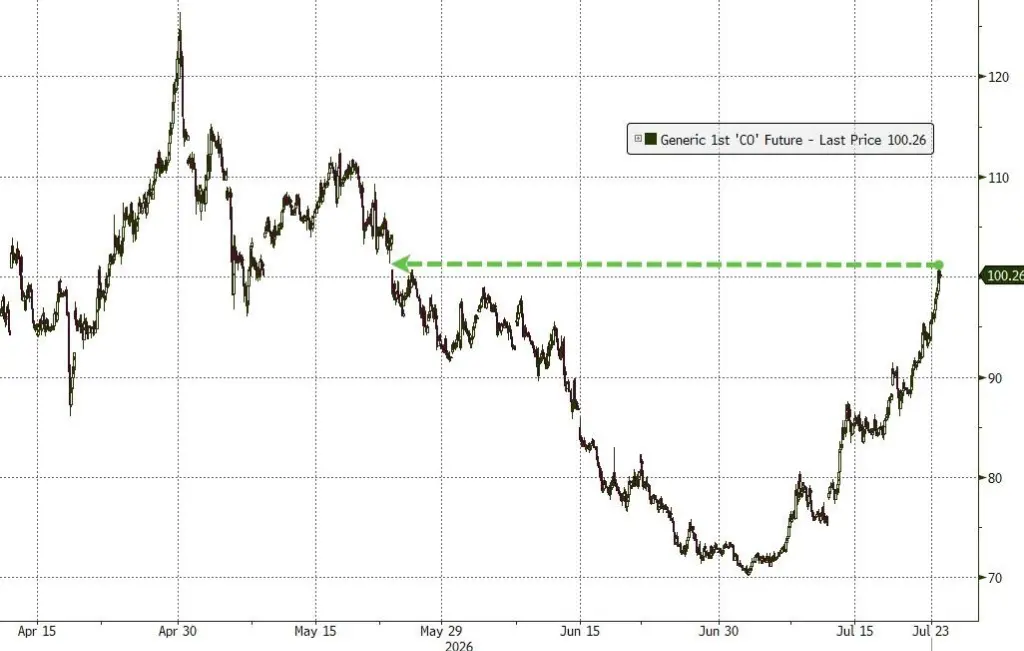
Previously, the market generally expected that once oil prices breached a certain threshold, pushing up retail gasoline prices and dragging down presidential approval ratings, the Trump administration would intervene to curb oil prices.
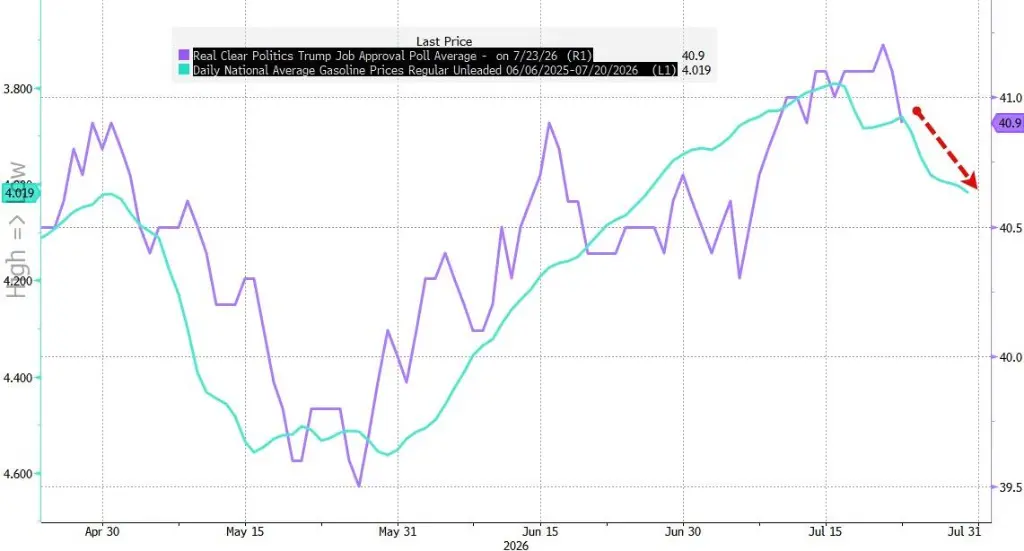
This expectation has supported stock market resilience to some extent, but Privorotsky pointed out that each day that passes without a policy response at the same price level forces the market to drive the outcome itself.

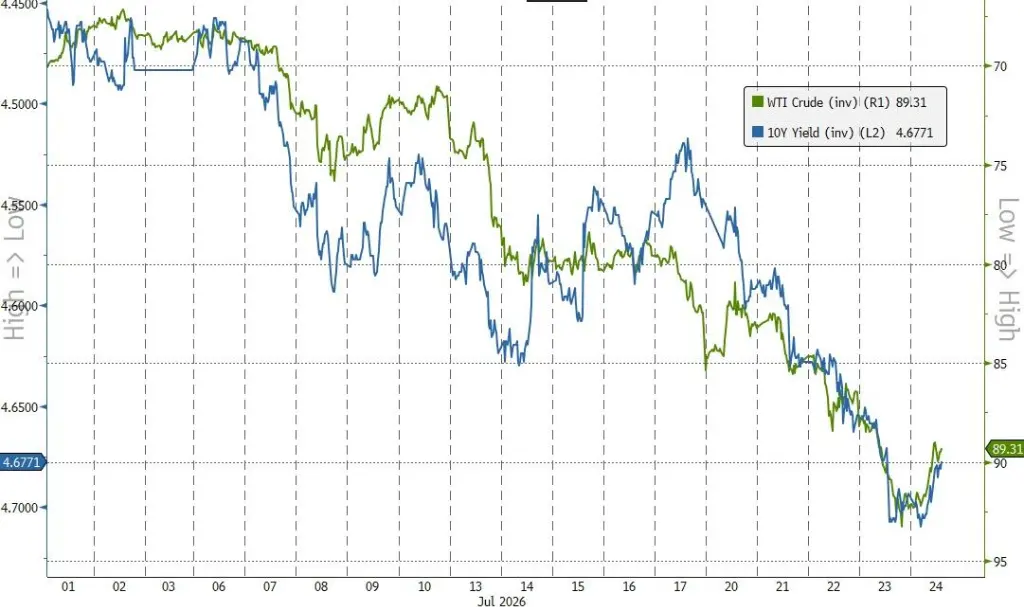
The interest rate shock is becoming the most difficult variable to ignore in this loop.
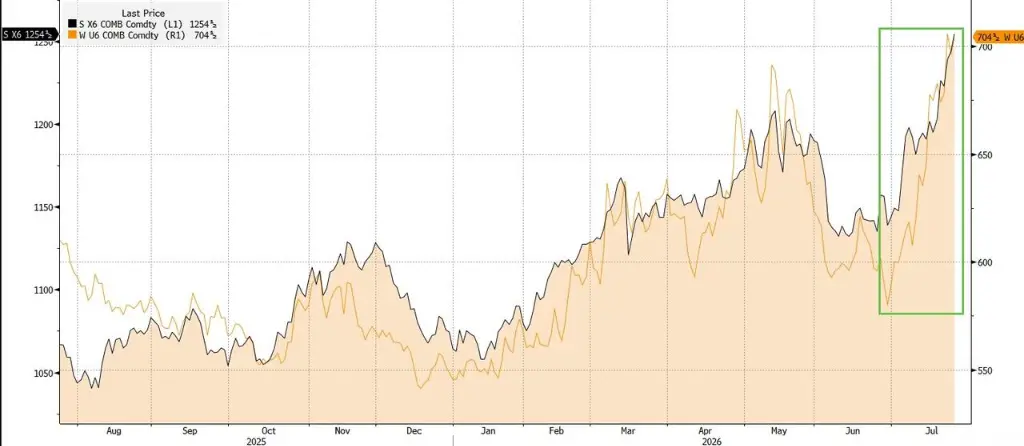
Meanwhile, the transmission of energy costs into food inflation is also about to become a reality.
Warning signals have already appeared at the real economy level—despite record-high revenues, rising ticket prices, and relatively robust demand, American Airlines still lowered its 2026 performance guidance, citing that its fuel costs have increased by about $1.6 billion since early July.

Geopolitical tensions continue to heat up.

According to CCTV News, on July 24 local time, when discussing the "exit strategy" for the war with Iran at the White House, President Trump stated that the US has two choices: first, continue current military operations, possibly intensifying strikes, and gradually destroy Iran's military capabilities; second, reach an agreement through negotiations.

Wall Street Insights mentioned that earlier that day, Reuters cited sources reporting that Pakistan is exploring ways to push for the resumption of stalled US-Iran negotiations.

Israeli Prime Minister Netanyahu will visit the White House to meet with Trump next Tuesday. Privorotsky suggests this timing may be brewing a "TACO moment" for the market—a sudden negotiation or compromise-driven market movement.

The second reflexivity loop revolves around the capital expenditures of hyperscale tech companies, with its core contradiction being: is the market still willing to view massive investments as growth signals with no cost?

Google became the negative symbol of this earnings season for tech. The company announced an increase in its 2026 capital expenditure guidance to $195-205 billion, with free cash flow for the quarter at negative $5.9 billion, and its stock price subsequently fell by 6.9%.

While operational data such as 82% growth in cloud business was impressive, the market is no longer willing to view expenditures as cost-free strategic investments, and questions about cutting-edge product roadmaps and return on investment received almost no positive response.

The deeper impact lies in competitive transmission. If Google increases spending, it will force peers to follow suit, putting pressure on the entire hyperscale cloud computing sector. The hardware side is also sounding alarms:

  • STMicroelectronics' core profits missed expectations, and Q3 revenue guidance appeared slightly weak, with the stock falling about 14%;
  • Texas Instruments (TXN) performed relatively solidly but still closed down 3%.

Regarding the competitive landscape in artificial intelligence, Privorotsky pointed out that the gap between leading closed-source models and Chinese open-source models has narrowed significantly.
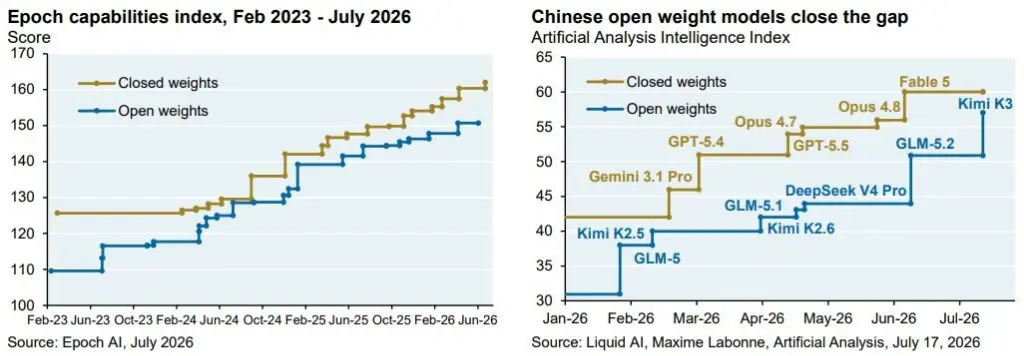
He stated that the gap, previously measured in nine to twelve months, has now compressed to weeks on some benchmarks. The cost-to-marginal-benefit ratio of pre-training versus reinforcement learning and post-training is creating vastly different economic models; the intensity of competition at the application layer and the flatness of the competitive landscape are historically rare.

He believes that the risks from small models and efficiency improvements are a "story for later," but should not be underestimated.

The third reflexivity loop is hidden within the bond and financing structures of hyperscale tech companies.

Privorotsky views the bond market as the most noteworthy risk signal at present.

Taking Meta's "Hyperion" financing of $27.3 billion completed through the Beignet SPV as an example, this bond issuance was priced at par and later traded above 109, but has now fallen back to around 95.
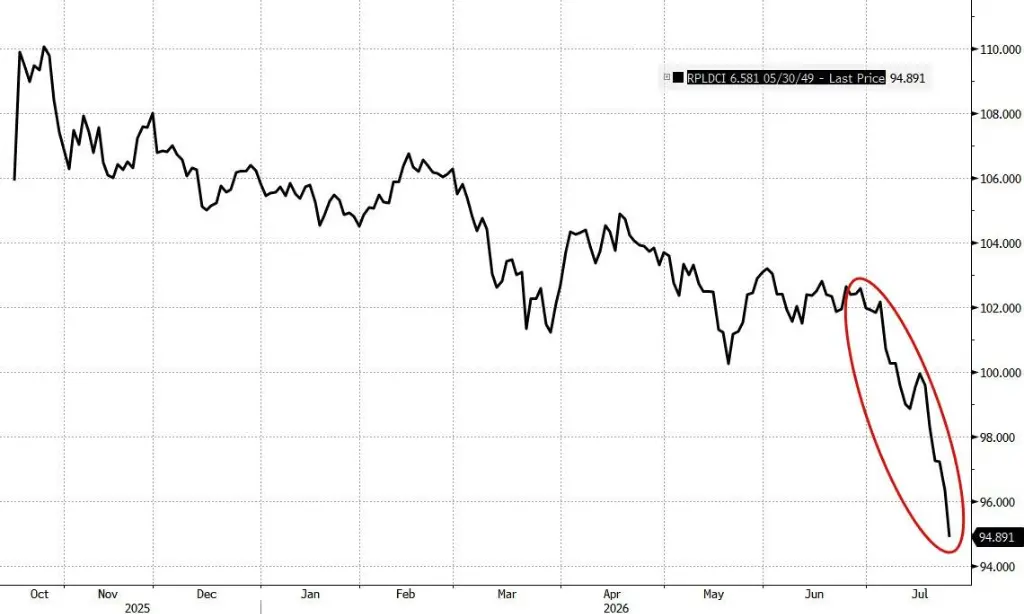
Although the overall financial health of hyperscale cloud providers remains robust, with balance sheet leverage not high, the impact of valuation repricing on stock multiples has been quite significant.
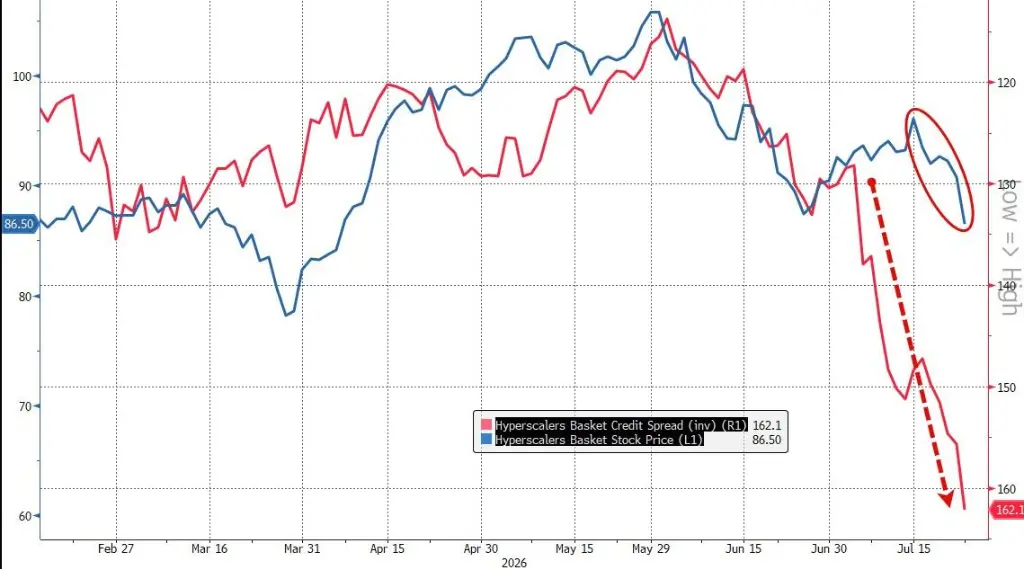
The more severe problem is that as capital expenditures accelerate, free cash flow conversion continues to deteriorate, and the impact on leveraged entities providing financing for infrastructure construction will be even more drastic.

Privorotsky warns that today's capacity expansion could evolve into tomorrow's computing power oversupply, and at that time, larger-scale depreciation expenses will begin to wash over the income statement.
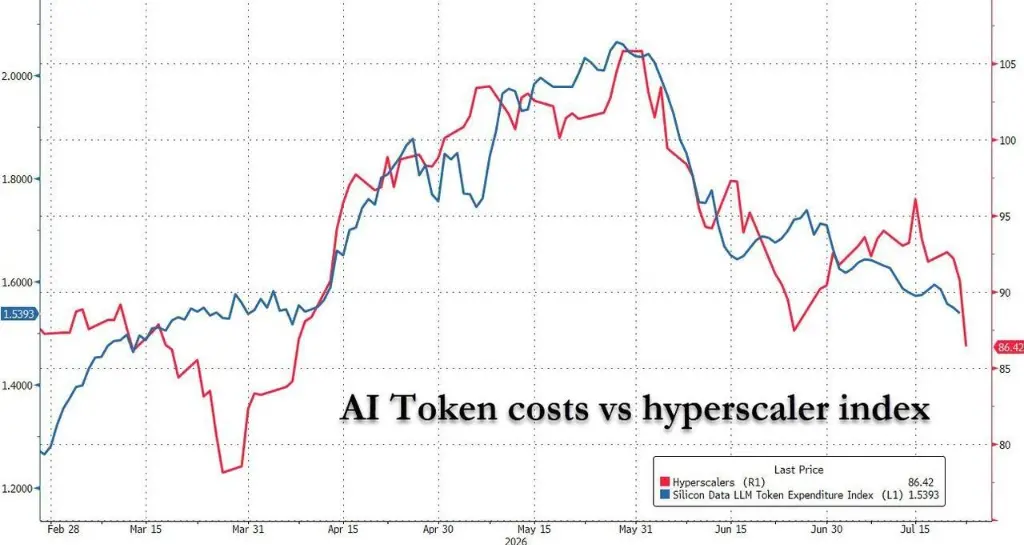
Looking ahead to the near term, Privorotsky named two events that will serve as crucial tests for the aforementioned reflexivity themes.

The first is Microsoft's earnings conference call this Wednesday. He believes, "If the reflexivity theme is to play out, this might be the most crucial call."

The market will closely scrutinize Microsoft's balance between capital expenditures, cloud growth, and free cash flow to judge whether the hyperscale tech narrative can stabilize.

The second is the IPO of Chinese memory chipmaker ChangXin Memory on the STAR Market. ChangXin Memory is currently the world's fourth-largest DRAM producer, and this fundraising round amounts to approximately $8.6 billion.

Privorotsky emphasized, "This is by no means an insignificant new competitor." If its post-IPO stock price trades close to the valuation levels implied by the OTC perpetual market, it will have a significant impact on the entire memory chip sector.

Privorotsky concluded with a sentence summarizing the current situation:

It feels a bit like circular referencing on the oil price issue.

In a market dominated by reflexivity, every variable is both cause and effect.

Пов'язані питання

QWhat are the three self-reinforcing reflexive loops mentioned by Goldman Sachs's Rich Privorotsky that are putting the global market in a fragile and dangerous balance?

AThe three self-reinforcing reflexive loops are: 1) The two-way feedback mechanism between oil prices and politics. 2) The capital expenditure explosion by hyperscale technology (cloud) companies. 3) The debt and financing risks embedded in the bonds and funding structures of these same hyperscale companies.

QWhy did Google's stock fall despite strong cloud growth in its recent earnings report, according to the article?

AGoogle's stock fell because the market is no longer willing to view massive capital expenditures as cost-free strategic investments. The company raised its 2026 capital expenditure guidance significantly to $195-205 billion and reported negative free cash flow of $5.9 billion for the quarter, raising investor concerns about investment returns and future profitability.

QWhat is the 'TACO moment' that Privorotsky suggests might be brewing around the meeting between Israeli PM Netanyahu and President Trump?

AA 'TACO moment' refers to an unexpected negotiation or compromise that triggers sudden market movements. Privorotsky suggests the upcoming meeting between Netanyahu and Trump could be a catalyst for such a moment, potentially impacting oil prices and geopolitical tensions.

QWhat specific warning does Privorotsky give regarding the bond market, using Meta's 'Hyperion' financing as an example?

APrivorotsky warns that the bond market is a key risk signal. He cites Meta's 'Hyperion' bond issuance of $27.3 billion, which was priced at par (100) and traded above 109, but has since fallen to around 95. This price drop indicates growing market concern about the debt used to finance AI infrastructure, suggesting a repricing of risk for hyperscale companies.

QWhich two upcoming events does Privorotsky identify as critical tests for the 'reflexivity thesis' presented in the article?

AThe two critical upcoming events are: 1) Microsoft's earnings call, where the market will scrutinize its balance between capital expenditure, cloud growth, and free cash flow. 2) The IPO of Chinese memory chip maker CXMT (ChangXin Memory Technologies) on the STAR Market, as its post-listing valuation could significantly impact the global memory chip sector.

Пов'язані матеріали

Meme Coins Peak in 17.2 Days on Average: Ephemeral Fervor and the Great Capital Migration

Meme Coins' Average Peak: 17.2 Days - A Fleeting Frenzy and a Capital Exodus A Bloomberg analysis reveals the stark reality behind meme coin mania: extreme short-term speculation. On average, a new meme coin reaches its all-time high (ATH) a mere 17.2 days after its first trade. Alarmingly, 25% of projects peak within just 38.4 hours. The subsequent decline is brutal, with the median time to drop 95% from the peak and enter dormancy being 370 days. Only about 3% ever break their previous ATH again. This drastic compression of the speculative lifecycle is driven by zero-barrier token creation on platforms like Pump.fun and automated trading tools like sniper bots, which enable instant deployment and rapid pump-and-dump schemes. The market is saturated, diluting liquidity and forcing a predatory, player-versus-player environment where early holders quickly exit with minimal gains. As the odds of success in traditional meme coins diminish, speculative capital is migrating. Decentralized prediction markets like Polymarket, offering transparent, event-driven betting, are attracting significant liquidity. Concurrently, AI agent tokens are drawing funds with their combination of high volatility and long-term narrative tied to artificial intelligence. This capital shift marks a move away from simplistic "greater fool" assets toward platforms with clearer mechanisms or dynamic technological themes.

marsbit23 хв тому

Meme Coins Peak in 17.2 Days on Average: Ephemeral Fervor and the Great Capital Migration

marsbit23 хв тому

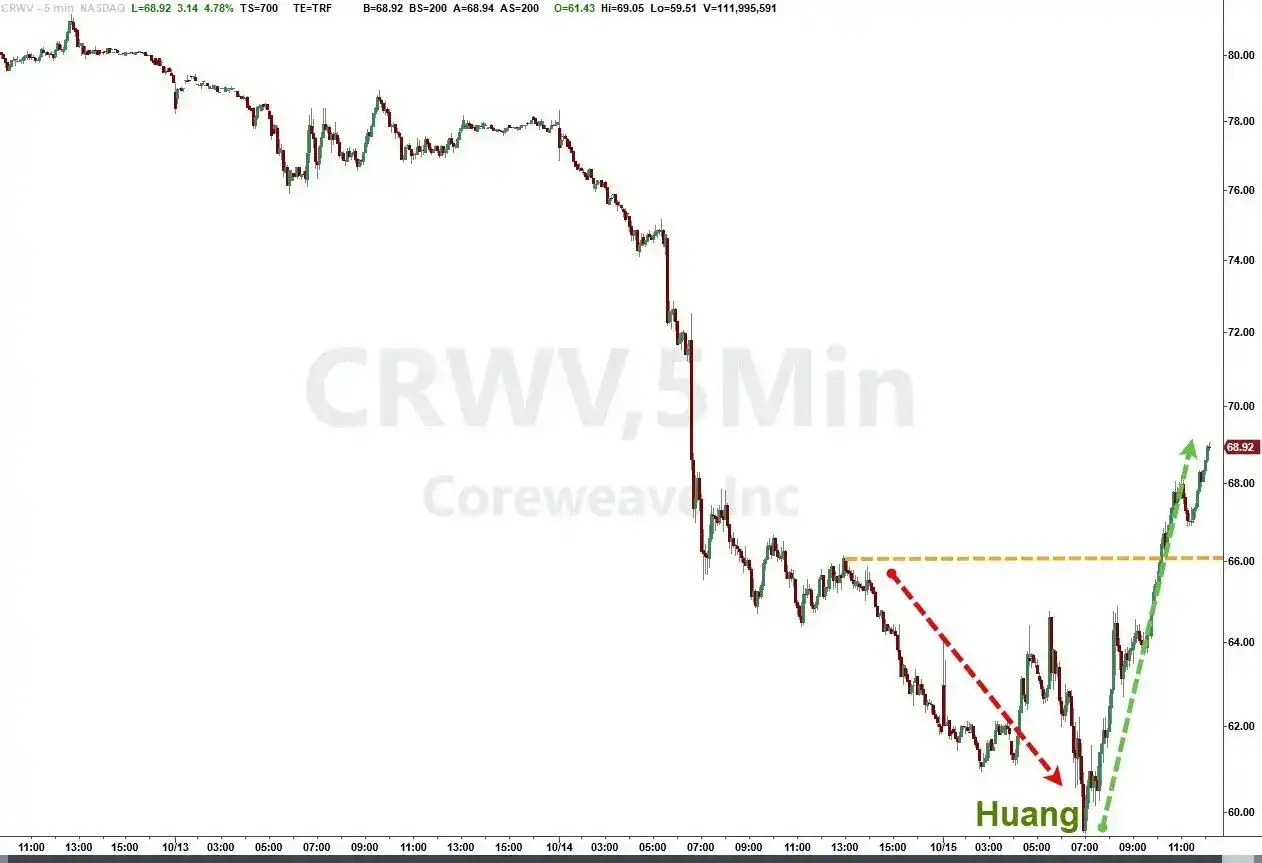
CoreWeave Default Probability Exceeds 60%! Huang Renxun 'Puts Out Fire': Financing Costs Declining, No Need for NVIDIA to Provide Backstop

CoreWeave, a major AI cloud service provider and key NVIDIA customer, is facing heightened credit market concerns. Its five-year credit default swap (CDS) spreads soared to a record high of over 1190 basis points, implying a perceived default probability exceeding 60%. Concurrently, its bond prices plummeted, with yields surging above 15-16%, reflecting intense investor worries about its ability to service nearly $50 billion in debt while remaining unprofitable. This stress is spreading within the AI infrastructure sector. CDS spreads for companies like Oracle, SoftBank, NVIDIA, and others also widened significantly, indicating a broader market reassessment of the debt risks behind massive AI capital expenditures. In response, NVIDIA CEO Jensen Huang publicly expressed confidence in CoreWeave, stating its "financial strength is growing daily" and its cost of capital is declining. He explicitly stated NVIDIA sees no need to provide a financial backstop for CoreWeave, in which it holds a roughly 10% stake. His comments helped CoreWeave's stock recover from early losses. The core issue under scrutiny is whether the future cash flows from AI investments can cover the enormous upfront costs and interest burdens, especially as financing becomes more expensive. The situation highlights a critical shift in market focus: from purely evaluating AI compute demand to questioning the sustainability of the debt-fueled expansion models used to build that capacity.

marsbit43 хв тому

CoreWeave Default Probability Exceeds 60%! Huang Renxun 'Puts Out Fire': Financing Costs Declining, No Need for NVIDIA to Provide Backstop

marsbit43 хв тому

Farcaster Changes Hands Again: The Hottest Potato in the Decentralized World

The decentralized social protocol Farcaster has changed ownership for the third time in nine months, being described as a "hot potato" in the decentralized world. On October 15, 2026, Rish, co-founder of Neynar, announced that Network School, founded by Balaji Srinivasan, would take over Farcaster, including its application, protocol codebase, and related products. This followed Neynar's acquisition of Farcaster from its original creator, Merkle Manufactory, in January 2026. Farcaster, which achieved a $1 billion valuation after a $150 million Series A round in 2024, saw its user activity and revenue decline sharply post-2025. Daily active users (DAU) dropped 40% from its peak of nearly 100,000, and monthly revenue fell to around $10,000. After taking over, Neynar pivoted Farcaster toward developers, but protocol revenue (including from Clanker) plummeted by 99% from Q1 to Q3 2026, leading to the search for a new owner. Network School, Balaji Srinivasan's venture practicing his "network state" theory and recently valued at $2 billion, plans to rebrand Farcaster as the "Network State Protocol." Significant rule changes include requiring users to accept a "social smart contract" to mint an NFT for full access, implementing content moderation based on Singaporean public conduct codes, and introducing AI-assisted review with potential human verification. These changes, particularly the centralized control over content and access via the dominant official app (formerly Warpcast), have sparked community debate. The repeated ownership transfers highlight a core tension in decentralized social networking: while the protocol layer is technically decentralized, control over the primary user application grants centralized power over the entire network's experience and direction. Each new owner brings a different vision, but all face the fundamental challenge of reviving a platform with declining users and revenue.

marsbit43 хв тому

Farcaster Changes Hands Again: The Hottest Potato in the Decentralized World

marsbit43 хв тому

US Stock Market Trends (October 16): Dow Surges Over 550 Points, TSMC's Net Profit Rises Nearly 70% but Stock Closes Lower

**U.S. Market Trends (October 16): Dow Jumps Over 550 Points, TSMC Falls Despite 69% Net Profit Surge** U.S. stocks reversed early losses on Thursday. The Dow Jones surged over 550 points (1.08%), while the Nasdaq Composite edged up 0.08%. The Philadelphia Semiconductor Index fell for a seventh consecutive session, closing down 0.88%. The S&P 500 rose 0.33%, with healthcare, materials, and financials leading gains. Energy and tech sectors declined. Major tech stocks were mixed. Microsoft and Alphabet gained, while Nvidia and Tesla fell. Server stocks like Dell and Hewlett Packard Enterprise dropped sharply. Despite reporting strong Q3 results—a 69% year-on-year jump in net profit and raising its full-year revenue growth forecast to ~44%—TSMC's U.S.-listed shares fell 1.80%. Investor concerns persist about funding for massive AI/data center expansions and their eventual returns. CoreWeave's stock rebounded to close nearly 6% higher after Nvidia CEO Jensen Huang stated the AI cloud provider was strengthening and did not need rescue, easing equity investor worries. However, its bonds remained under pressure due to high leverage and funding needs. Economic data showed mixed signals. September PPI surged 1.3% month-on-month (the highest since March 2022), driven by energy prices. Retail sales grew 0.8%, largely fueled by gasoline spending. Excluding autos and gas, growth was minimal. Despite hot inflation prints, Treasury yields retreated, with the 10-year near 5.09%. Oil (WTI) rose over 3%, while gold gained 2%. Bitcoin traded around $82,300. Focus turns to upcoming remarks from Fed officials ahead of the quiet period and key data like industrial production, as investors weigh inflation against growth concerns and tech sector volatility.

marsbit59 хв тому

US Stock Market Trends (October 16): Dow Surges Over 550 Points, TSMC's Net Profit Rises Nearly 70% but Stock Closes Lower

marsbit59 хв тому

Торгівля

Спот
活动图片