The Sixth Kondratieff Wave Cycle is Approaching: How Should Ordinary People Prepare for the Next Decade?

marsbitPublished on 2026-10-09Last updated on 2026-10-09

Abstract

The sixth Kondratiev wave is approaching, centered on energy revolution and artificial intelligence. Historical analysis shows each transition from depression to recovery is driven by major technological breakthroughs. Currently at the end of the fifth wave's depression phase, 2026-2030 presents a prime investment window before the sixth wave's rise. This period is ideal for dollar-cost averaging into indices like the Nasdaq 100 or S&P 500, which inherently hold core companies driving the next technological cycle. Starting investments during this anticipated recovery phase, characterized by market volatility, allows for accumulating assets at lower average costs before the expected prosperity period post-2030. The strategy leverages the cyclical nature of economic waves, positioning early investors to benefit from the forthcoming AI and digital economy boom.

Author:The Unfathomable SOL

Prosperity in life relies on the Kondratieff wave. That's right.

Starting October 2026, the best time for dollar-cost averaging is here.

The phrase "prosperity in life relies on the Kondratieff wave," widely circulated in investment circles, accurately captures the profound relationship between cycles and personal wealth accumulation.

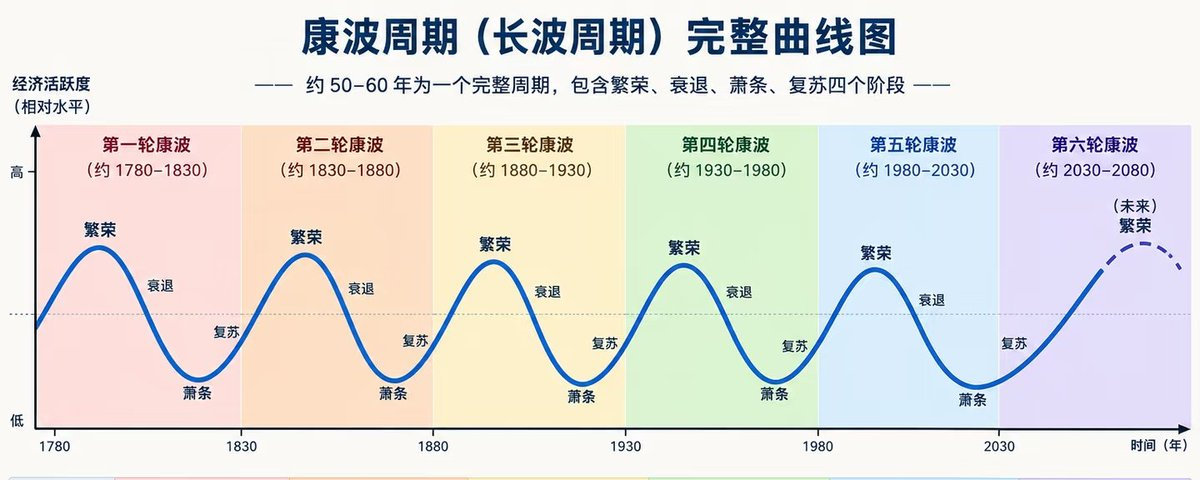
October 2026 stands at a crucial historical turning point; we are standing at the end of the depression phase of the fifth Kondratieff cycle (the Information Technology era), poised to enter the recovery phase of the sixth Kondratieff cycle (centered on the energy revolution and artificial intelligence).
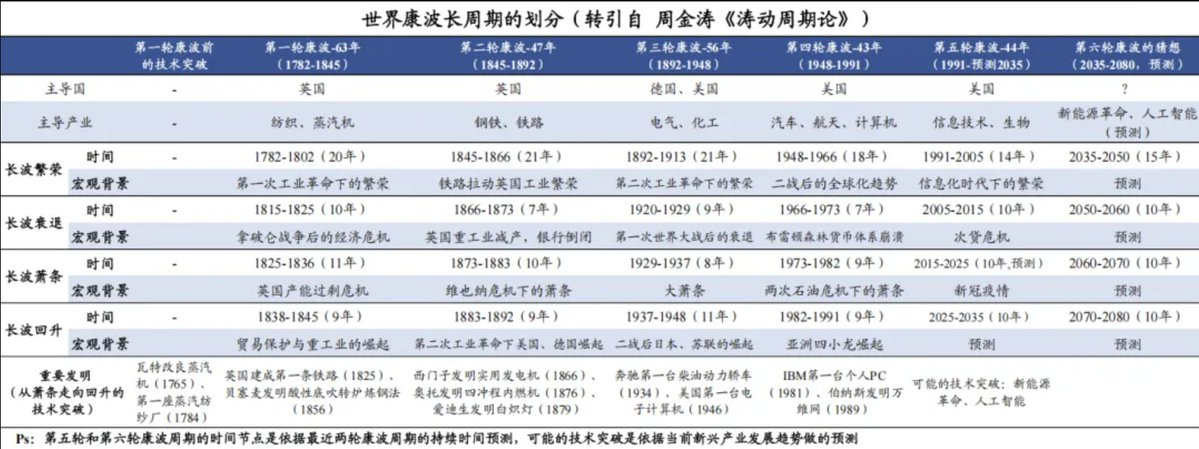
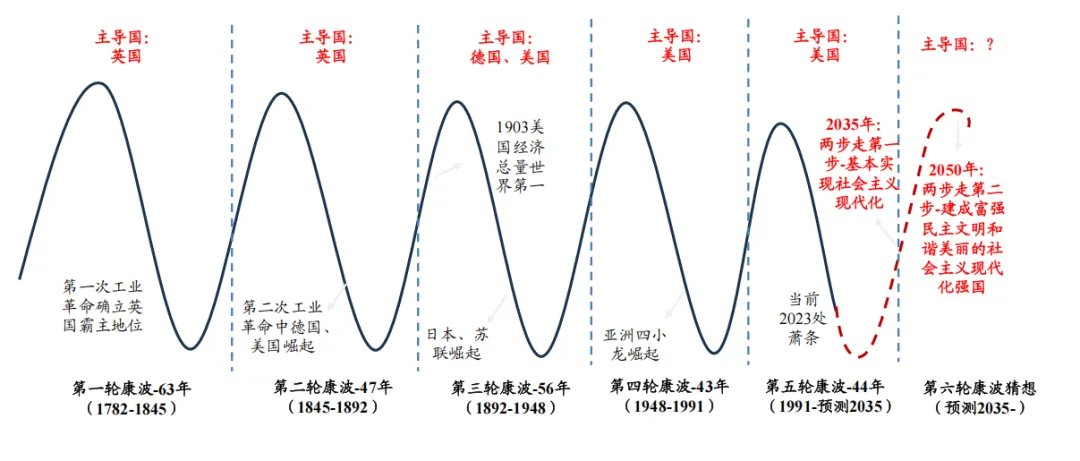
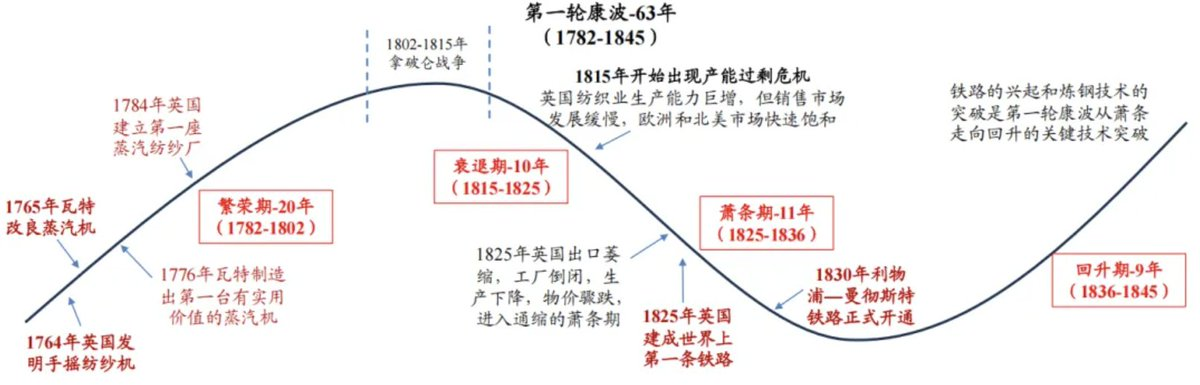
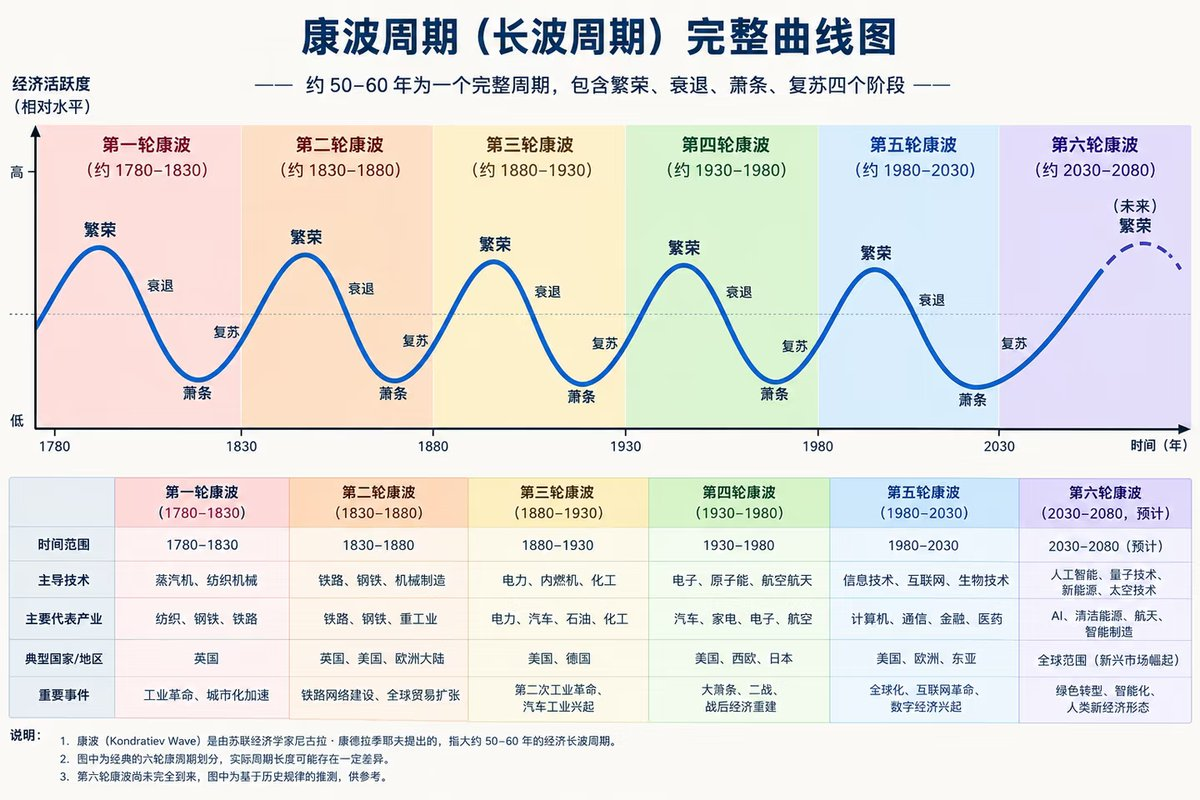
Looking back at the five completed Kondratieff waves, each corresponds to a technological revolution. As shown in the figure below, the first Kondratieff period, spanning from 1782 to 1845, was led by Britain, using textiles and the steam engine to initiate the first Industrial Revolution;
The second Kondratieff wave, from 1845 to 1892, was still dominated by Britain, though it peaked with the widespread adoption of steel and railways;
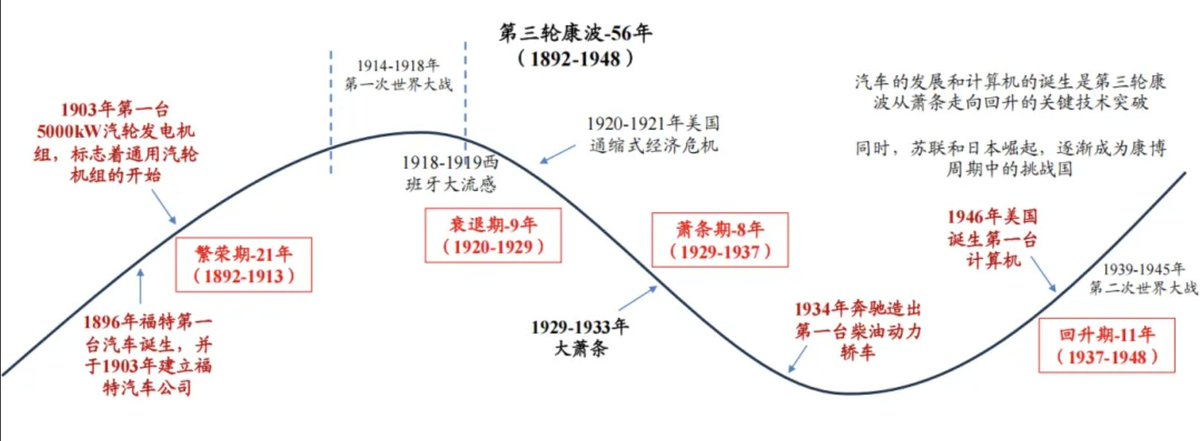
The third Kondratieff wave, from 1892 to 1948, saw the dominant power shift from Europe to the United States, with electricity, heavy chemicals, and the internal combustion engine playing leading roles;

The fourth Kondratieff period, from 1948 to 1991, was led by the United States, with automobiles and computers driving post-war globalization and prosperity;
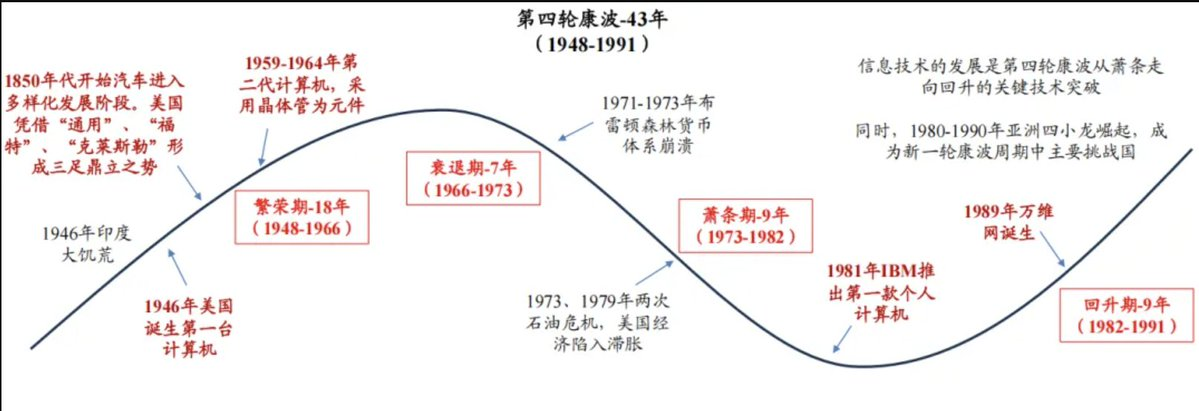
The fifth Kondratieff wave, from the predicted 1991 to 2035, remains dominated by the United States, with information technology and the internet profoundly changing the world.
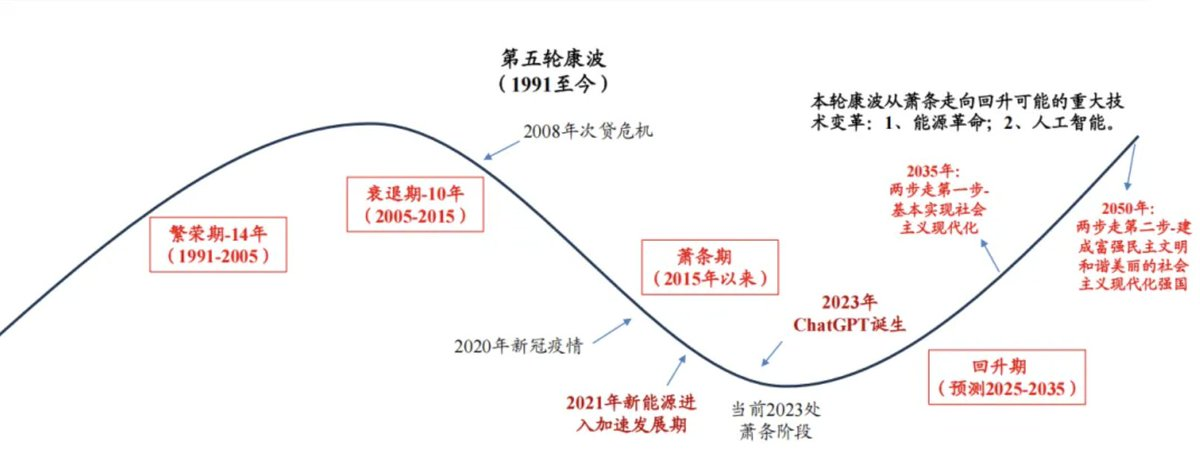
We can clearly see that each Kondratieff wave's transition from depression to recovery requires major technological breakthroughs as catalysts, such as railways and steelmaking for the first, electricity and heavy chemicals for the second, automobiles for the third, and information technology for the fourth.

In recent years, the world has experienced a series of shocks including the "mask" [likely referring to the pandemic], geopolitical conflicts, and soaring inflation, precisely aligning with the typical characteristics of a Kondratieff depression phase: low growth and alternating inflation/deflation, with old growth drivers fading and society entering a painful cleansing phase.

The fifth Kondratieff wave, driven by information technology, began around 1991, and its prosperity and recession phases have become history. In 2026, we are in a period where the old forces have dissipated and new forces are not yet mature—a 'transitional' phase, yet this is precisely the golden window for positioning for the future.

Looking ahead from 2026 to the next decade, the insight from the Kondratieff cycle is very clear: the core driving force moving from depression to recovery must be new technologies capable of revolutionizing productivity.

Looking at the column in the chart for each wave's "technological breakthroughs leading from depression to recovery," we can see: the first wave featured Watt's improvements to the steam engine and the rise of railways; the second wave saw the invention of the generator, internal combustion engine, and incandescent light bulb; the third wave brought the diesel-powered car and the electronic computer; the fourth wave witnessed the birth of the personal PC and the World Wide Web. The fifth wave saw information technology and the internet profoundly change the world.

Leading the development of this recovery trend is precisely the technological breakthrough predicted for the sixth Kondratieff wave (spanning 2035 to 2080) in the chart, specifically the energy revolution and artificial intelligence.

So, what should we do next?

Why 2026–2030 is the Best Period for Dollar-Cost Averaging
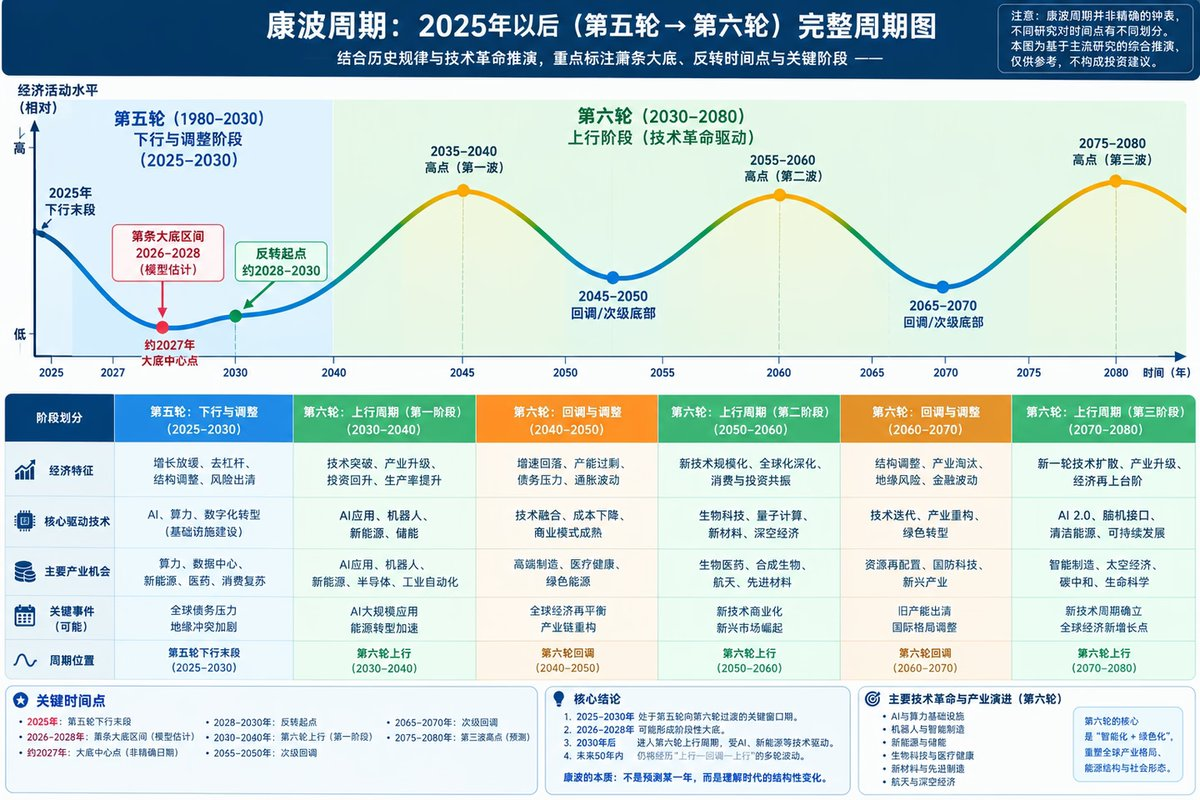
Not because I foresee any particular market trend—I don't have that ability. It's because I have re-evaluated my own dollar-cost averaging plan for the next decade, and the conclusion is clear: the five years from 2026 to 2030 represent the best DCA window I can see.

Three reasons, ranked by importance.

1. Position: The Sowing Phase of the Kondratieff Cycle

Before his passing, Zhou Jintao's division of the fifth information technology Kondratieff wave was: Recovery 1982–1991, Prosperity 1991–2004, Recession 2004–2015, Depression 2015–2025. He passed away in 2016 and didn't have time to outline the sixth wave. However, the consensus projection within the cycle research community is that 2025–2026 marks the transition point from depression to recovery.

Note, the recovery phase is not the prosperity phase. Its characteristics are repeated bottoming, structural divergence, and no universal rally—it rises, falls back, and climbs again.

This characteristic torments market timers but is a gift for DCA practitioners. The strategy of dollar-cost averaging fears the prosperity phase most: prices rise continuously northward, and each purchase is more expensive than the last. It thrives in the environment of a recovery phase—the market repeatedly gives you discounts, and your average cost is depressed to low levels through waves of volatility.

Regarding position, in one sentence: 2026–2030 is the sowing phase of the next cycle, and DCA is the natural sowing tool.

2. Vehicle: The Index You DCA Into Is the Engine of This Cycle

The technological vehicles of the sixth Kondratieff wave are AI, computing power, and the digital economy.

Open the composition table of the Nasdaq-100: Nvidia, Microsoft, Apple, Amazon, Google, Meta—the core assets of the sixth Kondratieff wave are this index itself. The same goes for the S&P 500, where digital economy companies constitute an absolute majority of the top ten holdings.

More crucially, these two indices rebalance faithfully every December: bringing in the best performers and removing the laggards. I don't need to judge which company will win in this technological revolution—I only need to be certain of one thing: whoever wins, it will likely be in the Nasdaq-100.

Dollar-cost averaging into a self-updating collection of digital economy companies is equivalent to turning the industrial dividends of the sixth Kondratieff wave into my regular deposits.

3. Timing: Sowing Must Precede Prosperity

This is the most easily overlooked point.

A Kondratieff wave typically takes more than five years to progress from recovery to prosperity. This means that those who start DCA in 2026 will have accumulated five years of cheap chips by the time the prosperity phase arrives around 2030; whereas those who enter the market in 2030 can only chase prices higher all the way during the prosperity phase.

Within the same cycle, the cost structure for those who enter in the first five years and those who enter in the last five years belongs to two different worlds. This is the meaning of "window"—it's not a single day, but the few years when sowing must happen before the harvest.
Therefore, 2026–2030 is the optimal DCA period in my personal judgment.

Trending Cryptos

Related Questions

QWhat is the core argument made in the article regarding the next Kondratiev Wave?

AThe article argues that we are at the end of the fifth Kondratiev Wave (the Information Technology era) and are about to enter the sixth wave. This sixth wave will be driven by the dual engines of an energy revolution and artificial intelligence (AI), representing the major technological breakthroughs needed to move the global economy from a depression phase to a recovery phase.

QAccording to the author, why is the period from 2026 to 2030 considered the best time for Dollar-Cost Averaging (DCA)?

AThe author identifies three key reasons why 2026-2030 is the best DCA window. First, it coincides with the 'sowing' period of the new Kondratiev Wave's recovery phase, where market volatility helps lower the average purchase cost. Second, the key assets of the sixth wave (AI, compute, digital economy companies) are already core components of major indices like the Nasdaq 100. Third, starting DCA several years before the anticipated prosperity phase (around 2030+) allows an investor to accumulate cheaper shares compared to those who enter later during the peak.

QWhat are the primary technological drivers identified for the past Kondratiev Waves mentioned in the article?

AThe article lists the following technological drivers for the past Kondratiev Waves: The First Wave was driven by textiles and the steam engine. The Second Wave by steel and railways. The Third Wave by electricity, heavy chemicals, and the internal combustion engine. The Fourth Wave by automobiles and computers. The Fifth Wave, which is ending, was driven by information technology and the internet.

QHow does the author suggest an ordinary person can practically benefit from the upcoming sixth Kondratiev Wave?

AThe author's primary practical suggestion is to use a Dollar-Cost Averaging (DCA) strategy to invest in broad market indices, specifically highlighting the Nasdaq 100 and the S&P 500. The logic is that these indices contain the major companies (like NVIDIA, Microsoft, Apple) that are driving the sixth wave's core technologies (AI, digital economy). By regularly investing in these self-updating indices, an individual can passively capture the industrial红利 of the new technological revolution without needing to pick individual winning companies.

QWhat characteristics define the 'recovery phase' of a Kondratiev Wave, and why is it suitable for DCA?

AThe 'recovery phase' is characterized by a bottoming-out process with structural differentiation and no broad-based rally—prices rise and fall repeatedly in a volatile, grinding pattern. This environment is considered suitable for Dollar-Cost Averaging because the strategy thrives on volatility. Instead of trying to time the market, DCA involves buying at fixed intervals, which means purchasing more shares when prices are low during dips and fewer when prices are high, ultimately achieving a lower average cost per share over the long term.

Related Reads

Tech Veteran: Anthropic IPO Will Be the Peak of the US AI Rally, Will "Go Big on China AI" If Conditions Allow

Veteran tech investor Jack Selby, head of Copper Sky and managing partner of Peter Thiel's family office, warns that Anthropic's planned IPO—aiming to raise up to $100 billion—could mark the peak of the AI market rally. He cautions that if the highly anticipated IPO prices well below expectations, the expiry of lock-up periods could trigger significant selling pressure and a large-scale AI market correction. Selby names SoftBank and Oracle as "canaries in the coal mine," flagging Oracle's higher debt ratio as a bigger risk, and suggests investors needing AI exposure consider Google instead. Selby also questions Anthropic's fundamentals: over 80% of its revenue is non-recurring and vulnerable to competitors closing the technology gap within six to nine months. He notes the business is extremely capital-intensive—requiring costly data, energy, data centers, and chips—and that with interest rates no longer near zero, calling it a trillion-dollar company seems far-fetched. He further highlights Chinese competition, saying DeepSeek and other Chinese AI models trail Anthropic by only about six months, posing a direct threat. Selby says he would "aggressively go long on Chinese AI" if conditions allow, arguing that Anthropic cannot claim all its business must rely on U.S. models, since most AI use cases resemble basic tool applications, leaving room for Chinese alternatives.

marsbit2h ago

Tech Veteran: Anthropic IPO Will Be the Peak of the US AI Rally, Will "Go Big on China AI" If Conditions Allow

marsbit2h ago

Grayscale's $1 Million Sponsorship Can't Save It: Why ZEC, Once Hyped as the Belle of the Ball, Crashed Again?

Grayscale announced a $1 million ecosystem sponsorship for Zcash on November 10, pledging to return all first-year management fees from its Zcash ETF (ZCSH) to network development and marketing, with the first $100,000 distributed to four nonprofit organizations. Yet the same day, ZEC plunged 11.3% to around $1,043, extending its 30-day decline to nearly 20%. After two months of hype from overseas KOLs and institutions touting ZEC as a "second spring for old coins," the token quickly turned into a slow bleed under the weight of $2.3 billion in open interest. The article argues that Wall Street's narrative halo and Grayscale's PR subsidy have been exhausted, and ZEC—lacking fundamental support—has once again become an ATM for highly leveraged speculators to cash out on good news. Grayscale's pledge, while seemingly generous, is voluntary and can be modified or terminated at any time; only $400,000 of the $1 million has actually been paid, making it more brand marketing for its own ETF than genuine ecosystem donation. The sum is negligible relative to Zcash's market cap, and the Zcash ETF has not attracted sustained institutional capital the way Bitcoin or Ethereum ETFs did. Without new external liquidity, the inflated narrative cannot hold. The core problem is market structure: ZEC perpetual futures open interest stands at roughly $2.3 billion, dominated by high-volatility leveraged gamblers. The article contends that the earlier social media hype was a precise harvest of derivatives liquidity—promoters used the "first privacy ETF" theme to lure retail into leveraged longs, then exited as open interest peaked and the sponsorship news landed. Compounding this, Zcash's privacy pool suffered a critical vulnerability about three months before the ETF listing, halving the price and shattering conservative investors' confidence despite a July fix. The piece concludes that "old coin re-hype" follows a familiar script: find a traditional-finance-approved angle, package a grand revaluation narrative, use KOLs to drive retail buying, then distribute chips at peak liquidity. Those who hyped ZEC have largely cashed out, leaving behind a broken price and $2.3 billion in unsettled leverage. Grayscale's advertising cannot save Zcash; a real revival requires far more than Wall Street's charity.

marsbit3h ago

Grayscale's $1 Million Sponsorship Can't Save It: Why ZEC, Once Hyped as the Belle of the Ball, Crashed Again?

marsbit3h ago

Trading

Spot

Hot Articles

How to Buy PEOPLE

Welcome to HTX.com! We've made purchasing ConstitutionDAO (PEOPLE) simple and convenient. Follow our step-by-step guide to embark on your crypto journey.Step 1: Create Your HTX AccountUse your email or phone number to sign up for a free account on HTX. Experience a hassle-free registration journey and unlock all features.Get My AccountStep 2: Go to Buy Crypto and Choose Your Payment MethodCredit/Debit Card: Use your Visa or Mastercard to buy ConstitutionDAO (PEOPLE) instantly.Balance: Use funds from your HTX account balance to trade seamlessly.Third Parties: We've added popular payment methods such as Google Pay and Apple Pay to enhance convenience.P2P: Trade directly with other users on HTX.Over-the-Counter (OTC): We offer tailor-made services and competitive exchange rates for traders.Step 3: Store Your ConstitutionDAO (PEOPLE)After purchasing your ConstitutionDAO (PEOPLE), store it in your HTX account. Alternatively, you can send it elsewhere via blockchain transfer or use it to trade other cryptocurrencies.Step 4: Trade ConstitutionDAO (PEOPLE)Easily trade ConstitutionDAO (PEOPLE) on HTX's spot market. Simply access your account, select your trading pair, execute your trades, and monitor in real-time. We offer a user-friendly experience for both beginners and seasoned traders.

10.3k Total ViewsPublished 2024.03.29Updated 2026.06.02

How to Buy PEOPLE

Discussions

Welcome to the HTX Community. Here, you can stay informed about the latest platform developments and gain access to professional market insights. Users' opinions on the price of PEOPLE (PEOPLE) are presented below.

活动图片