Standard Chartered pushes $2T stablecoin forecast to 2030 as transaction volumes grow

cointelegraphPublished on 2026-10-15Last updated on 2026-10-15

Abstract

Standard Chartered now projects the stablecoin market will reach a $2 trillion market capitalization by 2030, a delay of two years from its earlier forecast. This revision follows a market plateau at around $309 billion this year. The bank's research highlights that transaction volumes continue to grow despite the stalled overall value, indicating existing stablecoins are circulating more frequently as their use cases diversify. Analyst Geoffrey Kendrick outlines four distinct market segments: Tether's USDT leads in emerging-market savings, Circle's USDC is ahead in developed-market payments and AI agent transactions, while both USDC and Ethena's USDe are strong in crypto trading. Intense competition is expected in developed-market payments from new challengers, with the division of reserve yields being a key factor for gaining market share. The forecast comes alongside U.S. regulatory developments following the 2025 GENIUS Act, including proposed rules on issuance and reserve requirements, and potential accounting changes that could encourage broader business adoption for payments and settlements.

Standard Chartered says stablecoin transaction activity continues to grow even as the market’s overall value has stalled, suggesting existing stablecoins are circulating more frequently rather than new supply driving growth.

In a report shared with Cointelegraph, the bank said it now expects stablecoin market capitalization to reach $2 trillion by 2030, two years later than initially projected, after the market plateaued at roughly $309 billion this year.

Geoffrey Kendrick, StanChart’s head of digital assets research, said stablecoin usage continues to expand despite slower supply growth, with existing stablecoins changing hands more frequently as their use cases diversify.

Kendrick identified four distinct markets, each with different competitive dynamics. Tether’s USDt (USDT) dominates emerging-market savings, while Circle’s USDC (USDC) leads developed-market payments. USDC and Ethena’s USDe have established strong positions in crypto trading, while USDC also leads the much smaller market for transactions between AI agents.

The bank expects the most intense competition in developed market payments, where challengers such as USDG, M^0 and multibank stablecoin networks are pursuing alternatives to existing payment infrastructure.

According to Kendrick, how issuers and payment networks divide the yield generated by stablecoin reserves could ultimately determine which competitors gain market share.
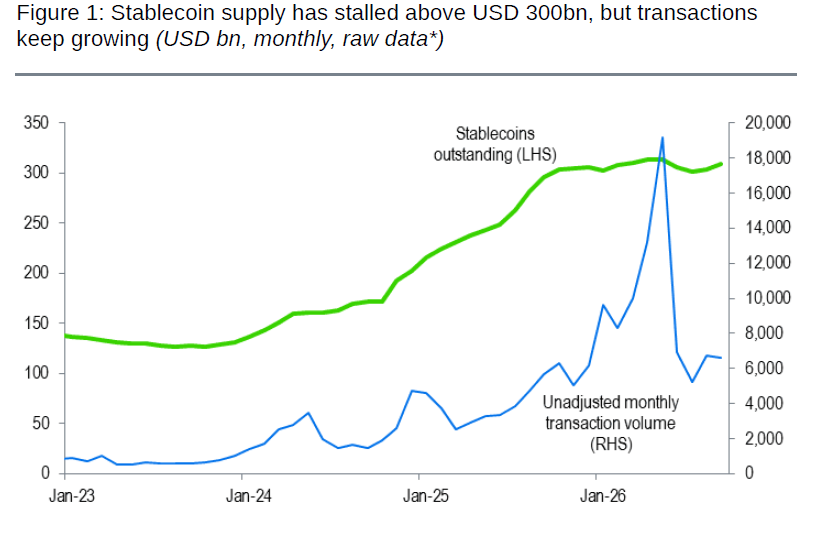
Source: Standard Chartered

Related: Crypto’s billions are back, but the premiums aren’t

US regulatory and accounting changes could shape stablecoin use

Standard Chartered’s revised forecast comes as regulatory and accounting developments in the United States could influence how businesses use stablecoins.

Since the GENIUS Act passed in 2025, US regulators have proposed rules governing stablecoin issuance, reserve requirements and consumer protections. Some measures have also clarified the limits of those protections, including a Federal Deposit Insurance Corporation (FDIC) proposal that would exclude stablecoin holders from pass-through deposit insurance.

The Treasury Department has also advanced implementation of the law. In August, it proposed rules restricting stablecoin issuance in the United States to federally or state-authorized issuers, with the licensing requirements expected to take effect in January 2027.

Separately, in August, the Financial Accounting Standards Board (FASB), which sets US accounting standards, proposed an update that could affect how companies report certain stablecoins on their balance sheets.

Blockchain payments company Tempo said the proposed changes could make it easier for businesses to use stablecoins for payments and settlement without introducing additional accounting complications.

Related: Crypto Biz: Wall Street and crypto fight for the same turf

Related Questions

QWhat is Standard Chartered's revised forecast for the stablecoin market capitalization by 2030, and what caused the delay?

AStandard Chartered revised its forecast to expect stablecoin market capitalization to reach $2 trillion by 2030, which is two years later than initially projected. The delay is due to the market plateauing at roughly $309 billion this year, despite stablecoin transaction activity continuing to grow.

QAccording to Geoffrey Kendrick, what is the primary driver of stablecoin growth currently, as opposed to the previous driver?

AAccording to Geoffrey Kendrick, the primary driver of stablecoin growth currently is the increased circulation frequency of existing stablecoins as their use cases diversify, rather than new supply entering the market.

QWhich four distinct markets for stablecoins are identified in the article, and what are their leading stablecoins?

AThe four distinct markets identified are: 1) Emerging-market savings, dominated by Tether's USDt (USDT). 2) Developed-market payments, led by Circle's USDC (USDC). 3) Crypto trading, where USDC and Ethena's USDe have strong positions. 4) Transactions between AI agents, a much smaller market also led by USDC.

QWhat US regulatory development from 2025, and its subsequent proposals, are mentioned as potentially influencing stablecoin use?

AThe article mentions the passing of the GENIUS Act in 2025. Subsequent regulatory proposals include rules governing stablecoin issuance, reserve requirements, consumer protections, and a Treasury Department proposal restricting U.S. stablecoin issuance to authorized issuers, with licensing requirements expected in January 2027.

QHow could the proposed update by the Financial Accounting Standards Board (FASB) affect businesses using stablecoins?

AAccording to the article, the proposed update by the FASB could make it easier for businesses to use stablecoins for payments and settlement by potentially simplifying how they report certain stablecoins on their balance sheets, thus avoiding additional accounting complications.

Related Reads

Global banks commit $270M to stablecoin venture targeting 2027 launch

A consortium of 21 financial institutions, including Citigroup, Goldman Sachs, Banco Santander, Deutsche Bank and BBVA, has committed about $270 million to Project Faro, a stablecoin initiative that aims to act as a stablecoin issuer and launch a US dollar stablecoin in the first half of 2027. The funding is intended to cover five years of operations, and the company plans to issue stablecoins pegged to the currencies of all G7 countries, with a euro-backed coin expected to follow the dollar launch. The group first announced the initiative in September, and the company is expected to be incorporated in the US. Similar initiatives are also underway, including Stripe-led Open USD and Qivalis, a European banking consortium. Several Faro members, such as BBVA, Rabobank and BNP Paribas, are also involved in competing projects, highlighting how traditional financial institutions are positioning themselves across multiple initiatives rather than committing exclusively to a single stablecoin project. Qivalis has made regulatory progress, receiving authorization from the Dutch central bank as an electronic money institution in October 2026. Despite growing institutional interest, Faro is entering a market dominated by crypto-native issuers: Tether's USDT and Circle's USDC account for approximately 85% of the roughly $290 billion stablecoin market as of Nov. 10. Distribution could offer the bank-backed venture a competitive advantage, since its participating institutions already have established banking customers, payment networks and relationships that could help distribute a new stablecoin. The challenge will be translating that existing financial infrastructure into a competitive onchain payment network.

cointelegraph1h ago

Global banks commit $270M to stablecoin venture targeting 2027 launch

cointelegraph1h ago

Strategy buys 1,036 Bitcoin as BTC holdings climb to 850,364

Strategy bought 1,036 Bitcoin for $81.9 million last week, bringing its holdings to 850,364 BTC. The company paid an average of $79,012 per BTC, according to its Monday filing with the US Securities and Exchange Commission. Strategy said it paid a total of $64.16 billion for its Bitcoin holdings, at an average price of $75,456 per coin. Its holdings now account for roughly 4.05% of Bitcoin's maximum 21 million supply. Since the start of October, Strategy has spent about $1.06 billion buying back its STRC preferred shares, nearly five times the $219.7 million it spent on Bitcoin over the same period. Strategy raised $283.8 million in net proceeds last week by selling about $2.05 million shares of its common stock (MSTR) through its at-the-market offering program. Strategy used $188.3 million of those proceeds to repurchase about 1.89 million STRC shares, following $208.2 million in buybacks the previous week. It spent $81.9 million on Bitcoin and allocated another $13.6 million to its USD Cash balance. Strategy's separate US dollar reserve fell to $4.77 billion from $4.79 billion after the company drew $21.1 million to pay dividends on its preferred stock. Its USD Cash balance rose about 10% to $146.2 million from $132.7 million. The latest Bitcoin purchase follows Strategy's acquisition of 811 BTC for $65.5 million the previous week. Strategy's common stock fell 3% to $125 in Monday's premarket trading, while its STRC preferred shares edged down 0.06% to $99.7, according to Yahoo Finance.

cointelegraph2h ago

Strategy buys 1,036 Bitcoin as BTC holdings climb to 850,364

cointelegraph2h ago

Trading

Spot
活动图片