Author: Jae, PANews
A shutdown wind is blowing through the public blockchain space. Following the decommissioning of the decade-old veteran Lisk and the once-famous gaming subnet DFK Chain, Harmony, a public chain that once made a name for itself with sharding technology, has also drawn a final curtain.
On the evening of September 6, Harmony put forward two non-binding proposals: it plans to shut down its mainnet, which has been running for nearly seven years, migrate the native token ONE to Ethereum, thus bidding farewell to the public blockchain race; simultaneously, it intends to shift its business focus from infrastructure to the AI video "remix economy".
In its announcement, Harmony cited the reason: security threats from state-level actors and AI agents have reached a level that can no longer be ignored. Just about a month ago, the project suffered a major hack, where attackers forged 3.01 trillion ONE tokens with just six transactions, forcing the team to roll back two shards, wiping out over 100,000 legitimate on-chain transactions in the process.
In other words, Harmony believes its capabilities are insufficient to maintain the network's security and must pivot to the next battlefield.
Mainnet Closure, ONE Migrates to Ethereum Seeking Renewal
Harmony's mainnet launched in 2019, entering the scene with the technical narrative of sharding for scalability, aiming to carve out a niche in the crowded public chain space with high throughput, low fees, and cross-chain interoperability.
However, competition in the public chain arena has intensified. Ethereum completed its scaling upgrades, continuing to dominate the market; high-performance chains like Solana, Sui, and Aptos keep eating away at developers and liquidity; waves of new public chains like Robinhood Chain roll in, and continuously iterating technological paradigms further squeeze the survival space for traditional standalone L1s. The cost of maintaining a public chain keeps rising, and Harmony's early sharding narrative gradually lost its appeal.
More deadly than market squeeze is the security crisis.
In June 2022, Harmony's Horizon cross-chain bridge was attacked, losing $100 million in assets. The FBI later confirmed the attack was by the North Korean hacker group Lazarus Group. Disaster struck again in August this year. Attackers exploited a cross-shard receipt verification vulnerability to repeatedly process valid receipts, minting ONE out of thin air without corresponding asset deductions. The team initially estimated 4 billion anomalous tokens, but after tracing the attack chain, they discovered the hackers forged 3.01 trillion ONE in just six transactions.
To plug the vulnerability, Harmony chose to roll back Shard0 and Shard1. The bug was fixed, but the cost was heavy: over 100,000 normal transactions were erased along with it. This action once again raised the eternal question in the decentralized world: when a major crisis hits, how should security governance, community interests, and immutability be balanced.
With multiple pressures piling up, the cost-effectiveness of continuing to shoulder the high security and operational costs to maintain an independent public chain has become increasingly low. Shutting down the mainnet is, in essence, a move of severing an arm to save the body: stripping away the human and financial resources consumed on infrastructure and redirecting them towards the AI content space with greater commercial potential.
With the mainnet closing, Harmony's ONE token will be transferred to Ethereum, with new tokens airdropped to corresponding holding addresses. Holders, in principle, do not need to actively claim them, but assets in multi-signature vaults, liquidity pools, and on-chain applications cannot be migrated.
The project promises that the total supply of ONE and its token release schedule will remain unchanged. Any future new token supply will be entirely used for the new AI video business. Once ONE becomes an ERC20 token, it can tap into the entire Ethereum ecosystem's traffic and tooling. Retaining ONE will also, to some extent, preserve the community, brand, and token economic system.
This design reflects Harmony's thinking of decoupling the "public blockchain network" from the "token economy."
In the past, ONE's foundation came from mainnet ecological activities like Gas consumption, transactions, and staking. If the mainnet shuts down, the original value capture mechanism naturally becomes ineffective. Migrating to Ethereum is about finding new use cases for ONE.
Harmony Enters the AI Video Arena, ONE Faces the Question of Value
Harmony's answer is: to make ONE the incentive and governance asset within the AI video business.
According to the proposal, Harmony aims to establish a content economy centered around "raw material → secondary creation → AI expansion → distribution and monetization":
-
Creators upload videos, prompts, and raw materials;
-
Fans or other users "Remix" the original work;
-
AI Agents extend the storyline further based on users' secondary creations, generating more videos;
-
Operators are responsible for video generation, content distribution, and quality review;
-
Users earn income through subscriptions, ads, etc.;
-
ONE serves functions like incentives, staking, and governance.
The project also plans to provide GPU subsidies for video operators, but operators will need to stake ONE to receive rewards based on their online service duration.
A commercialization path is also outlined in the proposal: setting a $10/month subscription fee, offering content promoters an initial persistent commission of up to 30%. After meeting staking and online rate requirements, the total first-year revenue target for an operator could be up to approximately $1 million. Optimistically, with a user base reaching millions, ad business could potentially generate tens of millions of dollars in revenue.
In this pivot, Harmony hasn't abandoned its long-term accumulation. The existing community, brand, and validator network can all serve as intangible assets for the cold start of the new business, and the AI content space itself holds vast market potential.
Among these, validators will begin shutting down their nodes starting September 10 but can participate in the new project as governors. Harmony will establish a one-time compensation pool of $1.372 million, distributed over four quarters to eligible validators and delegation stakers.
Simultaneously, some validators can transition into AI video operators, promoters, or other new business participants. This signifies Harmony's desire to preserve its network effects to the greatest extent possible.
In the past, validators' income came from protocol-hardcoded block rewards, with rules written immutably on-chain; in the future, if transitioning to the AI video business, income will depend on demand and orders from end-users. Moving from deterministic on-chain rewards to the highly uncertain AI consumer market – whether this identity conversion can succeed remains to be tested by the market.
From a product logic perspective, Harmony's AI video business resembles an AI-driven UGC secondary creation platform. The problem it needs to solve is how to enable a piece of original content to be continuously recombined by users, AI Agents, and operators, thereby forming a scalable content supply.
Behind the envisioned model lies a vast capability gap.
Harmony's past accumulated expertise modules are concentrated in blockchain infrastructure like consensus protocols, sharding architecture, and node operations. The AI video arena, however, competes on model capabilities, compute scheduling, content distribution, copyright management, user growth, product operation, and commercial monetization. The two skill sets have almost no natural overlap for migration.
Especially since the AI video space is already fiercely competitive, Harmony will face competitors who are AI tech giants with large models, massive funding, and mature products. Merely relying on a combination of "AI + token" cannot form a moat.
This surfaces the most crucial question of the entire pivot: Why must users use ONE?
Ordinary consumers generating or watching AI videos could use fiat currency or stablecoins for transactions. GPU operator service providers could also accept fiat or stablecoins for settlement. If ONE is merely an attached incentive token tacked onto the AI product, rather than a necessary medium for the business's operation, then the token will also struggle to capture value from business growth.
The economic model currently proposed by Harmony resembles an early-stage experiment: incentivizing operators with ONE, constraining service quality through a staking mechanism, and achieving revenue through traditional internet models like subscriptions and ads.
What Harmony needs to prove is that the growth of the AI video business can feed back into the demand for ONE; otherwise, the token risks becoming another layer of narrative packaging.
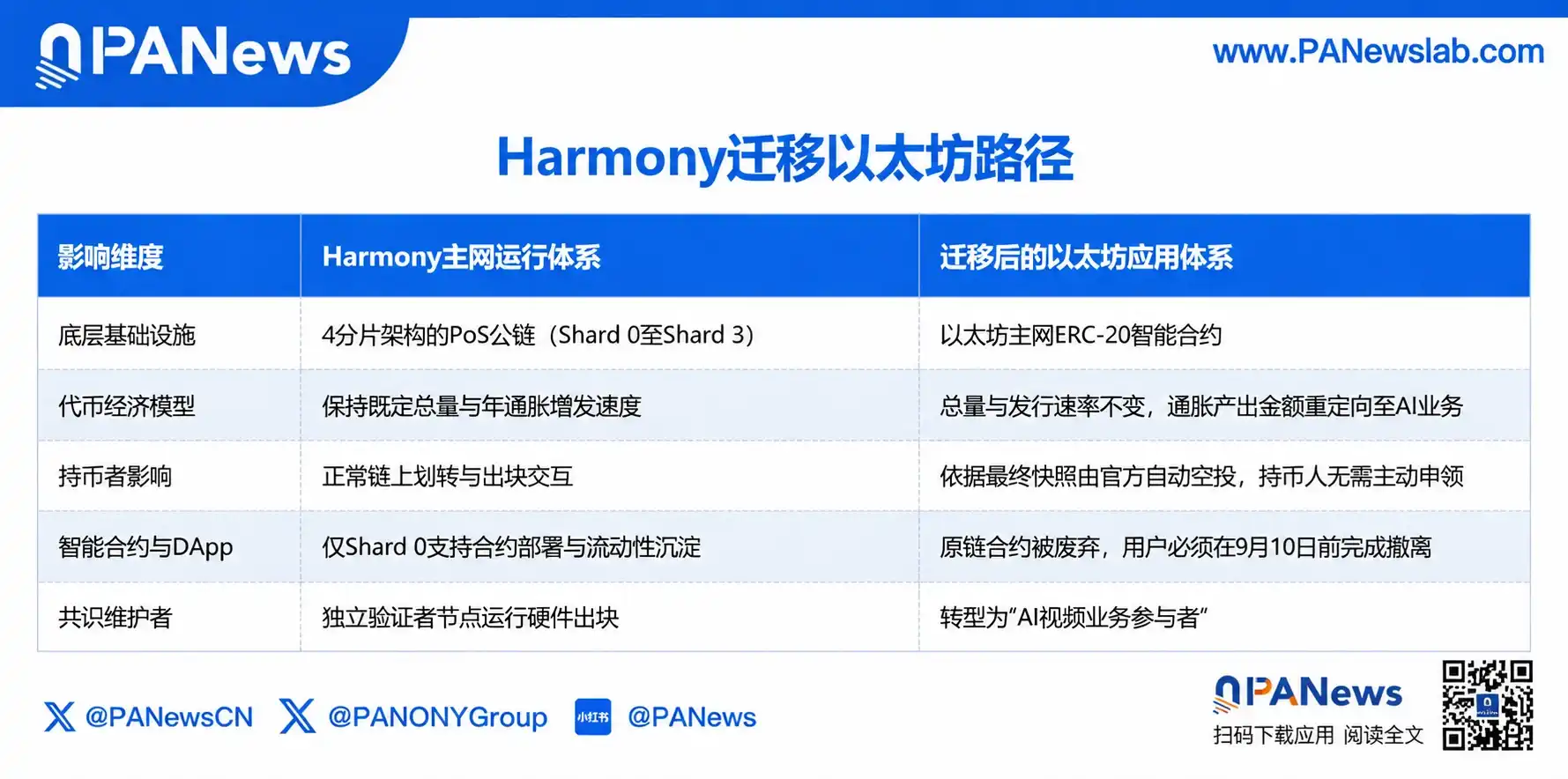
It's important to note that both current proposals are non-binding and may still be adjusted based on governance feedback.
Rather than defining Harmony's proposal as "abandoning public chains for AI," it might be more accurate to view it as a rare attempt at project reboot: a public chain that once envisioned a blueprint for sharding and scalability chooses to actively shut down its own mainnet, decouple its token from the public chain, and venture into the unfamiliar territory of AI video to compete.
Ethereum becomes its settlement layer, and ONE must also undergo a metamorphosis: from a Gas token for a sharded public chain to a value carrier for an AI content ecosystem.
For token holders, it's crucial to closely monitor the execution details: the final mainnet snapshot block height, asset accounting rules, migration support from major exchanges, audit results of the new ERC20 contract, etc.
For Harmony, another question awaits an answer: In the fiercely competitive AI content space, how can it prove that blockchain and ONE are indispensable components of this business model?
Shutting down the mainnet doesn't automatically equate to renewal. True rebirth begins with whether the new business can cultivate genuine demand. The outcome of this pivot awaits revelation by time.