Russia Introduces Protocol for Seizing Crypto Assets, Already Applied in Practice

cryptonews.ruPublished on 2026-10-12Last updated on 2026-10-12

Abstract

Russian authorities have reportedly used a new protocol for seizing crypto assets in a practical case. According to a published investigative action protocol (from October 10, 2026), an investigator in the Republic of Tatarstan seized $6,328 in digital currency. The funds were transferred from a trading account on the RoboForex platform, converting them to USDT and sending them to a specified TRON network address. The procedure was conducted with the participation of the account owner, a defense lawyer, and a specialist, following a court order to seize property. This case aligns with new Russian legislation effective from March and July 2026, which regulates the seizure and storage of digital assets as property in criminal proceedings. The rules establish a framework for transferring seized crypto to special state-controlled addresses. It is noted that the action described constitutes an arrest to secure the assets, not a final confiscation, which would require a separate court ruling. The authenticity of the specific protocol could not be independently verified.

  • An investigator from the Main Investigative Department of the Russian MVD in the Republic of Tatarstan seized digital currency amounting to $6328.
  • From a previously confiscated laptop, he initiated a withdrawal from a RoboForex trading account, choosing to receive the funds in $USDT via the TRON network.

A purported protocol of the investigative action has been published online, showing how the new Russian mechanism for seizing and storing digital assets can work in practice.

According to the document dated October 10, 2026, an investigator from the Main Investigative Department of the Russian MVD in the Republic of Tatarstan

The Happy Coin News editorial team was unable to confirm the authenticity of the published protocol; however, the procedure described in it aligns with the rules for handling seized digital currency that came into force this year.
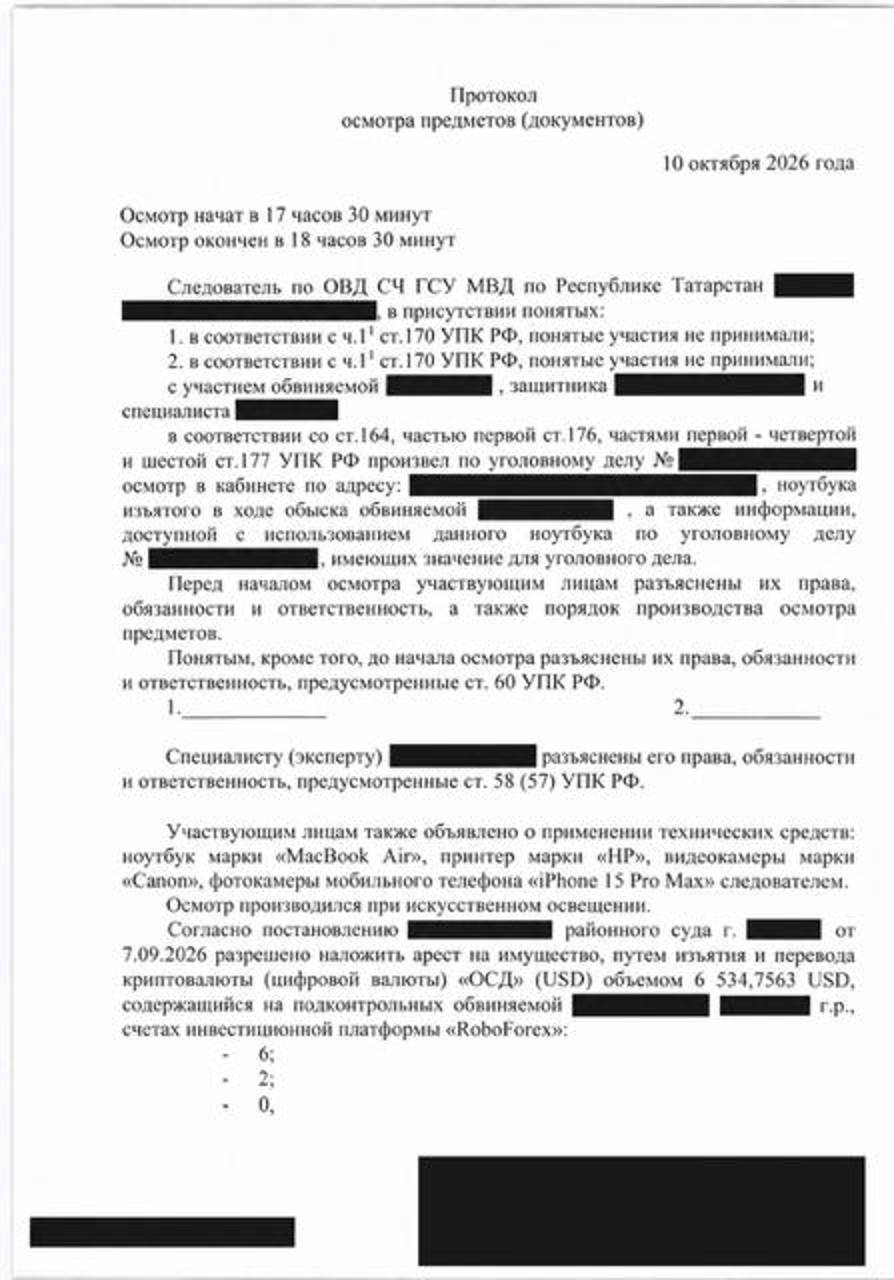
A fragment of the published protocol

How the Investigator Withdrew Funds via RoboForex

It follows from the document that the object of inspection was an HP Pavilion x360 Convertible laptop, previously seized during a search. The basis for the actions was a ruling by a district court in Kazan dated September 7 to seize property.

The accused provided access to the laptop and phone and, according to the protocol, voluntarily confirmed consent to the transfer of funds as part of cooperation with the investigation. Thus, the document does not describe account hacking or bypassing security; the investigative action was conducted with the participation of the owner of the credentials, a defense lawyer, and a specialist.

After logging into RoboForex, the account displayed a balance of $6641.84. The investigator opened the withdrawal section and specified an amount of $6328.

The subsequent operation went through the Difinex payment service. According to the data recorded in the protocol, the interface showed the receipt of approximately 6331.33 $USDT, a commission of 3 $USDT, and the option to choose a blockchain. The investigator specified TRON and entered the recipient address provided to him.

The official RoboForex instructions confirm the general procedure for such operations: the user selects a trading account and payment system, enters a password and amount, after which the selected service may require additional data or confirmation.
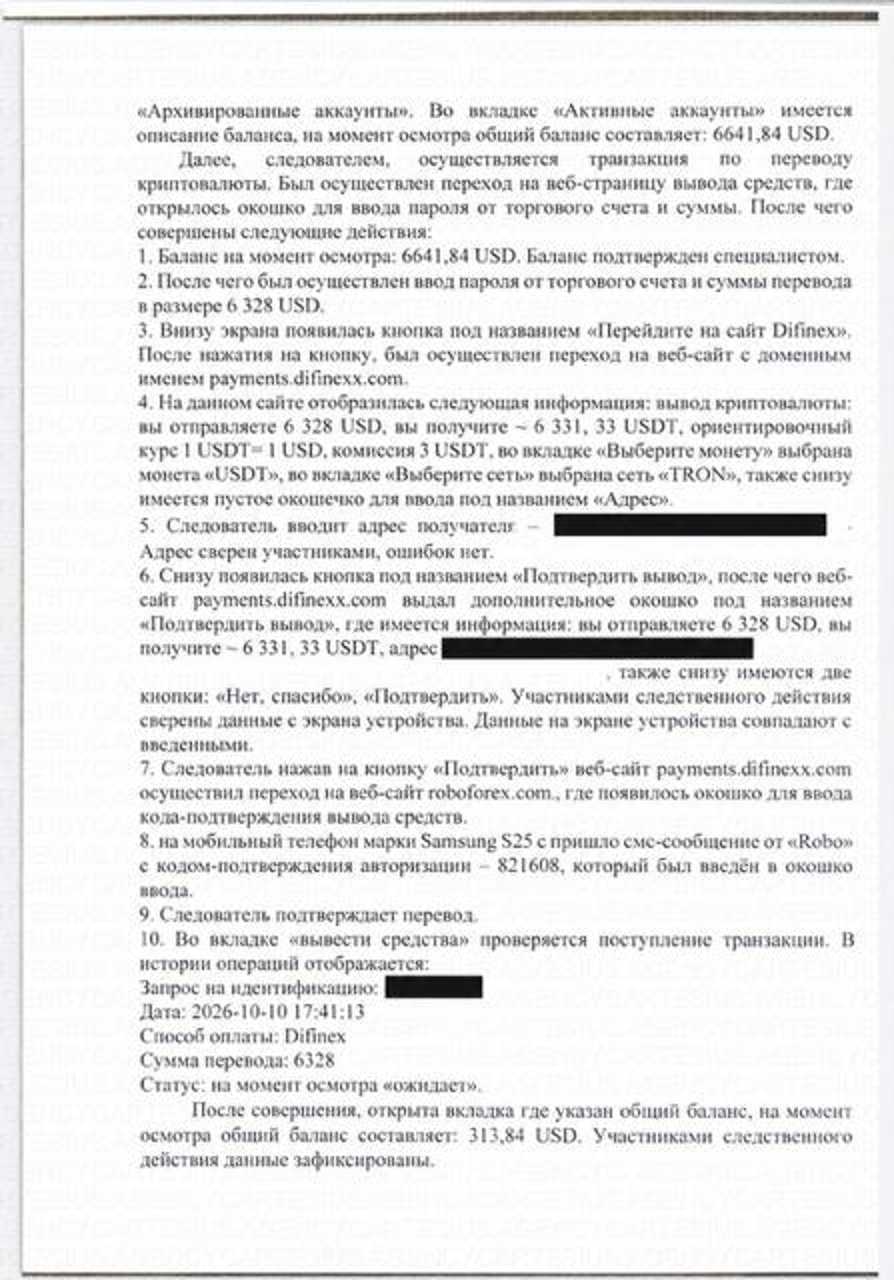
The investigator initiated a withdrawal of $6328 from RoboForex, receiving $USDT via the TRON network. At the time the inspection ended, the transaction was pending

After additional SMS confirmation, the request appeared in the RoboForex transaction history, and the account balance decreased to $313.84.

However, there is a crucial detail here: at the time the inspection was completed, the transfer had not yet been confirmed as received at the final address. Its status in the protocol is designated as "currently pending," with a processing time from five seconds to three days.

New Rules Only Came into Effect This Summer

The practical significance of the document is linked to changes in Russian legislation. Since March 3, 2026, Article 164.2 of the Criminal Procedure Code separately regulates the seizure of digital currency. Investigative actions must be conducted with the participation of a specialist, and to preserve the assets, they are allowed to be transferred to a special identifier address when technically possible. The protocol must record the type and quantity of digital currency, the sender and recipient addresses, and data allowing identification of the transaction.

Since July 3, government-approved Rules for the Storage, Transfer, and Accounting of Digital Currency in Criminal Proceedings have been in effect. They provide for an infrastructure in which a state agent bank, together with an authorized organization, provides identifier addresses for the MVD, FSB, Investigative Committee, Prosecutor's Office, FSSP, Federal Customs Service, and other agencies.

The published protocol fits well into this scheme: the investigator received an address for storing the asset, the participants verified it, after which it was used as the destination address for withdrawing $USDT.

However, it is impossible to determine the owner of the specific TRON address from the document—it is obscured in the published image.

This is Seizure for Now, Not Confiscation

Another important distinction concerns the legal status of the funds. Since March 2026, digital currency has been recognized as property for the purposes of criminal legislation, so it can be seized, including to secure a civil claim, a fine, or possible subsequent confiscation.

But seizure is not the same as confiscation. The latter implies the forced transfer of property into state ownership based on a corresponding court decision. The presented protocol records an investigative action to ensure the preservation of assets, not their final transfer to the state.

Risk Warning:

The information on the site is for informational and educational purposes only and is not investment advice or financial guidance. Cryptocurrencies and digital assets involve a high level of risk, including potential loss of capital. The editorial team is not responsible for decisions made based on published materials. It is recommended to conduct your own research (DYOR) before making investment decisions. Review the editorial policy at https://happycoin.news/about/


Related Questions

QWhat is the main topic and practical significance of the Russian protocol discussed in the article?

AThe article discusses the practical application of a new Russian protocol for seizing and storing cryptocurrency assets. Its significance lies in showcasing the operational mechanics of Russia's recently implemented legal framework, which allows law enforcement to officially arrest and transfer seized digital assets to government-controlled crypto addresses during criminal investigations.

QBased on the protocol, how did the investigator from Tatarstan transfer the cryptocurrency?

AThe investigator accessed a previously seized laptop and, with the owner's cooperation, logged into a RoboForex trading account. From there, he initiated a withdrawal of $6,328. Using the Difinex payment service, he chose to receive the funds in USDT via the TRON blockchain and sent them to a specific recipient address that was provided to him, likely a government-held 'identifier address' as per new regulations.

QWhat are the key differences between 'arrest' and 'confiscation' of cryptocurrency under the new Russian laws mentioned in the article?

AAccording to the article, 'arrest' is a provisional measure to secure and preserve assets during an investigation, ensuring they are available to satisfy potential future civil claims, fines, or confiscation orders. It does not transfer ownership. 'Confiscation' is a final court-ordered penalty where the property is forcibly transferred to state ownership. The described protocol documents an arrest, not a confiscation.

QWhich two key legal changes in 2026 established the framework for the procedure described in the protocol?

A1. Effective March 3, 2026: Amendments to Article 164.2 of the Russian Criminal Procedure Code (УПК РФ) officially recognized cryptocurrency as property for criminal law purposes and established procedures for its seizure, requiring specialist participation and allowing transfer to special storage addresses. 2. Effective July 3, 2026: Government-approved 'Rules for the storage, transfer, and accounting of digital currency in criminal proceedings' created the infrastructure, involving a state agent bank and an authorized organization to provide 'identifier addresses' for law enforcement agencies to hold seized assets.

QWhat crucial detail about the transaction's status was noted at the end of the on-site inspection in the protocol?

AAt the conclusion of the on-site inspection documented in the protocol, the USDT transfer from RoboForex was still pending final confirmation on the blockchain. Its status was recorded as 'currently awaiting' processing, with an estimated completion time ranging from five seconds to three days. The funds had left the trading account but had not yet been confirmed as received at the destination wallet.

Related Reads

Google says hackers use AI agents to find and exploit software flaws

Google Threat Intelligence Group (GTIG) has for the first time identified attackers using AI large language model frameworks to automate software vulnerability discovery and exploitation without step-by-step human direction. In a report published Monday, researchers described a tool found on an exposed staging server that compared software versions, identified potential flaws, and generated and executed exploit code. GTIG said threat actors used LLM frameworks to fully automate vulnerability discovery and exploitation without a human in the loop, hosting a multi-agent vulnerability research and weaponization framework designed to conduct continuous differential analysis comparing code before and after patch announcements on popular web applications, autonomously discovering and exploiting software vulnerabilities. Google warned these automated workflows give organizations less time to apply security patches before attackers develop ways to exploit vulnerable systems. Attackers are leveraging AI agent frameworks to automate patch reverse engineering via differential analysis and weaponizing N-day vulnerabilities. Vulnerability disclosures more than doubled between January and August, with exploited zero-days averaging eight per month in 2025 and 11 per month from January through August 2026, reaching 22 in August. Automated workflows also accelerate attackers' ability to move from initial access to domain administrator access, as cited in an August 2026 PaperCut campaign where attackers achieved that control within minutes. GTIG said two PHP vulnerabilities involved in exploitation attempts were discovered using LLM analysis. Anthropic also warned that AI-assisted attacks have evolved into multi-agent operations automating most of the cyberattack cycle from discovery to exploitation and data theft.

cointelegraph59m ago

Google says hackers use AI agents to find and exploit software flaws

cointelegraph59m ago

Coin-Stock Trend Indicator丨Third-largest BTC treasury company Twenty One Capital buys $10 million in BTC for the first time since July 2025; Bitmine total holdings value drops $2.5 billion in a week (November 17)

This week's crypto stock snapshot notes that the recent US equity move was merely an oversold rebound rather than a new high, with the impact of the Democratic midterm election win still spreading and Nvidia founder Jensen Huang's resignation controversy evolving into a broader AI-sector storm. The week's biggest US market event is Anthropic's IPO on November 19, though its fundraising and valuation fall short of SpaceX's record. Japanese stocks remain favored by Morgan Stanley analysts despite AI-related weakness, while Korean stocks fell 2.59% to 4,968.45, their lowest since February 2. In crypto stocks, last week's market crash hit DAT treasury companies hard, with ETH treasury firm Bitmine's holdings value dropping from $14.3 billion to $11.8 billion in a week, nearly all due to ETH's price decline. Listed companies (excluding miners) bought a net $51.86 million in Bitcoin last week, down 45.2% week-over-week. Strategy bought 485 BTC at $68,887 each for about $33.4 million, bringing total holdings to 850,849 BTC; Metaplanet bought none. Capital B bought 12 BTC at $77,500.2, holding 3,550 BTC; Strive bought 251 BTC at $69,853 for about $17.53 million, holding about 43,404 BTC. Total tracked holdings reached 1,171,317 BTC, up 0.04% week-over-week, worth about $75.53 billion, or 5.8% of Bitcoin's circulating market cap. Twenty One Capital bought 154.32 BTC for about $10 million in cash, its first purchase since July 2025, bringing holdings to about 43,700 BTC and making it the third-largest listed Bitcoin treasury; CEO Rapha Zagury said volatility creates opportunity and the firm bought the dip. BitMine added 7,653 ETH last week, holding 6,077,745 ETH (4.97% of total supply, 0.03% short of its 5% goal) plus 216 BTC, a $180 million investment in Beast Industries, $67 million in Eightco Holdings, and $448 million in cash and securities; its ETH holdings are worth about $11.1 billion at $1,823 per ETH. Chairman Tom Lee attributed ETH's 28% two-week drop to Nvidia-related turmoil triggering Asian margin selling and investors raising cash for Anthropic's reported November 18 IPO, saying it contradicts improving fundamentals. DeFi Development Corp. added 9,482 SOL, with Solana treasury holdings reaching about 2.62 million tokens, growing for a 10th straight week; its CHAD preferred stock raised enough to buy over 230 SOL today. CZ said Japan-listed ASIAN STAR will distribute 8 million yen worth of BNB to shareholders and pursue Japanese real estate tokenization on BNB Chain. DeFi Technologies reported Q3 2026 revenue of $18.3 million (down about 18% year-over-year), operating income of $7 million, and net profit of $22.3 million, with $53.4 million in cash and stablecoins and $48.2 million in digital assets. Ripple-backed Evernorth disclosed its 346 million XRP was booked at $342 million versus an initial $847 million record value, with cumulative impairments of $505 million, a nearly 60% decline.

marsbit1h ago

Coin-Stock Trend Indicator丨Third-largest BTC treasury company Twenty One Capital buys $10 million in BTC for the first time since July 2025; Bitmine total holdings value drops $2.5 billion in a week (November 17)

marsbit1h ago

Trading

Spot
活动图片