Rented Mac Computers Provide Attackers with Root Access via Screen Sharing Function Login

cryptonews.ruPublished on 2026-08-18Last updated on 2026-08-18

Abstract

CISA has elevated the severity rating of a macOS Screen Sharing vulnerability to a critical 9.8 out of 10. The flaw, tracked as CVE-2026-65400, resides in how the feature handles authentication via the Secure Remote Password protocol, potentially allowing an attacker to gain access before password verification occurs. Attackers have already exploited this by targeting internet-exposed Macs, gaining root access via port 5900, and silently installing Monero cryptocurrency mining software. While the Screen Sharing feature is disabled by default, it's commonly used on "bare metal" Macs rented from hosting providers. Security researchers identified tens of thousands of potentially vulnerable hosts online, with many being these hourly-rented machines. Apple has issued patches in macOS versions Tahoe 26.6.1, Sequoia 15.7.9, and Sonoma 14.8.9, urging all users to apply updates immediately.

On Friday, CISA raised the severity rating of a macOS screen sharing function vulnerability to critical — 9.8 out of 10.

Dutch investigators reported that attackers gained root privileges on internet-connected Mac computers and stealthily installed Monero mining software.

From 7.1 to 9.8 in a Week

When Apple released the patch, CISA scored this bug, tracked as CVE-2026-65400, at 7.1 in the National Vulnerability Database. The agency then revised the score to 9.8, which is close to the top of the CVSS scale.

The Dutch National Cybersecurity Centre took a similar approach. An August 12th update amended its initial advisory, stating that a publicly available proof-of-concept code is in circulation and active abuse has been confirmed.

As of Friday, this vulnerability had not been added to the federal catalog of Known Exploited Vulnerabilities maintained by the Cybersecurity and Infrastructure Security Agency. Apple's own entry in the Dutch agency's CVE registry still had the older 7.1 rating.

The vulnerability relates to how the Screen Sharing function handles authentication. Huntress trac the cause to a flaw in the service's use of the Secure Remote Password protocol, which is used to verify the user before granting access.

Huntress says that in practice, this causes the Mac to believe an outsider has already logged in. The failure occurs before the password check. Resetting or deleting screen sharing passwords does not eliminate this possibility.

"Anyone using Apple’s Screen Sharing feature on any supported version of macOS must immediately install the latest security updates," wrote Huntress researcher Ryan Doud.

Apple released this patch in macOS Tahoe 26.6.1, Sequoia 15.7.9, and Sonoma 14.8.9 on August 6th.

Tens of Thousands of Rented Mac Computers Are Affected

The NCSC stated that the victims' computers were fully compromised. In every case examined by researchers, the attacker gained access to the system via port 5900, the standard port for screen sharing, which remained open to the internet.

They then obtained root privileges and deployed a Monero cryptocurrency miner ($XMR). The Dutch agency did not disclose the number of affected systems or name a suspect.

The Screen Sharing function is disabled by default. However, it is a standard tool for managing Macs running on "bare metal," meaning physical Apple hardware rented and used in remote data centers, where most of the risk is concentrated.

According to Doud, using the internet scanning tool Censys, he discovered "tens of thousands of potentially vulnerable hosts." Many of these, Huntress claims, are machines rented by the hour from hosting providers.

Cryptopolitan reported on the Reaper malware, which exploits Script Editor to empty wallets, and macOS malfunctions that prompt victims to insert malicious commands into the Terminal.

Cryptojacking, the theft of computing power to obtain cryptocurrency, has long been a hallmark of Monero. Unlike specialized mining rigs, Monero cryptocurrency can be mined on regular CPUs, and transactions are private by default.

The profit from each hacked Mac is low. On Monday, the price estimated roughly 432 $XMR produced by the Monero network per day to be worth approximately $179,000, distributed among all miners. On Monday, $XMR traded at $413.47, up about 0.9% over the previous 24 hours.


Related Questions

QWhat vulnerability in macOS was escalated to a critical severity rating of 9.8 by CISA?

ACISA escalated the severity rating of a vulnerability in the macOS Screen Sharing function's authentication handling, tracked as CVE-2026-65400, to a critical 9.8 out of 10.

QHow did attackers gain root access to the compromised Mac computers according to the article?

AAttackers gained root access by exploiting the Screen Sharing vulnerability to access systems via port 5900, which was left open to the internet on the victim computers.

QWhat specific malware did the attackers deploy after compromising the Mac systems?

AAfter gaining root access, the attackers deployed a Monero cryptocurrency mining software (cryptojacking malware) on the compromised Mac systems.

QAccording to a Huntress researcher, how many potentially vulnerable hosts were found using an internet scanning tool?

AA Huntress researcher, using the Censys internet scanning tool, found 'tens of thousands of potentially vulnerable hosts,' many of which were machines rented by the hour from hosting providers.

QWhich macOS versions received the security patch from Apple to fix this Screen Sharing vulnerability?

AApple released the security patch in macOS Tahoe 26.6.1, Sequoia 15.7.9, and Sonoma 14.8.9 on August 6th to fix this vulnerability.

Related Reads

Monad's $909 Million Credit Economics: How a High-Performance Public Chain Breaks Through via Lending

Monad, developed by former Jump Trading quant engineers, has seen its on-chain revenue model shift dramatically from high-frequency trading to lending interest. Over the ten months to September 2026, global DeFi TVL fell from $111.4B to $95.5B, yet Monad's market share rose from 0.14% to 1.09%—an nearly eightfold increase—ranking tenth among all chains by DeFi TVL. Lending now dominates fee revenue: in September, lending apps contributed 71% of application fees versus just 16% from trading, with borrowers paying roughly 6.2% annualized interest on an average $903M loan book. Monad's capital efficiency is notably high, with every $1 of TVL generating $0.89 in borrowings versus 42% on Ethereum and 45% on Base. Institutional credit vaults hold $287M in uncollateralized loans—second only to Ethereum mainnet—with Accountable at 33% and Aave at 29% of lending balances. Aave's Monad market became its third-largest fee-generating deployment globally within 46 days. Spot trading fees fell to 1.2 basis points as monthly volume surged to $4B. MON trades at just 0.25x its DeFi TVL versus 7–12x for peers like AVAX, SUI, SOL, and SEI, and has outperformed competitors since its first full trading day. Annualized interest income stands at about $56.5M at current levels, with each additional $100M in loans adding $6.2M yearly—upside supported by upcoming Aave V4, infiniFi Prime, StraitsX stablecoins, and Category Labs' institutional clearing domain.

marsbit20m ago

Monad's $909 Million Credit Economics: How a High-Performance Public Chain Breaks Through via Lending

marsbit20m ago

BTC Short-Term Bottoming and Gathering Momentum, HYPE Triple Support Faces Critical Test | Guest Analysis

Last week, the crypto market was driven by news. On Nov 4, midterm election news sparked a 3.92% Bitcoin rally above $80K, but a day later, US stock declines triggered a 5.48% drop to ~$75,222, a new low since Sept 21, with fear index near 25. HYPE also fell 15.19% weekly, erasing prior gains and returning to ~$75. Key points: Bitcoin has held above the 52-week MA for eight weeks, satisfying the "price breakout principle," but the pullback confirmation signal is not yet issued and the 52-week MA (~$76,110) remains downward-sloping. The rebound from the July 1 low of $57,820 is still classified as an oversold bounce, not a confirmed bull market. On the daily chart, price remains in a descending channel, has broken below the key MA crossover (~$77,200), but holds above the 0.382 Fibonacci level ($76,130). The correction (wave i) has run 48 trading days with a max drawdown of 15.9%; a wave ii rebound is expected but not yet started. The "Shijie Ribbon" model still signals a long market. Strategy: mid-term stay in cash; short-term use 30% position for range trading, favoring buying dips near $72,500–73,500 with strict stops. HYPE: the weekly bearish engulfing candle was driven by external shocks, not fundamentals. Three support layers: the ribbon upper band (~$74.05, lower ~$71), the box lower edge (~$75, which triggered a 20% bounce on Oct 24), and the long-term uptrend line (~$68). Key support zones: $74–75 (ribbon upper + box bottom), $71 (ribbon lower), $68 (long-term trendline). Strategy: if price stabilizes at $74–75 or $68–71, consider light long positions (≤30%) with strict stops. Special rules: set initial stop at entry; move to breakeven at +1% profit; trail stop 1% per 1% gain. All analysis is personal technical opinion, not investment advice; markets carry risk.

Odaily星球日报35m ago

BTC Short-Term Bottoming and Gathering Momentum, HYPE Triple Support Faces Critical Test | Guest Analysis

Odaily星球日报35m ago

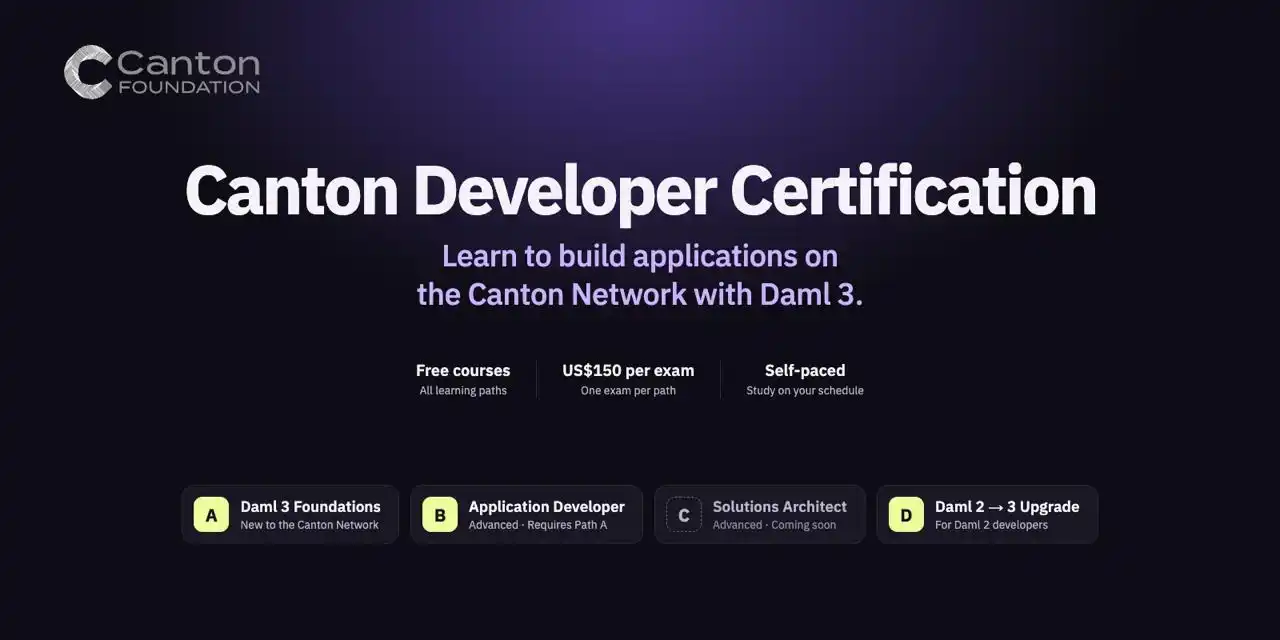
Canton Foundation Launches Official Daml 3 Certification, Expanding Developer Access and Establishing Institutional Finance Standards

Canton Foundation has launched the Canton Developer Certification, an official certification program for Daml 3, the smart contract language of the Canton Network. Combining a self-paced course with a certification exam, it offers developers worldwide a structured path to building applications for regulated financial markets. Canton Network is a public, permissionless blockchain designed for regulated finance, with over $6 trillion in on-chain assets processed by its supported applications. Daml is built to manage who may act on a contract and who may access its terms; the certification validates practical mastery of these authorization and privacy principles, establishing a recognized standard intended to strengthen institutional confidence in applications built on the network. The program is based on Daml 3 and Canton 3.x, the current technology underlying the network, letting newcomers start on the latest stack, helping production engineers deepen expertise, enabling institutional architects to design and integrate Canton deployments, and allowing existing Daml 2 developers to migrate their skills and codebases to Daml 3, unifying the community on a single, current platform. For ecosystem partners—financial institutions, application providers, system integrators, and validators—the certification provides a common technical foundation and a consistent way to assess developers' understanding of authorization and privacy requirements. Canton Foundation COO Amanda Martin said financial institutions need confidence that the applications they rely on are built by developers who understand regulated market requirements, and that the program both opens opportunities for developers globally and establishes a shared professional standard, building a stronger foundation for Canton's future growth by bringing the community together on Daml 3. The certification is now live at certification.canton.foundation; the course is self-paced and free to all developers, and the exam costs $150 per attempt. Canton Foundation is an independent nonprofit responsible for the governance and long-term development of Canton Network's shared infrastructure, supporting transparent and decentralized governance, ecosystem coordination, and broad participation by Global Synchronizer operators and network stakeholders, while working with financial institutions, technology providers, developers, and other participants to support the network's continued global growth and adoption.

marsbit46m ago

Canton Foundation Launches Official Daml 3 Certification, Expanding Developer Access and Establishing Institutional Finance Standards

marsbit46m ago

Nvidia Faces Independent Investigation, Bernstein Maintains $400 Target Price

Nvidia's board has launched an independent investigation following reports about CEO Jensen Huang's contacts with Megaspeed executive Alice Huang, though it says there is no reason to believe U.S. national security or company secrets were compromised. Three Republican House committee chairs have requested Huang attend a closed-door briefing on November 18 to explain the contacts and Nvidia's internal procedures for countering foreign intelligence activities, and Democratic Senator Chris Coons said Congress will investigate. Some reports suggested Alice Huang may have influenced Huang's lobbying to ease chip export restrictions to China, a claim Bernstein doubts, noting Huang has long publicly pushed to expand sales in China and that revenue from mainland China and Hong Kong has fallen sharply since export controls. Only H20 and limited H200 chips were approved for China sales, well behind Nvidia's most advanced products, and Bernstein sees limited room for recovery as Chinese customers prioritize domestic alternatives. Regulatory pressure may persist, with hawkish lawmakers potentially revisiting export limits. Bernstein maintains an Outperform rating and a $400 target price, about 114% above the November 6 close of $186.64, citing data center demand and earnings growth. It projects adjusted EPS of $4.77 for FY2026, $9.20 for FY2027 and $15.80 for FY2028. The target is based on average FY2028-2029 non-GAAP EPS of $19.04 at about 21x. Bernstein also flags Huang's succession as a key risk, given his central role and roughly 60 direct reports.

marsbit56m ago

Nvidia Faces Independent Investigation, Bernstein Maintains $400 Target Price

marsbit56m ago

Trading

Spot
活动图片