Author: Token Terminal
Compiled by: Saoirse, Foresight News
Uniswap is the largest decentralized spot exchange. According to Token Terminal data, as of August 8, 2026, Uniswap has cumulatively processed approximately $3.7 trillion in trading volume, generating about $5.1 billion in cumulative trading fees. Behind this economic activity lies an ecosystem that extends beyond the protocol itself, with members including Uniswap Labs, the Uniswap Foundation, DUNI (the legal entity name for Uniswap DAO), liquidity providers, traders, developers, and integration partners.
For most of Uniswap's history, the division of responsibilities among various entities within the ecosystem was clearly delineated. A portion of operational duties was primarily handled by Uniswap Labs and the Uniswap Foundation, while UNI governance controlled protocol-level decisions and resources under its jurisdiction. At the same time, traders generated massive trading volume and fees, but historically, there was no direct mechanism to link this economic output to the UNI token. Consequently, UNI holders could measure the scale of Uniswap's adoption and the economic value generated by the protocol but lacked a direct framework to connect these metrics to the UNI token.
The UNIfication reform changed this landscape. The reform shifted certain ecosystem development and growth responsibilities to Uniswap Labs, formally establishing a partnership between Labs and the governance system. Economically, the protocol fee was officially activated, converting a portion of trading fees into protocol revenue; a programmed burn mechanism then linked this revenue to a reduction in the UNI token supply. These adjustments have made the boundaries of Uniswap Labs' authority, the link between protocol business, and the UNI token clearer and more transparent.
This article dissects the state of Uniswap post-UNIfication from three dimensions: First, clarifying the division of responsibilities among Uniswap Labs, the Uniswap Foundation, and DUNI. Second, interpreting how the protocol fee and UNI burn reshape Uniswap's economic model. Third, based on measured data from Token Terminal, assessing the real-world performance of this new model, focusing on protocol-level value capture, UNI value accrual, and the significance of observable protocol revenue for fundamental analysis.
UNIfication Streamlines Uniswap's Division of Responsibilities
Before the UNIfication Reform
Prior to the reform, relevant responsibilities were distributed between Uniswap Labs and the Uniswap Foundation. Labs led Uniswap protocol development, building various products for users and developers to interact with the protocol. The Uniswap Foundation, established via a UNI governance vote in 2022, supported the entire ecosystem's development through grants, governance support, developer relations, and community building. UNI governance, independent of both entities, was responsible for specific protocol decisions and the allocation of treasury assets.
This structure separated protocol and product development from a significant amount of ecosystem growth work and highlighted the disconnect between governance decisions and their execution. UNI governance could approve proposals, modify protocol parameters, and allocate treasury funds, but governance itself is not an operating entity. If implementing decisions required signing contracts, hiring service providers, tax handling, or engaging with off-chain partners, an interface connecting on-chain governance to the real world needed to be established.
DUNI: Bridging On-Chain Governance and the Off-Chain Real World
Even before the UNIfication reform, UNI governance began addressing this pain point. In September 2025, a governance vote passed to establish DUNI—a Wyoming Decentralized Unincorporated Nonprofit Association (DUNA)—as the DAO's legal wrapper. DUNI grants the governance system a legitimate legal identity while preserving Uniswap's decentralized governance process: it can sign contracts, hire service providers, manage funds and obligations, and handle regulatory compliance and tax-related matters. This structure also provides liability protection, meaning participants are not personally liable for DUNI's debts simply by participating in governance.
DUNI expanded the capabilities of UNI governance: governance resolutions still follow the existing on-chain voting process; when resolutions require real-world execution, DUNI provides legal support. The Uniswap Foundation serves as DUNI's ministerial agent, with authority limited to administrative matters. DUNI also hires dedicated administrators to handle tax compliance, reporting, and other tasks.
In the UNIfication reform, DUNI's role is crucial: it acts as the legal counterparty, enabling the governance system to enter into a formal service provider agreement with Uniswap Labs.
UNIfication Shifts Operational Execution to Uniswap Labs
The UNIfication reform transferred the vast majority of ecosystem building and growth functions previously held by the Foundation to Labs. Past Foundation responsibilities like ecosystem support, grant programs, governance facilitation, and developer relations, along with most of the Foundation's staff, moved to Labs. Thus, in addition to its original protocol and product development work, Labs now has the added mission of driving the growth and expansion of the entire Uniswap ecosystem.
The Foundation retains a small team responsible for grant and incentive programs, continuing its established functions, including serving as DUNI's ministerial agent.
Funding for this new operational model: DUNI allocates an annual service budget of 20 million UNI to Labs, paid from the existing treasury on a quarterly basis; the reform approved funding for a two-year cycle. This budget is governed by the service provider agreement between DUNI and Labs, and the funds can be used for protocol iteration, integrations, project funding, incentive campaigns, business partnerships, developer events, and various ecosystem growth initiatives. This final agreement was negotiated by an independent committee of the Foundation acting in its capacity as DUNI's ministerial agent.
UNIfication was officially implemented in late December 2025; in January 2026, the first quarterly installment of 5 million UNI was disbursed to Labs.
The post-reform architecture can be summarized with three clear divisions: UNI governance is responsible for decision-making, DUNI provides the legal wrapper, and Uniswap Labs is responsible for execution. The Foundation plays a limited role within this system. The reform merely transfers operational execution to Labs; the core powers of UNI governance are not transferred to Labs.
With the organizational structure established, the next question to answer is an economic one: how is value generated by protocol activity transformed into value captured by the protocol and ultimately into value accrual for the UNI token?
UNIfication Builds a Clearer Economic Model for UNI
The previous chapter clarified the division of management, contracting, and execution responsibilities among Labs, the Foundation, and governance. UNIfication also reshapes the logic linking the economic value created by the protocol to the UNI token. In the past, Uniswap generated massive trading volume and fees, but there was no regularized mechanism to convert a portion of those fees into protocol revenue tied to UNI. The protocol fee functionality, which was included in Uniswap's smart contract design from the beginning, filled this gap.
From Protocol Usage to UNI Value Accrual
The starting point of this economic model is traders and their trading activity. Monthly active traders reflect user engagement; trading volume measures the scale of assets flowing through the protocol; trading fees measure the economic value generated by the business. Protocol revenue represents the portion of those trading fees retained by the protocol. The burn mechanism then connects protocol revenue to UNI: when accumulated protocol fee assets are released, a corresponding amount of UNI must be burned, achieving permanent token deflation.
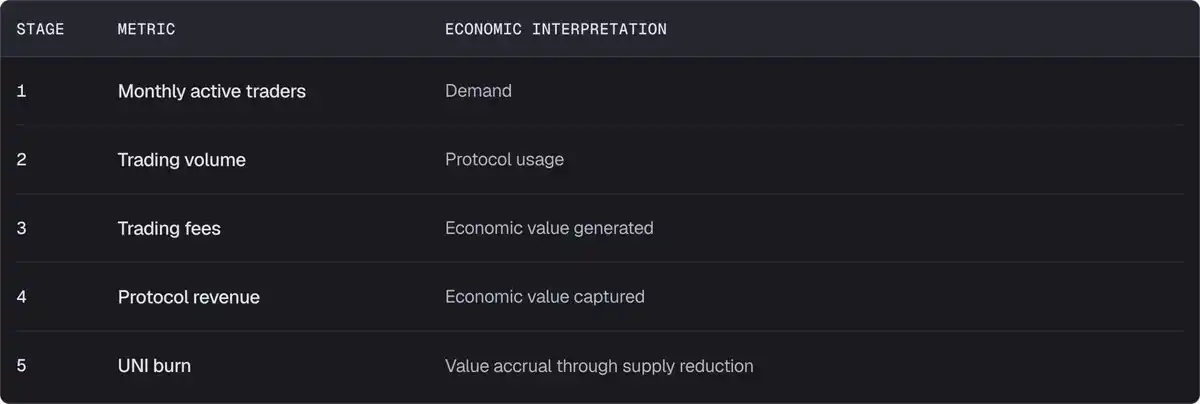
How Value Flows Through Uniswap
It is crucial to distinguish that trading fees ≠ protocol revenue. Trading fees represent the total sum of all fees generated from trades; protocol revenue is only the subset captured by the protocol, not an additional fee charged to users.
Protocol Fee: Enabling Value Capture at the Protocol Level
This new revenue mechanism operates on an already mature business foundation. As of August 8, 2026, Uniswap's cumulative trading volume is $3.7 trillion, with cumulative trading fees of $5.1 billion. Historically, all fees went to liquidity providers. Activating the protocol fee merely reallocates a portion of the existing fee pool; it does not create new trading activity out of thin air.
Initial rollout scope: All v2 pools on Ethereum mainnet, plus selected v3 pools.
v2 pools: The total trading fee remains 0.30%, with the allocation adjusted to 0.25% for liquidity providers and 0.05% for the protocol.
v3 pools offer more flexibility: UNI governance can independently set protocol fees for individual pools. The initial parameter rules: for pools with fee tiers of 0.01% and 0.05%, the protocol takes one-quarter of the liquidity provider fee; for pools with 0.30% and 1.00% tiers, it takes one-sixth. The initial rollout covered most major trading pools on Ethereum; governance can subsequently adjust fee parameters and expand pool coverage.
v4 pools offer even greater freedom: the protocol fee is deducted first from the trade input asset, with the remainder then used to calculate the liquidity provider fee; protocol fees can also be governed and configured per pool.
Therefore, protocol revenue is not a fixed percentage of trading volume or fees. Its level depends on trade composition, fee tiers, the range of pools with activated protocol fees, and governance-set parameters. These variables collectively determine how much of the economic value generated from trading is converted into protocol revenue.
Linking Protocol Revenue to UNI via a Permissionless Burn Mechanism
The connection between protocol revenue and UNI is facilitated by two new smart contracts. Protocol fees in various token forms are deposited into the immutable contract TokenJar, where assets accumulate continuously. Firepit manages the asset release process: market participants pay a corresponding amount of UNI to claim the accumulated fee assets from the TokenJar; the UNI paid by participants is permanently burned. The protocol itself does not need to actively sell its accumulated fee assets to acquire UNI.
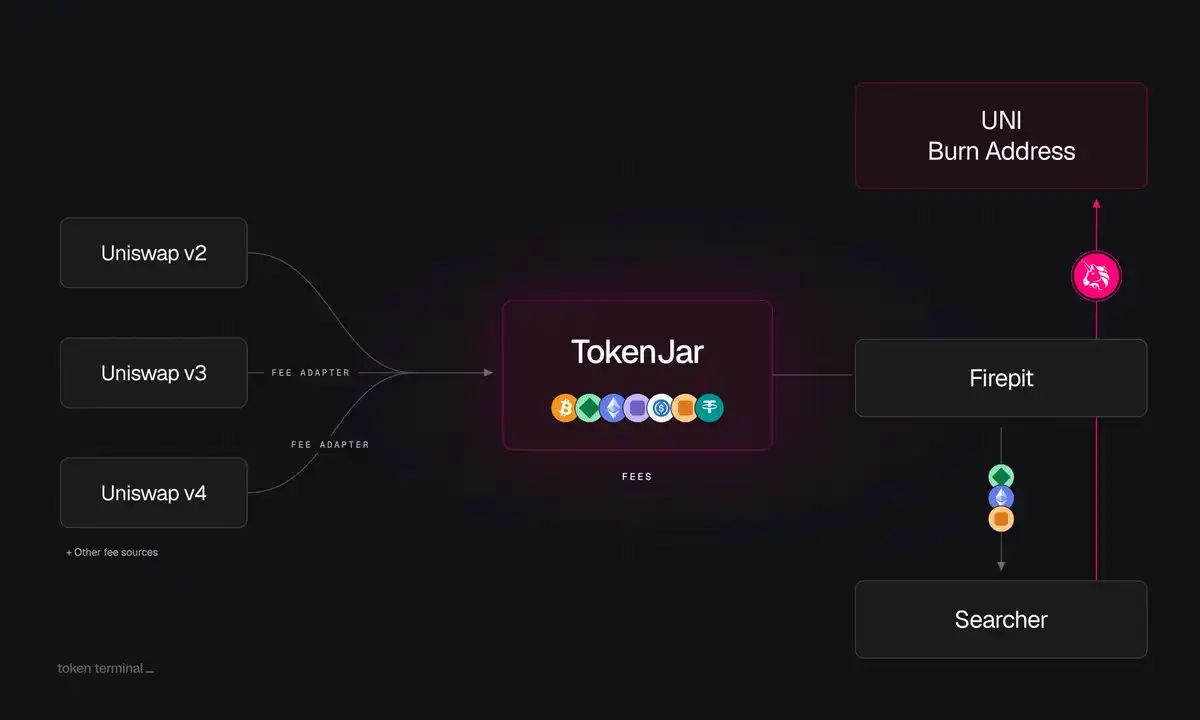
The Flow of Protocol Revenue to UNI Burn
This mechanism is not equivalent to distributing dividends to token holders. UNI holders do not directly receive fee assets as dividends or cash. Protocol revenue simply provides the economic foundation for the regularized deflation of UNI. Furthermore, revenue generation and burn occurrence are not synchronized: fee assets will remain stacked in the TokenJar until their value is sufficient to incentivize external participants to voluntarily trigger the release operation.
UNIfication also executed a separate one-time treasury burn: 100 million UNI were burned from the governance treasury. The proposal described this figure as an estimate: roughly the amount of UNI that would have been burned if the protocol fee had been active since UNI's inception. It's important to distinguish the two: the one-time treasury burn is a single reduction of treasury-held tokens; Firepit is the ongoing burn mechanism for future protocol revenue.
With the mechanisms explained, we now move to quantitative questions: how much trading does Uniswap actually handle, how much economic value does it create, how much revenue does the protocol capture, and what does this economic reality mean for UNI? Chapter three answers these using Token Terminal data.
The New Economic Model is Now Quantifiable
Chapters one and two introduced the changes brought by UNIfication. We can now evaluate the post-reform system with real on-chain usage data and financial metrics. Token Terminal's data allows for a unified observation of Uniswap's business scale, revenue captured by the protocol, and the relationship between that revenue and UNI. This chapter analyzes the period following the reform's implementation, prioritizing complete calendar month data and distinguishing between objective observations and the underlying influencing mechanisms.
Uniswap Continues to Attract Traders and Handle Large-Scale Trading
The foundation of Uniswap's economic model is users consistently choosing to trade on the protocol. Monthly active traders measure demand strength; trading volume and fees measure the economic value created by trading. These metrics should be considered together: an increase in user count does not guarantee a proportional rise in volume (average trade size may decrease); fewer traders could still yield higher total volume (larger individual trades).
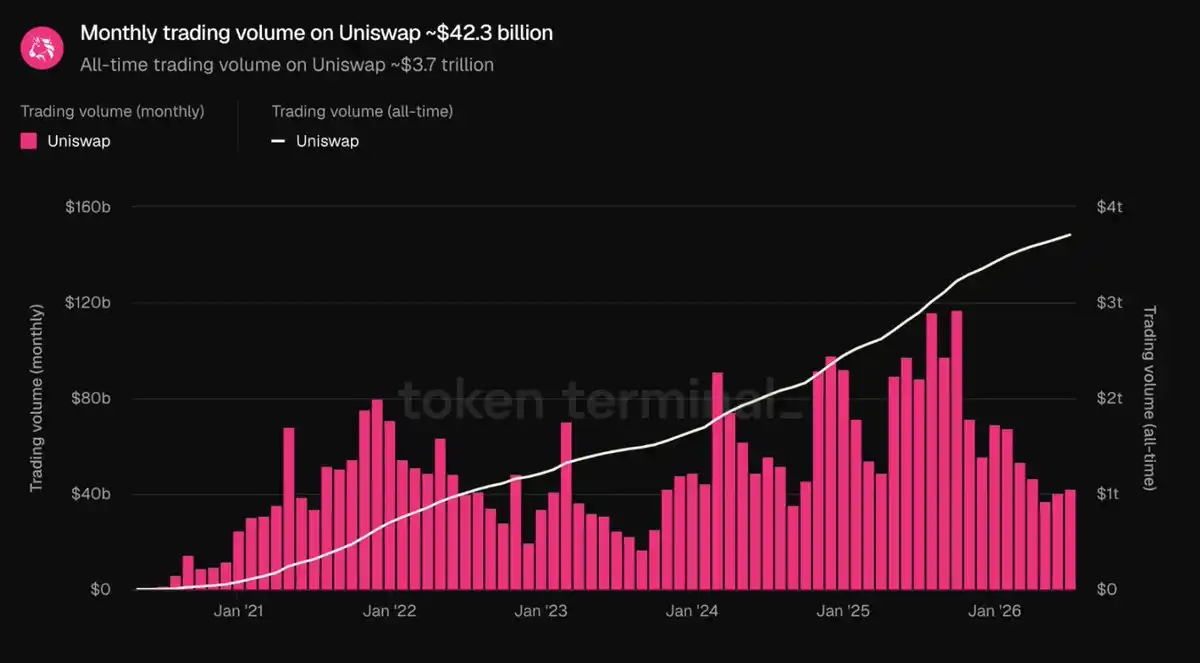
Uniswap's Monthly and Historical Trading Volume
From January to July 2026, Uniswap's total trading volume was $357.6 billion, averaging $51.1 billion per month. Monthly volume declined from $69.5 billion in January to $37.0 billion in May; it recovered partially to $40.8 billion and $42.3 billion in June and July, respectively. Trading scale contracted in the first half of the year before showing some signs of recovery.
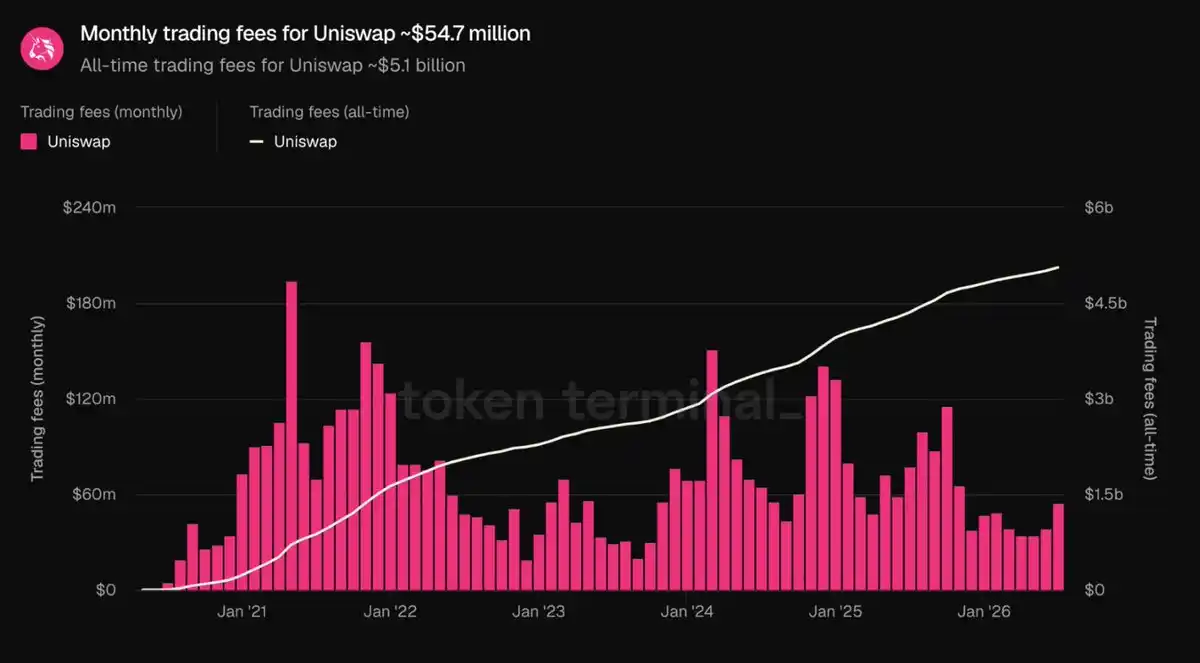
Uniswap's Monthly and Historical Trading Fees
Over the same seven months, total trading fees generated were $297.9 million. Fees were $47.6 million in January and $48.8 million in February; they followed volume downward in March-April; bottomed at $35.0 million in May; then rebounded, reaching $54.7 million in July. Despite July's trading volume being significantly lower than January's, July's fees were actually the highest among these seven months.
The divergence in trading volume and fee trends underscores the need to analyze them separately. Fees depend not just on total turnover but also on which pool types trades occur in and their corresponding fee tiers. For the first seven months of 2026, on average, every $1 of trading volume generated 8.3 basis points in fees; the actual effective rate fluctuates with trade composition. Volume indicates protocol usage scale; fees more closely reflect the actual economic value generated by the business.
This is the business foundation for evaluating the new protocol fee mechanism. Our focus is no longer solely on how large Uniswap's trading volume is, but on how much of this economic value is captured at the protocol level.
The Protocol Fee Introduces an Observable Layer of Revenue and Value Accrual
The protocol fee, activated in late December 2025, began generating revenue thereafter. From January to July 2026, cumulative protocol revenue was $28.2 million; total trading fees for the same period were $297.9 million. Protocol revenue constituted approximately 9.5% of trading fees, equivalent to 0.79 basis points of trading volume.
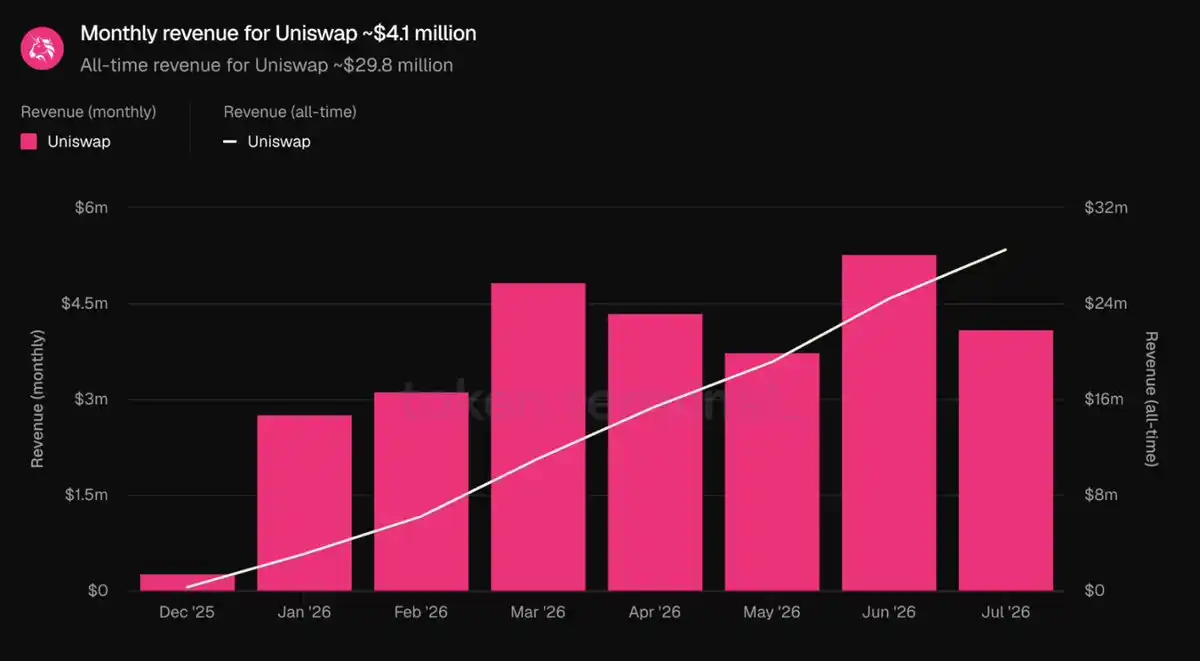
Uniswap's Monthly and Historical Revenue
Comparing two ratios is more insightful than looking at the absolute protocol revenue number alone. Trading fees represent the total economic value created by the business; "protocol revenue ÷ trading fees" represents the value capture rate. "Protocol revenue ÷ trading volume" provides a second perspective. These two indicators together allow us to separate changes in the protocol's monetization ability from changes in overall user activity.
Monthly protocol revenue shows noticeable fluctuation: $2.8 million in January, peaking at $4.8 million in March, dropping to $3.7 million in May, rising to $5.3 million in June, and then $4.1 million in July. As of August 8, 2026, cumulative protocol revenue since the reform's implementation was $29.8 million. Monthly volatility stems partly from market conditions and partly from the protocol fee being rolled out progressively across pools and blockchains.
Rollout schedule: Ethereum v2 and selected Ethereum v3 pools were activated first in December 2025; subsequently expanding to other blockchains, all v3 pools on a chain, and some v4 pools. Therefore, annualizing data from early 2026 would underestimate the protocol's long-term revenue potential—initially, only a portion of the trading volume was within the protocol fee's coverage.
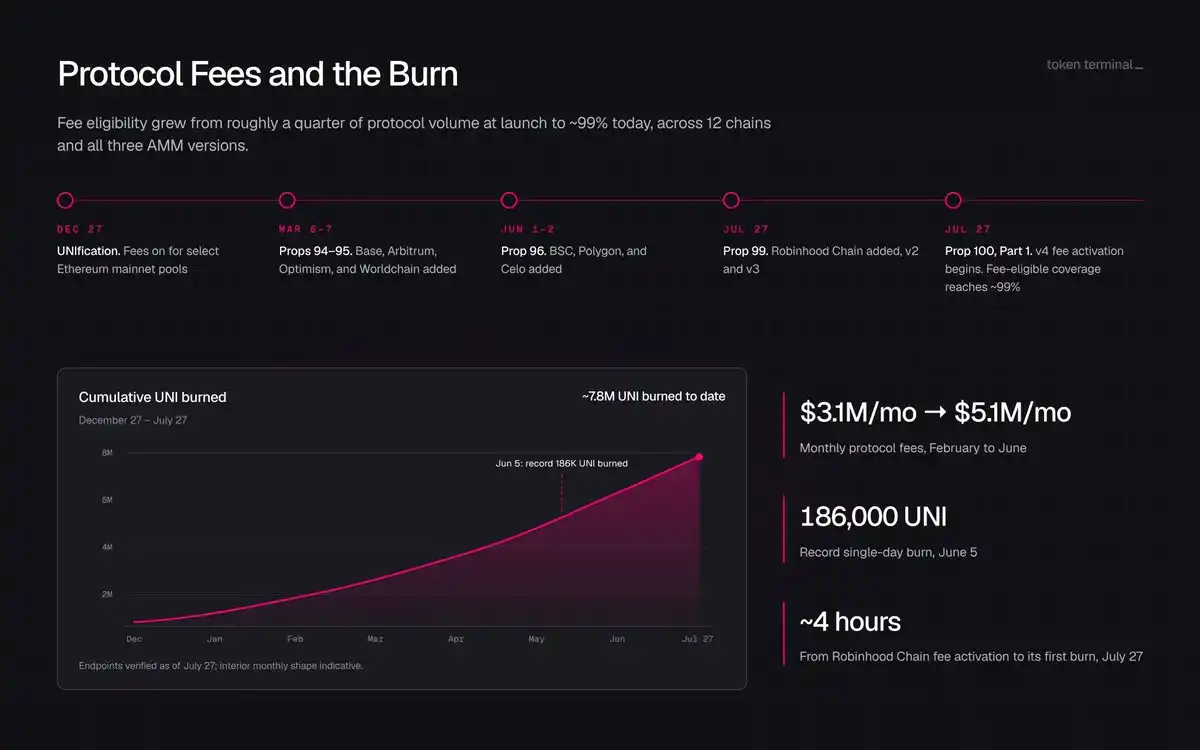
Uniswap Protocol Fee Rollout Timeline
There is no single, fixed percentage for protocol revenue capture. Revenue depends on which pools trades occur in, the fee tiers of those pools, whether the pool has the protocol fee activated, and governance-set parameters. Even if total volume remains constant, a change in trade composition can increase or decrease protocol revenue. Similarly, governance expanding or adjusting protocol fee coverage can change the scale of value capture without requiring any change in user behavior.
Measured results from the first seven months of 2026: for every $100 in trading fees generated, approximately $9.5 was converted into protocol revenue; correspondingly, every $1 billion in trading volume yielded about $79,000 in protocol revenue. These are merely the actual results for this period, not permanent fixed rates; future performance depends on the trading business itself and governance adjustments to fee coverage and parameters.
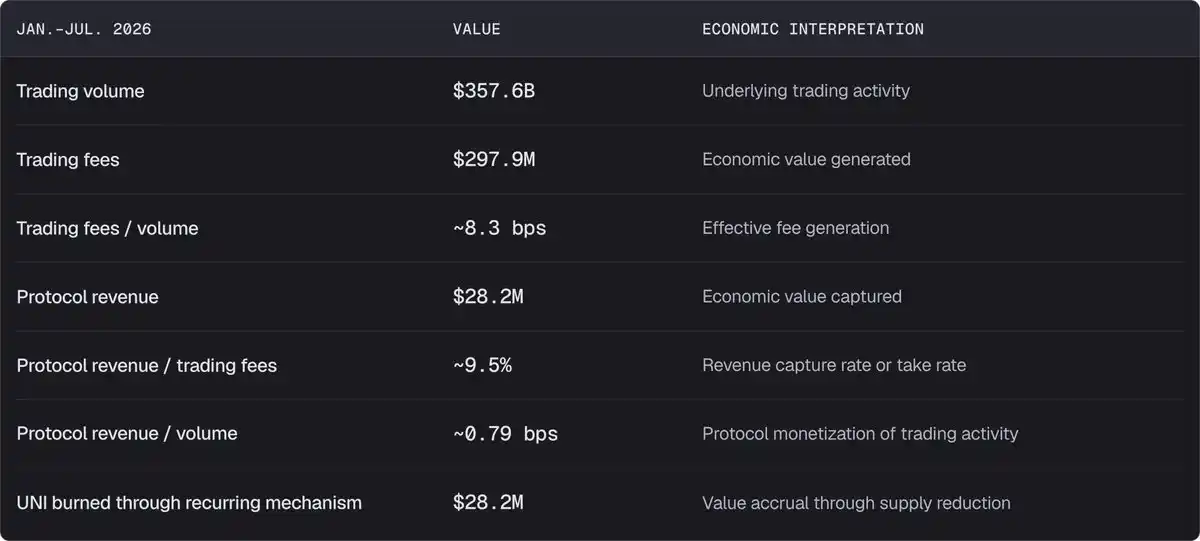
The Protocol Fee Introduces a Measurable Layer of Value Capture
Protocol revenue is only half of this new value system. Assets captured by the protocol accumulate in the TokenJar and must await Firepit release to trigger UNI burns. The moment revenue is confirmed is not the moment burning occurs. Assets will accumulate in the TokenJar until the release operation becomes economically attractive. Therefore, short-term comparisons between protocol revenue and burn amounts can lead to incorrect conclusions; over a longer time horizon, cumulative protocol revenue and cumulative burn scale should converge.
In summary, UNIfication brings two major tangible changes: 1) Protocol business now generates an observable stream of protocol revenue. 2) This revenue is linked to a mechanism that regularly reduces the circulating supply of UNI. However, the actual magnitude of both effects still depends on trading activity, fee generation scale, protocol fee coverage, governance parameters, and the timing of triggering the release of TokenJar assets. All these variables are now observable on-chain, no longer reliant on speculation.
Observable Protocol Revenue Provides a New Basis for UNI Fundamental Analysis
With the activation of the protocol fee, the framework for analyzing UNI has also changed. Before the reform, analysts relied on metrics like monthly active traders, trading volume, trading fees, TVL (Total Value Locked), and market share to evaluate Uniswap. These metrics could demonstrate the protocol's adoption and economic output, but there was no regularized protocol revenue stream linked to UNI token deflation. The relationship between protocol business performance and UNI token economics was indirect and ambiguous.
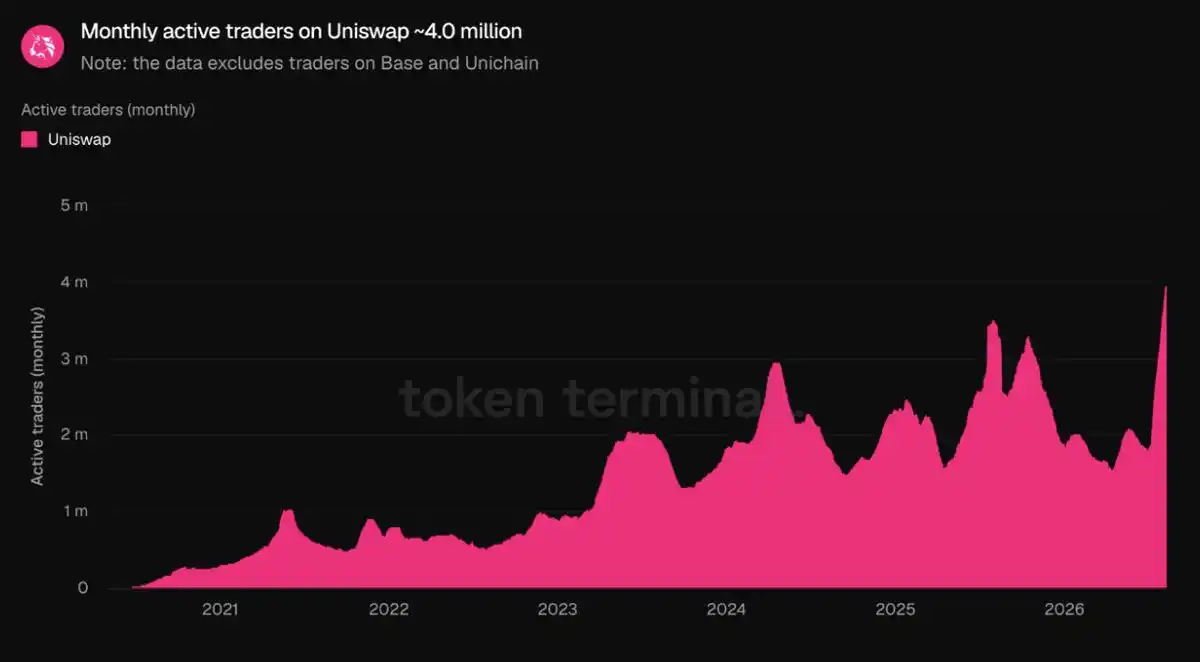
Monthly Active Traders on Uniswap
Protocol revenue and regularized UNI burns add two new observable metrics to the analytical framework. It is now possible to quantify how much economic value Uniswap creates, what proportion the protocol captures, and how that captured value drives a reduction in the UNI supply.
Important reminder: This does not equate UNI to equity; UNI holders do not possess traditional corporate ownership rights, dividends, or shareholder privileges. However, it provides a more directly correlated analytical framework linking protocol operating performance to UNI token economics.
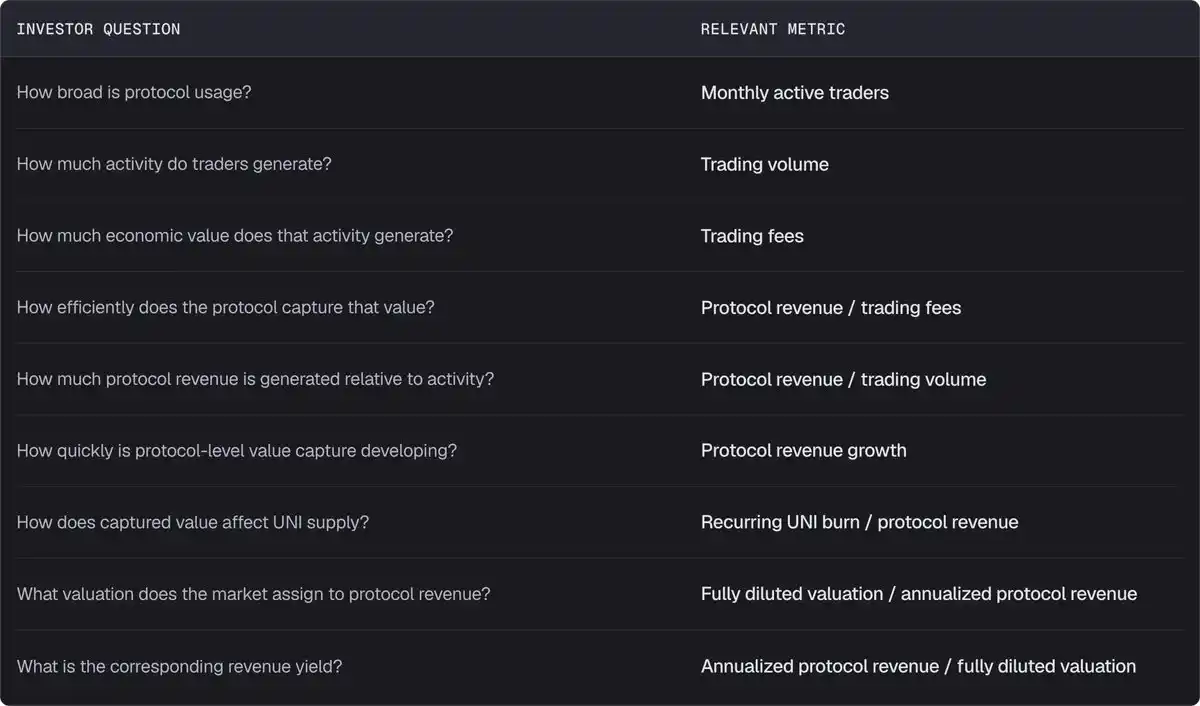
Therefore, Fundamental Analysis of UNI Can Encompass Multiple Layers
From a valuation perspective, this expands the analytical toolkit rather than providing an absolute valuation formula. As of August 8, 2026, UNI's fully diluted valuation was approximately $3.5 billion. Based on the annualized protocol revenue at that time, the fully diluted price-to-sales (P/S) ratio was about 67x; corresponding to an annualized protocol revenue yield relative to the fully diluted market cap of about 1.5%.
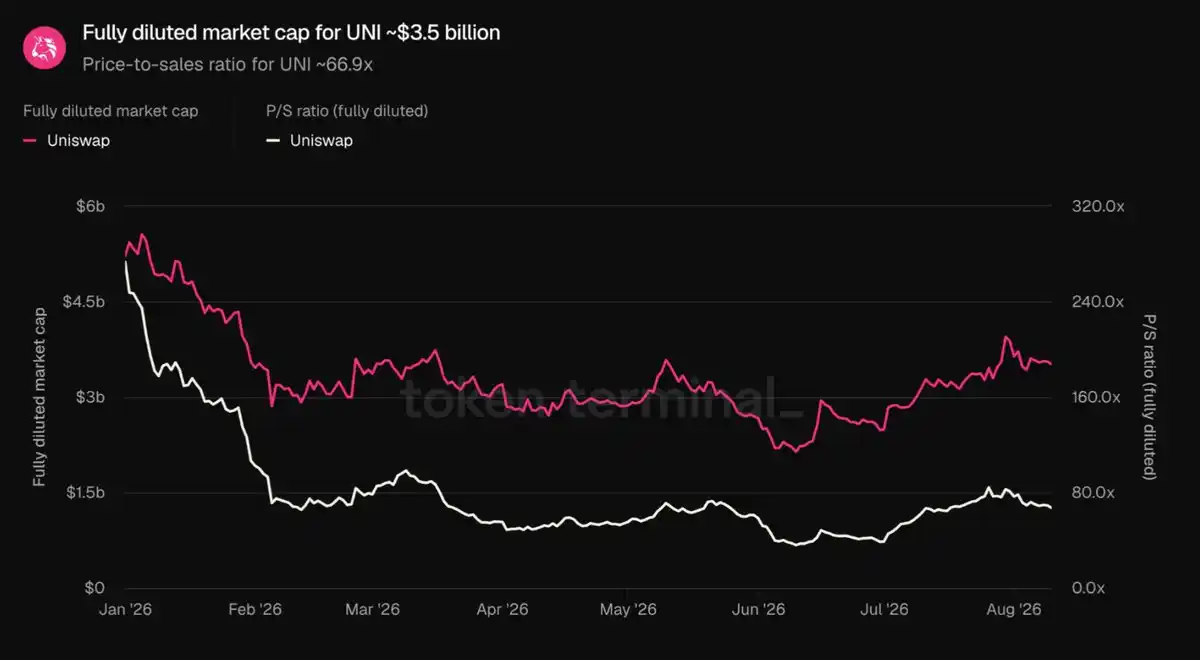
Uniswap (UNI) Fully Diluted Market Cap and Price-to-Sales Ratio
Traditional public company P/S valuation multiples cannot be directly applied. UNI does not represent an equity claim on Uniswap Labs; protocol revenue is not distributed to UNI holders like corporate profits. The utility of this metric is limited: it merely standardizes the comparison between UNI's market valuation and the economic value currently captured by the protocol.
The revenue base itself is still in its early stages: the protocol fee has been active for less than a year; governance can modify fee coverage at any time; changes in trading volume or capture rates mean simply annualizing short-term revenue can severely overestimate or underestimate future revenue. Therefore, the P/S multiple cannot be used alone to determine a fair price; it must be considered alongside revenue growth rate, value capture rate, underlying trading volume, and the actual translation of protocol revenue into UNI burns.
Nevertheless, this represents a significant upgrade in analytical capability. Researching UNI no longer relies solely on governance rights, product adoption, market share, or speculation about future monetization. Now, one can directly observe the protocol revenue stream, calculate the efficiency of converting trading fees into protocol revenue, track how much captured value actually leads to UNI burns, and then compare these economic realities against UNI's market valuation.
Thus, UNIfication has made the economic relationship between Uniswap's business and the UNI token measurable. Analytical questions are beginning to resemble those for traditional profitable businesses: business growth rate, monetization efficiency, and the valuation assigned by the market; but all analysis must be grounded in Uniswap's unique protocol and governance architecture.
Conclusion
UNIfication, on one hand, redefined the division of work between the Uniswap Foundation and Uniswap Labs, and on the other hand, altered the linkage logic between the protocol's economic output and the UNI token. Organizationally: The vast majority of ecosystem development and growth work previously undertaken by the Foundation was transferred primarily to Uniswap Labs; governance power, the legal wrapper, and execution responsibilities remain separated. DUNI holds protocol-level decision-making power and governance treasury resources, providing the necessary legal identity for off-chain implementation; Labs, as DUNI's service provider, is responsible for driving Uniswap protocol development. The Uniswap Foundation retains streamlined duties, continuing to serve as DUNI's ministerial agent.
Economically, the activation of the protocol fee introduced a continuous stream of protocol revenue. Token Terminal data shows that from January to July 2026, Uniswap's trading volume was $357.6 billion, trading fees were $297.9 million, and the protocol captured $28.2 million in revenue, representing 9.5% of trading fees. Through TokenJar and Firepit, this captured value can drive the ongoing deflation of the UNI token.
For researchers and investors, the core change is: the link between protocol business performance and the UNI token is now directly observable. Past analysis of Uniswap referenced monthly active traders, trading volume, fees, TVL, and market share. Now, protocol revenue and regularized UNI burns add observable dimensions for value capture and value accrual; revenue-based valuation metrics also provide another way to compare UNI's market capitalization with the underlying protocol's economic fundamentals.
Therefore, UNIfication itself does not determine UNI's price, nor does it guarantee Uniswap's future business performance. It establishes a new operational and economic architecture upon which we can base our analysis. The connections between governance authority, business execution, protocol value capture, UNI token deflation, and market valuation have become more explicit, and each element can be independently observed and measured.