Nu Global Taps USDC and EURC to Power Cross-Border Payments

TheNewsCryptoОпубліковано о 2026-09-11Востаннє оновлено о 2026-09-11

Анотація

Brazilian fintech giant Nu Holdings, the company behind Nubank, has launched Nu Global, a multi-currency digital account that automatically converts deposits into Circle's USDC and EURC stablecoins. This marks the company's formal entry into the U.S. market, its first expansion beyond Latin America after 13 years. Deposits earn interest (3.50% APY for USDC, 2.20% for EURC) and users receive a virtual Mastercard for global spending with competitive exchange rates. The platform also allows holding and trading cryptocurrencies like Bitcoin and Ethereum. Cross-border money movement to over 35 countries is fee-free. This move leverages Nu's existing base of over 140 million customers, positioning stablecoins as a mainstream tool for everyday cross-border payments and significantly expanding the distribution for USDC and EURC.

Nu Holdings, the Brazilian fintech behind Nubank, Latin America’s largest digital bank, has launched Nu Global, a multi-currency digital account that automatically converts deposits into Circle‘s USDC and EURC stablecoins. The launch comes alongside a formal entry into the United States market, marking the company’s first move beyond its core Latin American markets after thirteen years of operation.

In addition, Nu is entering this next phase off the back of a record quarter: its customer base surpassed 140 million, quarterly net income crossed $1 billion, and return on equity hit 32%. The company continues to post increasing customer activity with a low cost to serve.

David Velez, Founder and CEO of Nu, put it plainly:

“This is the next chapter of something we started thirteen years ago in a small house in São Paulo. Since our founding, we have believed that consumer-obsessed digital banking is the future of retail banking globally, and after proving this hypothesis with over 140 million fanatical customers in Latin America, we are excited to start executing our thesis beyond our core region.”

What Nu Global Actually Offers?

Every deposit made into a Nu Global account is automatically converted into USDC or EURC. It earns 3.50% APY and 2.20% APY daily, respectively. Also, users get a virtual Mastercard compatible with Apple Pay and Google Pay for global spending at competitive exchange rates with no markups.

Beyond stablecoins, the platform lets users hold and trade Bitcoin (BTC), Ethereum (ETH), Solana (SOL), and other curated digital assets directly in the app. Moreover, it is all backed by multilingual support around the clock.

Money movement is fee-free across over 35 countries, starting with Europe, Latin America, the US, Brazil, Colombia, and Mexico. Also, the US launch is backed by a partnership with FDIC-insured Lead Bank while Nu pursues its own national bank charter.

Why This Move Matters?

Nu is already Brazil’s largest private financial institution, Mexico’s largest digital bank, and Colombia’s fourth largest by deposits. Bringing stablecoins and digital asset access to a combined base of 140 million customers, many of whom are underserved by traditional banking. It’s a structural shift in how everyday people move money across borders.

Significantly, Circle’s USDC and EURC gain one of the largest distribution channels in fintech history. For the stablecoin market, Nu Global’s scale normalises stablecoin usage as a daily financial tool rather than a crypto-native product. This is a key acceleration of mainstream adoption regardless of where broader crypto markets are trading.

Crypto Market Highlights

Trezor Security Alert: Fake Emails Sent From Legitimate Address

TagsCircleCryptomarketNUNubankstablecoinsUSDC

Пов'язані питання

QWhat is Nu Global and what are its core features?

ANu Global is a multi-currency digital account launched by Nu Holdings. Its core features include automatic conversion of deposits into Circle's USDC and EURC stablecoins, earning daily APY (3.50% for USDC, 2.20% for EURC), a virtual Mastercard for global spending, and the ability to hold and trade digital assets like Bitcoin and Ethereum. It also offers fee-free money movement across over 35 countries.

QHow does Nu Global's launch mark a significant expansion for Nu Holdings?

AThe launch of Nu Global marks Nu Holdings' formal entry into the United States market, representing the company's first strategic move beyond its core Latin American markets after thirteen years of operation.

QWhy is Nu Global's use of stablecoins like USDC and EURC considered a significant development?

AIt is significant because it provides Circle's USDC and EURC with one of the largest distribution channels in fintech history. For the market, it normalizes stablecoin usage as a daily financial tool for a massive user base, accelerating mainstream adoption regardless of broader crypto market conditions.

QWhat are some of the recent financial highlights of Nu Holdings mentioned in the article?

ANu Holdings recently reported a record quarter where its customer base surpassed 140 million, quarterly net income crossed $1 billion, and return on equity reached 32%.

QWhat partnership supports Nu Global's launch in the United States?

AThe U.S. launch of Nu Global is backed by a partnership with FDIC-insured Lead Bank, while Nu Holdings simultaneously pursues its own national bank charter.

Пов'язані матеріали

Meme Coins Peak in 17.2 Days on Average: Ephemeral Fervor and the Great Capital Migration

Meme Coins' Average Peak: 17.2 Days - A Fleeting Frenzy and a Capital Exodus A Bloomberg analysis reveals the stark reality behind meme coin mania: extreme short-term speculation. On average, a new meme coin reaches its all-time high (ATH) a mere 17.2 days after its first trade. Alarmingly, 25% of projects peak within just 38.4 hours. The subsequent decline is brutal, with the median time to drop 95% from the peak and enter dormancy being 370 days. Only about 3% ever break their previous ATH again. This drastic compression of the speculative lifecycle is driven by zero-barrier token creation on platforms like Pump.fun and automated trading tools like sniper bots, which enable instant deployment and rapid pump-and-dump schemes. The market is saturated, diluting liquidity and forcing a predatory, player-versus-player environment where early holders quickly exit with minimal gains. As the odds of success in traditional meme coins diminish, speculative capital is migrating. Decentralized prediction markets like Polymarket, offering transparent, event-driven betting, are attracting significant liquidity. Concurrently, AI agent tokens are drawing funds with their combination of high volatility and long-term narrative tied to artificial intelligence. This capital shift marks a move away from simplistic "greater fool" assets toward platforms with clearer mechanisms or dynamic technological themes.

marsbit15 хв тому

Meme Coins Peak in 17.2 Days on Average: Ephemeral Fervor and the Great Capital Migration

marsbit15 хв тому

CoreWeave Default Probability Exceeds 60%! Huang Renxun 'Puts Out Fire': Financing Costs Declining, No Need for NVIDIA to Provide Backstop

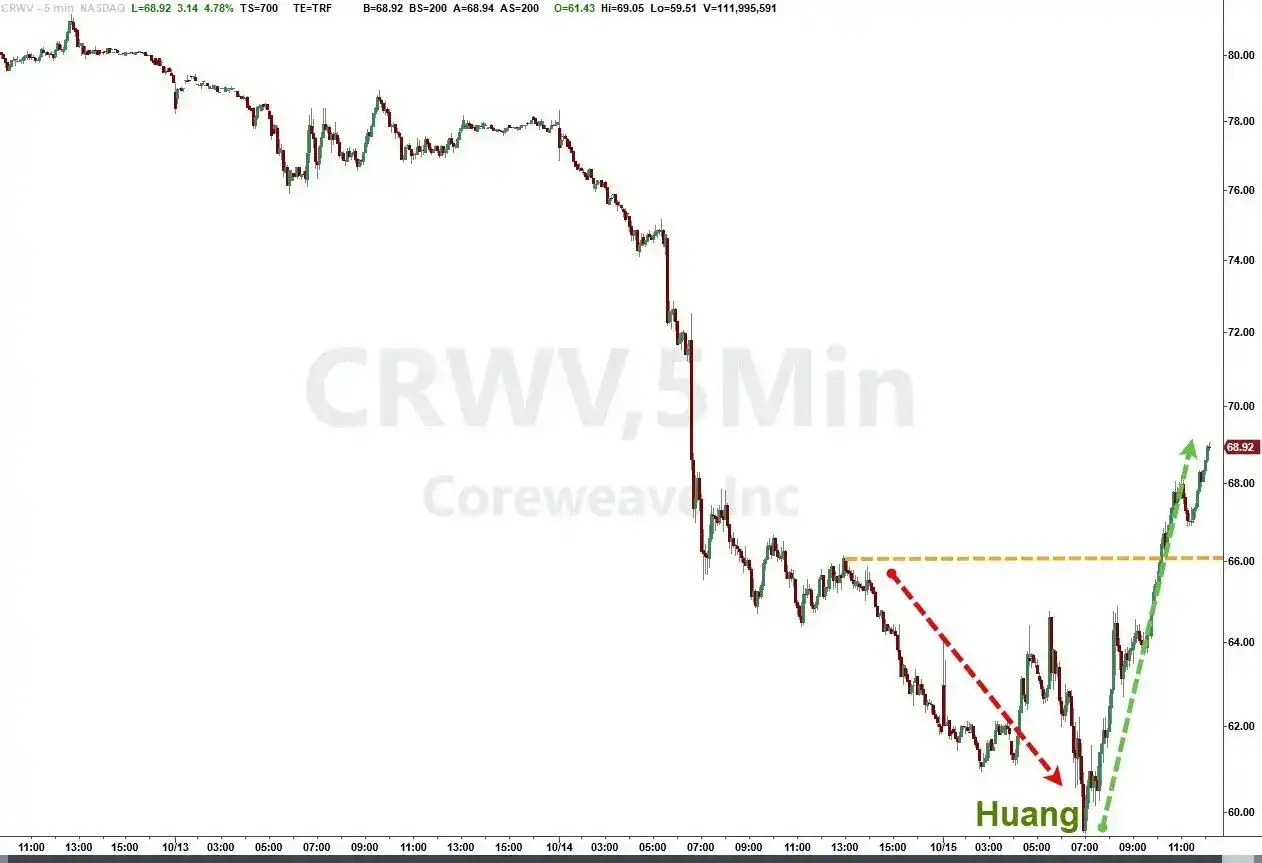
CoreWeave, a major AI cloud service provider and key NVIDIA customer, is facing heightened credit market concerns. Its five-year credit default swap (CDS) spreads soared to a record high of over 1190 basis points, implying a perceived default probability exceeding 60%. Concurrently, its bond prices plummeted, with yields surging above 15-16%, reflecting intense investor worries about its ability to service nearly $50 billion in debt while remaining unprofitable. This stress is spreading within the AI infrastructure sector. CDS spreads for companies like Oracle, SoftBank, NVIDIA, and others also widened significantly, indicating a broader market reassessment of the debt risks behind massive AI capital expenditures. In response, NVIDIA CEO Jensen Huang publicly expressed confidence in CoreWeave, stating its "financial strength is growing daily" and its cost of capital is declining. He explicitly stated NVIDIA sees no need to provide a financial backstop for CoreWeave, in which it holds a roughly 10% stake. His comments helped CoreWeave's stock recover from early losses. The core issue under scrutiny is whether the future cash flows from AI investments can cover the enormous upfront costs and interest burdens, especially as financing becomes more expensive. The situation highlights a critical shift in market focus: from purely evaluating AI compute demand to questioning the sustainability of the debt-fueled expansion models used to build that capacity.

marsbit35 хв тому

CoreWeave Default Probability Exceeds 60%! Huang Renxun 'Puts Out Fire': Financing Costs Declining, No Need for NVIDIA to Provide Backstop

marsbit35 хв тому

Farcaster Changes Hands Again: The Hottest Potato in the Decentralized World

The decentralized social protocol Farcaster has changed ownership for the third time in nine months, being described as a "hot potato" in the decentralized world. On October 15, 2026, Rish, co-founder of Neynar, announced that Network School, founded by Balaji Srinivasan, would take over Farcaster, including its application, protocol codebase, and related products. This followed Neynar's acquisition of Farcaster from its original creator, Merkle Manufactory, in January 2026. Farcaster, which achieved a $1 billion valuation after a $150 million Series A round in 2024, saw its user activity and revenue decline sharply post-2025. Daily active users (DAU) dropped 40% from its peak of nearly 100,000, and monthly revenue fell to around $10,000. After taking over, Neynar pivoted Farcaster toward developers, but protocol revenue (including from Clanker) plummeted by 99% from Q1 to Q3 2026, leading to the search for a new owner. Network School, Balaji Srinivasan's venture practicing his "network state" theory and recently valued at $2 billion, plans to rebrand Farcaster as the "Network State Protocol." Significant rule changes include requiring users to accept a "social smart contract" to mint an NFT for full access, implementing content moderation based on Singaporean public conduct codes, and introducing AI-assisted review with potential human verification. These changes, particularly the centralized control over content and access via the dominant official app (formerly Warpcast), have sparked community debate. The repeated ownership transfers highlight a core tension in decentralized social networking: while the protocol layer is technically decentralized, control over the primary user application grants centralized power over the entire network's experience and direction. Each new owner brings a different vision, but all face the fundamental challenge of reviving a platform with declining users and revenue.

marsbit35 хв тому

Farcaster Changes Hands Again: The Hottest Potato in the Decentralized World

marsbit35 хв тому

US Stock Market Trends (October 16): Dow Surges Over 550 Points, TSMC's Net Profit Rises Nearly 70% but Stock Closes Lower

**U.S. Market Trends (October 16): Dow Jumps Over 550 Points, TSMC Falls Despite 69% Net Profit Surge** U.S. stocks reversed early losses on Thursday. The Dow Jones surged over 550 points (1.08%), while the Nasdaq Composite edged up 0.08%. The Philadelphia Semiconductor Index fell for a seventh consecutive session, closing down 0.88%. The S&P 500 rose 0.33%, with healthcare, materials, and financials leading gains. Energy and tech sectors declined. Major tech stocks were mixed. Microsoft and Alphabet gained, while Nvidia and Tesla fell. Server stocks like Dell and Hewlett Packard Enterprise dropped sharply. Despite reporting strong Q3 results—a 69% year-on-year jump in net profit and raising its full-year revenue growth forecast to ~44%—TSMC's U.S.-listed shares fell 1.80%. Investor concerns persist about funding for massive AI/data center expansions and their eventual returns. CoreWeave's stock rebounded to close nearly 6% higher after Nvidia CEO Jensen Huang stated the AI cloud provider was strengthening and did not need rescue, easing equity investor worries. However, its bonds remained under pressure due to high leverage and funding needs. Economic data showed mixed signals. September PPI surged 1.3% month-on-month (the highest since March 2022), driven by energy prices. Retail sales grew 0.8%, largely fueled by gasoline spending. Excluding autos and gas, growth was minimal. Despite hot inflation prints, Treasury yields retreated, with the 10-year near 5.09%. Oil (WTI) rose over 3%, while gold gained 2%. Bitcoin traded around $82,300. Focus turns to upcoming remarks from Fed officials ahead of the quiet period and key data like industrial production, as investors weigh inflation against growth concerns and tech sector volatility.

marsbit51 хв тому

US Stock Market Trends (October 16): Dow Surges Over 550 Points, TSMC's Net Profit Rises Nearly 70% but Stock Closes Lower

marsbit51 хв тому

Торгівля

Спот
活动图片