Author: Dong Jing
The storage sector is experiencing a concentrated sell-off triggered by multiple overlapping pressures. Micron closed down 3.88% on Monday, while SanDisk fell deeper by 5.97%. These two bellwether stocks have declined in six out of the last seven trading sessions. Micron is down nearly 20% from its June peak, approaching a technical bear market.
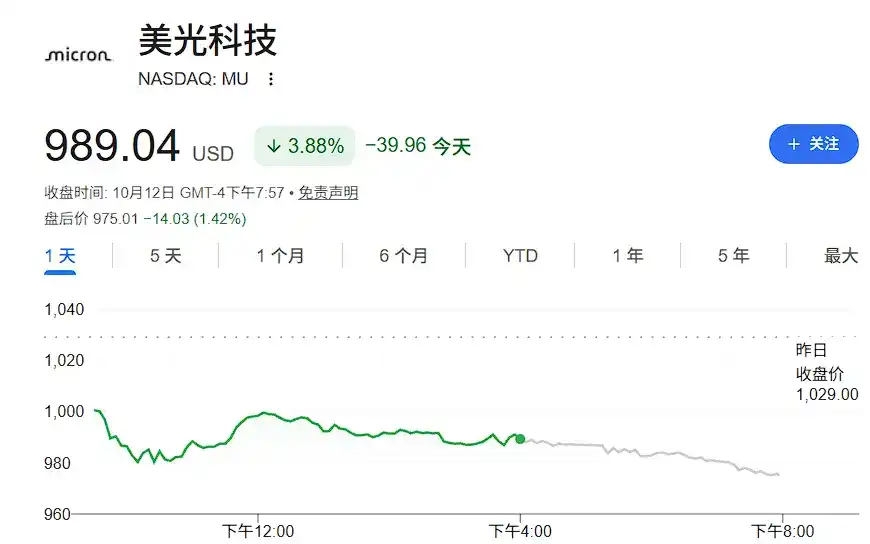
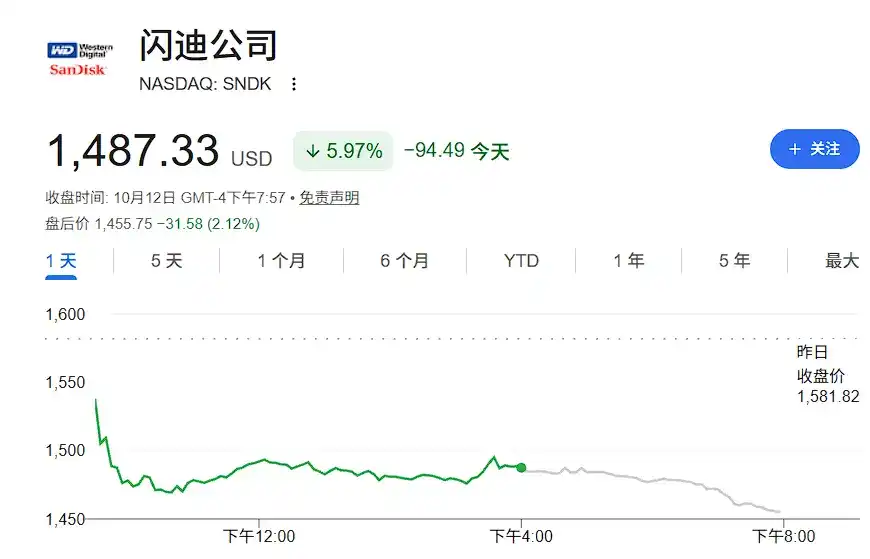
The trigger for this round of adjustment comes from three shocks: a catch-up decline in the South Korean market post-holiday, the early termination of the historically largest share buyback plans by Samsung and SK Hynix, and the key progress announced by Changxin Memory Technologies (CXMT) in Shanghai regarding its new 4F² DRAM architecture with plans to launch server memory products by year-end. Goldman Sachs EMEA Trading Head Rich Privorotsky summarized this situation as "storage remains the epicenter," pointing directly to the market's core concern: despite the extremely strong recent fundamentals, fears about peak earnings are suppressing valuations.
However, the market's paradox lies in the fact that the fundamentals of the storage industry have never been stronger, yet investors have already turned their gaze to 2027-2028: when the continued expansion of Chinese storage capacity and the simultaneous production of new Korean wafer fabs may reverse the supply-demand balance. As Pictet's Jon Withaar puts it, storage stocks "have become value stocks, cheaply valued based on current earnings," but "retail investors and fast-money hedge funds are chasing growth, not value."
South Korean Market Catch-up Decline, Buyback Support Disappears
The Korea Composite Stock Price Index (KOSPI) plunged 3.65% on Monday, closing at 6384.2 points, just above the 200-day moving average support at 6376 points. The tech-heavy KOSDAQ fell 4.8%, and the semiconductor index KRXSEMI dropped 5.2%. SK Hynix and Samsung each fell about 4.5%. According to Goldman Sachs' Seoul trading desk, the day's movement was "a one-way decline from the opening bell."
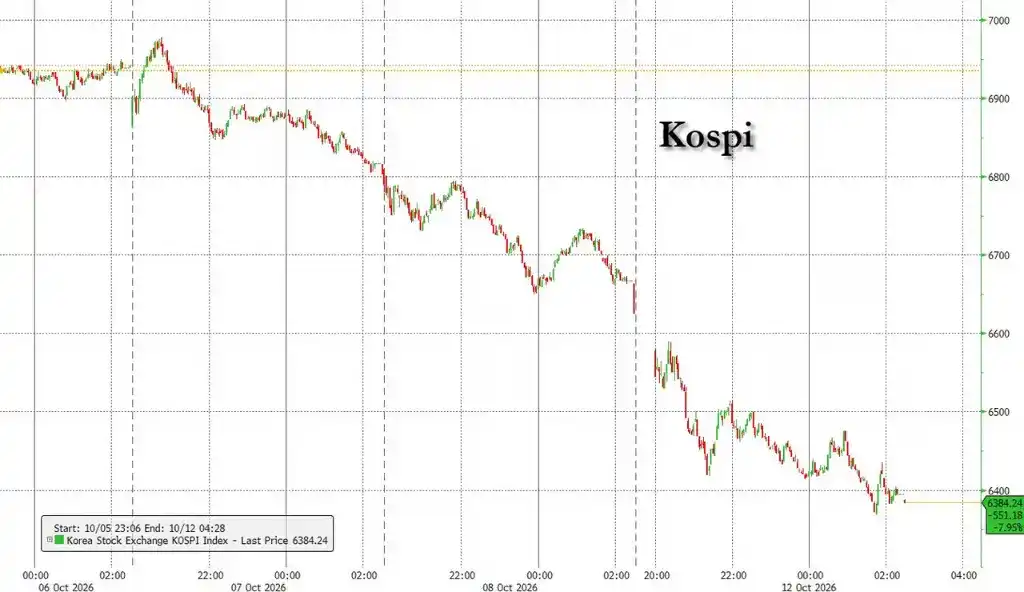
The direct cause of this catch-up decline was the South Korean market needing to digest the losses of U.S. chip stocks from the previous two trading days after being closed for the Hangul Day holiday. Foreign capital was a net seller for the fifth consecutive day, with net selling in the tech sector reaching $1.3 billion in a single day, including $782 million from SK Hynix and $415 million from Samsung. Retail investors bought on the dip, net buying $710 million in Samsung, but Goldman Sachs notes that the scale of net buying by retail investors is showing a declining trend.
A deeper structural issue is the disappearance of buyback support. As previously reported, the combined buyback plans of Samsung and SK Hynix totaling approximately 55 trillion won (about $400 billion) – the largest in South Korean history – ended weeks earlier than planned, with Samsung's buyback effectively ceasing on October 6. In the three trading days since the buyback ended, the KOSPI has fallen about 8%. The KOSPI is now down about 30% from its historical high on June 22, with SK Hynix falling even deeper by 45%.
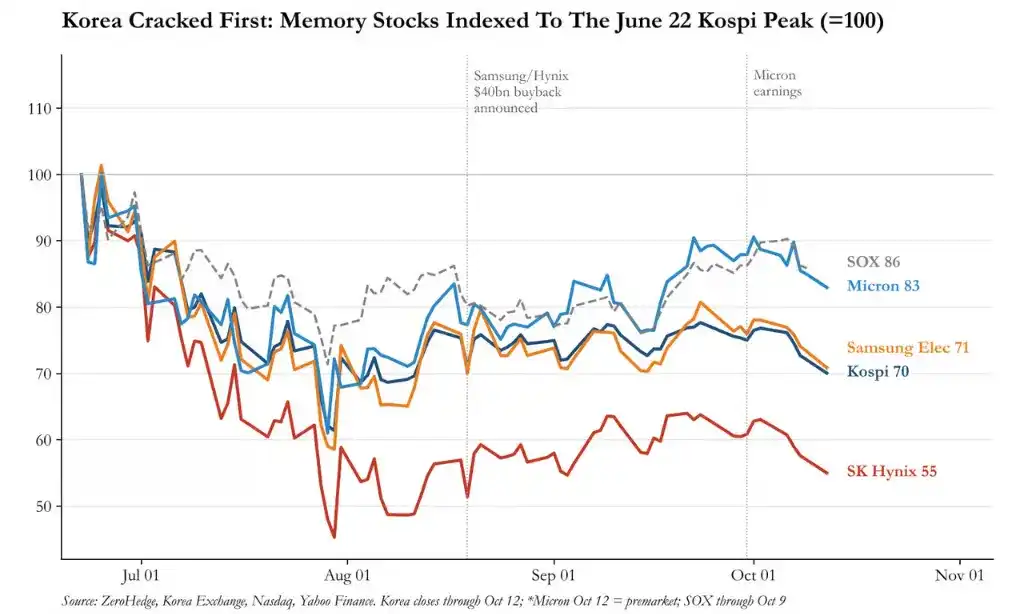
Analysis suggests that the South Korean market, which led the rally during the storage upcycle, is now breaking down first in the downcycle, potentially playing the role of a leading indicator once again.
Changxin's 4F² Breakthrough Heats Up Long-term Supply-Side Concerns
News from Shanghai over the weekend became a significant catalyst for this round of selling. According to a report by the Shanghai Securities News, at the 4th Integrated Chips and Chiplets Conference held from October 9-10, Changxin Memory Technologies (CXMT) President Cao Kanyu announced that the company had made key progress in its 4F² architecture development and officially stated it expects to launch a new generation of DDR5 RDIMM products integrating the 4F² architecture and hybrid bonding by the end of the year, directly targeting the server memory market.
The core significance of the 4F² architecture lies in its density leap. The current mainstream in the DRAM industry is the 6F² architecture, where each memory cell occupies an area six times the square of the minimum feature size. 4F² means the area per cell is reduced by about one-third, theoretically enabling about a 50% increase in storage density on the same wafer area and at the same process node. The core innovation of Changxin's 4F² architecture is its self-developed VSG (Vertical Surrounded Gate) transistor, which enhances gate control through a vertical surrounding channel structure, addressing both leakage and short-channel effects, while achieving area scaling through the transistor's vertical layout.
The transition from 6F² to 4F² is essentially a fundamental change from a horizontal to a vertical transistor channel layout, requiring integration of entirely new process flows and cannot rely on the design and manufacturing systems of the 6F² era. Changxin has also decoupled DRAM from CMOS processes, achieving high-speed interconnects through wafer-level hybrid bonding, which is seen as a key turning point for DRAM technology moving from 2D scaling to 3D integration.
It is reported that Changxin initiated 4F² research and patent layout upon its establishment, with over 300 disclosed patent families, reportedly leading peers both domestically and internationally. The company published papers related to the 4F² architecture in 2021 and continued to disclose R&D progress in 2023 and 2025. In 2025, Changxin also presented a paper at IEDM, reporting the successful experimental verification of DRAM and CMOS wafer-level bonding on a 12-inch wafer platform.
For Samsung and SK Hynix, this timeline presents direct pressure. SK Hynix only announced its 4F² roadmap in 2025. According to reports by Korean media The Elec, Samsung's target is to achieve mass production of sub-10nm DRAM based on this architecture in 2028. If Changxin successfully delivers 4F² DDR5 RDIMM products by year-end as planned, it will lead the two Korean giants by about two years at the cell architecture level.
Recent Fundamentals Strong, But Market Already Pricing the Peak
The fundamental data for the storage industry remains exceptionally strong, which is precisely the market's dilemma – the robust numbers are already fully priced in, and investors are beginning to discount longer-term risks.
Taiwan's Nanya Technology's third-quarter results were described by Goldman Sachs' Taipei trading desk as "another stunning quarter": revenue reached NT$133.6 billion, up 62% quarter-on-quarter and soaring 612% year-on-year; gross margin was 85.7%, up 6.2 percentage points quarter-on-quarter; operating profit margin was 80%; blended average selling price increased over 60% quarter-on-quarter, with more than half of the increase coming from contract resets on long-term agreements expiring in 2025. Management expects that contract prices in 2027 can still achieve double-digit increases, and maintaining a gross margin above 80% is "expected."
However, Goldman Sachs' Taipei trading desk was blunt in its commentary: "There are insufficient near-term catalysts to drive further re-rating." Samsung's near nine-fold growth in third-quarter operating profit should have restarted the storage rally, but instead triggered selling – this itself illustrates where market expectations currently stand.
Goldman Sachs Prime Book data shows that last week, the U.S. Information Technology sector abruptly shifted from being the sector with the largest net buying in four out of the previous five weeks to the sector with the largest net selling, marking the fastest selling pace in seven weeks. Technology hardware, storage & peripherals, and semiconductors were the most heavily sold sub-sectors.
The pressure on storage stocks does not come from deteriorating fundamentals, but from the market's premature pricing of the cycle peak.
Simultaneously, the market's core narrative has shifted from "how strong are the near-term fundamentals" to "what will the supply-demand landscape be like in 2028." Goldman Sachs Korea research team listed six key points for Samsung's earnings call on October 29, with the top one being: whether the company will explicitly state, like Micron, that storage supply will become tight in 2028.
Furthermore, Acer CEO Jason Chen previously stated publicly that "the supply shortage issue has completely disappeared" and expects storage prices to peak around mid-2027. Acer, HP, and Asus have already adopted Changxin chips in their PC products. ASML reportedly raised spare parts prices for Korean customers by about 10%, which Samsung and SK Hynix have accepted, effective from January 2027.
The market will also face several important milestones this week: TSMC will report earnings on Thursday, ASML will release its report on Wednesday, and SEMICON West will also be held – these events will provide new directional signals for the chip sector.