Just Now, Claude 5.1 Released! The World's Most Powerful Model Is Here

marsbitPublished on 2026-09-02Last updated on 2026-09-02

Abstract

Anthropic has launched two new AI models: Claude Fable 5.1 and Claude Mythos 5.1. Fable 5.1 is described as one of the most powerful publicly available models, optimized for complex reasoning, long-term tasks, and agent workflows. It offers significantly improved performance over its predecessor, Fable 5, across various benchmarks—notably more than doubling scores in scientific research agent tests. Despite these gains, costs have been reduced by lowering cache read prices by 75%, leading to an estimated 25-45% cost reduction for typical and highly agentic workloads, respectively. The model demonstrates enhanced capabilities in debugging, scientific research (e.g., protein design, processing NASA data), and business automation. Mythos 5.1 shares the same base capabilities but operates under stricter safety controls and is available only to vetted partners for higher-risk domains like advanced cybersecurity and life sciences. Both models feature improved safety mechanisms with reduced false block rates. Fable 5.1 is now accessible via Anthropic's platforms and major cloud providers, while new anti-distillation measures and invisible watermarking for EU compliance have been introduced.

Just now, Anthropic has launched the new generation models Claude Fable 5.1 and Claude Mythos 5.1.

Anthropic claims that Claude Fable 5.1 is currently one of the most powerful publicly available models, designed for complex reasoning, long-cycle tasks, and Agent workflows. Claude Mythos 5.1, on the other hand, represents the higher boundary of their exploration.

It is important to note that while both share the same foundational model capabilities, they employ different safety measures tailored for different usage scenarios.

Fable 5.1 is open to general users, developers, and enterprises. Mythos 5.1 is available to vetted partners in high-risk fields, maintaining stricter access controls.

In other words, one is tasked with entering the real world to work, while the other is kept in a more strictly controlled environment. This might also be Anthropic's exploration of a future AI product form: the most powerful model may not be provided to everyone in the same form.

Officially, they state that these two models represent significant progress in the Claude series' capabilities and demonstrate how they continue to advance safe deployment while enhancing model performance.

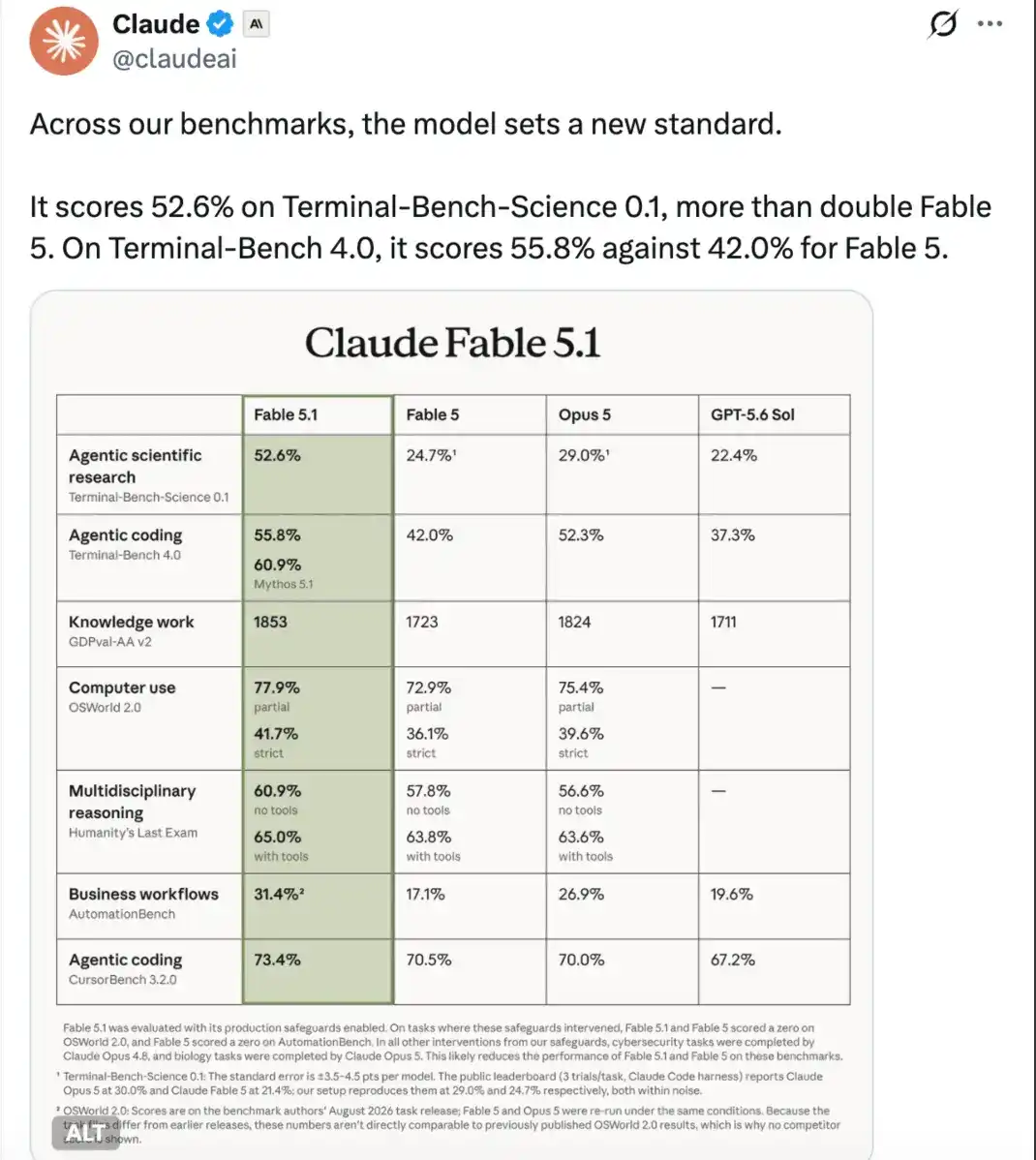
As the "world's most powerful" model, Fable 5.1's performance remains impressive. Official data shows that Fable 5.1 outperforms the previous flagship Fable 5 in multiple benchmark tests.
But with greater power comes a cheaper price. Anthropic states that Fable 5.1 maintains the same base price, while cache read costs are reduced by 75% compared to Fable 5. In practical use, this reduces the overall cost of the model by about 25% for typical workloads; for highly agentic workloads, costs can be reduced by up to 45%.
It seems even the most powerful models are now emphasizing cost-effectiveness.

Let's take a closer look.

Lower Tiers Match the Previous Generation, Fable 5.1 Focuses on "Cost-effectiveness"

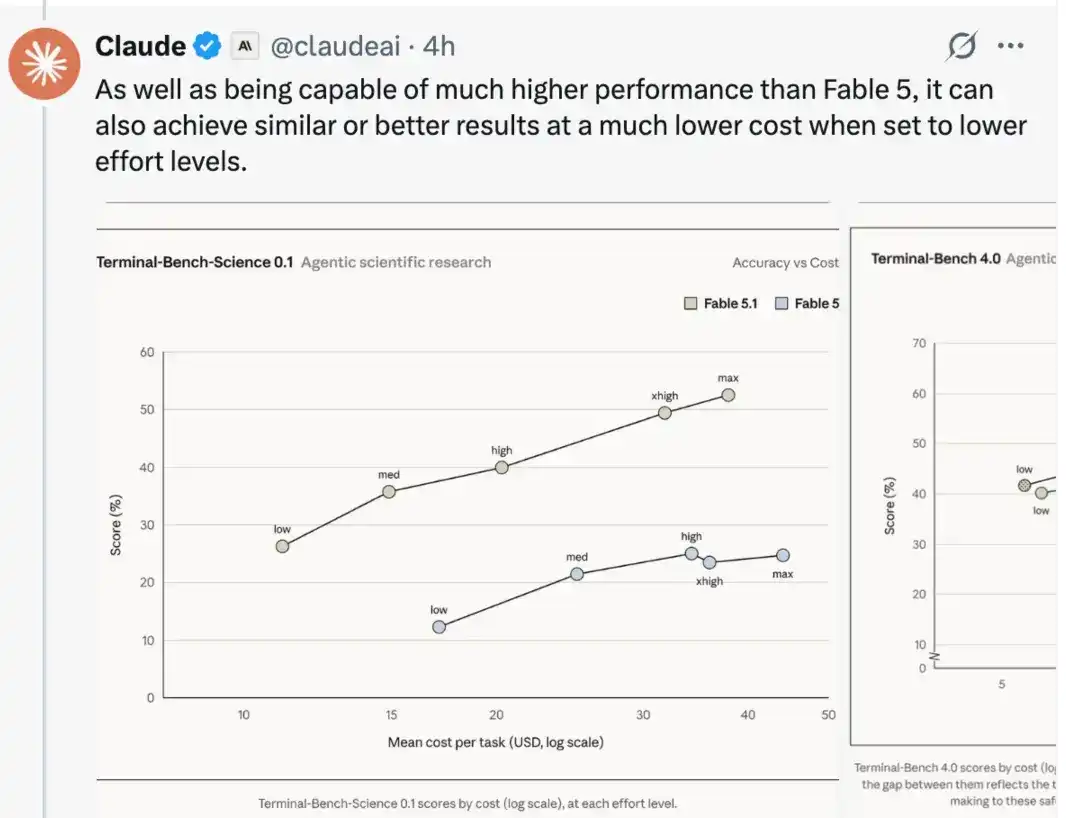
Compared to simply topping the leaderboards, Anthropic this time emphasizes more: Fable 5.1 can complete tasks that previously required Fable 5's higher inference tiers at lower inference costs.

According to official tests, Fable 5.1 at low and medium inference strengths can already achieve performance close to or even surpassing Fable 5. Claude Code defaults to high inference strength, while Claude Cowork and Claude . ai default to medium strength. Users can also adjust between speed, cost, and effectiveness based on task complexity.

Specifically, Fable 5.1 achieved 52.6% on the scientific research-oriented Agent benchmark Terminal-Bench-Science 0.1, more than double the 24.7% of Fable 5; on Terminal-Bench 4.0, Fable 5.1 reached 55.8%, and Mythos 5.1 with more capabilities unlocked further reached 60.9%.

In knowledge work, computer operations, and business process tests, the new models also show improvements. AutomationBench scores increased from 17.1% for Fable 5 to 31.4%, and CursorBench 3.2.0 improved from 70.5% to 73.4%.
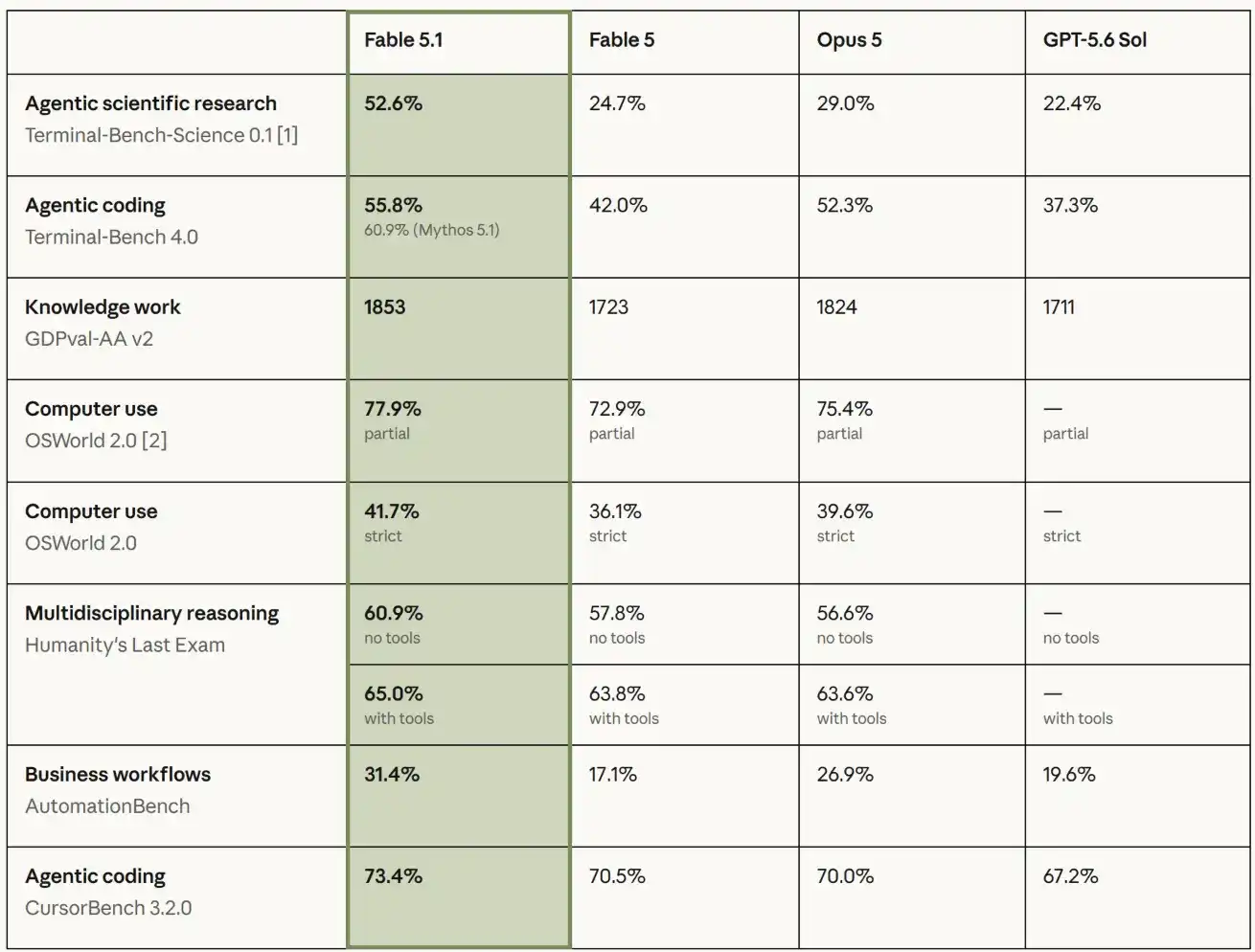
In multiple benchmark tests, Fable 5.1's scores surpassed Fable 5, with the most significant improvements in scientific research Agent and business workflow capabilities.
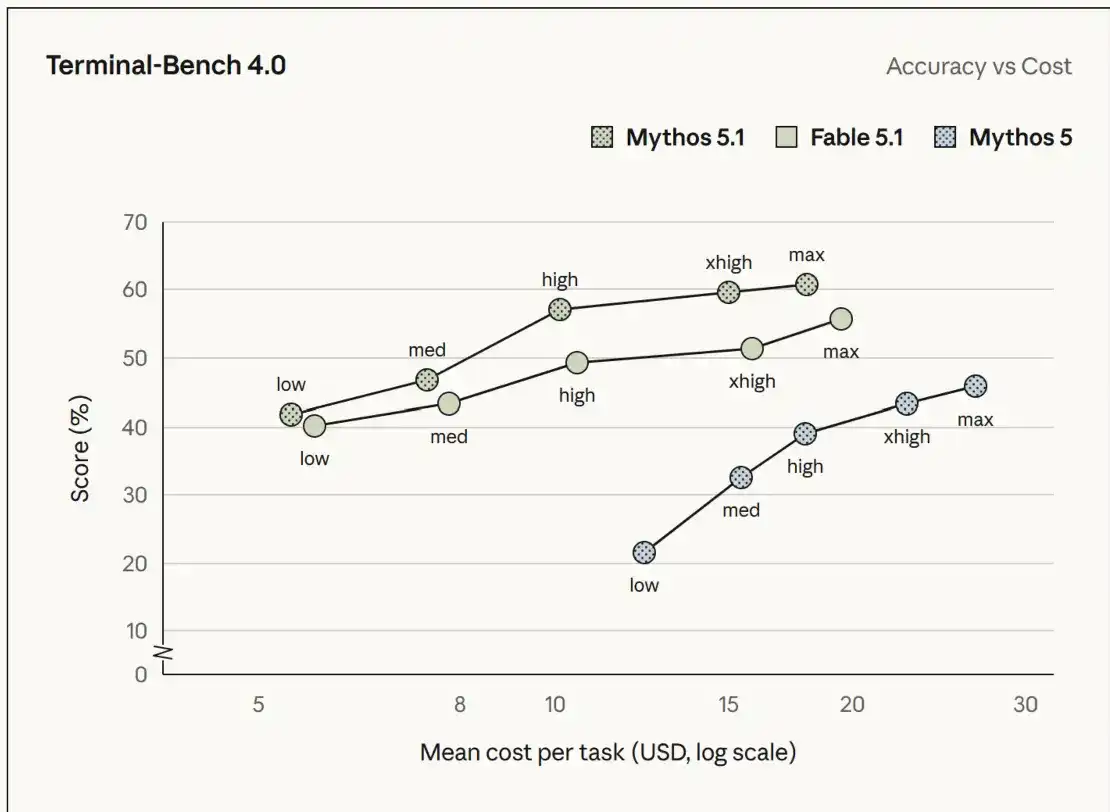
In the Terminal-Bench 4.0 test, both Fable 5.1 and Mythos 5.1 exceeded the previous generation Mythos 5 at different inference strengths.
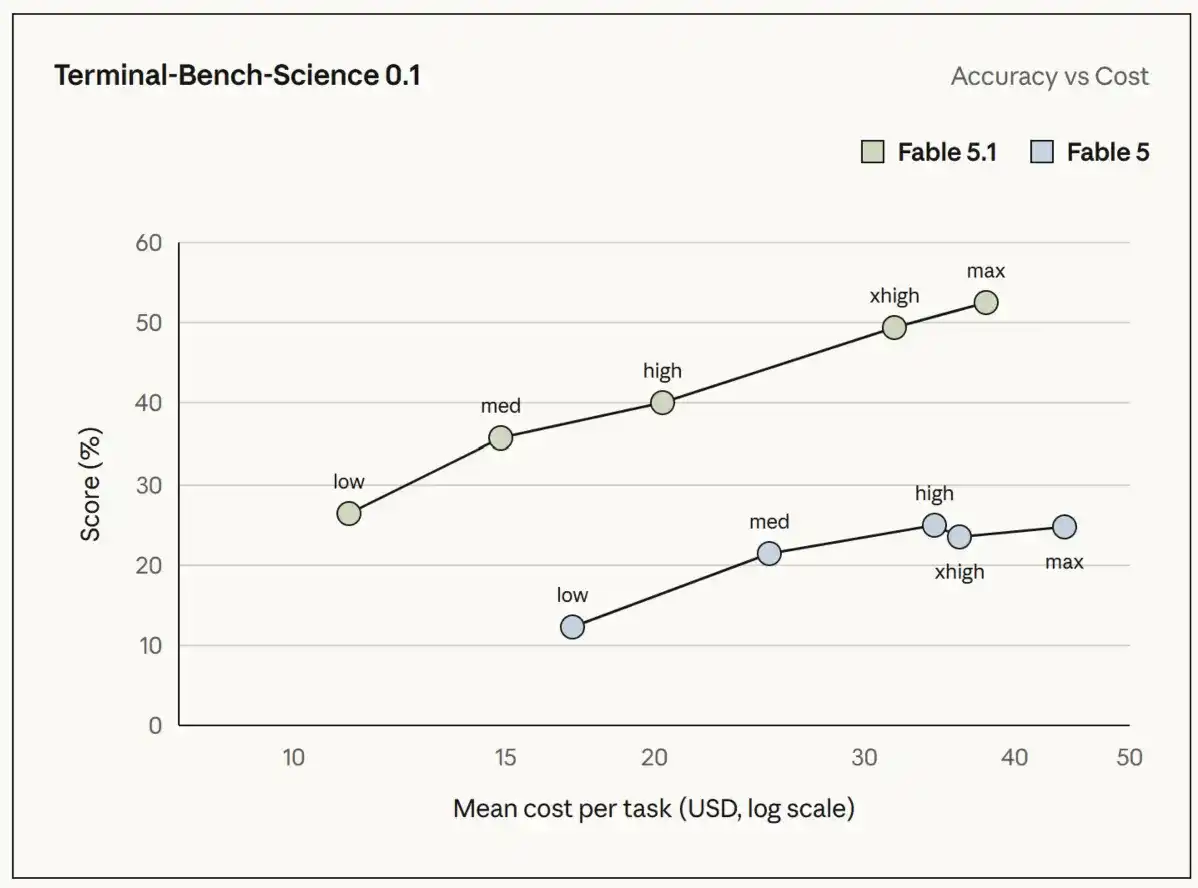
In the Terminal-Bench-Science 0.1 test, Fable 5.1's highest score reached 52.6%, more than double that of Fable 5.

Anthropic believes an important change in Fable 5.1 is its greater willingness to track the root causes of problems, making it more suitable for executing complex tasks lasting hours or even tens of hours.

Investment firm Millennium discovered during testing that an internal piece of code would crash about once every million runs. This problem had troubled the engineering team for four or five years, and other models couldn't find the cause. Fable 5.1, however, by disassembling an external vendor's library and comparing core dump files, ultimately pinpointed the issue to a bug in the third-party library.

Ramp also had Fable 5.1 run continuously for 38 hours. After discovering that original machine learning results were affected by labeling errors, the model corrected the problem, launched six sets of experiments, and finally compiled new results and follow-up recommendations.

From Writing Code to Conducting Scientific Research

In this release, Anthropic dedicates considerable space to introducing the performance of Fable 5.1 and Mythos 5.1 in scientific research.

In a protein design experiment, researchers had Mythos 5.1 call open-source protein design and folding tools, then sent the generated designs to two external institutions for experimental validation.

On three target proteins, the affinity of the binders designed by Mythos 5.1 was 10 times that of the best solutions in the Adaptyv Bio related protein design competition. When targeting 12 proteins, the model's effective binder hit rate approached 50%, while Anthropic cites the common industry level as 10% to 15%.

Fable 5.1 also used radar images collected over 30 years ago by NASA's Magellan probe to generate a new high-resolution elevation map for about one-third of Venus's surface.

NASA Magellan probe radar image of Venus, showing a small shield volcano about 15 km in diameter at the center.

The original map could only show details at a scale of 10 to 20 kilometers. The new map improves the resolution capability to 2 to 3 kilometers, with elevation measurement accuracy improved by up to 25%. Anthropic plans to release this map under a Creative Commons license for reference by follow-up missions like NASA's VERITAS and the European Space Agency's EnVision.

In computational biology, Mythos 5.1 increased the runtime speed of 7 open-source protein and genome deep learning models by up to 2.5 times by writing custom GPU kernels and caching intermediate results, while maintaining consistent output. For some whole-genome analysis tasks, GPU costs are projected to be reduced by 30% to 60%.
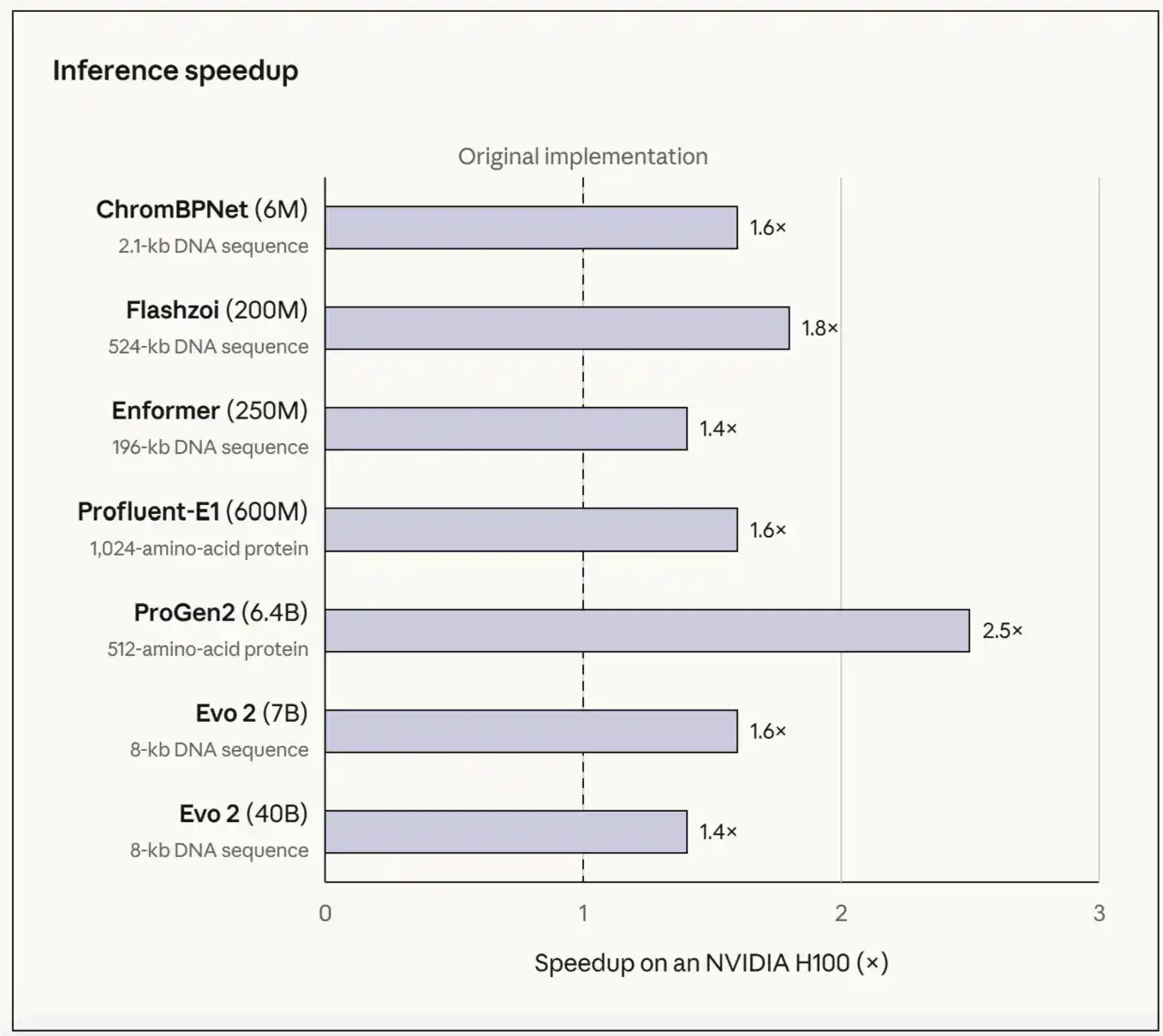
After Mythos 5.1 optimized 7 open-source protein and genome models, inference speed increased by 1.4 to 2.5 times.

Anthropic wants to use these cases to demonstrate that models are moving from organizing materials and writing code to proposing solutions, running tools, and delivering scientific results ready for experimental validation.

Cache Prices Drop 75%, Agent Tasks Up to 45% Cheaper

Beyond performance, pricing is the most direct change for Fable 5.1.

The input and output prices for Fable 5.1 remain unchanged at $10 and $50 per million tokens, respectively. However, the cache read price has been reduced by 75% from previous levels to $0.25 per million tokens.

Cache reading refers to the model reusing already processed context. Its proportion might be limited in simple Q&A, but in Agent tasks that require repeatedly reading codebases, conversation history, and tool results, cache often constitutes the main cost.

Based on Anthropic's calculations from actual usage data in August 2026, the overall cost of running typical tasks with Fable 5.1 is about 25% lower than with Fable 5; for complex Agent tasks with long contexts and frequent tool calls, the cost reduction can reach up to about 45%.
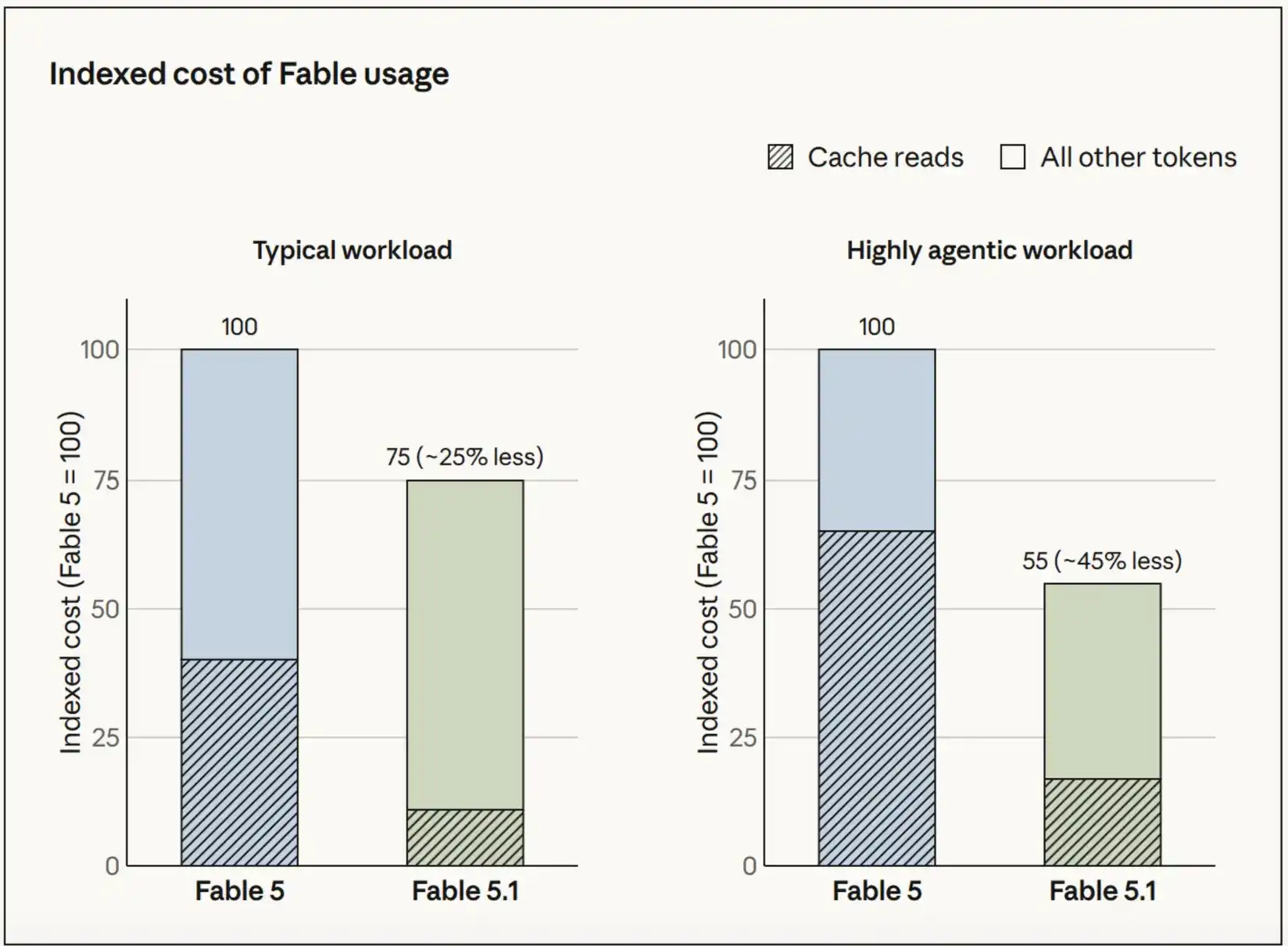
After the cache read price reduction, typical task costs for Fable 5.1 decreased by about 25%, with highly agentic task costs reduced by up to about 45%.

Fable 5.1 is now available on Claude . ai, Claude Code, and the Claude API, and is also offered through AWS, Google Cloud, and Microsoft Azure. Developers can call the new model via claude-fable-5-1.

Anti-Distillation Mechanisms Strengthened

Fable 5.1 and Mythos 5.1 actually use the same underlying model. Their main difference lies in safety restrictions.

Fable 5.1 is fully open to general users and enterprises. Mythos 5.1 has looser cybersecurity and life sciences restrictions and is currently only available to vetted individuals and institutions.

In cybersecurity, Fable 5.1 can already help users discover software vulnerabilities but still cannot directly generate exploit code. Dual-use tasks like penetration testing, exploit generation, and vulnerability scanning based on binary files may still be handed over to more restricted models.

After adjustments, the new cybersecurity protection mechanism's false positive rate is reduced by about 60% compared to Fable 5. The biosafety mechanism's false positive rate for basic biology and medical questions is also reduced by 85%, while advanced capabilities involving life sciences R&D are mainly opened through Mythos 5.1's vetting program.

Anthropic has also introduced Enterprise Frontier Safeguards. Enterprises can keep data in their own controlled cloud infrastructure, with the enterprise responsible for default human review, thereby achieving privacy effects close to "zero data retention" while retaining safety monitoring capabilities. This mechanism is planned to roll out in phases starting this fall.

For large-scale model distillation, Fable 5.1 has also added new restrictions. For API accounts created after today, it will no longer be possible to retain Claude's historical thinking records while manually modifying previous context in multi-turn conversations. Anthropic states this change primarily aims to block a publicly known capability extraction method.

Furthermore, to meet the requirements of the EU AI Act, Fable 5.1's text output will contain invisible watermarks. Anthropic has also begun small-scale testing of a detection API, initially open to regulators, media, fact-checking organizations, and research institutions.

Finally, as netizens say, the early bird gets to use 5.1.

Related Questions

QWhat are the two new models announced by Anthropic, and what are their primary purposes?

AAnthropic announced Claude Fable 5.1 and Claude Mythos 5.1. Claude Fable 5.1 is designed for complex reasoning, long-horizon tasks, and Agent workflows, and is available to general users, developers, and businesses. Claude Mythos 5.1 represents a higher capability frontier and is offered to vetted partners in higher-risk domains under stricter access controls.

QWhat are the key performance and cost improvements of Claude Fable 5.1 compared to its predecessor, Fable 5?

AClaude Fable 5.1 shows significant performance gains in benchmarks like Terminal-Bench-Science 0.1 (52.6% vs 24.7%) and Terminal-Bench 4.0 (55.8% vs lower scores for Fable 5). Crucially, while maintaining the same base price, its cache read cost is reduced by 75%, leading to an overall cost reduction of about 25% for typical workloads and up to 45% for highly agentic workloads.

QHow does the new model demonstrate capabilities in scientific research, according to the article?

AThe models show advanced scientific research capabilities. Mythos 5.1 designed protein binders with 10x higher affinity than competition winners and achieved a near 50% hit rate. Fable 5.1 created a new high-resolution elevation map of Venus from old NASA data, improving resolution from 10-20 km to 2-3 km. Mythos 5.1 also optimized seven open-source bioinformatics models, speeding them up by 1.4x to 2.5x.

QWhat are the main differences in safety and access between Claude Fable 5.1 and Claude Mythos 5.1?

ABoth models share the same base capabilities but differ in safety measures. Fable 5.1 is broadly available with standard safety restrictions. Mythos 5.1 has looser restrictions in areas like cybersecurity and life sciences, allowing tasks like exploit generation or advanced bio-research, but access is strictly controlled and granted only to vetted partners after review.

QWhat new security and compliance features are introduced with the Fable 5.1 release?

AKey new features include: 1) Enhanced anti-distillation measures preventing manual context modification in multi-turn conversations for new API accounts. 2) 'Enterprise Frontier Safeguards' for data control and near-zero data retention. 3) Reduced false positive rates for cybersecurity (by ~60%) and biosafety (by 85%) mechanisms. 4) Inclusion of invisible watermarks in text outputs for EU AI Act compliance, alongside a detection API for authorized entities.

Related Reads

Nomura Research Report Interpretation: US Stock ETFs Absorb $6.9 Billion in a Single Week, Stock-Bond Divergence Continues to Intensify

Nomura's FX Insights report, dated November 16, 2026, notes that although foreign inflows into U.S. equity ETFs and mutual funds rose to $6.9 billion in the week of November 9–13, up from $5.4 billion the prior week, the dip-buying momentum slowed somewhat in the latter half of the week. Nearly 39% of the weekly total (about $2.5 billion) flowed in on November 9 alone, extending the bargain-hunting seen after the previous week's selloff, when $2.1 billion entered on November 6. Daily buying stayed above $1 billion (November 11: $1.6 billion; November 12: $1.4 billion), but Nomura says the overall pace has begun to ease slightly. Divergence between equities and bonds is intensifying. U.S. bond ETFs and mutual funds saw $287 million of net outflows during the week, extending the prior week's $182 million outflow. Emerging-market thematic ETF inflows fell to $1.4 billion from $2.2 billion, with the split again favoring equities: $1.9 billion into stock funds versus $425 million of net outflows from bond funds. Asia-Pacific cross-border flows showed clear signs of braking. Net purchases of U.S. portfolio assets by previously active Korean retail investors plunged to $768 million from $2.6 billion, driven mainly by a sharp contraction in Korean retail buying of U.S. stocks. Taiwanese investors continued selling dollar assets, offloading another $439 million of USD-denominated bonds after net sales of $697 million the prior week.

marsbit24m ago

Nomura Research Report Interpretation: US Stock ETFs Absorb $6.9 Billion in a Single Week, Stock-Bond Divergence Continues to Intensify

marsbit24m ago

Goldman Sachs Research Report Interpretation: S&P 500 Seen Rising to 8,700 by End of Next Year, AI Investment Shift Spawns Four Major Themes

Goldman Sachs' 2027 US equity outlook, dated November 17, 2026, argues the bull market isn't over but has entered its middle phase. Healthy economic fundamentals and sustained AI investment should lift the S&P 500 to 8,700 by end-2027, implying roughly 17% upside. However, as AI capex growth peaks, market focus shifts from infrastructure spending to practical monetization. Earnings growth will cool: S&P 500 EPS growth slows from about 30% in 2026 to 11% in 2027 (core growth around 18% excluding tech giants' investment income). Valuation looks relatively safe—the 12-month forward P/E contracted 19% in 2026 to about 18x, near the 10-year average. The 8,700 target is derived from 2028 earnings estimates at 18x P/E; with high rates and AI uncertainty, systemic multiple expansion is unlikely, so gains must be earnings-driven. The AI relay baton is passing. Hyperscaler capex contributed 12 percentage points of 2026 index earnings growth, but its year-over-year growth is expected to plunge from 105% to 73% in 2027, with depreciation pressure eroding profits—by 2028, cloud capex could be a 5-point net drag on S&P 500 earnings. Goldman favors companies that can genuinely monetize AI or use it to boost productivity, especially asset-heavy, physical-economy productivity beneficiaries. Corporate leverage is rising: investment-grade and high-yield issuance could reach $2.8 trillion in 2027, with cloud providers borrowing heavily on and off balance sheet. Buyback growth stalled in Q3, with the buyback yield at 1.4%—a 20-year low outside recessions. "Buyback aristocrats" with strong free cash flow and sustained share reduction are scarce assets. With earnings growth near single digits, style tilts toward self-sustaining growth. Goldman likes secular growth stocks, favoring energy infrastructure (rare earnings acceleration) and transportation (cyclical upside). Defense matters too: high earnings concentration is a risk, so cheap healthcare and some consumer staples offer protection, while mid-caps—with underextended earnings and low P/Es—help diversify mega-cap risk. This is a summary of third-party research; ratings, targets and forecasts are the analyst's views, not investment advice. Markets carry risk; decisions should be independent.

marsbit34m ago

Goldman Sachs Research Report Interpretation: S&P 500 Seen Rising to 8,700 by End of Next Year, AI Investment Shift Spawns Four Major Themes

marsbit34m ago

Gold Rush 2027: Wall Street Giants Predict Bull Market Endures, Opportunities Hidden in Structural Trends

Global markets enter 2027 at a crossroads, balancing AI-driven FOMO against bubble fears, lingering inflation, and geopolitical risk. Major Wall Street outlooks converge on one theme: AI remains the dominant investment thesis, but storytelling alone no longer justifies valuations. Morgan Stanley upgraded global equities to overweight with an S&P 500 target of 8,700 by end-2027, citing EPS growth from $369 to $420. Goldman Sachs sees roughly 16% total return for the S&P 500 over 12 months, though it warns of a "Great Halving" in earnings growth—S&P 500 EPS growth falling from 36% to 11%. Stocks can still rise because tech valuations have compressed to the 20th percentile of the past two decades. AI capex is projected at $1.8 trillion in 2027, but hyperscaler spending growth is peaking and depreciation pressures are mounting, challenging AI "shovel sellers." China assets are being re-rated, with Goldman overweight Hong Kong and Morgan Stanley preferring A-shares. Energy and infrastructure emerge as hard constraints: the world faces a $106 trillion infrastructure gap, and grid upgrades, transformers, and storage are high-conviction plays. Oil could fall to $78/barrel, but Middle East escalation is the biggest tail risk. In asset allocation, the Beta era is ending. Goldman favors "growth scarcity"—overweight US and Japan, underweight Europe. Morgan Stanley stresses quality and recommends overweight US Treasuries as a hedge. Bonds are back, with global aggregate yields at 5.3%, a two-decade high, and negative stock-bond correlation likely to return. Alternatives gain ground; JPMorgan estimates 30% in diversified alternatives lifts expected returns to 7.5% and Sharpe ratios by 21%. It also quantified Bitcoin for the first time—10% base-case annualized return, 55% volatility—but excluded it from strategic allocation. Overall, 2027 rewards discipline: dancing with volatility and locking in genuine value as growth becomes scarce.

marsbit44m ago

Gold Rush 2027: Wall Street Giants Predict Bull Market Endures, Opportunities Hidden in Structural Trends

marsbit44m ago

All Four Lines of Defense Broken: How Many Cards Does Bitcoin Have Left to Play?

Bitcoin fell from $74,000 to $61,900 in five days, triggering over $300,000 liquidations and wiping more than $100 billion from total crypto market value. The fear index hit 10, a level last seen in June. The selloff was triggered by October CPI at 0.4% month-over-month versus 0.3% expected, pushing December rate-hike odds to nearly 90%. Bad news piled up: BlackRock's IBIT saw its longest outflow streak, MSCI announced removing Strategy from US indexes (potentially $2.8 billion in passive selling), Nvidia's CEO resigned, and Middle East tensions escalated. The Fed's September rate cut cycle has reversed into tightening, with officials warning of further hikes, while the Bank of Japan may raise rates again in December, risking yen carry-trade unwinds. All four major cost baselines are broken: ETF average cost ~$81,500, market average ~$77,500, short-term holder cost ~$75,600, and Strategy's ~$75,400. About 4 million BTC bought between $85,000 and $118,000 are underwater. MVRV fell to ~1.2, still above the below-1.0 level historically seen at bear-market bottoms. Both 2018 and 2022 saw lower second bottoms. Galaxy's base case targets $40,000–46,000. However, mid-sized wallets and Strategy keep accumulating, spot volume rose 24.5%, and some argue leverage has cleared with most macro bad news priced in. December brings the Fed meeting, BOJ meeting, and Deribit options expiry; ETF flows, stablecoin supply, and MVRV will determine direction.

marsbit1h ago

All Four Lines of Defense Broken: How Many Cards Does Bitcoin Have Left to Play?

marsbit1h ago

Trading

Spot
活动图片