Jensen Huang: AGI Has Arrived, OpenAI Astra Runs on NVIDIA, 400K GPUs Coming Online

marsbitОпубліковано о 2026-09-07Востаннє оновлено о 2026-09-07

Анотація

NVIDIA CEO Jensen Huang declared that the era of Artificial General Intelligence (AGI) has arrived, crediting OpenAI's new flagship model Astra—trained on over 100,000 NVIDIA Grace Blackwell NVLink72 chips—for this milestone. He further announced that "400K GPUs are coming online," signaling a major expansion in NVIDIA's computing power supply and reinforcing its dominant position as the core infrastructure provider for leading AI companies. The announcement follows OpenAI's release of Astra, which it calls the world's most intelligent and human-aligned model, capable of handling the most demanding professional tasks. OpenAI President Greg Brockman stated, "Welcome to the era of AGI," defining it as a highly autonomous system outperforming humans in most economically valuable work. However, the declaration faces skepticism. AI researcher Gary Marcus criticized Huang for lacking evidence or a clear definition of AGI, arguing that Astra meets only a few of ten key criteria. OpenAI CEO Sam Altman also expressed caution, calling AGI a "poorly defined term" and somewhat of a "meaningless marketing buzzword." Despite the debate, NVIDIA's role as the foundational compute provider is undisputed. OpenAI, Meta, Anthropic, and Google heavily rely on NVIDIA's high-end chips. This demand has fueled NVIDIA's financial performance, with quarterly revenue reaching $96.2 billion, driven largely by its $89 billion data center business. The impending deployment of 400,000 GPUs underscores th...

Author: Xu Chao, Wallstreetcn.com

NVIDIA CEO Jensen Huang declared the era of Artificial General Intelligence officially open, attributing this historic milestone to OpenAI's latest flagship model Astra—a model trained on NVIDIA chips. This statement once again positions NVIDIA as the dominant force in AI infrastructure and hints at a significant upcoming expansion in computational power.

On Sunday, Huang posted on the X platform to congratulate the OpenAI team, stating "AGI has arrived," and revealed that Astra was trained on more than approximately 100,000 NVIDIA Grace Blackwell NVLink72 chips. He also stated, "400K GPUs are coming online," sending a strong signal that NVIDIA's computing power supply is set to leap forward.
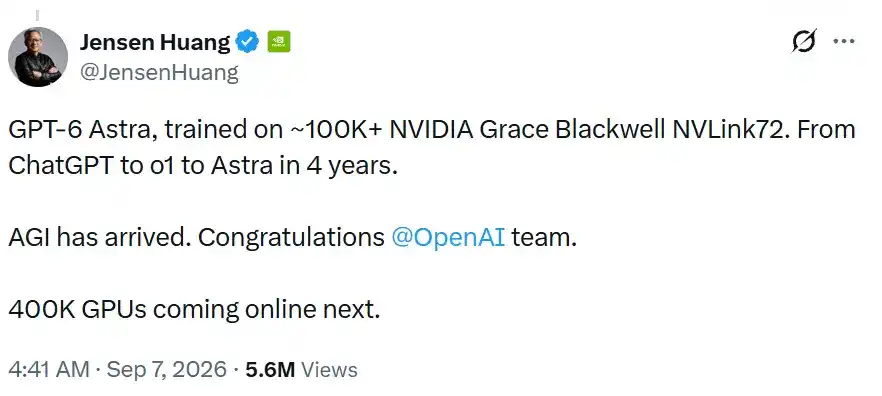
This statement has direct market implications. NVIDIA's data center business has become its core growth engine, and Huang's preview of 400,000 new GPUs indicates that demand for orders from leading AI customers continues to expand.

OpenAI released Astra last Thursday, positioning it as "the world's most intelligent and human-aligned model," and stated that the model can "tackle the most demanding professional work with unmatched speed, precision, and judgment." OpenAI President Greg Brockman told the media during the launch: "Welcome to the era of AGI."

Brockman further predicted that when people look back at history, they will believe AGI was born "around this time, and I think maybe it's this model." "Personally, I do think we've reached it," he said. Astra began rolling out to users this week.

OpenAI defines AGI as "highly autonomous systems that outperform humans at most economically valuable work," and positions Astra as a major research breakthrough, marking a fundamental shift in the boundaries of tasks that can be entrusted to AI.

However, not everyone agrees with this declaration. Prominent AI researcher and critic Gary Marcus directly stated that Huang was being "premature."

"Huang gave neither evidence nor a definition, and to me this looks like an attempt to impose a corporate will on a scientific question," Marcus wrote on his Substack. "Declaring victory in the absence of a definition only muddies the waters."

Marcus then listed his own 10 criteria for defining AGI, noting that Astra meets only one or two. "By common definitions, Astra still falls short," he said.

Even OpenAI's own CEO, Sam Altman, has been quite cautious about the concept. He recently stated on the "Sources" podcast that AGI is at best "an extremely poorly defined word. I was going to say, it's more like an irrelevant marketing term."

Regardless of how the definition of AGI is debated, NVIDIA's position as the core computing power supplier for leading AI companies is undisputed. In a funding announcement this March, OpenAI referred to NVIDIA as "the bedrock of our infrastructure," stating that "our training clusters and most of our inference stack consistently run on NVIDIA GPUs."

Leading AI companies such as Meta, Anthropic, and Google also heavily rely on NVIDIA's high-end chips. This demand has translated into NVIDIA's impressive financial performance—the company reported quarterly revenue of $96.2 billion in August this year, more than doubling year-over-year; its data center business revenue reached $89 billion, with AI chips being a major growth driver.

Huang's post on X mentioned that the next batch going online will be 400,000 GPUs, further strengthening expectations of NVIDIA's computing power expansion. From ChatGPT to o1, to Astra, the technological leaps within four years have all been built upon NVIDIA's continuously upgraded chip foundation.


Пов'язані питання

QAccording to the article, what did NVIDIA CEO Jensen Huang announce about AGI (Artificial General Intelligence)?

AJensen Huang announced that the AGI era has arrived, attributing this milestone to OpenAI's new flagship model Astra, which was trained on NVIDIA chips.

QHow many NVIDIA GPUs are expected to come online next, as per Jensen Huang's statement in the article?

AAccording to Jensen Huang's statement, the next batch to come online will be 400,000 GPUs.

QWhat is the primary criticism that AI researcher Gary Marcus raises against Jensen Huang's declaration about AGI?

AGary Marcus criticizes Jensen Huang's declaration by stating that he provided neither evidence nor a clear definition for AGI, calling it an attempt to 'corporate-wash a scientific issue' and saying it only muddies the waters.

QWhich major AI companies are highlighted in the article as being highly dependent on NVIDIA's advanced chips?

AThe article highlights that OpenAI, Meta, Anthropic, and Google are all highly dependent on NVIDIA's advanced chips for their AI infrastructure.

QWhat was NVIDIA's quarterly revenue for the period mentioned in the article, and what was the primary driver of this growth?

ANVIDIA's quarterly revenue for the period mentioned was $96.2 billion, more than doubling year-over-year. The primary driver of this growth was its data center business, which generated $89 billion in revenue, largely from AI chips.

Пов'язані матеріали

Solana Cancels Major Shanghai Event As Attendance Surge Creates Problems

Solana's Accelerate event in Shanghai, scheduled for October 16, was abruptly postponed shortly before it began after registrations exceeded the venue's permitted capacity, according to Solana Foundation president Lily Liu. The event, called Solana Accelerate China, was intended to connect blockchain developers and businesses in the region. The postponement occurred in a country where commercial cryptocurrency activities face significant restrictions, prompting speculation about government intervention. However, organisers attributed the delay to attendance and venue compliance issues rather than a blanket ban by authorities. They noted the distinction between technical blockchain development and illegal cryptocurrency business activities, which are not necessarily treated the same under every regulatory framework. China remains an important source of software engineering talent, and international blockchain organisations continue trying to maintain relationships with developers there. No replacement date was announced at the time of postponement. For attendees who had travelled to Shanghai, the cancellation was an immediate inconvenience. For Solana, the impact is reputational and operational, as the foundation aims to show its ecosystem can develop internationally. The events illustrate how quickly such ambitions can encounter practical obstacles when regulatory expectations and a rapidly growing audience collide. Interest in Solana development may remain strong, but staging the next event will require more careful preparation.

bitcoinist6 год тому

Solana Cancels Major Shanghai Event As Attendance Surge Creates Problems

bitcoinist6 год тому

Торгівля

Спот
活动图片