Original Author: Zhao Ying
Original Source: Wall Street News
Japanese government bond (JGB) yields have surpassed 3% for the first time in 30 years. Nomura Research Institute warns that the source of this round of global long-term interest rate increases is Japan itself, not external factors. The combination of Japan's fiscal risks and the expectation of monetary policy normalization is spreading to the global market through the bond market, posing a systemic threat to tech stocks, AI investment, and even the real economy.
The yield on 10-year Japanese Government Bonds (JGBs) briefly exceeded 3.0% during trading in Tokyo, marking the first time since September 1996. According to Feng Chasing Trading Desk, Takahide Kiuchi, Executive Economist at Nomura Research Institute, noted in a recent report that over the past year, the yield on 10-year JGBs has risen by approximately 1.4 percentage points, while the increase in the U.S. 10-year Treasury yield was only about half of Japan's. This suggests the rise in JGB yields is primarily driven by domestic factors, not transmission from overseas markets.
Takahide Kiuchi argues that, in terms of absolute yield levels, Japanese bonds have hit a 30-year high, while U.S. Treasuries have only returned to levels seen since January 2025. The yield on German 10-year government bonds is at its highest since 2011, and the yield on UK 10-year gilts is at its highest since 2008. In a comprehensive comparison, Japan is more likely to be the source pushing global long-term rates higher, rather than a passive follower. Meanwhile, the Trump administration has begun unusually intervening in Japan's economic policies, pressuring the Bank of Japan to raise interest rates and urging the Kishida government to scale back fiscal expansion.
Three factors pushing Japanese bond yields above 3%
According to the Nomura Research Institute report, the 10-year JGB yield approached the 3% mark in August and finally breached this integer level intraday on September 1, driven by three main forces.
First, rising expectations for Fed rate hikes. Recent comments by Fed Chair Kevin Warsh at the Jackson Hole symposium reinforced market expectations for a rate hike at the Fed's September Federal Open Market Committee (FOMC) meeting, putting pressure on global bond markets.
Second, rising expectations for BOJ rate hikes. The market widely expects the Bank of Japan to raise its policy rate at its September monetary policy meeting, further pushing up JGB yields.
Third, intensifying risks of Japanese fiscal expansion. By the end of August, the total budget requests from various Japanese ministries for the 2027 fiscal year's general account exceeded the 2026 fiscal year's budget by about 20 trillion yen, significantly heightening market concerns about the deterioration of Japan's fiscal situation.
Fiscal risk is the primary cause of yield increases
Nomura Research Institute conducted a decomposition analysis of the factors behind the 1.4 percentage point increase in the 10-year JGB yield over the past year. The results show that rising inflation expectations contributed approximately 0.49 percentage points, changes in the BOJ's JGB holdings contributed about 0.08 percentage points, the rise in U.S. 10-year Treasury yields contributed about 0.08 percentage points, changes in expectations for the real policy rate contributed about 0.15 percentage points, and "other" factors contributed a substantial 0.60 percentage points—a category believed to primarily reflect the risk premium associated with the deterioration of Japan's fiscal condition.
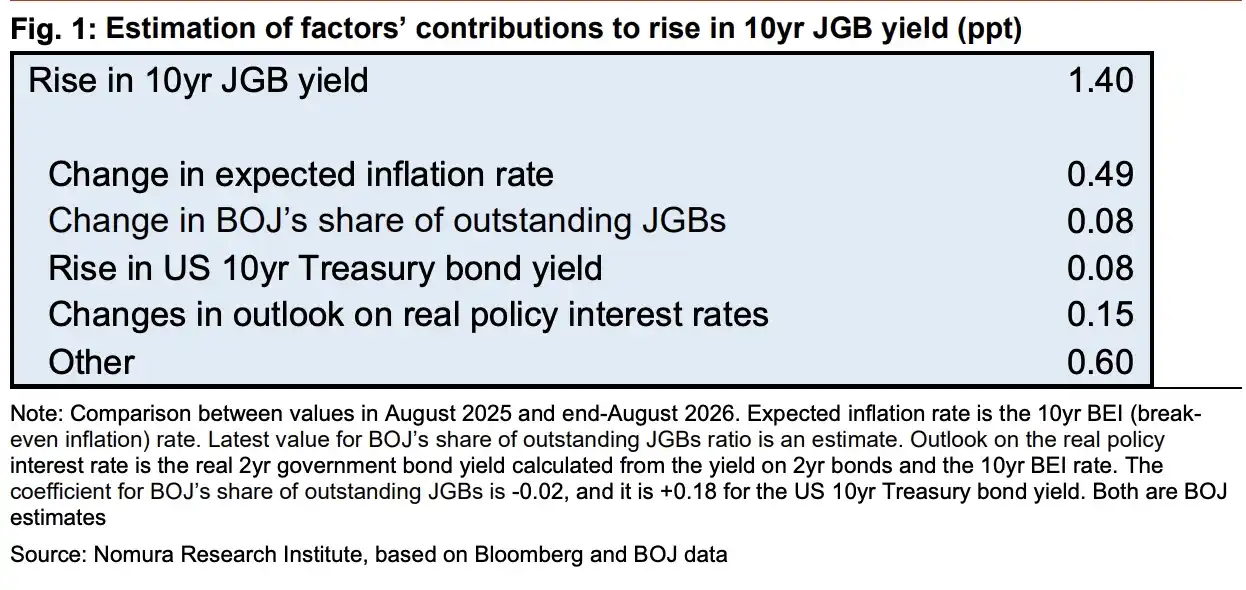
This means that among all factors pushing JGB yields higher, the fiscal risk premium is the single largest contributor, far exceeding the impact of inflation expectations and monetary policy expectations.
Takahide Kiuchi points out that rising long-term interest rates are not always a "bad thing"—if they stem from increased economic growth potential or rising inflation expectations, real interest rates may not necessarily follow suit, limiting negative shocks to the economy. However, if the increase is primarily due to fiscal risk, it often has a substantial negative impact on economic activity, and this type of shock is typically more lagged and harder to detect than increases in short-term rates.
Unusual intervention by the Trump administration in Japan's economic policy
The Trump administration has begun intervening in Japan's economic policies in an unusual manner. At a recent G20 meeting of finance ministers and central bank governors, U.S. Treasury Secretary Bessant explicitly told Japan's Finance Minister, Tsutsumi Satsuki, and Bank of Japan Governor, Kazuo Ueda, that Japan needs to clearly communicate its path to fiscal sustainability and its plans for raising interest rates.
Previously, after the end of the joint U.S.-Japan foreign exchange intervention in late July, Bessant had publicly expressed anticipation for a BOJ rate hike. Nomura Research Institute believes the logic behind the Trump administration's move is: the sustained depreciation of the yen and the fall in Japanese bond prices (rising yields) could have negative spillover effects on U.S. and even global markets. Therefore, Washington is seeking to more proactively intervene in the direction of Japan's economic policy, urging the BOJ to hike rates and pushing the Kishida government to scale back its fiscal expansion stance.
The report notes that if the Kishida government gradually adjusts its aggressive fiscal policy stance, the risk of Japan's fiscal deterioration would decline, and upward pressure on 10-year JGB yields would also ease.
Rising Japanese bond yields could trigger global financial market turmoil and cool the AI boom
Nomura Research Institute warns that the potential impact of the Japan-originated rise in global long-term interest rates on the economy and financial system should not be underestimated.
From a macro perspective, rising long-term rates will increase interest expenses for governments worldwide, potentially triggering a negative "fiscal deterioration—rising yields" spiral. At the same time, it will depress the market value of bonds held in financial institutions' asset portfolios, shaking the stability of their balance sheets. Furthermore, rising interest rates will also put downward pressure on the prices of risk assets such as real estate and stocks.
Particular attention should be paid to technology and AI-related stocks. These assets are especially sensitive to rising interest rates. Takahide Kiuchi points out in the report that if the Japan-centered rise in long-term interest rates persists, it could trigger a cooling of the AI boom in the stock market. A decline in AI-related stock prices would further weaken the ability of related companies to raise large-scale investment funds through equity or debt financing, thereby putting the brakes on the expansion of physical asset investment in AI infrastructure.
"This may not be just a gradual cooling of global economic activity, but could potentially trigger a sudden economic slowdown," the report states. Nomura Research Institute believes this also partly explains why the Trump administration has chosen to take the unusual step of direct intervention, urging Japan to avoid policies that could further depress the yen and push long-term yields higher.