Author|Azuma(@azuma_eth)

From Strategy to Bitmine, we have seen the rise of too many crypto treasury companies (DATs) over the past two years — some have accumulated massive amounts of BTC through continuous fundraising, others have taken a different path by heavily investing in altcoins like ETH, and some previously inconspicuous listed companies have transformed themselves into proxies for crypto assets in the public stock market through this model.
This model was once quite effective, as long as the company's stock could command a premium above its net asset value, allowing it to continue raising funds, buying more coins, and further boosting market attention... But have you ever thought, what if one day this game can no longer be played? How should a crypto treasury company exit?
Now, we are gradually witnessing the answer to this question with the UK-listed company Satsuma — sell BTC, shut down operations, return the vast majority of capital to shareholders, and then delist from the stock market.
As the planned delisting date of September 14 officially arrives, Satsuma is about to become the first case in the treasury boom of the past two years to actively complete the process of "liquidating BTC → returning capital → final delisting" — although there have been similar cases before, Profusa managed to retain its listing status under delisting pressure, and DigiAsia chose delisting due to a merger and reorganization. The situations are different from Satsuma's.
How Did Satsuma Reach This Point?
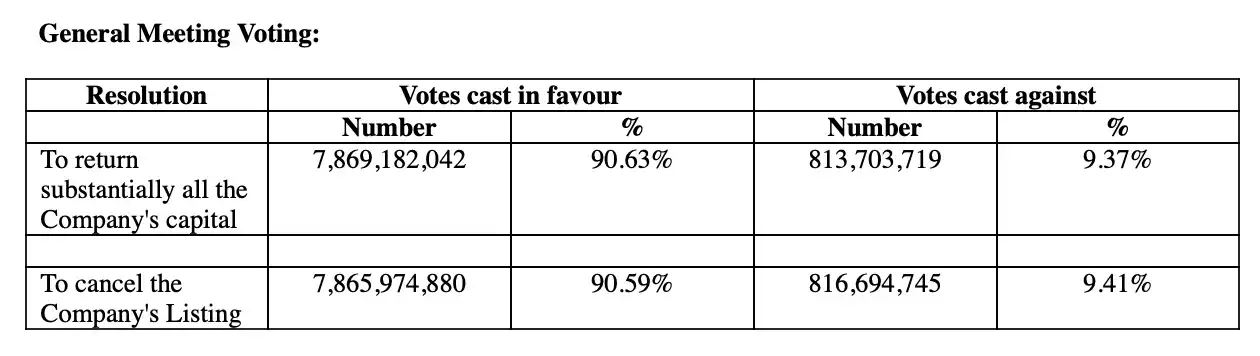
On July 20, 2026, Satsuma held a general meeting to vote on two special resolutions: one was to return the vast majority of the company's capital to shareholders; the other was to cancel the company's listing on the FCA Official List.
The outcome was not particularly surprising. The first resolution received 90.63% of the votes in favor, and the second received 90.59%. After the shareholder vote passed, the board immediately began preparing to cease the company's trading activities and started selling the remaining 669 BTC holdings.
This was not a sudden decision. In fact, Satsuma's BTC treasury strategy had long been in trouble. Since pivoting to the treasury route, Satsuma had accumulated 1199 BTC at one point, but the average acquisition cost exceeded $113,000. As BTC prices fell, the value of the company's BTC assets on the books rapidly shrank, and the valuation given by the capital market also declined.
In December 2025, Satsuma sold 579 BTC in one go, about half of its holdings at the time, raising approximately £40 million (a unit price of about £69,084, roughly equivalent to $93,057 at the current exchange rate). However, the purpose of this transaction was not to actively reduce BTC exposure but to address liquidity pressure — the company needed to repay a convertible bond due that month, amounting to about £78 million. But the situation did not improve afterward. BTC prices continued to fall, and Satsuma's cash flow pressure grew increasingly severe.
By this point, the reverse drawbacks of the BTC treasury model had been fully exposed in Satsuma's case — when a company needs to sell BTC to repay debt, the original cycle of "raise funds → buy coins → raise more funds" becomes difficult to sustain.
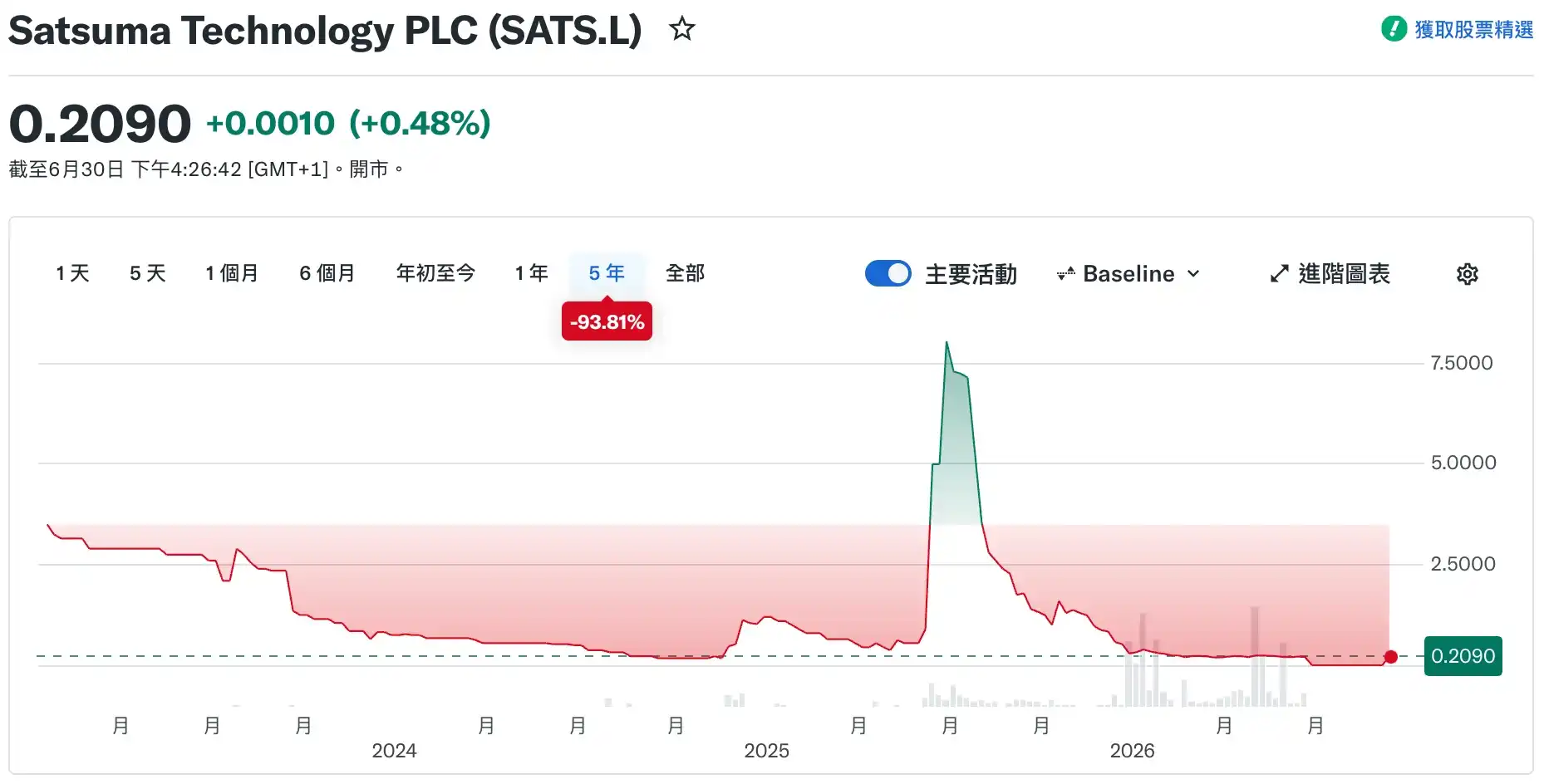
The performance on the stock price side was even more dramatic. Calculating from the peak in June 2025 to the time of the delisting vote in July this year, Satsuma's stock price had fallen by about 99%, and its market capitalization had at times even fallen below the value of the BTC it held.
In other words, the market was no longer willing to pay a premium for this BTC treasury company, so the very purpose of maintaining this listed entity began to be questioned. In April 2026, Pantera Capital, one of Satsuma's largest institutional shareholders, publicly demanded that the company abandon the treasury model, sell its remaining BTC, and return cash to shareholders. Subsequently, shareholders holding over 20% of the company's shares jointly requested a general meeting, ultimately pushing forward the capital return and delisting proposals.
In the end, over 90% of shareholders voted in favor of the capital return and delisting, officially concluding Satsuma's story as a BTC treasury company.
What Steps Are Involved in a DAT's Active Delisting?
The remaining question is how exactly the delisting is executed, and Satsuma has personally demonstrated a complete set of procedures for the market.
The first step is the shareholder meeting passing a special resolution. A company cannot simply shut down the listed entity based solely on a board decision. Satsuma first needed shareholders to vote on whether to agree to return capital and cancel the listing qualification.
The second step is determining the final shareholders and number of shares entitled to the capital return. Satsuma chose to return capital through "B Shares." After the registration period ended, the final number was confirmed as 11,235,874,700 shares. This is important because the final amount each share can recover depends mainly on two variables — how much capital the company ultimately has left, and how many shares ultimately participate in the distribution.
The third step is selling BTC, ceasing operations, and cleaning up the balance sheet. This is the most critical step in a DAT's exit process, meaning it transitions from a listed company holding BTC to a liquidation entity awaiting the distribution of remaining cash. Between July 24 and July 31, Satsuma sold all its remaining 669 BTC, raising approximately £31.91 million in total (a unit price of about £47,667, roughly equivalent to $64,226 at the current exchange rate).
The fourth step is court confirmation of the capital reduction scheme, a specific aspect of the UK Companies Act process. On September 8, the UK High Court approved Satsuma's cancellation of 11,235,874,700 "B Shares" and the return of approximately £30.72 million to shareholders. Therefore, the return amount per "B Share" has been confirmed as £0.002734.
The fifth and final step is delisting and completing asset distribution to shareholders. According to the timeline previously announced by Satsuma, the company will complete its delisting on September 14, and eligible shareholders are expected to receive their "refund" by September 28. Only at this point has a BTC treasury company truly completed its exit.
Another Test for Treasury Companies
Of course, Satsuma's story cannot simply be understood as a failure of the crypto treasury model. After all, leading companies like Strategy and Bitmine are still expanding their asset holdings. However, for smaller DATs with limited fundraising capabilities, when BTC prices fall, stock prices fall below net asset value, and even fundraising becomes difficult, "continuing to hoard coins" is no longer the only answer.
In a sense, how to buy BTC is only the first half for a treasury company; how to exit is the second half it must face. From shareholder voting, to liquidating BTC and returning capital, to court approval and final delisting, Satsuma's process provides a fairly complete "exit manual" for those who may follow.
As more companies rush into the DAT track, the market should perhaps also start paying attention to another metric: a treasury company must not only have the ability to buy BTC, but also the ability to safely return assets to shareholders when the rules of the game change.