Cryptocurrency owners lose fortunes not only after hacks: sometimes an incorrect swap route, an error in an address, choosing the wrong network, or granting one extra permission to a smart contract is enough for million-dollar investments to virtually disappear after a single signature.
Cryptocurrency gives users direct control over their money, but along with it transfers almost all responsibility to the owner. The blockchain does not evaluate a person's intentions. If the parameters are confirmed, the network executes the command as it was signed: it sends tokens to the specified address, conducts an exchange based on available liquidity, or allows a contract to use assets.
This is why an error in a wallet interface or on a DeFi platform can cost more than ordinary market volatility. Even if the asset remains valuable on the books, after an incorrectly signed transaction, it is often already impossible to recover.
Most often, such losses result from several scenarios: phishing, address poisoning, incorrect network selection, improper permissions to smart contracts, errors in swap routing, and social engineering. The scale can be enormous: one signature or one copied address in such situations has led to losses of millions and tens of millions of dollars.
The price of crypto assets can fall not only due to normal volatility. Pressure on the market is intensified by hacks, regulatory bans, technical failures, mass liquidations, and liquidity shortages—therefore, a technical error sometimes turns into a personal portfolio crash for the owner.
A Large Swap Can Destroy the Price on Its Own
One recent case occurred on the Solana network. A user attempted to exchange about 7.8 million STONKS tokens, which were valued at approximately $1.8 million. But the deal went through a Raydium route with extremely weak liquidity. As a result, the user received only about 26.8 RAY, or roughly $25.
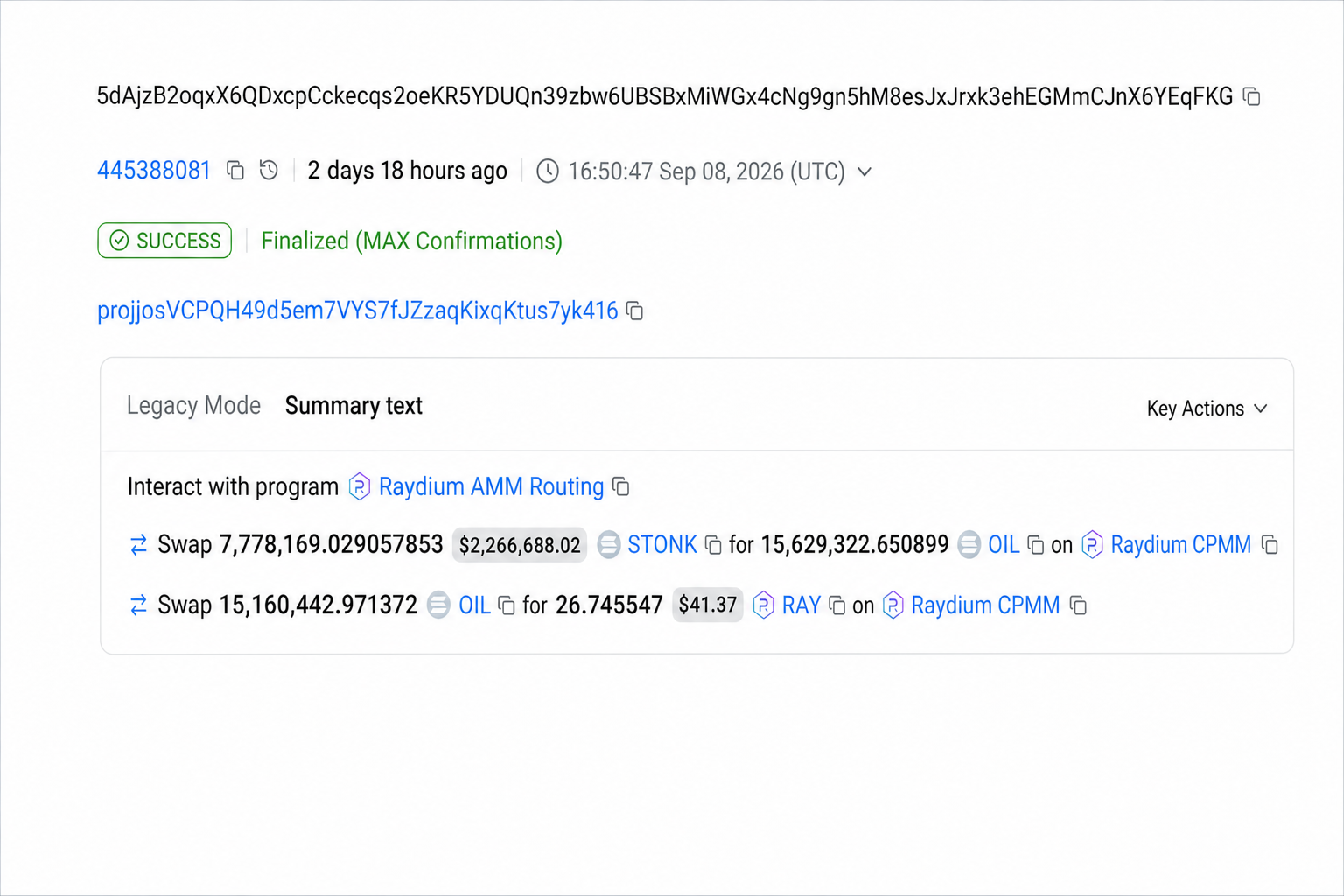
From a technical standpoint, everything was correct: the tokens were debited, the exchange took place, and the result was recorded on the blockchain. The error was not in the network's operation but in the execution price. The liquidity pool simply could not handle such a volume without a sharp skew.
When a trade passes through pools, a large order changes the balance of assets within them. If the exchange volume is much larger than the available liquidity, the user's own order begins to move the price against itself. Consequently, the final amount may be incomparable to the estimated position value.
A similar story became particularly noticeable in March 2026. A user attempted to exchange USDT worth about $50 million for $AAVE via the Aave interface. After completing the transaction, he was left with only 324 $AAVE worth about $36,000.
The Aave interface did not hide the risk. The project's founder, Stani Kulechov, explained that the system warned the user of extreme slippage due to the unusually large order and required separate confirmation of consent to the risk. The user checked the appropriate box on the mobile device and proceeded with the operation.
Later, Aave developer Martin Grabina clarified that the key reason for the losses was the trade's own impact on the price: the order was too large relative to the available liquidity.
CoW Swap stated that it found no signs of hacking or malicious activity. The trade was executed according to the parameters of the signed order. Later, Aave decided to try to return about $600,000 in fees that were received as a result of this transaction to the user.
In November 2025, a similar error occurred with a Cardano holder. He exchanged 14.4 million ADA worth about $6.9 million for only 847,695 USDA, losing approximately $6.05 million due to a lack of liquidity. Before this, the wallet conducted a small test transaction, but it did not show what would happen when exchanging the entire amount.
A Wrong Address Turns a Transfer into an Irrecoverable Loss
Even more dangerous is a situation where the blockchain executes an operation correctly, but the money goes to the wrong recipient. In May 2024, the owner of 1155 WBTC worth about $68 million fell victim to address poisoning. This is an attack where a malicious actor slips an address that visually resembles the real one into the wallet's transaction history.
The scheme does not require stealing the private key. The attacker creates a similar address and sends a small amount from it to the victim's wallet. Then the owner, checking only the beginning and end of the string, copies the fake address from the transaction history and sends funds to it himself. In this case, 1155 WBTC were sent to the erroneous address, and later the value of these assets was estimated at approximately $71 million.
The transaction history, which many use as protection against typos, becomes a tool of deception in such an attack. It is enough not to check the entire sequence of characters, and the network will unquestioningly send the assets to where the signer specified.
Sometimes a catastrophe does not even require a malicious actor. In 2024, a Renzo user, while copying, confused his own wallet address with the address of a related technical smart contract and sent assets worth about $25 million there. After unsuccessful attempts to recover the funds, he offered $2.5 million to anyone who could help regain access to them.
Not only private users make mistakes. Wintermute provided Ethereum multisig wallet addresses to the Optimism developers but did not check if it could control the same address on the Optimism network. Before the main operation, there were test transfers, but the problem only became apparent after sending 20 million OP.
The Danger May Lie Not in a Transfer, but in a Permission
Not all losses begin with the direct sending of tokens. In DeFi, users often sign permissions allowing smart contracts to work with their assets. Such consent can remain active long after a specific operation is completed.
A brief summary of this case: January 2026; exploitation of a vulnerability in the DEX aggregator SwapNet, integrated with Matcha Meta; about $13.4 million in losses; cause—protocol vulnerability and direct permissions instead of One-Time Approval; almost the entire amount, about $13.34 million, came from a single wallet.
This is the main risk of approvals. A signature may not debit funds immediately but can grant an external contract access to assets for weeks or months. When the contract gains the ability to use this permission, the wallet owner may have long forgotten that they ever granted it.
Why Blockchain Doesn't Save from Human Errors
All these cases share one thing: in most episodes, the network did exactly what it was instructed to do. The swap proceeded based on available liquidity, WBTC were sent to the specified address, and the smart contract used a previously granted permission.
In traditional finance, there is usually an intermediary between a person and the final execution of a payment. A bank can limit the amount, stop a suspicious transfer, or request additional confirmation. In cryptocurrencies, the owner of a private key can move millions independently. But along with the intermediary, part of the protection from one's own actions also disappears.
Even a test transaction does not guarantee safety. Wintermute conducted test transfers, the victim of address poisoning trusted the wallet history, and the Aave user confirmed the warning about critical slippage. Bitcoin, DeFi tokens, or stablecoins in this sense obey the same logic: the owner's signature is decisive.
Major operations require several independent checks.
- Verify the address in its entirety, not just the first and last characters.
- Choose the correct network before sending funds.
- Assess the expected output amount before confirming a swap.
- Check liquidity, especially for large exchanges.
- Regularly revoke unnecessary smart contract permissions.
- Use hardware wallets for large amounts.
- Enable two-factor authentication where available.
- Understand basic phishing and social engineering schemes to not automatically trust an interface.
Before signing, it's worth checking not only the amount but also the address, network, exchange route, liquidity, and permissions: in the blockchain, it is these parameters that become the final command for the network.
The main advantage of self-custody simultaneously remains its main risk. No one can manage assets without the owner's consent. But if the owner himself signed an incorrect transaction, often there is no one to stop it.
Full control over cryptocurrency means not only freedom from intermediaries. It also means the possibility of losing money without intermediaries—with a single mistaken signature.
end-content