Hiring Plummets by 80%, Is the Crypto Talent Market Saturated?

比推Опубліковано о 2026-01-19Востаннє оновлено о 2026-01-19

Анотація

The cryptocurrency job market in early 2026 has seen a significant slowdown, with an 80% year-on-year decline in new job postings during the first two weeks of January compared to the same period in 2025. Only 85–90 new roles were detected across major crypto-focused job platforms, excluding direct corporate pages. Despite this sharp drop, the market isn't entirely saturated. Most openings (60%) are technical or engineering roles, with a strong preference for experienced professionals—65% of positions target mid-to-senior level candidates, often requiring 5+ years of experience (7+ for management roles). Key hiring is concentrated in infrastructure, stablecoins, and fintech/payment startups, with growth-stage companies (Series A and beyond) leading recruitment efforts. A notable shift is the rising competition for talent between ecosystems, particularly Solana’s growing challenge to Ethereum’s long-standing dominance. In 2024, Solana attracted a larger share of new developers (22%) than Ethereum (16%) for the first time since 2016, fueled by increased funding and ecosystem growth. The author suggests that 2026 will favor projects with strong fundamentals, real users, and sustainable revenue models, as the industry moves away from speculative token launches and focuses on tangible value creation.

Written by: willthetrill

Compiled by: Chopper, Foresight News


Is the hiring market in the cryptocurrency industry saturated now? Both yes and no. Although there were layoffs sporadically in December, overall, hiring momentum remained strong in the fourth quarter.

To uncover the truth, I specifically extracted data from major vertical recruitment websites in the crypto industry for the first two weeks of January 2026 (this data does not include official company recruitment pages). The results showed that only 85-90 new unique positions were added during this period.

This year's start has been quite quiet. In contrast, the data for January 2025 was quite impressive, with a total of 1,192 positions posted in that single month, making it the highest month for recruitment in all of 2025.
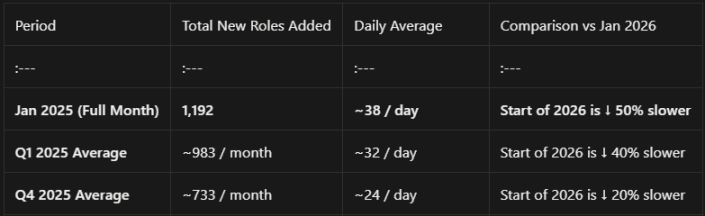
Data as of January 12, 2026

In the first two weeks of January 2025, the average number of daily job postings was about 38; in the same period of 2026, the average number of daily job postings was only about 6.5.

Recruitment activity in early January decreased by approximately 80% compared to the same period last year. This data confirms the widespread speculation: the industry's start this year is far less heated than last year.

Analyzing the details of the above job data, the main characteristics of the current recruitment market are as follows:

  • Job Type Distribution: Technical / Engineering positions account for 60%, Non-Technical / Business Development positions account for 40%.

  • Job Grade Distribution: Specialist / Senior Specialist / Manager / Department Head and other mid-to-senior level positions account for about 65%. This signal indicates that companies are prioritizing the recruitment of experienced talent to lead key projects related to core product development and business growth.

  • Experience Requirements: Most positions require candidates to have more than 5 years of relevant experience; management positions require more than 7 years of experience.

When conducting screening interviews with candidates, I often ask them: What currently attracts you to the crypto industry? The answers are invariably two: prediction markets and stablecoins. Therefore, it's not surprising that the data shows about 60% of recruitment demand is concentrated in infrastructure teams, stablecoin projects, and payment / fintech infrastructure startups. Furthermore, the talent war between the Kalshi and Polymarket platforms continues, and this competition is expected to persist.

Currently, the most aggressive recruiters are those growth-stage companies (i.e., companies that have completed Series A funding or later rounds). A quick glance at the recruitment pages of several companies and information on the Ashby platform also confirms this conclusion.

  • Series A Companies: Lifi Protocol has 13 open positions, Privy IO (acquired) has 10 open positions, Crossmint has 10 open positions, Coinflow Labs has 14 open positions;

  • Series B Companies: TurnkeyHQ has 12 open positions;

  • Series C Companies: Raincards has 49 open positions;

  • Series D Companies: Anchorage has 66 open positions.

However, perhaps more interesting is the change in talent flow.

Having worked full-time in crypto recruitment for 5 years, I can't help but recall: "Has there ever been a public chain ecosystem, like Solana, that challenged Ethereum's dominance in the recruitment and developer growth arena?" The answer is: No, at least never on this scale.

Looking back, other public chains like Polkadot and Cosmos have all experienced phases of rapid developer growth, but they never managed to pose a challenge to Ethereum of the same magnitude in terms of market share and sustained recruitment scale.

Solana is the first ecosystem with the real strength to compete with Ethereum. In 2024, it set a historic record, achieving, for the first time since 2016, a higher percentage of new contributing developers than Ethereum. Solana attracted over 22% of the crypto industry's new developers, while Ethereum's share was about 16%. This phenomenon is quite rare, considering that in the past, Ethereum almost monopolized the vast majority of new talent.
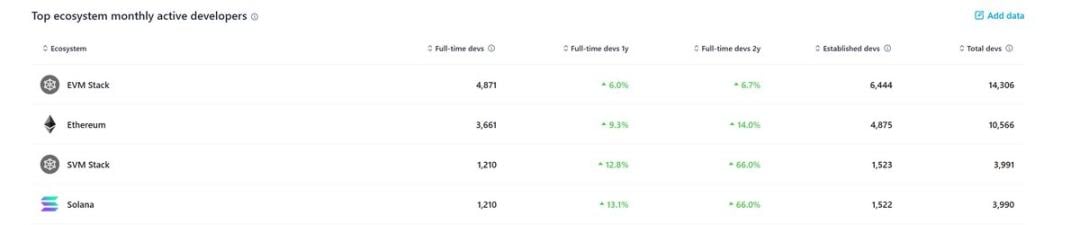
Data source: Electric Capital "Developer Report", as of January 14, 2026

In the third quarter of 2025 alone, 23 Solana ecosystem projects completed financing, raising $211 million, a 70% year-on-year increase in ecosystem financing scale.

For example: When a project completes a $13.5 million financing round (like Raikucom did in Q3 2025), its first priority is to recruit 5-10 senior engineers to build the core engineering team and business development team. These types of positions often do not appear on public recruitment websites but are filled through investor / angel investor networks, hackathon events, and targeted headhunting.

The crypto industry is constantly evolving, and the landscape of the recruitment market will change accordingly. Through token issuance, crypto technology can push internet capital markets to maximize development, but the reality is that the vast majority of tokens issued in the past two years have seen their prices fall.

I believe that in 2026, the ripple effects of this phenomenon will gradually become apparent, affecting how companies raise risk capital, their market expansion strategies, and, of course, their talent recruitment strategies.

The projects that will stand out this year will undoubtedly be those with solid business fundamentals, a real user base, solving actual needs, and most importantly, generating revenue.


Twitter:https://twitter.com/BitpushNewsCN

Bitpush TG Discussion Group:https://t.me/BitPushCommunity

Bitpush TG Subscription: https://t.me/bitpush

Original link:https://www.bitpush.news/articles/7604019

Пов'язані питання

QAccording to the data, by what percentage did the daily job posting rate in the crypto industry drop in the first two weeks of January 2026 compared to the same period in 2025?

AThe daily job posting rate dropped by approximately 80% in the first two weeks of January 2026 compared to the same period in 2025.

QWhat are the two main areas that candidates cite as their reason for joining the crypto industry, which also account for 60% of the hiring demand?

AThe two main areas are prediction markets and stablecoins.

QWhich blockchain ecosystem is highlighted as the first to seriously challenge Ethereum's dominance in developer recruitment and growth?

AThe Solana ecosystem is highlighted as the first to seriously challenge Ethereum's dominance.

QWhat type of companies are currently the most aggressive in their hiring, according to the article?

AGrowth-stage companies (those that have completed Series A funding or later) are currently the most aggressive in their hiring.

QWhat key characteristic is mentioned for projects that are predicted to stand out in 2026?

AProjects that are predicted to stand out in 2026 are those with solid business fundamentals, a real user base, that solve actual needs, and, most importantly, are able to generate revenue.

Пов'язані матеріали

In Conversation with Ray Dalio: We Are Currently in an AI Bubble, with 1% of My Portfolio in Bitcoin

Ray Dalio, founder of Bridgewater Associates, warns in an interview that the current AI boom shows classic bubble characteristics, which could lead to significant economic downturns as seen in past cycles like 1929 or 2000. He explains that speculative enthusiasm, fueled by debt and overvaluation, often precedes a crash when rising rates or taxation force asset sales, causing widespread losses and recession. Dalio also outlines his "Big Cycle" theory, describing an approximate 80-year pattern where widening wealth gaps, massive government deficits, and shifting geopolitical power (like China's rise) create internal conflict and global instability. He emphasizes that we are in a late-cycle, transitional phase where traditional powers like the US and UK face decline. For personal wealth protection, Dalio advises diversification beyond cash into assets like stocks, bonds, real estate, and particularly gold, which he prefers over Bitcoin. While he holds about 1% of his portfolio in Bitcoin as a non-printable hard asset, he views gold as more secure from technological or governmental threats. Regarding AI's impact, Dalio believes it will disproportionately benefit capital owners, worsening inequality by replacing both physical and cognitive labor. He suggests that human intuition and emotional intelligence, combined with AI, will be key for future workers. On taxation, Dalio argues that wealth taxes are impractical and risk triggering asset sell-offs, reducing productive investment. He points to the UK as a cautionary example of debt, low productivity, and political strife. Geopolitically, Dalio foresees a more regionalized world, with the US showing weakness in prolonged conflicts like with Iran, akin to past imperial declines. The ideal outcome, he suggests, is coexisting powerful blocs (e.g., Americas, China-Asia Pacific) without major war.

marsbit10 хв тому

In Conversation with Ray Dalio: We Are Currently in an AI Bubble, with 1% of My Portfolio in Bitcoin

marsbit10 хв тому

Daily 7.2 Trillion KRW: Foreign Capital's Record Net Buying on Friday! Wall Street Says Headwinds for Korean Stock Fund Flows Have Subsided

South Korean stock market sees a dramatic shift in fund flows. On July 31, foreign investors made a record net purchase of approximately KRW 7.2 trillion in KOSPI stocks, marking a fundamental reversal from the persistent large-scale net outflows seen in previous months. This contributed to a significant narrowing of foreign net selling in July to KRW 9.8 trillion, down sharply from KRW 48.4 trillion in June and KRW 44.5 trillion in May. Simultaneously, domestic institutional pressure eased. South Korean pension funds and asset managers turned to a net buying position in July, purchasing KRW 1.0 trillion worth of KOSPI shares, contrasting with net sales in May and June. Market volatility is expected to be dampened by new financial regulations. Effective July 31, the Financial Services Commission tightened access for retail investors to single-stock leveraged ETFs by raising the minimum cash deposit requirement. Trading volumes for these products subsequently dropped to about 50% of their monthly average. Citigroup Research maintains its year-end KOSPI target of 10,000 points. The firm cites several supportive factors: the substantial easing of headwinds from capital outflows, a robust fundamental outlook for the semiconductor sector, historically low market valuations, strong economic fundamentals, and the potential for policy support from financial authorities if needed.

marsbit10 хв тому

Daily 7.2 Trillion KRW: Foreign Capital's Record Net Buying on Friday! Wall Street Says Headwinds for Korean Stock Fund Flows Have Subsided

marsbit10 хв тому

Thanks to Dice Rolls, Bitcoin Keys Are Stored Offline, But Not Everyone Will Do It

The article discusses using dice rolls to generate secure Bitcoin wallet seeds, providing entropy independent of potentially flawed hardware random number generators. It explains that each fair dice roll offers about 2.585 bits of entropy, with around 50 rolls needed for a standard 12-word seed phrase and 99+ recommended for higher security. This method gained attention after a vulnerability was revealed in some Coldcard hardware wallets, where a faulty firmware RNG (dating back to 2021) compromised generated keys. The analysis notes that while a dice-generated main seed was safe from this specific flaw, other Coldcard functions (like creating paper wallets, backup keys, or passwords) could still be vulnerable if they used the defective RNG. The piece argues that while dice-based entropy is technically robust, the manual process is error-prone, tedious, and unrealistic for most new users, who might make mistakes in recording or inputting rolls. It concludes that while manual entropy generation should remain an option for advanced users, the long-term goal is to develop reliable, user-friendly hardware and software that securely generates randomness without requiring specialized knowledge. Coldcard users are advised to check their firmware version and replace any secondary secrets (like paper wallet keys) created with vulnerable devices, while also considering multi-signature setups with devices from different manufacturers for added security.

cryptonews.ru5 год тому

Thanks to Dice Rolls, Bitcoin Keys Are Stored Offline, But Not Everyone Will Do It

cryptonews.ru5 год тому

Торгівля

Спот
活动图片





