G7 Warning on Quantum Attacks Accelerates Transition to New Cryptographic Security System

cryptonews.ruОпубліковано о 2026-09-05Востаннє оновлено о 2026-09-05

Анотація

The G7 cybersecurity working group urges countries and businesses to immediately begin transitioning to post-quantum cryptography, a warning directly relevant to crypto networks, exchanges, and custodians who must undertake costly system upgrades before quantum computers threaten modern encryption. Their report, while not mentioning cryptocurrencies specifically, highlights the risk quantum computing poses to public-key cryptography, which underpins crypto transactions. A key concern is the "harvest now, decrypt later" strategy, where encrypted data is collected for future decryption, a threat also applicable to blockchain's publicly visible keys. Europe has set concrete deadlines, mandating that all EU member states begin their transition by the end of 2026, with high-risk systems completing it by 2030. This shifts quantum readiness from a technical issue to a regulatory and competitive necessity. Bitcoin and Ethereum are pursuing different upgrade paths. Bitcoin's BIP-360 proposal aims to mitigate long-term quantum vulnerabilities, while Ethereum's broader roadmap targets upgrades to validator signatures, commitments, and zero-knowledge proofs by 2029. A major challenge is the increased data size of post-quantum signatures, which could raise storage, bandwidth, and transaction costs. The immediate market risk is not a quantum attack itself, but the complex preparation for it: governance debates, protocol development, infrastructure changes, and the vulnerability of old w...

The G7 Cybersecurity Working Group is calling on countries and businesses to immediately begin transitioning to post-quantum cryptography. This warning is directly relevant to crypto networks, exchanges, and custodians, who need to undertake costly upgrades of their systems before quantum computers become a threat to modern cryptography.

The working group published a document on September 3, 2026, titled "Preparing for the Post-Quantum Era: A Call to Action," which frames quantum computing as a business and cybersecurity risk that organizations must be prepared for before the emergence of a cryptographically viable machine.

Why a report that nowhere mentions the word 'cryptocurrency' still strikes a blow at the crypto market

The G7 document contains no specific mentions of cryptocurrencies, although the concept is directly related to blockchain technology. Decrypt notes that cryptocurrency transactions and fund management are based on public-key cryptography.

While exact timelines are unknown, a number of recent advances suggest that in the future, quantum computers capable of breaking widely used public-key cryptography mechanisms will emerge.

— G7 Cybersecurity Working Group

The concern is not only about the possibility of future attacks.

Harvest now, decrypt later.

— G7 Cybersecurity Working Group

The strategy involves collecting encrypted data today and decrypting it in the future when quantum technology becomes sufficiently advanced. A similar problem exists with blockchains, where public keys and transaction history may remain visible forever, making keys vulnerable to future hacking.

The G7 proposes efforts in areas such as raising awareness, national policy, research, collaboration between public and private sectors, and post-quantum procurement requirements.

Europe has already put dates on the calendar

Europe has gone further by setting deadlines. In June 2025, the EU adopted a coordinated roadmap for transitioning to Post-Quantum Cryptography (PQC).

The European Commission's Post-Quantum Cryptography (PQC) policy insists that all member states begin transitioning to the new system by the end of 2026, while high-risk systems must transition immediately and by 2030.

This means quantum readiness has ceased to be merely a technical issue. As new requirements concerning post-quantum technology become part of procurement and cybersecurity legislation, companies without a proper migration policy may face compliance and competitiveness challenges.

Bitcoin and Ethereum take different paths

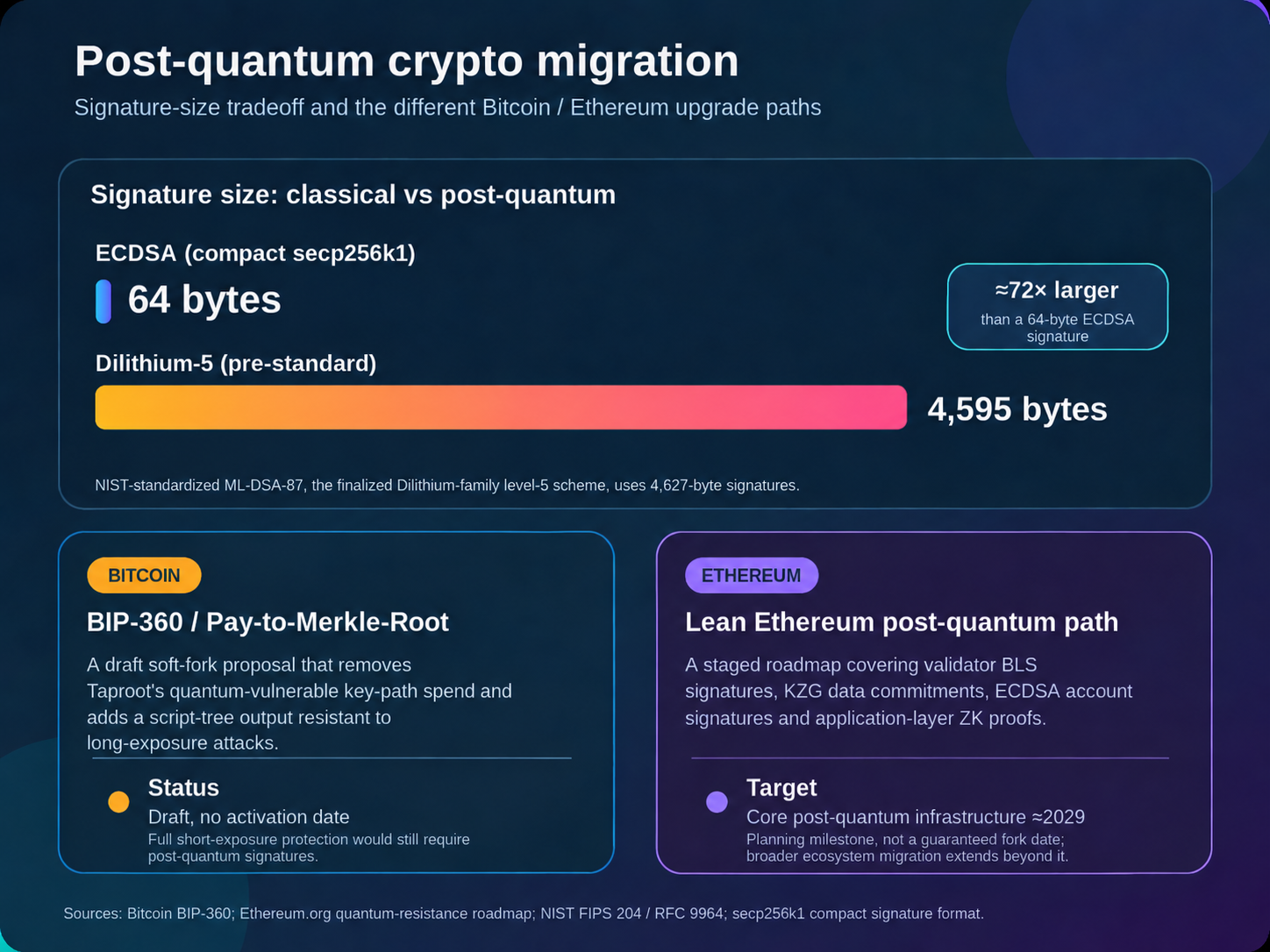
BIP-360 (Pay-to-Merkle-Root) is considered by Bitcoin as a soft fork proposal aimed at reducing vulnerability to long-term quantum computer attacks. BIP-360 requires the disabling of the Taproot key spending mechanism, which is susceptible to quantum processing, although its creators acknowledge that faster attacks on transactions in the mempool will still depend on the implementation of post-quantum digital signatures. The activation date for BIP-360 is not yet determined.

Ethereum is working on a broader post-quantum security system. In his roadmap update for February 2026, Vitalik Buterin mentioned four components that need upgrading: validator BLS signatures, KZG commitments, account ECDSA signatures, and application-layer zero-knowledge proofs. Ethereum plans to build the core post-quantum infrastructure in 2029, although the process of migrating to this new technology may take some additional time.

The cost is high. A compact secp256k1 ECDSA signature occupies about 64 bytes, while an older parameter set, Dilithium-5, used approximately 4595 bytes. The NIST-approved ML-DSA standard uses ML-DSA-87 signatures, which occupy about 4627 bytes. Thus, the signature size may also increase storage requirements, bandwidth, and transaction costs.
The short-term risk lies in the migration itself

Consequently, the immediate market risk is not about when a quantum computer will break Bitcoin. Rather, it's everything related to preparing for it: governance disputes, protocol development, larger key signatures, infrastructure changes, and old wallets whose public keys have been exposed.

An article published in March 2026 by Google Quantum AI argued that breaking 256-bit elliptic curve cryptography would require far fewer resources than previously thought. Google even announced the completion of its own systems migration by 2029.

NIST presented draft IR 8547, which recommends phasing out 112-bit ECDSA after 2030 and banning the use of ECDSA after 2035.

Previously, Cryptopolitan published a report claiming that quantum readiness may ultimately be incorporated into institutional custody criteria and investor due diligence standards, making a network's migration plan a competitive advantage.


Пов'язані питання

QWhat is the main warning issued by the G7's cybersecurity working group, and which sectors are most directly impacted?

AThe G7's cybersecurity working group warns countries and businesses to immediately begin the transition to post-quantum cryptography. This warning is directly relevant to crypto networks, exchanges, and cryptocurrency custodians, who need to undertake costly upgrades before quantum computers become a threat to modern cryptography.

QAccording to the G7 document, what is the 'Harvest Now, Decrypt Later' strategy?

AThe 'Harvest Now, Decrypt Later' strategy involves collecting encrypted data today and decrypting it in the future once quantum technology becomes sufficiently advanced. This presents a similar problem for blockchains, where public keys and transaction history remain visible forever, making keys vulnerable to future hacking.

QWhat specific deadline has the European Union set for the transition to post-quantum cryptography (PQC), and what is required by this timeline?

AThe European Union, through its coordinated PQC roadmap adopted in June 2025, insists that all member states must begin the transition to the new system by the end of 2026. Furthermore, high-risk systems are required to transition immediately and must complete the transition by 2030.

QHow are the approaches of Bitcoin and Ethereum to post-quantum security different as described in the article?

ABitcoin is considering BIP-360 (Pay-to-Merkle-Root), a soft-fork proposal aimed at mitigating vulnerability to long-term quantum computer attacks by deprecating the quantum-vulnerable Taproot key-spend mechanism. Ethereum is working on a broader post-quantum security system, planning to upgrade four key components and build a core post-quantum infrastructure by 2029.

QWhat is identified as the immediate market risk regarding quantum computing, rather than a quantum computer breaking Bitcoin?

AThe immediate market risk is not when a quantum computer will crack Bitcoin, but rather everything involved in preparing for it. This includes governance disputes, protocol development, larger key signatures, infrastructure changes, and the vulnerability of old wallets whose public keys have been exposed.

Пов'язані матеріали

The Life and Death of an Ordinary Meme Coin

The Life and Death of a Meme Coin Despite their association with retail speculation, meme coins effectively attract attention and liquidity to new ecosystems. However, their viral nature and low creation barriers mean they typically have extremely short lifecycles. An analysis of 150 meme coins using survival analysis techniques reveals a harsh reality. The median meme coin reaches its all-time high (ATH) just 17.2 days after its first trade, with a quarter peaking within 1.6 days. The journey from ATH to a 95% crash takes a median of 370 days. Price performance is overwhelmingly negative: over half of the coins trade more than 95% below their ATH. Only 5 out of 151 sampled coins (3.3%) have ever reclaimed their ATH after a 90% drop. By 300 days post-launch, most coins retain only 10% of their initial value. The analysis of local peaks versus the ultimate ATH shows that two-thirds of Solana-era meme coins experienced only one significant price surge, peaking within days and never recovering. Chain activity, measured by addresses with a balance over $1, mirrors this pattern, with current activity for major meme coins below 7% of its peak. While the data paints a bleak picture for long-term holding, meme coin speculation is deeply embedded in market culture and continues to migrate to new platforms. The pursuit of asymmetric returns persists, driven by gambling dynamics rather than rational investment, suggesting this trend will continue evolving alongside on-chain financialization.

marsbit42 хв тому

The Life and Death of an Ordinary Meme Coin

marsbit42 хв тому

The Nightmare of Timers: Missing the Best 15 Days of Performance Over the Past 3 Years, Bitcoin Returns Would Underperform Cash

**Title: The Market Timer's Nightmare: Missing Bitcoin's Top 15 Days Leads to Underperformance vs. Cash** A Grayscale report highlights a critical risk for Bitcoin investors: the immense opportunity cost of being absent from the market during its brief, explosive rallies. Over the past three years, Bitcoin delivered a cumulative return of approximately 225%. However, its gains are hyper-concentrated. If an investor missed just the 5 best trading days, the return collapses to 95%. Missing the top 10 days slashes it to 27%. If the top 15 days (less than 1.4% of the period) are missed, the return turns negative at -11%, underperforming cash. In stark contrast, the Nasdaq 100 would still retain a 21% gain after removing its own best 15 days. These crucial surge days typically occur under conditions of peak pessimism—following panic sell-offs, regulatory clarity, or short squeezes—when holding cash feels safest. The repricing is also extremely rapid, often happening within hours before a clear "right-side" trend is apparent. Therefore, the greatest investment risk for assets like Bitcoin is not volatility or drawdowns, but the high probability of missing the few days that generate virtually all excess returns. The report concludes that time in the market is superior to timing the market, emphasizing strategies like dollar-cost averaging to ensure participation during these decisive moments.

marsbit44 хв тому

The Nightmare of Timers: Missing the Best 15 Days of Performance Over the Past 3 Years, Bitcoin Returns Would Underperform Cash

marsbit44 хв тому

Торгівля

Спот
活动图片