Don't Rush to Short Ethereum: Five Reasons Countering the 'Liquidity Moat Has Been Lost' Argument

marsbitPublished on 2026-10-10Last updated on 2026-10-10

Abstract

Summary: The article disputes claims that Ethereum is losing its "liquidity moat." The author argues against points that suggest Ethereum's relevance is declining, such as low trading volume for tokenized stocks, flagship applications migrating, and a slow decline in stablecoin dominance. Key rebuttals include: - Ethereum's value is partly driven by its monetary premium and role as a reserve/collateral asset, not just transaction-based revenue (REV). - Growth on its Layer 2 networks (e.g., Base, Robinhood Chain) represents a win for Ethereum, not a loss. While some apps expand to other blockchains, Ethereum often remains the majority platform. - Even with a falling share of the growing stablecoin market, Ethereum's absolute value would increase significantly. - Long-term fundamentals remain strong: Ethereum leads in DeFi TVL (65%), real-world asset (RWA) value, institutional adoption (ETFs), security, and developer activity. It is described as the "world computer" of crypto.

Author: Jake Koch-Gallup

Compilation: Deep Tide TechFlow

Deep Tide Introduction: As more and more people begin to question Ethereum's value capture ability, this article provides a contrarian perspective. The author directly responds to the argument that "Ethereum is losing its liquidity moat" and offers counterarguments from the perspectives of monetary premium, Layer-2 ecosystems, and stablecoin market share. For investors who are reassessing Ethereum's long-term positioning, this is a thought-provoking piece worth reading alongside contrasting views.

If you haven't read Carlos's newsletter from this Tuesday, go read it first. His core argument is: Ethereum is losing its final moat, liquidity. We debated this on the 0xResearch podcast (you can listen here), and I strongly disagree with his view (can you believe it? Blockworks analysts actually have different opinions).

His first example is that tokenized stocks on Ethereum have almost no trading volume, with only $25 million in trading volume over the past 30 days, representing about 3% of the supply. But Ethereum holds the second-largest share in tokenized stock supply. Carlos anticipated this, but I still believe the purpose of tokenized stocks is to expand global investors' access to US markets, not for lending and DeFi. On the podcast, his response was: tokenized stocks lying on your blockchain do nothing because they don't generate revenue, and trading volume generates revenue.
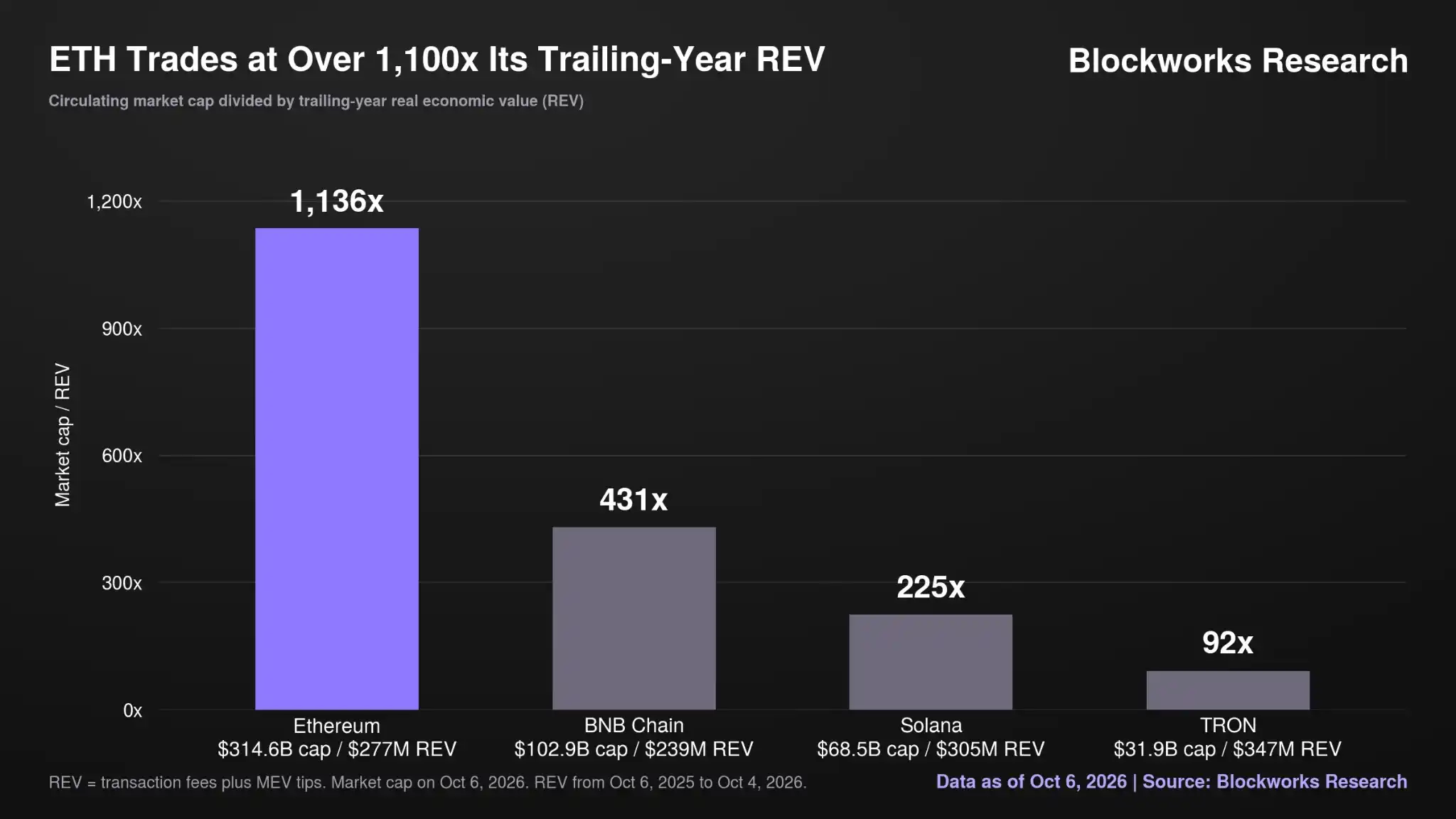
Dear reader, this is likely where you and I start to truly diverge. I don't believe Ethereum necessarily needs to generate revenue. It already possesses a monetary premium, like many other L1s. Real Economic Value (REV) alone is far from sufficient to explain the market capitalization of most L1s; ETH is trading at over 1100 times its REV from the past year. Since the market clearly prices Ethereum partly as a reserve asset and collateral asset (ETFs, treasury bonds, DeFi collateral), ignoring this is tantamount to saying ETH and most L1s are perpetually overvalued by 99%, which isn't a very useful statement.
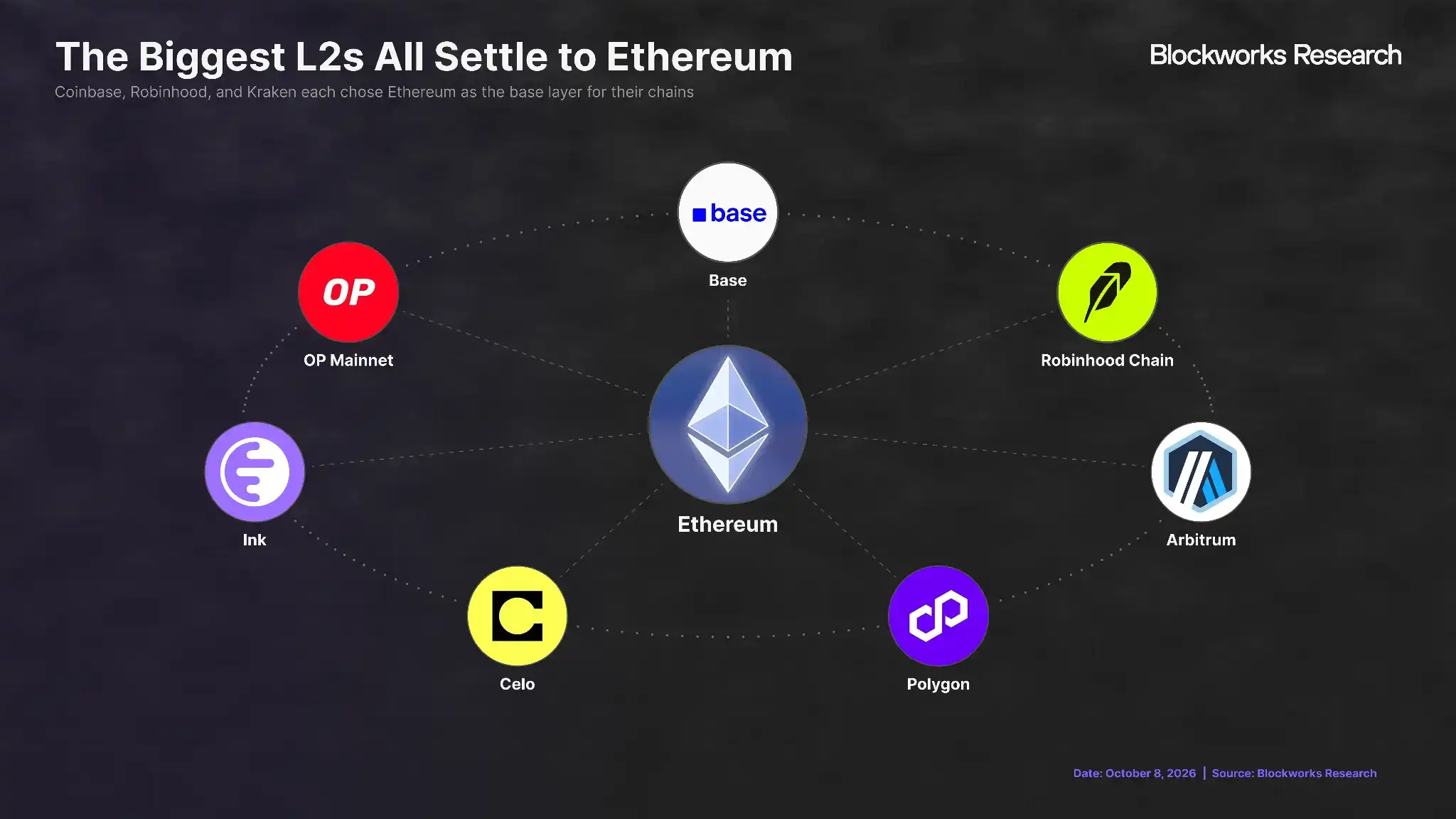
His second argument is that flagship applications are prioritizing growth elsewhere. He cites Robinhood Chain accounting for 43% of Uniswap's trading volume over the past 30 days, while Ethereum accounts for only 32%. He also mentioned Ethena's growth on Base. Both points are valid, but Robinhood Chain and Base are both Ethereum Layer-2 networks. If we agree that REV is less important for L1s, then the growth of Ethereum Layer-2s is a victory for Ethereum. To be fair, Ethena has also expanded to Solana, TRON, and Avalanche, which are not Layer-2s. Ethereum's share in USDe has dropped from 88% to 56%, but it remains the majority. Ethena is increasing distribution channels, not leaving.
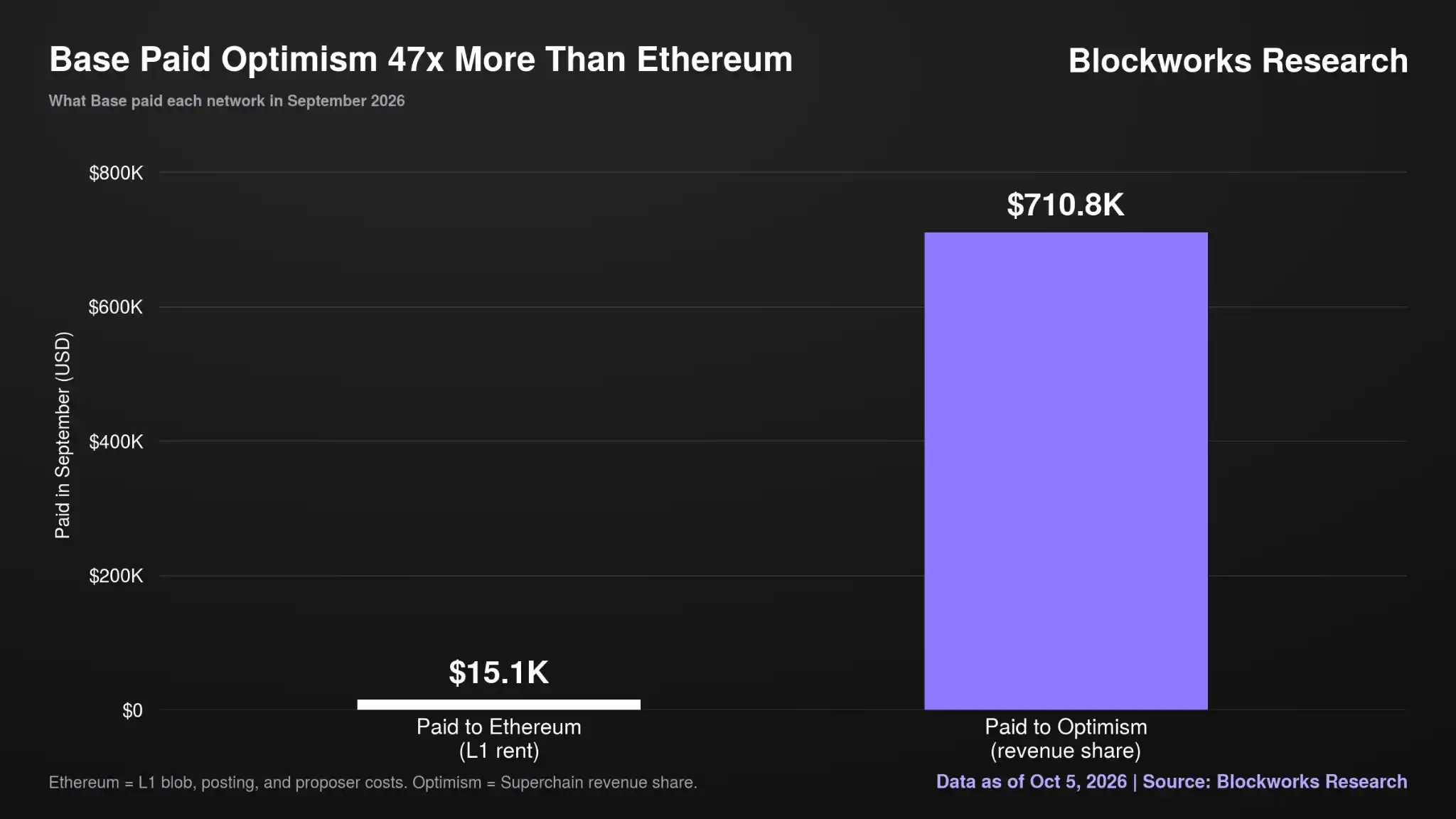
However, if you do believe REV is extremely important, consider this: In September, Base paid Ethereum about $15,000 in rent to publish data. In the same month, it paid the Optimism Collective $711,000. Now imagine a world, 3 to 5 years from now, where Ethereum says, "You know what, we want that kind of revenue Optimism is getting too," and raises the minimum fee for publishing data. Base might not like it, but if Layer-2 networks are 10 times larger by then, that's a lot of money. So market share matters, even if it's not generating much REV right now.
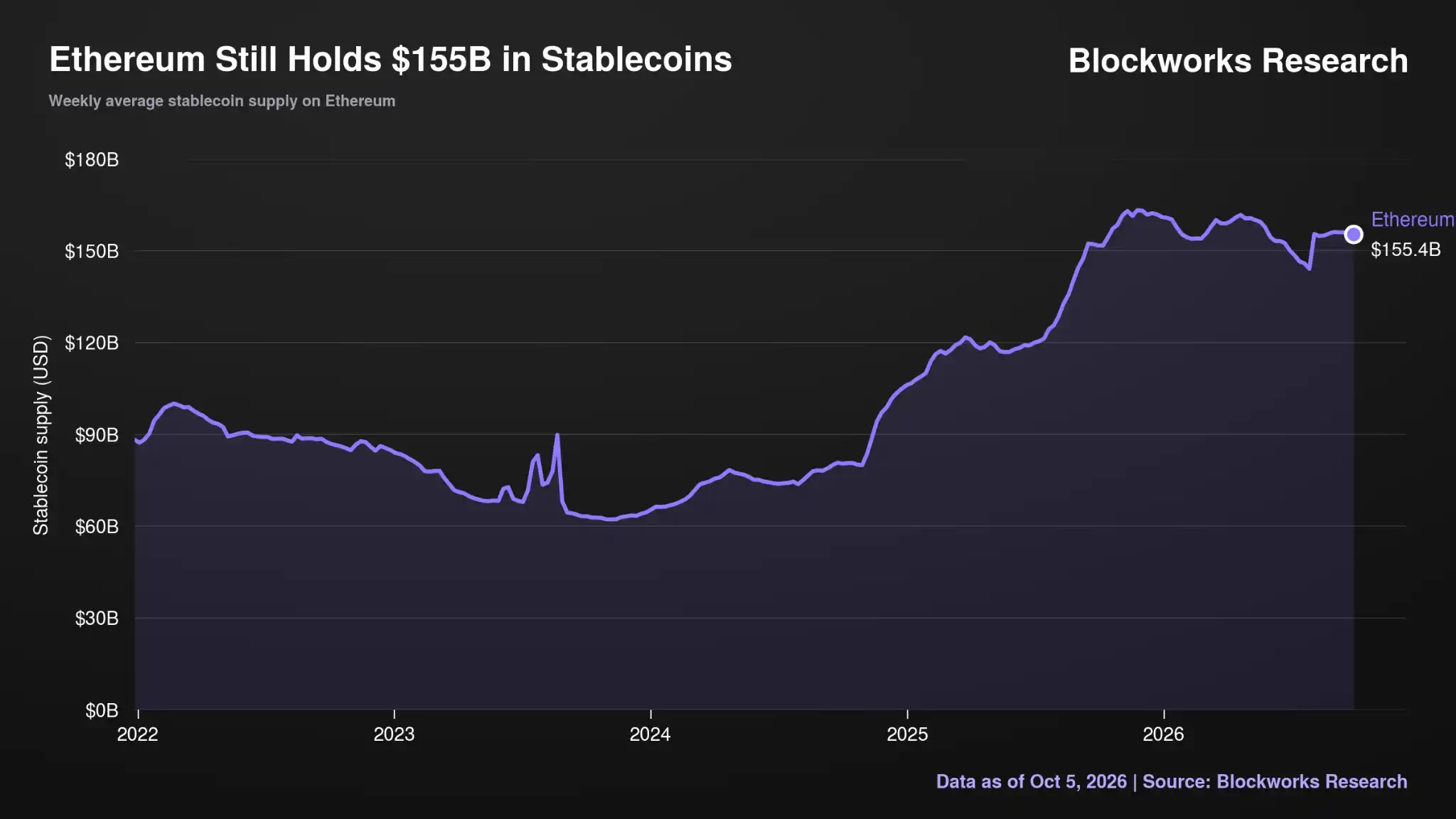
His final argument is that Ethereum's stablecoin dominance is slowly declining, which is true. But the stablecoin market is not winner-takes-all. Even if Ethereum's dominance drops from 51% to 30% over the next 10 years, the stablecoin market itself will continue to grow. If the total stablecoin market cap reaches $3 trillion in 10 years, Ethereum would have nearly $1 trillion in stablecoins, almost six times today's holdings of $155 billion. If you want to hear Carlos's response to my rebuttals here, be sure to check out the podcast. Setting those aside for now, let's look at why Ethereum remains valuable and will continue to be.

Reasons Why Ethereum Remains Valuable
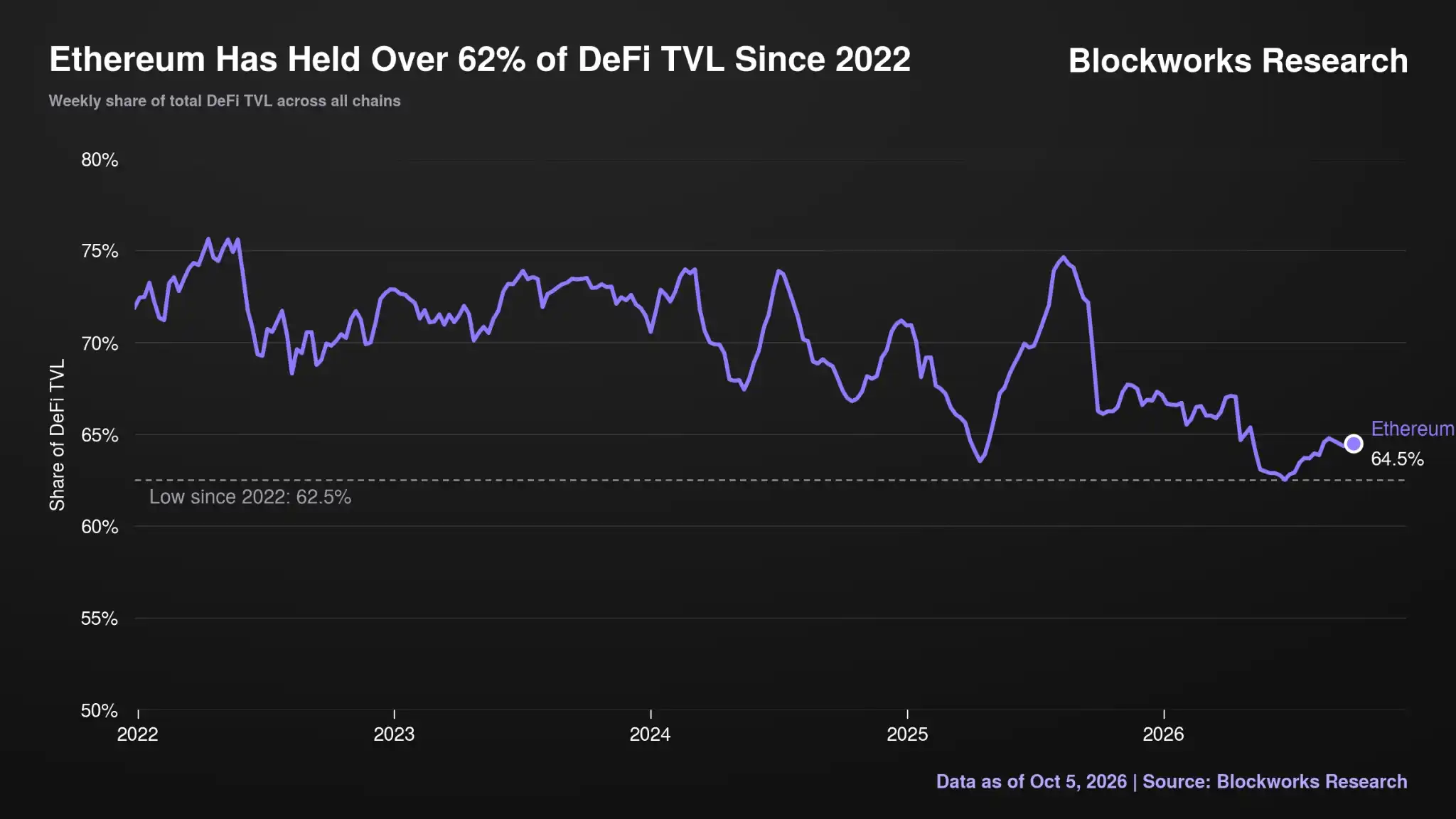
Ethereum has by far the largest Total Value Locked (TVL) in DeFi, accounting for 65% of the total. Since 2022, it hasn't fallen below 62% for any single week.

Ethereum still possesses the deepest liquidity, the most secure network, and the most institutional participation of any blockchain besides Bitcoin.

Ethereum holds the largest on-chain Real-World Asset (RWA) management volume (though its share has fallen from 99% in 2022 to 45% today).

Institutions hold ETH as an asset, not for its revenue. Spot ETFs and corporate treasuries hold about 13% of ETH's total supply.

Robinhood and Coinbase could have launched their own L1s, but they chose to settle on Ethereum.

The largest tokenized funds, such as BlackRock's BUIDL, launched first on the Ethereum mainnet.

Ethereum has been running for over 10 years without a single network-wide outage.

Ethereum and its Layer-2 networks have the largest developer base in crypto, with EVM being the default toolkit, even copied by competing L1s.

36% of the ETH supply is staked, just hitting a new all-time high, providing native yield to holders, which institutions can access via staking ETFs.

Ethereum is the world's computer for crypto.

Ultimately, I am a fundamental investor. Crypto projects (usually) should have revenue, and that value should accrue to token holders. So believing ETH can survive on its monetary premium and minimal REV might just be holder self-soothing. But maybe, just maybe, Ethereum should be valued as a world computer.

Today's Highlight
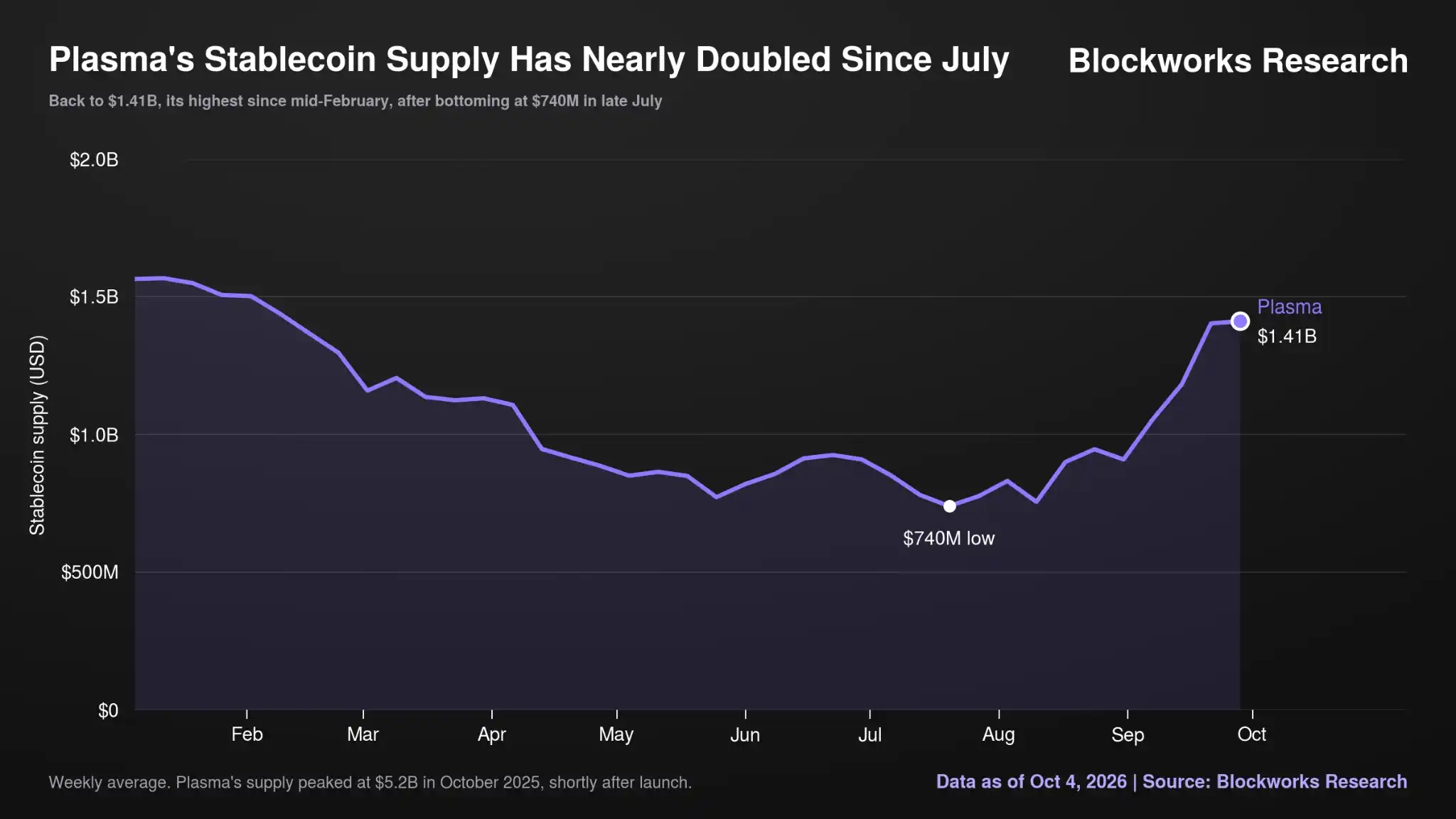
After declining throughout the year, Plasma's stablecoin supply has almost doubled since July, reaching $1.41 billion, the highest level since mid-February. While still far from its peak of $5.2 billion when it launched, the competition for a stable chain isn't over yet.

Trending Cryptos

Related Questions

QWhat is the author's main argument against the claim that Ethereum is losing its liquidity moat?

AThe author argues that Ethereum still possesses a strong 'monetary premium' as a reserve and collateral asset, has the largest DeFi ecosystem and institutional adoption, and benefits from the growth of its Layer 2 networks, which ultimately strengthens Ethereum rather than detracting from it.

QHow does the author justify the shift of flagship applications like Uniswap and Ethena to other chains, such as Base or Solana?

AThe author contends that these applications expanding to chains like Base (an Ethereum Layer 2) is a net positive for Ethereum, as it represents growth within its ecosystem. For expansions to non-L2s like Solana, it's framed as adding distribution channels, not leaving Ethereum, especially since Ethereum still holds a majority share in cases like Ethena's USDe.

QAccording to the author, why is Revenue Extracted from Users (REV) not the most important metric for valuing Ethereum?

AThe author states that the market prices Ethereum not just on its REV, but significantly on its role as a reserve and collateral asset (evidenced by ETFs and DeFi). Ignoring this 'monetary premium' would mean labeling ETH and most L1s as perpetually 99% overvalued, which is an unproductive perspective.

QWhat evidence does the author provide to demonstrate Ethereum's continued dominance and resilience?

AThe author cites several points: Ethereum holds 65% of total DeFi TVL, has the most secure network and deepest liquidity, the largest on-chain Real World Asset (RWA) management, significant institutional ETH holdings (13% of supply), the longest runtime without network failure, the largest developer base, and 36% of ETH supply is staked.

QHow does the author interpret the potential future decline of Ethereum's stablecoin market share?

AThe author argues that the stablecoin market is not winner-take-all and is itself growing. Even if Ethereum's share declines from 51% to 30%, if the total market grows to $3 trillion, Ethereum would still hold nearly $1 trillion in stablecoins—a six-fold increase from today's holdings.

Related Reads

Mercado Bitcoin begins post-hack reopening without a timeline for withdrawals

Mercado Bitcoin, one of Brazil's largest crypto exchanges, began restoring read-only access to customer accounts in phases on Monday, a week after attackers drained an estimated $49 million from the platform. Access started at 19:00 UTC, with all accounts expected to be viewable by 21:00 UTC, showing holdings as they stood on Nov. 2, the day of the hack. The exchange has yet to say when customers will be able to withdraw funds. Fabricio Tota, vice president of new business, said the exchange hoped read-only access would reassure customers that their assets were still recorded on the platform. He explained that the company opted for "a more conservative approach" to reactivating accounts "to ensure our return happens with the utmost security." The caution follows concerns from blockchain security analysts that attackers were able to access addresses, draining funds through standard transfers rather than a smart contract exploit. Blockchain analysts traced some of the stolen funds to customer deposit addresses, but Mercado Bitcoin says customers won't bear the losses. Tota said the vast majority of assets were never even touched by anyone and were not involved in the incident. On Nov. 4, Mercado Bitcoin pledged to cover all losses with company funds, bolstered by a $20 million investment from stablecoin issuer Tether in July. Tota highlighted that a portion of the stolen funds were also frozen in the hours after the company announced the attack. The next phase of recovery will require users to confirm their registration details before they can move funds. The exchange plans to restore withdrawals via Pix, Brazil's instant payment system, initially allowing customers to withdraw only to accounts in their own name. Tota gave no date for either step. Mercado Bitcoin has yet to explain how the attackers gained access to its wallets. Blockchain data company Bitquery found that as of Nov. 4, wallets linked to the attacker held most of the stolen funds that had escaped freezes, including 106.07 BTC.

cointelegraph2h ago

Mercado Bitcoin begins post-hack reopening without a timeline for withdrawals

cointelegraph2h ago

Avalanche’s AVAX leads crypto gains following NYSE tokenization deal

Avalanche's AVAX token rose as much as 10% on Monday, becoming the top gainer among the 100 largest cryptocurrencies, after the New York Stock Exchange announced plans to use Avalanche's blockchain to settle trades on a new platform for trading tokenized stocks around the clock. AVAX later eased to $8.86, still up over 8% on the day, with a market cap of around $3.95 billion and $439.7 million traded in the past 24 hours. Avalanche's total value locked stands at $633 million, up 4% over the past day. NYSE's head of digital issuance, Dennis Lee, said the exchange is examining how blockchain technology can expand its equities offerings and is picking the right technology for each job. The deal underscores Wall Street's growing effort to use blockchain to make stock trading faster and enable trading outside regular market hours; traditional US markets are open 9:30 am to 4:00 pm EST on weekdays, with trades often taking at least one business day to settle. The NYSE first announced plans for the platform in January, and Ava Labs revealed in September that the exchange had spent about a year testing Avalanche, though the final selection was not confirmed until Monday. Avalanche will record stock trades and help complete transactions on the platform, which will let investors buy and sell digital versions of stocks across different blockchains. Lee said the settlement ledger needs to be fast, reliable, permissioned, cost-predictable, and backed by a large developer community—all of which Avalanche meets. The platform could launch before the end of 2026 pending regulatory approval. Ava Labs chief business officer John Nahas said first conversations with the NYSE began nearly a year ago and called it an important step toward blockchain becoming foundational financial infrastructure. The news comes as other major firms invest in blockchain for faster, round-the-clock trading: Nasdaq plans to invest $100 million in Kraken's parent Payward to launch tokenized stocks by Q2 2027, and the DTCC launched a service in October allowing firms to turn traditional securities into digital tokens. The NYSE deal follows other efforts to bring traditional assets onto Avalanche, including Progmat moving over 452 billion yen in digital securities onto a dedicated Avalanche blockchain in July and Aave Labs' plans for a lending service using tokenized assets as collateral.

cointelegraph2h ago

Avalanche’s AVAX leads crypto gains following NYSE tokenization deal

cointelegraph2h ago

Can using a chip for two more years really help get through the cold winter?

The smartphone industry is grappling with rising memory chip costs that are driving up device prices, forcing manufacturers to find ways to stay competitive. A recent leak about a chip called "SM7635" with a 2.96GHz peak CPU frequency and Adreno 810 GPU suggests Qualcomm may be reusing its Snapdragon 7s Gen3 (originally launched in 2024 at 2.5GHz) yet again. The chip already spawned a 2025 variant (SM7635-AC, renamed Snapdragon 7s Gen4) with a 2.7GHz clock, and the new 2.96GHz version will likely become the Snapdragon 7s Gen5—marking a third generation from one original design. This practice of reusing and overclocking mid-range SoCs is not new. MediaTek's Helio X20/X23/X25/X27 and Dimensity 1100/1200/1300, as well as Qualcomm's Snapdragon 615/616/617, 765/765G/768G, and 778G/778G+/782G, followed similar patterns. Previously, however, this was mainly done to widen the gap between flagship and non-flagship products and give flagship buyers more perceived value—not primarily to cut costs. Mid-range buyers were assumed not to care much about chip model numbers. Now the situation is different. One brand recently launched a mid-to-low-end phone with the Snapdragon 7s Gen4 priced at 3699 yuan—a price that a year ago could buy a flagship with a fifth-generation Snapdragon 8 Elite, roughly three to four times more powerful. While SoC isn't the only cost component, consumers clearly get less value for the same money today. Counterpoint Research reports global smartphone SoC shipments fell 21% year-over-year in Q3 2026. Even flagship lines show signs of chip reuse—the Dimensity 9600M appears to be an overclocked Dimensity 9500. With few flagships using fully-specced memory and storage, rumors suggest next year's devices may widely reuse current-generation flagship SoCs while upgrading memory and storage instead. This helps control costs but may further dampen consumers' willingness to upgrade, making such reuse an unsustainable strategy. Restoring market confidence will require both chipmakers and device brands to offer consumers more tangible benefits.

marsbit6h ago

Can using a chip for two more years really help get through the cold winter?

marsbit6h ago

Trading

Spot

Hot Articles

Discussions

Welcome to the HTX Community. Here, you can stay informed about the latest platform developments and gain access to professional market insights. Users' opinions on the price of ETH (ETH) are presented below.

活动图片