‘Disappointing’ — crypto advocates react to delay in CLARITY vote

cointelegraphОпубліковано о 2026-08-10Востаннє оновлено о 2026-08-10

Анотація

The Digital Asset Market Clarity (CLARITY) Act's Senate cloture vote has been delayed until September, disappointing crypto industry advocates who see the postponement as reducing the bill's chances of passing before the 2026 midterm elections. The Senate's inaction before its recess frustrated supporters like Senator Cynthia Lummis. While figures such as Coinbase's CEO remain hopeful for September, banking critics argue the bill creates unfair advantages. Despite the setback, prediction markets still show some users betting on the legislation passing this year, though it would require further votes in the House and the President's signature to become law.

With the Digital Asset Market Clarity (CLARITY) Act now set for a cloture vote in September, many advocates and industry leaders are frustrated and disappointed at lawmakers’ failure to act before the US Senate broke for a month-long recess.

On Saturday, the Senate Daily Press reported that Majority Leader John Thune filed cloture on a motion for the CLARITY Act to go to the chamber floor for consideration, ending speculation that lawmakers would address the bill more than a year after it was passed by the House of Representatives. The CLARITY vote is now expected when the Senate reconvenes in mid-September, and would require support from 60 senators to pass.

Across the crypto industry, many executives and advocates expressed their disappointment with the Senate’s inaction, as the push to September will happen with just 50 days before the 2026 midterm elections, likely reducing the odds of CLARITY passing.

“[Y]ou can imagine how frustrated I am,” said Senator Cythnia Lummis on Friday after the chamber did not schedule a vote on CLARITY, adding: “I will continue working with my colleagues to get this done — this fight is far from over.”
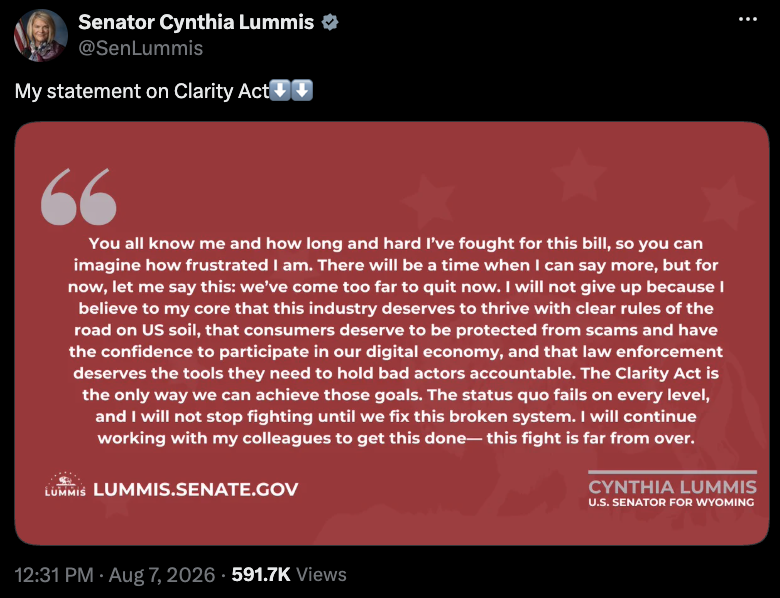
Source: Cynthia Lummis

Others, including Coinbase CEO Brian Armstrong and the exchange’s chief policy officer Faryar Shirzad, called the Senate’s action “disappointing” but said that September would be the time to “finish the job.” Bitmine Chair Tom Lee noted in the company’s weekly report that “financial markets seem more focused on the recent softer inflation and jobs data” rather than any potential impact of CLARITY not passing.

While there were reports of progress in bipartisan talks on the crypto market structure bill, lawmakers in the Senate didn’t announce solutions in response to pushes from many Democrats for stricter ethics provisions, in particular for rules affecting US President Donald Trump’s crypto investments. Trump continues to face scrutiny from many in Congress over his family’s crypto business, World Liberty Financial, and his own projects, including the memecoin launched days before he took office.

Some banking advocates, in contrast, have been pushing lawmakers to address how CLARITY could still allow companies to pay interest to stablecoin holders in certain situations, challenging the industry. In a Thursday Wall Street Journal op-ed published before Thune’s cloture motion, the publication’s editorial board said that, under CLARITY, small banks would miss out “because they rely on interest payments to attract deposits.“ The editorial continued:

“The Clarity Act can serve a useful purpose with some language changes,“ said the editorial board. “The crypto industry and its friends in Washington portray themselves as defenders of free markets. What they really want is to be quasi-banks without abiding by the same regulations.“

Related: CLARITY Act delay gives Asian financial hubs an opening: First Digital CEO

Prediction market users still anticipating CLARITY by 2027

Despite the setback for the bill in Congress, some event contracts on prediction market platforms are still offering users favorable odds on CLARITY passing by the end of the year.

On Kalshi, an event contract with $1.23 million wagered gave users an 88% chance of the Senate voting on the legislation before Oct. 1, while a similar one on Polymarket gave a 26% chance of the bill being signed into law this year. That contract had total wagers topping $5.79 million. If passed by the Senate, CLARITY would need to return to the House for a vote before potentially going to Trump’s desk.

Magazine: BIP-110 ends with a whimper, CLARITY vote punted: Hodler’s Digest, Aug. 9

Пов'язані питання

QWhat is the main reason for the disappointment among crypto advocates regarding the CLARITY Act, according to the article?

AThe main reason for disappointment is the Senate's failure to hold a vote on the CLARITY Act before going on a month-long recess, pushing the critical cloture vote to September and likely reducing its chances of passing so close to the midterm elections.

QWho filed the cloture motion to bring the CLARITY Act to the Senate floor for consideration, and when is the vote now expected?

AMajority Leader John Thune filed the cloture motion. The vote is now expected when the Senate reconvenes in mid-September.

QWhat specific concern from some banking advocates is mentioned as a challenge to the CLARITY Act?

ASome banking advocates are concerned that the CLARITY Act could still allow companies to pay interest to stablecoin holders in certain situations, arguing that this would put small banks at a disadvantage as they rely on interest payments to attract deposits.

QAccording to prediction markets mentioned in the article, what are the odds given for the CLARITY Act being signed into law by the end of the year?

AOn Polymarket, a prediction market contract gives a 26% chance of the CLARITY Act being signed into law by the end of the year.

QWhat is one political issue that reportedly delayed Senate progress on the crypto market structure bill, as mentioned in the article?

AProgress was delayed due to pushes from many Democrats for stricter ethics provisions, particularly rules affecting former President Donald Trump's crypto investments, with lawmakers not announcing solutions in response.

Пов'язані матеріали

Founders Fund Leads $5 Million Token Purchase of ANVL: What Exactly is This "Non-Lending" DeFi Protocol Doing?

On October 6th, Founders Fund, led by Peter Thiel, invested $5 million to purchase ANVL tokens from the DeFi protocol Anvil's treasury. The round included participation from Pantera Capital and others, alongside angel investors like Compound founder Robert Leshner. Anvil is not a lending protocol. Instead, users lock assets like ETH or USDC into its vault to generate a verifiable on-chain "Letter of Credit" (LOC). This LOC acts as an economic guarantee, proving the user has sufficient locked collateral to back financial commitments, without borrowing funds. The protocol applies this mechanism to use cases like payment guarantees for merchants (via integration with Flexa) and enabling instant deposits for traders on exchanges like Bullish. Anvil's economic model is unique: it charges zero protocol fees. Its native token, ANVL, derives value solely from governance rights over parameters like supported collateral types. The total supply is 100 billion tokens. Despite an 83% price surge on the investment news, ANVL remains down approximately 89% from its all-time high. The protocol's Total Value Locked (TVL) has also fallen about 87% from its peak of ~$109 million in July 2025 to around $14 million currently. The investment represents a strategic bet that on-chain credit guarantees could become a significant category. Key factors to watch include the rate of real enterprise adoption through Anvil's SDK, the long-term sustainability of its zero-fee model, and the broader migration of traditional trade finance needs to blockchain infrastructure.

marsbit1 год тому

Founders Fund Leads $5 Million Token Purchase of ANVL: What Exactly is This "Non-Lending" DeFi Protocol Doing?

marsbit1 год тому

Mathematical Explosion: OpenAI Overnight Solves 722 Math Problems, Quasi-Riemann Hypothesis Proven

OpenAI has stunned the global mathematics and AI communities by releasing a GitHub repository containing 722 manuscripts addressing 372 previously unresolved major mathematical problem families, all reportedly generated by an unreleased internal AI model. The announcement, made without prior peer review, has provoked both excitement and alarm among mathematicians. The most notable breakthrough claims to be a proof of a "quasi-Riemann Hypothesis," establishing a zero-free region for Dirichlet L-functions with real part greater than 7/8 and eliminating the Landau-Siegel zeros—a significant leap in analytic number theory. The work has reportedly undergone formal verification using Lean. Other highlighted results include: unconditionally proving the NP-hardness of the basic semidefinite programming (SDP) threshold for approximation algorithms, based solely on P ≠ NP and circumventing the Unique Games Conjecture; proving the rational Hodge conjecture for abelian varieties with complex multiplication (CM); and resolving both the symmetric and asymmetric Mahler conjectures in convex geometry. According to OpenAI, most proofs were generated automatically by the model, with an average "thinking" time of just three hours per problem. This unprecedented scale and speed have sparked intense debate about the future of human mathematicians. While some express fear about the concentration of intellectual power, others see it as the dawn of a new era of discovery driven by AI. The mathematical world is now tasked with scrutinizing these claims, which, if verified, would represent historic milestones.

marsbit1 год тому

Mathematical Explosion: OpenAI Overnight Solves 722 Math Problems, Quasi-Riemann Hypothesis Proven

marsbit1 год тому

As Midterm Elections Approach, the Real Trade in U.S. Stocks Isn't About Who Wins

With the US midterm elections approaching in early November, political uncertainty has re-emenrged as a market variable. While market participants are weighing potential shifts in congressional control and policy direction, historical data suggests midterm elections themselves are not a definitive negative catalyst for US equities. Since 1937, the S&P 500 has averaged a positive gain of 9.2% in midterm election years, though this lags behind the 13.3% average for non-election years. A more consistent historical pattern is increased market volatility and a tendency for stronger performance concentrated in the fourth quarter, as political uncertainty is resolved. The article, citing analysis from J.P. Morgan and Capital Group, argues that the market's primary concern is policy path uncertainty rather than which party wins. This uncertainty tends to depress markets in the run-up to the vote, with a potential rebound afterward as the political risk premium dissipates. However, the article cautions against attributing market performance solely to the election. Recent midterm years like 2018 and 2022 saw significant market declines primarily driven by factors like Federal Reserve tightening and inflation, not the election outcome itself. The core argument is that the midterm election's impact on markets is often secondary to more fundamental drivers. Regardless of whether the result is a unified or divided government, the market's longer-term trajectory has historically been determined by underlying economic conditions. For the current environment, the key variables to watch post-election are not political labels but the path of interest rates, corporate earnings trends, and whether any actual policy changes materially alter cash flow expectations for businesses. The election may influence sentiment and policy expectations, but the sustainability of any year-end rally will ultimately depend on these core fundamentals of profitability, rates, and economic data.

marsbit1 год тому

As Midterm Elections Approach, the Real Trade in U.S. Stocks Isn't About Who Wins

marsbit1 год тому

AI Can't Change 'DNA': How Long Can SanDisk Stay Strong?

**AI Cannot Alter the "DNA": How Much Longer Can Western Digital's Run Last?** This analysis examines the sustainability of the current "super cycle" for NAND flash memory, driven by AI, with a focus on Western Digital (WD). The core argument is that while AI demand has fundamentally shifted NAND's role from a data warehouse to an essential component on the compute path, especially for AI inference, this does not eliminate the industry's cyclical nature. The piece first assesses the supply-demand dynamics. On the supply side, major producers are showing capital expenditure restraint for NAND, prioritizing DRAM/HBM. Capacity growth through 2028 relies heavily on technological upgrades (increasing 3D layers to 300+) and expansion primarily from China's YMTC, rather than new fabs. Global new fab capacity from players like Samsung and WD/Kioxia is concentrated post-2029. This results in estimated bit supply growth (CAGR ~24% for 2026-2028) largely driven by higher per-wafer output. Demand is undergoing a structural shift. AI-related NAND demand (for data lakes, KV cache, and staging) is forecast to grow at a 75% CAGR from 2025-2028, becoming the dominant driver. Data center demand will surpass 50% of total NAND demand in 2026. Consumer demand (PC, smartphone) is being squeezed and is expected to decline or stagnate. A key 2027 demand catalyst is NVIDIA's Rubin platform with its dedicated contextual memory storage (ICMS). The analysis concludes that a supply-demand deficit will persist into 2027. However, 2028 is identified as a potential inflection point where supply (led by YMTC's new fab) could outpace demand, ending the price rally. For Western Digital, the analysis models a more conservative path than management's guidance. It forecasts Average Selling Price (ASP) peaking in FY28 (ending June 2028) before declining in FY29-30 as the market loosens, though supported by long-term agreements (LTAs) and a higher mix of data center products. Consequently, margins and profits are expected to peak in FY28 and then contract. The valuation suggests WD's current price largely reflects a neutral scenario, with limited short-term upside unless the market becomes convinced that prices will remain stable post-2028. The fundamental takeaway is that despite AI's transformative impact, NAND's cyclical "DNA" remains intact.

marsbit2 год тому

AI Can't Change 'DNA': How Long Can SanDisk Stay Strong?

marsbit2 год тому

Торгівля

Спот
活动图片