A couple of days ago, OpenAI released 722 mathematical manuscripts on GitHub (later withdrawing a few), covering 17 fields including number theory, geometry, theoretical computer science, and mathematical physics. Some of them came with Lean formal proofs that could be mechanically checked by computers. According to OpenAI, they were all produced by an unreleased internal frontier model, with the average computational cost for each result roughly equivalent to running ChatGPT Pro in thinking mode for about three hours.
This was not OpenAI's first major move in mathematics. A month earlier, on September 8th, it announced that its internal model had coordinated tens of thousands of agents over approximately 88 hours to produce a blow-up proof related to the Navier-Stokes Millennium Prize problem, immediately sparking disputes over authorship and priority. Following the release of the 722 manuscripts, similar doubts quickly emerged.
Beyond the controversy, a fact rarely mentioned is that mathematics has become the scientific field where AI has made the fastest advances largely because it has a built-in referee: whether a Lean proof is correct is determined by the compiler.
But once the problem shifts from paper to the physical world—such as whether a new material can achieve superconductivity at liquid nitrogen temperatures or whether an alloy will crack under high heat—no formal system can replace a real experiment.
This is precisely the point emphasized by Liam Fedus in the latest episode of the podcast The Frontier. The co-creator of ChatGPT, former OpenAI Vice President and head of post-training, is now building a physical lab in Menlo Park, attempting to provide AI scientists with the data that the internet cannot offer.
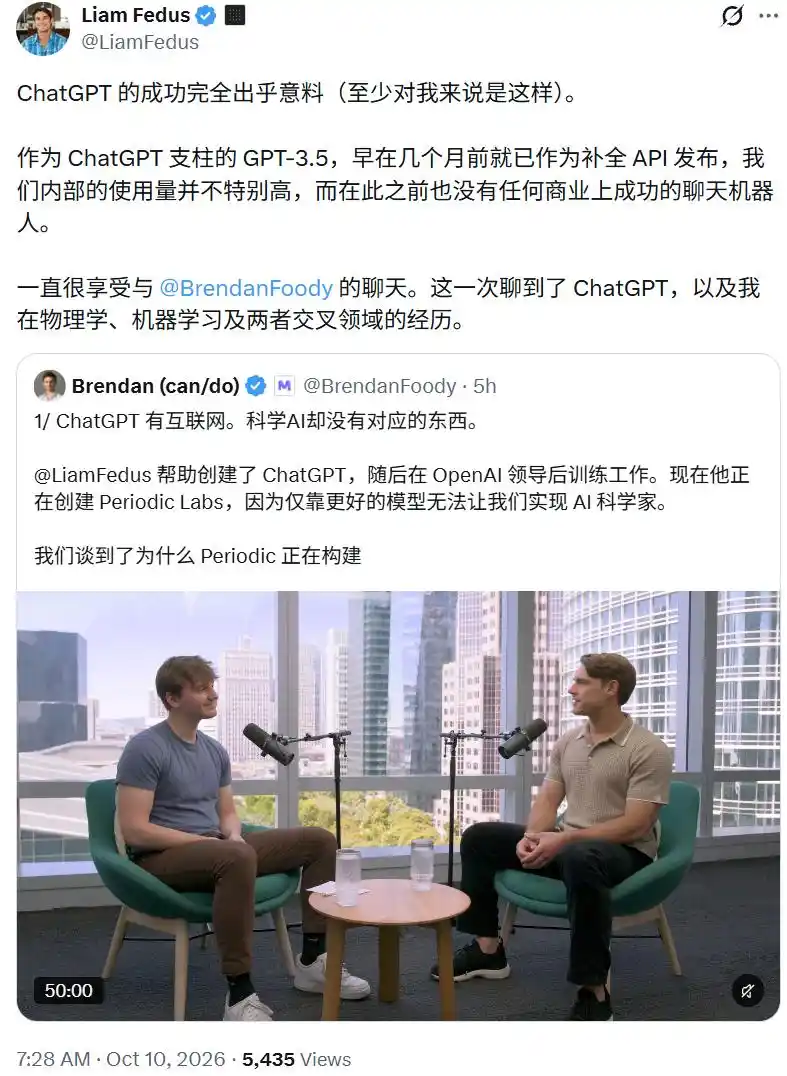
In a 50-minute conversation with host Brendan Foody, founder of Mercor, he recounted the internal details around ChatGPT's creation, explained why ChatGPT and AI programming were the first to achieve breakthroughs, and clarified why building Periodic Labs was an absolute necessity.
From Rural Maine to ChatGPT: A Physicist's Detour
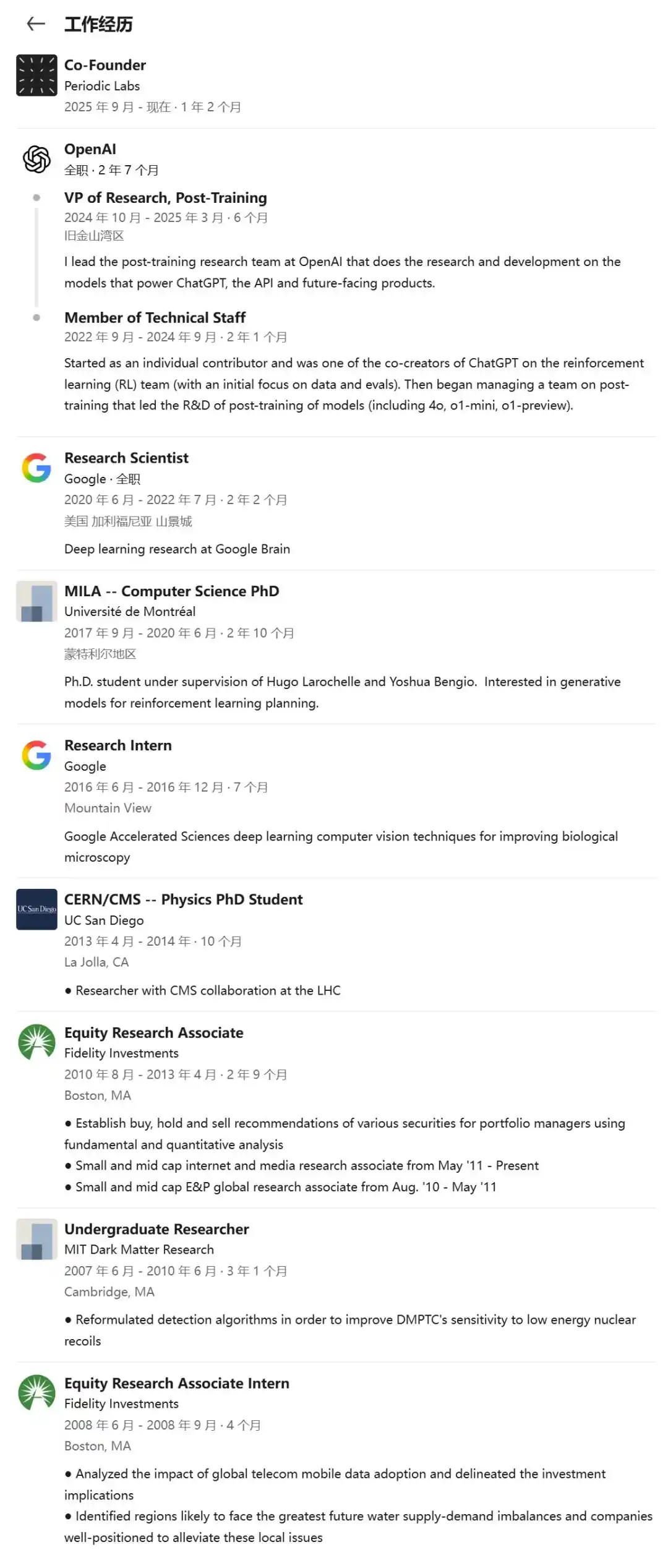
Fedus grew up in the countryside of Maine. He recalls a school assignment called 'Science in the News' where students had to write about local scientific news. However, there was hardly any technical progress to report from rural newspapers, so he turned to the internet for material and was captivated by a physics website. In college, he wavered between physics, chemistry, and economics, ultimately choosing physics because it was 'fundamental enough.'
While studying physics at MIT, he participated in a dark matter detection project called DMTPC. According to one theory, dark matter signals would show directional variations over time, and the team hoped to build more sensitive detectors based on this.
It was also here that he first encountered a machine learning problem: inferring a particle's direction and energy from the detector's raw data was essentially a machine learning task. He later briefly entered the finance industry before pursuing particle physics at UC San Diego, participating in particle track reconstruction at CERN, where the same problem reappeared. 'I realized that to push the frontiers of machine learning, I needed to be at the institutions at the frontier.'
The turning point came during the heyday of Generative Adversarial Networks (GANs). Fedus tried applying GANs to language generation but found it doubly difficult: GANs themselves were unstable and prone to mode collapse, and the generator produced discrete tokens, making it impossible for the discriminator's gradient to directly backpropagate. Thus, 'you had all the problems of GANs and all the problems of reinforcement learning at the same time.'
He emailed Ian Goodfellow, then a Google researcher, about this, and the reply convinced him to join these pioneers.
In 2016, he joined Google Accelerated Sciences as an intern, using convolutional networks to study yeast cell replication and division. He later joined Google Brain and completed his Ph.D. in Computer Science at Mila under Yoshua Bengio and Hugo Larochelle.
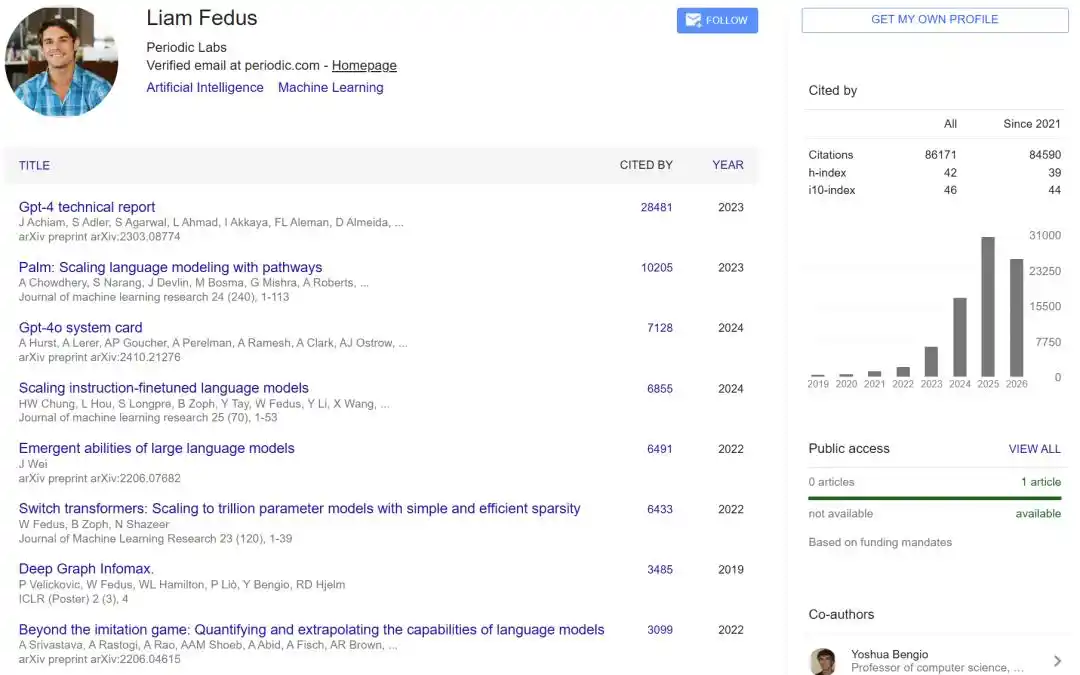
At Google Brain, Fedus collaborated with Barret Zoph and Noam Shazeer to propose the Switch Transformer, scaling the Mixture of Experts (MoE) architecture to trillion-parameter levels. This work later became an important reference for open-source MoE models.
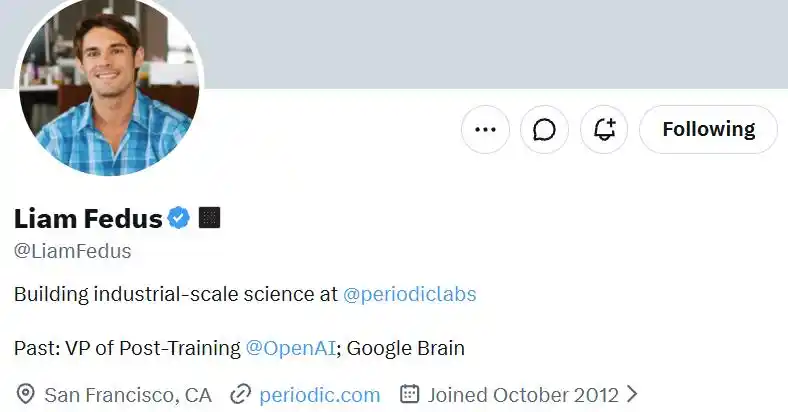
He joined OpenAI in 2022, helping to create ChatGPT. In October 2024, he succeeded Barret Zoph to lead the post-training team, and left to start his own venture in March 2025.
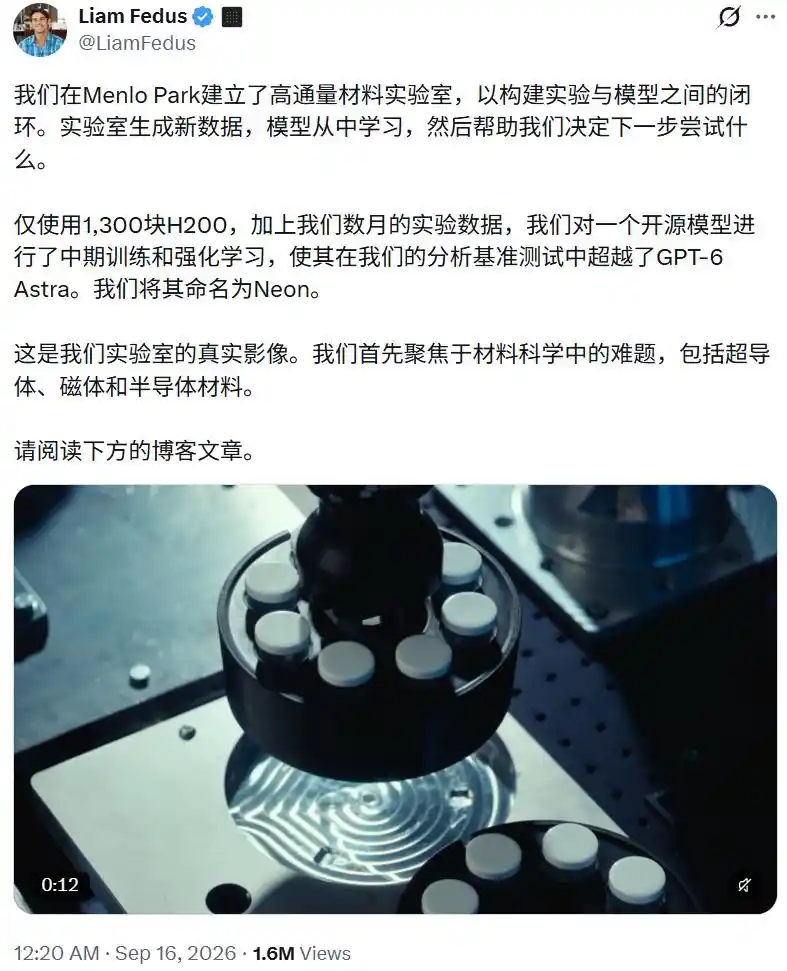
The company he founded, Periodic Labs, has another co-founder, Ekin Dogus Cubuk. The two met nearly a decade ago at Google Brain. Cubuk later led the chemistry and materials team at DeepMind and is an author of the GNoME paper, a project that in 2023 predicted a large number of new stable crystal structures. In 2025, Periodic Labs emerged from stealth with a $300 million seed round from investors including a16z, DST, NVentures (under NVIDIA), Accel, and individuals like Jeff Bezos, Eric Schmidt, and Jeff Dean.
In mid-September this year, Periodic released its first model, Periodic Neon, a roughly 1-trillion-parameter model post-trained on data from its own lab, designed to interpret X-ray diffraction patterns. The company claims it outperforms GPT-6 Astra on its internal benchmarks, though this result is currently self-reported.
ChatGPT Almost Became a Meeting Robot
On Fedus's first day at OpenAI, Greg Brockman showed the new hires the freshly trained GPT-4. 'It was about a year and a half ahead of any system I had seen.' But he also admitted that GPT-4 still made mistakes common to other language models: it hallucinated and couldn't solve math problems. It was clearly a huge leap forward, but no one knew how to turn it into something valuable for the world.
With about six months left until GPT-4's planned release, the team discussed various product forms, including writing assistants, coding assistants, and a meeting robot—a favorite of some—that would sit in conferencing software to take notes and assign tasks. The host joked that if they had actually built the meeting robot, the world would be very different. Ultimately, John Schulman made the call, insisting on maintaining generality and building a chatbot.
Interestingly, early internal signals weren't optimistic. Fedus estimates that among friends and family who got early access to GPT-4, about 90% didn't really care. As a researcher focused on architecture, he initially saw this as a negative signal. 'But in retrospect, there was actually a very positive signal hidden here: 5% to 10% of people really loved it and used it every day. Every time we pushed an update, they would complain, "I preferred the previous version."'
Even more surprising is that the ChatGPT that took the world by storm wasn't even GPT-4, but GPT-3.5, which had been available via API for several months. The real variable was the product form: it changed from a 'completion' interface to a 'conversation' interface.
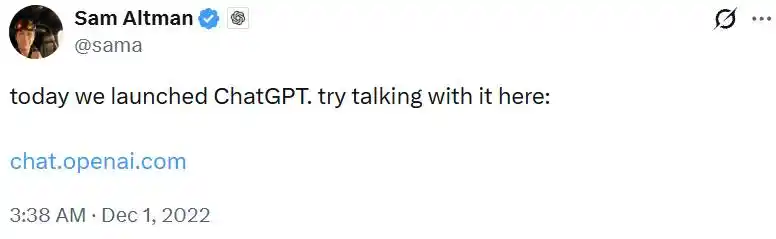
Fedus gave an example: in completion mode, to get the model to write a poem in a certain style, you had to start with something like 'A recently discovered lost poem by a famous writer begins as follows:'. In conversation mode, you could simply say 'Please help me write a poem in this style.' 'It's a small thing, but it feels very natural.' Beyond that, it was about doing a lot of tedious detail work around supervised fine-tuning and RLHF. 'Everything ultimately comes back to the data; we were constantly looking at the data.'
When the team internally voted to predict ChatGPT's user numbers, guesses ranged from 10,000, 50,000, with the boldest guess being 1 million. 'We originally just wanted to do a low-key research preview, publish a blog post, and maybe have 10,000 researchers try it out.' The result was chaos. 'All the dashboards were red.' In the summer of 2023, usage dropped, and the team faced a 'survival crisis,' fearing ChatGPT's popularity was over. They later realized: it was just students on summer break.
When You're Too Close to the Technology, You Only See Its Flaws
During his later tenure at OpenAI leading the post-training team, one of the works Fedus was most proud of was bringing reasoning models into chat scenarios.
Reasoning models excel at math and programming, but making them suitable for everyday conversation wasn't easy. 'If you just ask 'How are you?' and the model thinks for three minutes, that's clearly not a good user experience.' The team needed to manage the dynamic boundary of thinking and design different reasoning strategies for different domains. The reasoning method for solving a math problem is completely different from that for composing an article.
Another achievement that satisfied him was the data flywheel: how to use user feedback to continuously improve the system. He strongly agreed with OpenAI's consistent philosophy of iterative deployment—engaging with reality and closing the feedback loop as quickly as possible. 'Letting the world gradually adapt to what's coming, while figuring out where the system might fail.' In his view, establishing predictable scaling laws based on user feedback was a significant achievement for the team.
When asked about his first impression of GPT-4, Fedus said something characteristic of a researcher: 'When you're too close to the technology, you only see its flaws.' Researchers don't celebrate a model getting 80% of questions right; they focus on the evaluations, asking why it couldn't solve a certain math problem or follow a summary instruction. Early on, everyone kept their own private 'hand-feel' test questions. He had one quantum mechanics question that all previous models answered poorly until the reasoning model appeared and started getting it right. 'I was truly amazed; it showed very interesting properties, like self-correction.'
Why Chat and Programming Broke Through First
The host raised a key question: Over the past few years, there have been two real breakthroughs: ChatGPT and AI Programming.
Why these two fields specifically? What's missing for the physical world to see a similar breakthrough?
Fedus's answer was that ChatGPT relied on a sufficiently strong pre-trained foundation model and RLHF.
He believed ChatGPT couldn't have succeeded with technology at the GPT-3 level. GPT-3.5's ability to compress the distribution of internet data was much stronger, providing a better foundation for subsequent fine-tuning and reinforcement learning. RLHF distilled human preferences into the neural network, providing a good optimization signal. But it had a fundamental limitation: reward models trained on 'Do you prefer answer A or B?' are not sensitive to correctness—whether mathematical, code, or factual accuracy. 'What they encode is actually style, intent, and form.' ChatGPT doesn't need to be perfect at everything; it just needs to cross the threshold of product-market fit.
Programming is different. Today's AI programming agents spend significant compute on long-chain reasoning, interacting with the environment, and constantly adjusting based on failures and new evidence. This requires strong verifiability and error-correction capabilities. Test-time computation plus verifiable rewards are the real keys to unlocking programming ability. The host added that programming also has GitHub, a vast repository of human knowledge containing a wealth of unit tests, something most scientific and knowledge work fields lack.
Fedus used AlphaFold as an example: its success was built on decades of accumulated protein structure data. 'Machine learning systems aren't magic; you train them on what data and for what tasks, and that's what they become good at.' And materials science is precisely an area severely lacking good data. Experimental data online is very noisy; two research groups doing the same experiment might get different conclusions. Papers often omit key details; a sentence like 'We synthesized this material' hides millions of degrees of freedom. More critically, there are almost no negative results. 'Everything you see online succeeded, which is obviously a highly biased data distribution.'
'To Build an AI Scientist, You Must Actually Do Science'
This is the fundamental reason Periodic Labs must build a lab. Fedus envisioned a scenario: even if you had a superintelligent system capable of surveying the entire frontier of human knowledge, judging which knowledge is self-consistent, discarding which claims, running some simulations, and arriving at several hypotheses about the world, 'but without the ability to put ideas into practice, you're stuck at thinking.' To collapse multiple possibilities into a single truth, you must conduct experiments.
Periodic's approach combines three technical paths: the reasoning capabilities of language models, computational physics simulation, and high-throughput laboratories.

Fedus recalled that when discussing GNoME with Cubuk, they found that system used active learning but didn't use language models at all. The two agreed that these things should have been combined. They chose materials discovery as the entry point because materials are foundational to all advanced industries like semiconductors, aerospace, and energy; the iteration cycle is relatively fast; the signal-to-noise ratio is acceptable; and there are mature simulators for many materials already.
'To create an AI scientist, you must actually do science.' Fedus said. AI systems can learn from the internet, run physics simulations, and build a hypothesis space about which atomic configurations are stable and might have what properties. But ultimately, they must be validated in the lab in Menlo Park, obtain negative results, calibrate the feedback data, and cross-reference it with simulations and published literature. 'We believe there's no room for compromise on this point.'
The method of data collection also evolved through trial and error. What they care about most is the complete context: what the hypothesis was, how the experiment was conducted, and what the results were. A physics simulation dataset from twenty years ago is almost useless on its own because you don't know its intent or whether it represents a positive or negative result. The team initially even tried having scientists wear GoPros while moving around the lab, 'but they didn't really like that,' and later switched to simpler methods like audio logs and uploading lab notebooks.
An unexpected discovery was that shortly after setting up the small-scale lab, the team quickly hit an intelligence bottleneck. 'Scientists and engineers told us: we can't possibly understand this much data; we need help.' In Fedus's view, AI makes a research paradigm closer to the scale of machine learning possible, and the data collection itself must be intelligent enough. 'If your data collection is clumsy and misses things, the next generation of AI will be blind to that part.'
When asked how many labs there might be in the future, his answer was 'easily reaching several dozen.' The current lab isn't capable of serious alloy or polymer research. Different physical domains require different experimental conditions, but the experience in orchestrating labs, identifying bad data, and deploying intelligence across machines is transferable.
Superconductors, Nuclear Fusion, and Moore's Law
Periodic's long-term goal, in Fedus's words, is 'intentionally understanding and designing matter,' and new types of superconductors are among the most important targets, benefiting medical devices, maglev trains, and lossless power transmission.
He specifically clarified that whether room-temperature superconductivity is physically possible remains unproven. 'We are searching for it, and I think this is one of the best opportunities humanity has ever had for this.' But it doesn't have to reach room temperature to be valuable: as long as the critical temperature is significantly above the liquid nitrogen range, coupled with properties like good ductility, ease of manufacture, and lower reliance on rare earths, it would have a huge impact on nuclear fusion reactors, which rely on superconductors to create powerful magnets.
When asked how far away commercial nuclear fusion is, he said based on the evidence he's seen, 'it seems very possible within the next seven years or so.' He added: 'Capital and technology are intertwined; the pace of technological progress isn't a fixed constant; it largely depends on how many resources society invests.'
If energy becomes cheap enough, the nature of many problems changes. Fedus used climate change as an example: from a purely engineering perspective, too much carbon dioxide in the atmosphere is essentially an energy problem. Once energy is extremely cheap, past public externalities can be internalized and solved within the economic system.
However, the most exciting impact for him is computing itself. 'Computing is fundamentally a physical process.' As society invests more capital into data centers, if future material bottlenecks can be eliminated five years ahead, allowing Moore's Law to continue, AI progress can keep advancing. He also mentioned that Musk often talks about material challenges like rocket heat shields. Looking around, 'we are everywhere limited by the materials we have.'
Data vs. Compute, and the Future of Work
Regarding the common question 'Should money be invested in data or compute?', Fedus returned to Scaling Laws: when other variables are unconstrained, loss predictably decreases with increases in compute, data, and parameters. The key is which constraint you're under—compute or data. If certain domains crucial for downstream tasks are severely underrepresented in pre-training corpora and existing RL task distributions, investing in data yields much higher returns. He believes every company should strive to make performance gains from data as predictable as those from compute.
The host then asked about the future of expert data. Fedus believes demand will only grow because many critical, economically valuable datasets are still severely lacking, and 'work itself across various industries is constantly evolving; it's not like taking a snapshot of a profession in 2026 solves the problem once and for all.' He expects the industry to remain highly dependent on such data for at least the next decade.
Discussing AI's impact on employment, Fedus brought up Geoffrey Hinton's earlier prediction that radiologists would be significantly reduced, whereas in reality, radiologists are still being hired in large numbers because the job involves much more than just reading scans.
He used software engineers as an analogy: if you compare a 2020 engineer's time allocation chart with today's models, models might already handle 80% to 90% of those tasks; by that standard, 'we've already achieved AGI.' But the nature of work keeps changing; engineers now spend more time on cross-functional collaboration and ensuring designs meet expectations.
He predicts that as intelligence becomes increasingly commoditized, 'things between people' will become increasingly important.
As for what the world will look like in ten years, this researcher who witnessed the ChatGPT explosion declined to give specific predictions. 'Ten years is a very long time. Think back to 2016; Transformers hadn't even been born then.' He only expressed general optimism about the future and agreed with Dario Amodei's notion of a 'republic of geniuses in data centers.'
Conclusion
Placing Fedus's conversation against the backdrop of the 722 mathematical manuscripts yields an interesting contrast. Mathematics has Lean, peer review, and proofs that can be checked line by line by a compiler. Yet, even so, the outside world demands 'reproduce first, acknowledge later' regarding OpenAI's achievements. In the worlds of materials, chemistry, and physics, there isn't even such a ready-made referee; the only final verdict comes from real experiments.
In a research blog, Periodic summarized this idea as 'Nature is our learning environment.' The company is betting that after internet corpora are nearly exhausted, it can dig a well of data that keeps flowing for AI. Whether it can deliver depends on whether the lab can translate massive capital into reproducible physical discoveries. But at least one point Fedus made is clear: On the path to an AI scientist, thinking alone is not enough.
This article is from the WeChat public account "Almost Human" (ID: almosthuman2014), author: Panda