- According to Chainalysis, the crypto economy of North America exceeded $3 trillion.
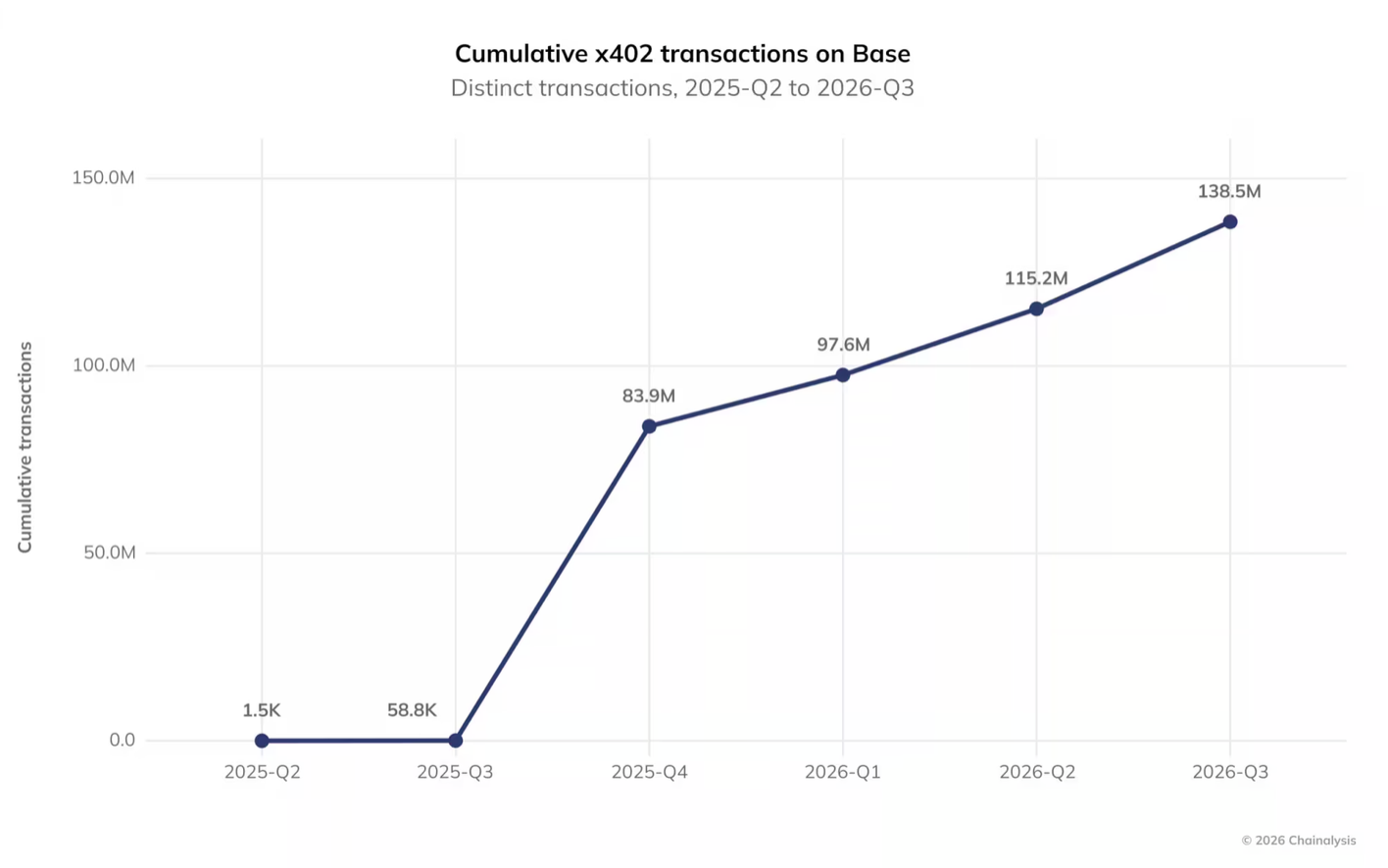
- At the same time, AI agents conducted over 138 million transactions on Base.
- Analysts also recorded an increase in crypto transfers from Canada to $2.36 billion.
According to a report by analytics firm Chainalysis, the crypto economy of North America for the 12 months ending July 1, 2026, amounted to $3.02 trillion, maintaining its position as the most influential region in the global crypto market. Despite a contraction in the US market, AI agents are increasingly using cryptocurrencies for autonomous payments, while stablecoins and tokenized assets are strengthening the US role in global finance.
The combined indicator for the US and Canada decreased by 1.9% compared to the previous reporting period. However, the dynamics of the two countries differed: the US crypto economy contracted by 2.2% to $2.78 trillion, while Canada's grew by 2.3% to $247.7 billion.
"Much of what we see compared to 2025 is due to industry maturity. Infrastructure elements created in 2025 are turning into products with real users, liquidity, and markets in 2026," noted Hoolie Tejwani, Head of Coinbase Ventures.
AI Agents Conducted Over 138 Million On-Chain Transactions
One of the main development directions has been agentic commerce — a model where AI agents independently pay for goods and services using cryptocurrencies. According to Chainalysis, by the end of the reporting period, over 138 million transactions occurred on the Base network via the x402 protocol, created by Coinbase for on-chain payments between programs and services.
The advantage of such payments is the ability to conduct microtransactions that are economically unfeasible for traditional payment systems. Over 87% of x402 payments during the studied 16-month period ranged from $0.0001 to $0.10, with the most common amounts falling within the one to ten cent range.
Circle, the issuer of $USDC, describes the role distribution as follows:
"Card payment systems are for agent payments initiated by consumers, stablecoins are for machine-to-machine settlements where amounts are too small for the card payment economy."
Analysts also recorded signs that the protocol's use is moving beyond experiments:
- the share of wallets that received a refill within 30 days increased from 70.6% among wallets first funded in Q3 2025 to 89.3% for the group from Q2 2026;
- the median interval between a wallet's first funding and its first payment via x402 decreased from 73 days at the end of 2025 to 18 minutes in Q3 2026;
- the share of wallets that made their first payment within an hour of funding increased from 4% in Q3 2025 to 67% in Q3 2026.
AI agents primarily spend funds on machine-readable information: code analysis, financial analytics, search and data APIs. They also pay for agent development tools, gaming services, and AI model computations.
The US dominates this segment: US wallets account for 30% of geolocated transactions between agents and services. Furthermore, they facilitate 88.1% of payments for AI model computations, 41.8% of payments for agent tools and directories, and 23.2% of payments for data and search APIs.
"AI agents are becoming economic participants, where each agent essentially is a new 'user' of the blockchain," said Tejwani.
US Exports Digital Dollars, While Canada Develops P2P Payments
According to Chainalysis's assessment, the US remains the leading exporter of digital dollars, while Bitcoin is increasingly being accumulated by US investors and institutions. In 2026, the country became a net importer of Bitcoin in terms of cumulative cross-border flows for the first time since 2022. Transfers exceeding $10 million accounted for the inflow of 53,200 BTC.
Simultaneously, 99.1% of the trading volume in stablecoin order books was for dollar-pegged tokens. According to Circle, as of the end of the quarter, $73.3 billion of $USDC was in circulation — 19% more than a year earlier, while the quarterly on-chain transaction volume for the token reached $14.8 trillion.
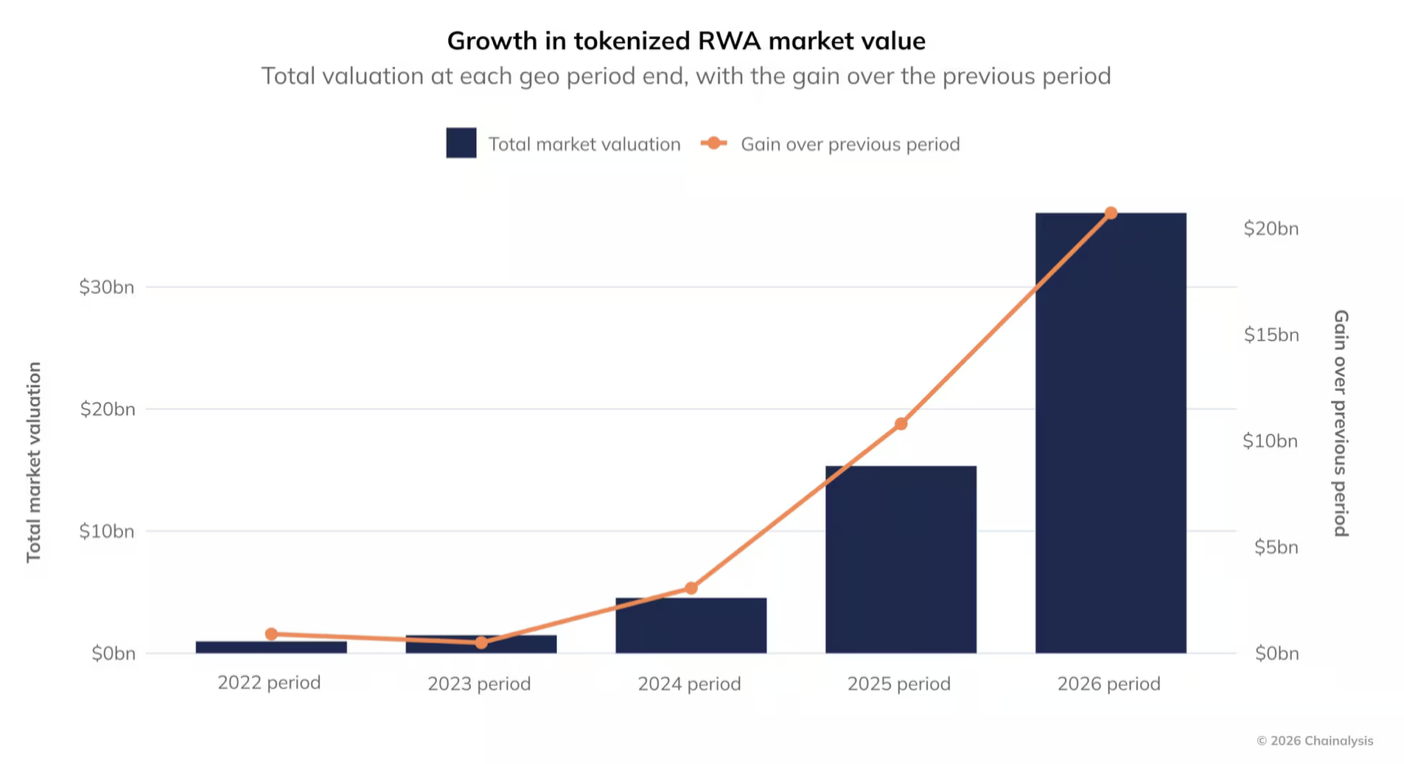
The US also dominates the tokenization of real-world assets (RWA). In Q2 2026, the global RWA market reached $36.07 billion, growing by 135% over the reporting period. The largest category was US government bonds — $15.42 billion, or 42.8% of the total value of tokenized assets.
Notably, Wintermute named RWA a potential driver of the next crypto market bull cycle.
Canada, in turn, demonstrated growth in P2P crypto economy. According to Chainalysis, stablecoins accounted for 44% of the trading volume in Canadian dollar-denominated order books, compared to 30% a year earlier. However, the dominance of dollar-denominated tokens creates a risk of increased dependence on the US financial system.
"This is a trend that Canadian policymakers are watching closely," said Morva Rohani, Executive Director of the Canadian Web3 Council, commenting on the growing popularity of dollar-denominated stablecoins.
An individual driver for the Canadian market has been international transfers. Transfers of stablecoins and Bitcoin from Canada to India, China, and the Philippines during the reporting period reached $2.36 billion — a 141% increase year-over-year. There were 3.56 million transactions with an average amount of $663.
According to Rohani, about 23% of Canada's population was born abroad — the highest share among G7 countries. This demographic structure could facilitate the use of cryptocurrencies for regular international remittances, especially considering that the average cost of a traditional money transfer from Canada is about 6.7%, whereas a stablecoin settlement may cost a cent or less.
In summary, Chainalysis notes a general trend: US companies are creating infrastructure for on-chain payments, stablecoins, and tokenized assets, while a significant portion of demand is formed outside the US. At the same time, the development of alternative stablecoins and national regulatory frameworks in the EU, Singapore, Hong Kong, and Canada indicates attempts by other markets to reduce dependence on dollar-based infrastructure.
Earlier we reported that the South Korean crypto market became the leader in East Asia thanks to AI tokens.