Capital starting to rotate back to crypto from AI: Raoul Pal

cointelegraphPublished on 2026-10-07Last updated on 2026-10-07

Abstract

Capital may be rotating from AI back into crypto as a weakening US dollar could provide a "green light" for the industry's rally, says Real Vision founder Raoul Pal. He notes that high bond yields and a strong dollar have constrained liquidity, but a weaker dollar could improve conditions. Pal observes that recent pauses in the AI trade, evidenced by Nvidia's stock decline during Bitcoin's August surge, allowed capital to flow into crypto. However, a full AI crash would be detrimental, signaling a liquidity drain. For crypto's continued rise, Pal prefers a scenario of a weaker dollar, steeper yield curve, and expanded money supply. Alternatively, sideways-trading AI stocks could also enable capital rotation into crypto. Regarding AI's impact, Pal suggests AI agents could increase economic activity on smart contract platforms like Ethereum and Solana by using them for transactions and potentially raising funds via token issuance. While enthusiastic about both networks, Pal is cautious about Solana overtaking Ethereum in market cap, citing Ethereum's greater "economic density"—more capital per user—as Solana's activity currently involves smaller, more speculative amounts. He refrains from specific price targets but suggests Bitcoin reaching $1 million by 2032 reflects broader adoption trends.

A weakening US dollar could give crypto the “green light” and help extend the industry’s rally, says Real Vision founder Raoul Pal.

He tells Cointelegraph on the latest episode of Trade Secrets that higher bond yields and the strong dollar are keeping liquidity from flowing freely.

“If they can engineer the dollar lower, then we get a green light for further movement in crypto,” he says. “I don’t want to get overly excited, so I haven’t got a full green light on everything.”
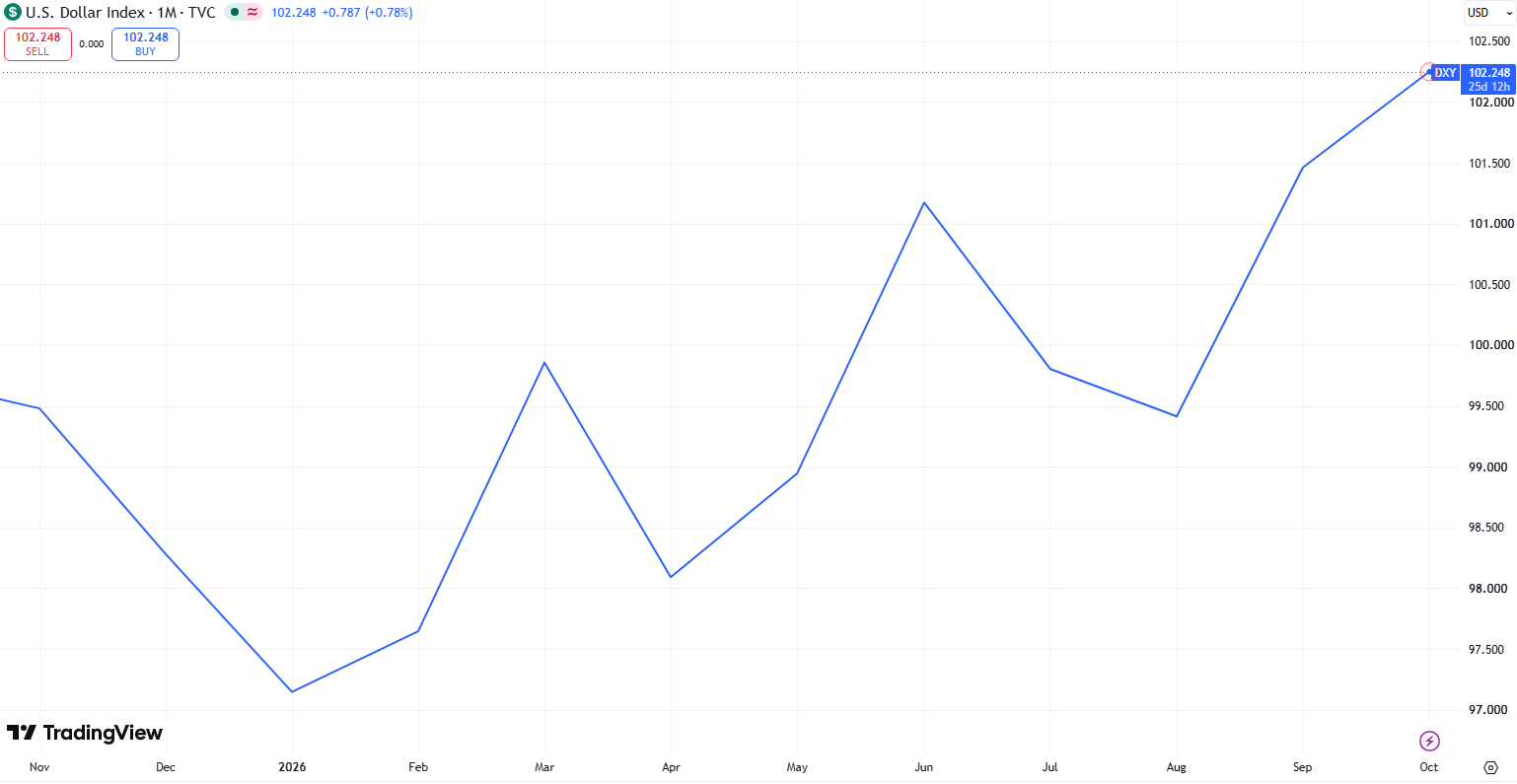
The US Dollar Index has been trading at the year’s highest levels. Source: TradingView


However he believes Bitcoin will miss out of much of the crypto economic activity generated by AI agents, which is likely to flow to smart contract platforms like Ethereum and Solana.

Related: El Salvador receives $138 million from IMF after Bitcoin waivers granted

Pal is among the most experienced high profile crypto analysts, having worked in hedge fund sales at Goldman Sachs in Europe and co-managed a global macro fund at GLG Partners. He launched the research platform Global Macro Investor in 2005 and co-founded financial media Real Vision in 2014.

Pal says he first bought Bitcoin in 2013, after applying a gold-based valuation framework to the cryptocurrency.

An AI pause could help crypto catch up

Bitcoin’s cycle recovery arguably came between Aug. 19 and Aug. 25 when BTC rose about 25% to $80,000. Interestingly, over that period, AI bellwether stock Nvidia notched up seven consecutive losing sessions.

Pal says pauses in the AI trade have allowed capital to rotate into crypto.

“You can tell there’s this sort of rotation for liquidity that’s around right now, which means it’s not abundant yet,” he says.
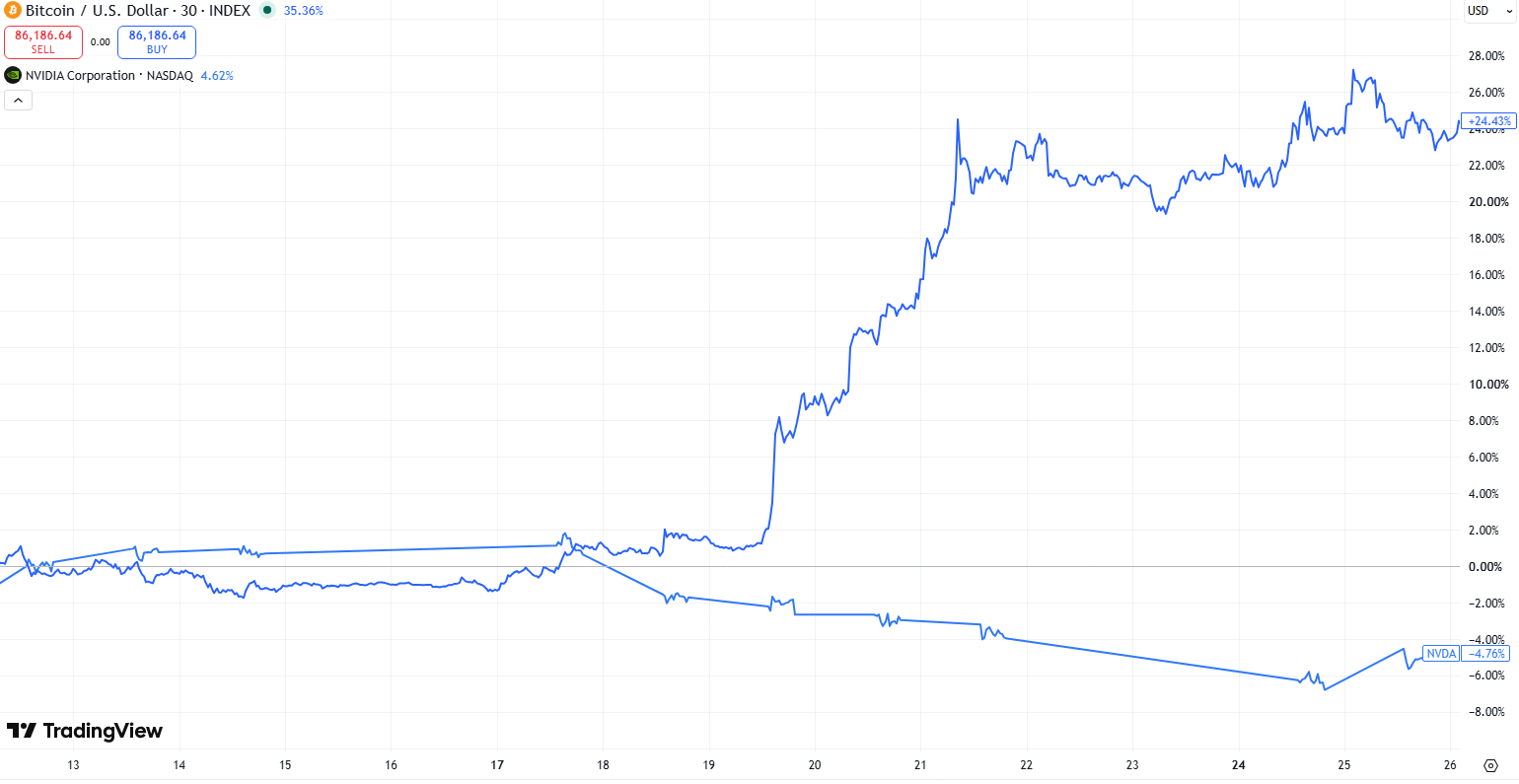
Bitcoin rallied while Nvidia shares fell in August. Source: TradingView

While AI has been competing with crypto for funds, an AI crash would be an unwelcome prospect, as a bursting bubble would indicate that liquidity is being “sucked out of the system,” while threatening the conditions crypto needs to rise.

“Things don’t go bust if liquidity is plentiful,” Pal says.

His preferred outcome would be a weaker dollar, a steeper yield curve and banks expanding the money supply through increased lending.

However, borrowing costs have been moving higher. The US 10-year Treasury yield climbed to 5.29% in September, while the Fed raised its benchmark rate by a quarter-point.

If those conditions don’t materialize, Pal’s “second best scenario” is for AI stocks to trade sideways, which would allow capital to rotate into crypto.

AI agents could bring more business to Ethereum and Solana

AI agents can now pay to access web content using stablecoins through a feature that Amazon Web Services introduced in June. Coinbase handles payment verification and settlement through its x402 protocol, with USDC on Base among the supported payment options.

Pal says agents could eventually raise the money they need to operate, by issuing tokens to fund projects that could last “a week, a month, a year,” then carrying out the work and generating returns.

He says Ethereum and Solana could attract more activity as software uses their smart contracts to transact.

“My guess is they’ll get more adoption over time as AI uses them,” he says.

Related: Coinbase’s AI payments protocol x402 launches app store for AI agents

Solana needs more than activity to overtake Ethereum

Ethereum’s greater concentration of capital makes Pal cautious about claims Solana will overtake it in market value, despite his enthusiasm for both networks.

Multicoin Capital co-founder Kyle Samani predicted on Trade Secrets last month that SOL would surpass Ether’s market capitalization “this market cycle.”

Samani “needs to hold his horses a little bit,” Pal says, even though he acknowledged that it is possible.

The networks are ahead of each other on different metrics. Solana recorded around 3.2 million active addresses over the preceding 24 hours on Monday, compared with Ethereum’s 387,000, according to DefiLlama. But Ethereum has about $54.4 billion in decentralized finance protocols, which is far ahead of Solana’s $6.7 billion.

Pal compares the networks using what he calls “economic density,” dividing total value locked by active users. He says Ethereum attracts more capital relative to its user count, and Solana’s activity involves smaller amounts.

“Solana’s core activity is speculation,” he says. “It’s just smaller clip sizes.”

Pal says he has stopped giving public price targets because his forecasts get clipped and recirculated online. He describes million-dollar Bitcoin by 2030 as a “meme” reflecting growing adoption, ETF interest and Bitcoin’s use as collateral.

“Does it make a million bucks? I don’t know, but certainly by 2032, yeah, I don’t have an issue with that.”

Magazine: Former SEC boss made AI Czar, Bitcoin may hit $600K this cycle: Hodler’s Digest

Related Questions

QAccording to Raoul Pal, what condition could give crypto the 'green light' for further movement?

AA weakening US dollar could give crypto the 'green light' for further movement, as higher bond yields and a strong dollar have been keeping liquidity from flowing freely.

QWhat recent market event does Pal suggest allowed capital to rotate from AI into crypto?

AA pause in the AI trade, specifically when Nvidia stock had seven consecutive losing sessions between August 19 and 25 while Bitcoin rallied about 25%, allowed capital to rotate into crypto.

QWhy does Pal believe Bitcoin will miss out on much of the crypto economic activity generated by AI agents?

APal believes the economic activity generated by AI agents is likely to flow to smart contract platforms like Ethereum and Solana, implying Bitcoin's functionality is less suited for this specific type of activity.

QWhat is Raoul Pal's 'second best scenario' for crypto if his preferred conditions of a weaker dollar and steeper yield curve don't materialize?

AHis 'second best scenario' is for AI stocks to trade sideways, which would allow capital to rotate into the crypto sector.

QWhat metric does Pal use to compare Ethereum and Solana, and what does it reveal about their differences?

APal uses 'economic density,' dividing total value locked by active users. He says this shows Ethereum attracts more capital relative to its user count, while Solana's activity involves smaller amounts and is more focused on speculation.

Related Reads

Mercado Bitcoin begins post-hack reopening without a timeline for withdrawals

Mercado Bitcoin, one of Brazil's largest crypto exchanges, began restoring read-only access to customer accounts in phases on Monday, a week after attackers drained an estimated $49 million from the platform. Access started at 19:00 UTC, with all accounts expected to be viewable by 21:00 UTC, showing holdings as they stood on Nov. 2, the day of the hack. The exchange has yet to say when customers will be able to withdraw funds. Fabricio Tota, vice president of new business, said the exchange hoped read-only access would reassure customers that their assets were still recorded on the platform. He explained that the company opted for "a more conservative approach" to reactivating accounts "to ensure our return happens with the utmost security." The caution follows concerns from blockchain security analysts that attackers were able to access addresses, draining funds through standard transfers rather than a smart contract exploit. Blockchain analysts traced some of the stolen funds to customer deposit addresses, but Mercado Bitcoin says customers won't bear the losses. Tota said the vast majority of assets were never even touched by anyone and were not involved in the incident. On Nov. 4, Mercado Bitcoin pledged to cover all losses with company funds, bolstered by a $20 million investment from stablecoin issuer Tether in July. Tota highlighted that a portion of the stolen funds were also frozen in the hours after the company announced the attack. The next phase of recovery will require users to confirm their registration details before they can move funds. The exchange plans to restore withdrawals via Pix, Brazil's instant payment system, initially allowing customers to withdraw only to accounts in their own name. Tota gave no date for either step. Mercado Bitcoin has yet to explain how the attackers gained access to its wallets. Blockchain data company Bitquery found that as of Nov. 4, wallets linked to the attacker held most of the stolen funds that had escaped freezes, including 106.07 BTC.

cointelegraph4h ago

Mercado Bitcoin begins post-hack reopening without a timeline for withdrawals

cointelegraph4h ago

Avalanche’s AVAX leads crypto gains following NYSE tokenization deal

Avalanche's AVAX token rose as much as 10% on Monday, becoming the top gainer among the 100 largest cryptocurrencies, after the New York Stock Exchange announced plans to use Avalanche's blockchain to settle trades on a new platform for trading tokenized stocks around the clock. AVAX later eased to $8.86, still up over 8% on the day, with a market cap of around $3.95 billion and $439.7 million traded in the past 24 hours. Avalanche's total value locked stands at $633 million, up 4% over the past day. NYSE's head of digital issuance, Dennis Lee, said the exchange is examining how blockchain technology can expand its equities offerings and is picking the right technology for each job. The deal underscores Wall Street's growing effort to use blockchain to make stock trading faster and enable trading outside regular market hours; traditional US markets are open 9:30 am to 4:00 pm EST on weekdays, with trades often taking at least one business day to settle. The NYSE first announced plans for the platform in January, and Ava Labs revealed in September that the exchange had spent about a year testing Avalanche, though the final selection was not confirmed until Monday. Avalanche will record stock trades and help complete transactions on the platform, which will let investors buy and sell digital versions of stocks across different blockchains. Lee said the settlement ledger needs to be fast, reliable, permissioned, cost-predictable, and backed by a large developer community—all of which Avalanche meets. The platform could launch before the end of 2026 pending regulatory approval. Ava Labs chief business officer John Nahas said first conversations with the NYSE began nearly a year ago and called it an important step toward blockchain becoming foundational financial infrastructure. The news comes as other major firms invest in blockchain for faster, round-the-clock trading: Nasdaq plans to invest $100 million in Kraken's parent Payward to launch tokenized stocks by Q2 2027, and the DTCC launched a service in October allowing firms to turn traditional securities into digital tokens. The NYSE deal follows other efforts to bring traditional assets onto Avalanche, including Progmat moving over 452 billion yen in digital securities onto a dedicated Avalanche blockchain in July and Aave Labs' plans for a lending service using tokenized assets as collateral.

cointelegraph5h ago

Avalanche’s AVAX leads crypto gains following NYSE tokenization deal

cointelegraph5h ago

Trading

Spot
活动图片




