Author: Aleks Larsen, General Partner at Blockchain Capital
Compiled by: Chopper, Foresight News
The financial industry has long grappled with the high costs of asset encapsulation. Each asset class exists in its own vessel, operating within its own system: a mortgage loan is an amalgamation of countless contracts, PDF files, databases, and service agreements; a private equity fund share corresponds to a subscription agreement and a line entry in a transfer agent's spreadsheet; stock holdings are dispersed across the ledger chains of brokerages, custodians, and depositories. Such examples are endless.
When assets transfer between institutions, they often require disassembly for verification, reconciliation, and clearing, before being repackaged to fit the recipient's system. The root cause of this massive redundancy is that different institutions maintain independent data records for the same underlying asset or the same financial entitlement.
Globally, this market fragmentation incurs enormous hidden societal costs. The global balance sheet holds vast assets, but the vast majority incur bespoke operational costs to flow freely across institutions. This friction impedes the redirection of capital towards emerging companies, infrastructure projects, residential real estate, and other productive sectors.
Tokenization addresses this pain point at its source. Tokens endow assets or financial entitlements with a standardized, machine-readable interface. Once assets are recognizable and callable within a shared network, exchanges, lending platforms, custodians, asset servicers, and applications can interface directly with the assets, eliminating the need to repeatedly build entire financial infrastructure from scratch. Ultimately, capital markets will operate on a common, programmable infrastructure, drastically reducing the friction costs associated with asset transfer, settlement, and monetization.
To understand the logic of how tokenization reshapes the world, the shipping container provides the most apt analogy.
How Containers Catalyzed the Modern Global Supply Chain
Before the 1960s, cargo came in countless forms: coffee in burlap sacks, machinery in wooden crates, cotton in bales, crude oil in barrels. Each commodity had its own specific loading and unloading requirements, and all cargo was handled manually on the docks. Skilled dockworkers possessed specialized techniques for tight packing, weight balancing, and securing goods to prevent shifting and damage during sea voyages. This cumbersome process existed fundamentally because global trade lacked a uniform loading container. A direct consequence was that ships spent more time docked in ports than sailing at sea. Breakbulk cargo was repeatedly transferred, reloaded, and counted between ships, trucks, trains, and warehouses, with frequent issues of damage, loss, and theft.
In 1956, North Carolina shipping entrepreneur Malcolm McLean modified a tanker, the 'Ideal-X,' sailing from Newark to Houston, loaded with standardized containers. Upon arrival, trucks could haul away the containers without needing to open them. The per-ton loading cost of the Ideal-X was far lower than traditional breakbulk handling, marking the birth of the modern shipping container.
Over the next two decades, containers became standardized under ISO norms, and the entire supply chain was reorganized around the box, with each link specializing. Ships were designed with vertical cells to safely stack containers; cranes were retrofitted into high-speed lifting machines adapted for standardized boxes; truck chassis and railcars were built to uniform dimensions and locking structures; ports transformed into massive transit hubs, transferring standardized containers between modes of transport.
The primary impact was a dramatic reduction in transportation costs (both time and money). Shipping times from Australia to Europe plummeted, while vessel capacity quadrupled. The mix of traded goods shifted towards manufactured and intermediate products, allowing companies to distribute production stages across different countries; new logistics providers emerged to coordinate the increasingly complex global network, and supply chains expanded rapidly in scale.
Secondly, economic activity surged. The World Bank estimates that bilateral trade between developed countries increased significantly in the fifteen years after both trading partners adopted containerization. Relying on the reconstruction around containers and supporting infrastructure, global supply chains achieved scale, propelling rapid global economic growth.
Tokens Are the Containers of the Financial World
Tokens are the containers that carry financial entitlements. What they hold is not physical goods, but various economic rights and states: ownership, transfer permissions, cash flow rules, access restrictions, and interaction logic callable by software programs.
Once an asset possesses a standardized, machine-readable interface, exchanges can list it for trading, lending markets can use it as collateral, custodians can safeguard it, and wallets can automatically route cash flows. Various software applications can recognize the asset and execute its transactional rules, without needing separate integrations with each partnering institution. This is the fundamental difference between tokenization and mere electronic documentation or adding database records: all market participants can treat the token as the unified runtime interface for the asset. When this effect accumulates across the ecosystem, the energy released will be immense.
Stablecoins are the most visible case study showcasing the potential of tokenization. Cross-border wire transfers of dollars via traditional banking systems can take days, while stablecoins can facilitate global transfers in seconds at near-zero cost. This is made possible by the foundational fact that a vast number of global exchanges, custodians, on-ramp/off-ramp service providers, payment institutions, and wallets recognize this token interface. They are the new financial ports, cranes, trucks, trains, and cargo ships, transporting value based on tokens. This infrastructure was initially built for Bitcoin and Ethereum; once established, stablecoins and other tokens could reuse this network. The success of stablecoins attracts more users, liquidity, applications, and infrastructure, and subsequently issued tokens benefit from this growing network effect.
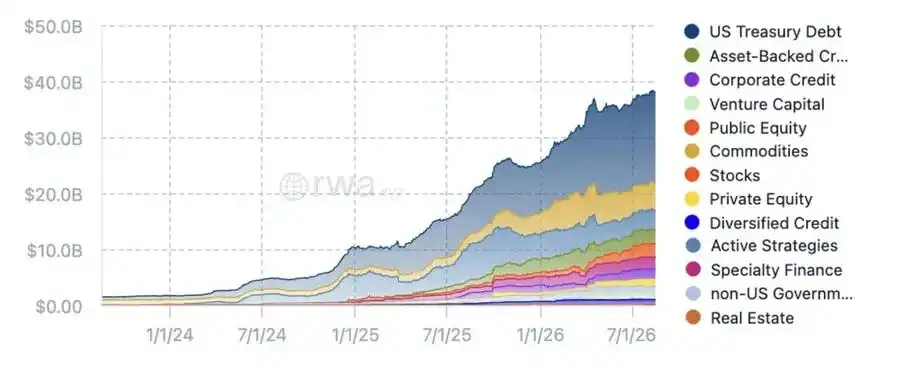
Source: rwa.xyz
The results are evident: a massive scale of stablecoins circulates, facilitating enormous transaction volumes, with velocity far exceeding traditional M1/M2 money. Cross-border remittance costs have dropped by an order of magnitude, enabling vast global populations to access a stable dollar payment system. Stablecoins have already validated the value of this dollar network, achieving a qualitative leap in cost, speed, and reach, multiplying the scale of economic activity facilitated per dollar.
Now, this highly liquid dollar pool is attracting more assets to connect with stablecoin deposit channels. The scale of RWA tokenized assets has grown approximately 10-fold compared to two years ago, and the growth rate is accelerating. Targets include US Treasuries, money market funds, commodities, private credit, equities, and various fund shares, covering diverse global markets.
Capital Markets Will Be Rebuilt Around Tokens
Just as the global supply chain was reshaped around containers, global capital markets will ultimately be rebuilt around tokens. The DeFi sector already shows the blueprint. Projects in our portfolio, like Aave V4, allow eligible token holders to pledge assets as collateral to access floating-rate credit from lender markets. The protocol embeds a complete set of trading rules, with the asset itself determining eligibility. This completely subverts traditional lending market structures. Today, if an individual or company wants to borrow against collateral, they first approach a financial institution. The institution controls access, vets the borrower based on its own risk processes, and offers financial products through its own channels. Financial services are tied to institutional relationships.
In the Aave ecosystem, the sole criterion for access judgment is the asset itself. Smart contracts recognize the token, execute transparent rules, and connect directly to capital markets. The binding relationship between asset holders and financial services is completely inverted: financial capabilities attach to the asset itself, not to the user-institution relationship.
In other words, tokens give assets executable capabilities akin to software. Once an asset is on-chain and recognized by the network, various applications can compete to layer value-added services onto it: exchanges providing trading liquidity, lending markets providing financing capability, wallets automatically distributing cash flows, and so on. The asset issuer only needs to tokenize once, without building separate systems for each use case.
This will fundamentally alter the business models of financial institutions. Currently, banks, brokerages, and asset managers bundle custody, underwriting, liquidity provision, asset management, and compliance within closed product systems for distribution. Crypto networks promote the unbundling and specialization of these functions. One institution handles credit issuance and loan management, while others provide capital, risk pricing, trading, insurance, or supporting application services. Assets, via a unified interface, flow freely between modular services without needing re-entry and rebuilding within each service provider's system.
The locus of competitive advantage shifts from large institutions to open networks. In the traditional financial system, large institutions can cover more products because they can bear the fixed infrastructure costs for each asset class and client segment. In public blockchain networks, much of the underlying infrastructure is a shared resource. New entrants can interface with assets, capital, and users without rebuilding ledgers, exchanges, custody, and settlement systems, dramatically lowering barriers to entrepreneurship and operation.
The network effects of stablecoins are already in a virtuous cycle. Capital markets will gradually transition into open networks, with numerous specialized financial services operating around tokenized assets. Under this new paradigm, institutions will compete based on capital quality, underwriting ability, risk control, asset management, and distribution strength, rather than on exclusive ownership of databases or monopolizing the sole channel for users to access markets.
Global Balance Sheets Will Eventually Be Fully On-Chain
The most important outcome of this transformation is the creation of a borderless global capital market.
Today, capital markets are bottlenecked by major institutions. The vast majority of individuals and businesses cannot access capital markets directly, limited to the finite product menus institutions are willing to offer. Institutions autonomously decide which clients, geographies, asset classes, and transaction sizes to serve.
Investors face reverse constraints; they cannot freely invest in all global assets, limited to what institutions have underwritten, packaged, and connected to distribution channels.
Ultimately, the vast majority of global economic value is locked out of existing capital markets. Small receivables, local infrastructure projects, private enterprises, emerging market credit, non-standard cash flows—even if economically valuable—remain unfinanced due to fragmentation, geographic dispersion, or small size, which traditional finance's high operational costs cannot justify. Investment opportunities exist, and capital supply is ample, but a connecting network is missing.
Tokenization changes this by providing assets with a standard interface, making them discoverable globally. As the financial system is rebuilt on this new interface, participation costs for everyone will plummet. Finance becomes a software-native capability, enabling applications to focus on niche asset categories and regional markets, reaching areas traditional finance cannot. Business processes previously unable to access sophisticated financial services can easily embed payments, working capital financing, collateral management, and treasury functions, connecting vast amounts of 'dormant assets' to on-chain capital markets. Objectively, tokenization cannot magically finance assets with no value, but many quality assets currently excluded by the system will likely become tradable.
Artificial Intelligence will further amplify this transformation by taking over operational tasks. AI agents can evaluate assets, price risk, allocate capital, manage collateral, and execute transactions within a global machine-readable market, continuously driving down the cost of financial services. The combination of AI and crypto-native payment rails will transform bespoke, intermittent markets into 24/7, global, automated ones, creating opportunities worldwide and dismantling institutional barriers to capital.
Capital allocation is humanity's core coordination tool. It determines where companies expand, which technologies scale, where homes and factories are built, and shapes regional economic development. Assets that are too small, localized, customized, or operationally costly for the traditional financial system become commercially viable for underwriting once connection, financing, and management costs plummet.
This mirrors the deep transformation brought by containers. Containers made new modes of trade and production economically feasible. Goods could be produced where costs were lowest, assembled elsewhere, and sold globally, as the coordination costs of supply chains fell dramatically.
Tokens will replicate this transformation for capital. Over the coming decades, global balance sheets will transition from isolated silos of records into an open market navigable by software, where capital flows based on the asset's intrinsic value, no longer constrained by who controls the financial gateway. Stablecoins have shown us the way: this system holds the potential to massively expand global capital markets and reach unprecedented domains.