BiyaPay Market Observation|US Stocks Pull Back, Intel and AMD Surge Against the Trend, Has the AI Chip Rally Shifted Focus?

marsbitPublished on 2026-09-10Last updated on 2026-09-10

Abstract

BiyaPay Market Observations: US stocks experienced a general pullback, with major indices closing lower on September 8th. However, a notable divergence emerged within the semiconductor sector: Intel surged around 9% and AMD rose nearly 6%, while NVIDIA declined about 2%. This suggests capital is not exiting the AI and chip theme but rotating within the sector. The rotation comes amid macro pressures from rising oil prices and Treasury yields, which increase inflation concerns and pressure equity valuations. In this environment, investors are becoming more selective, shifting focus from high-flying pure-play AI stocks towards companies with clearer near-term profit recovery or new growth narratives. Intel's rally was sparked by reports of potential CPU price hikes, signaling a reassessment of its pricing power and potential profitability recovery within the broader AI infrastructure build-out. Qualcomm gained after announcing a multi-generational collaboration with Amazon for AI data center chips, opening a potential new growth avenue beyond mobile. AMD's rise appears tied to the overall positive sentiment towards alternative AI chip plays. This movement indicates the AI investment theme is maturing. The narrative is evolving from a singular focus on market leaders to a more nuanced, multi-faceted evaluation of the entire supply chain. Key factors to watch include upcoming US CPI data, the Federal Reserve's policy meeting, and further validation of order momentum and financ...

US stocks reopened after the holiday, and the market did not directly continue its previous risk appetite.

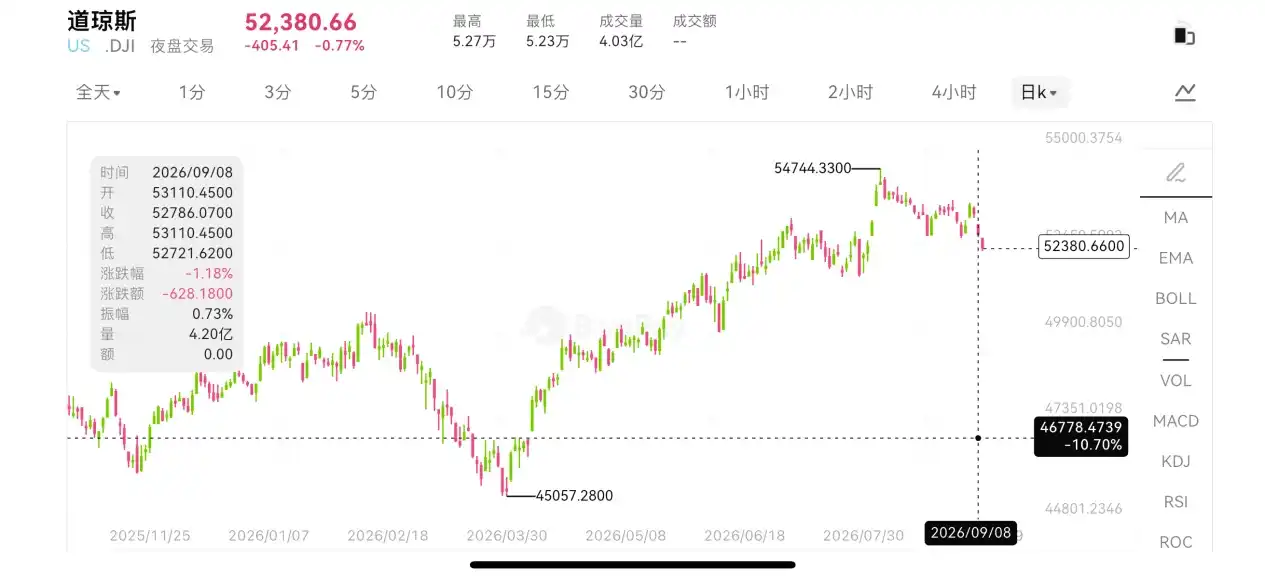
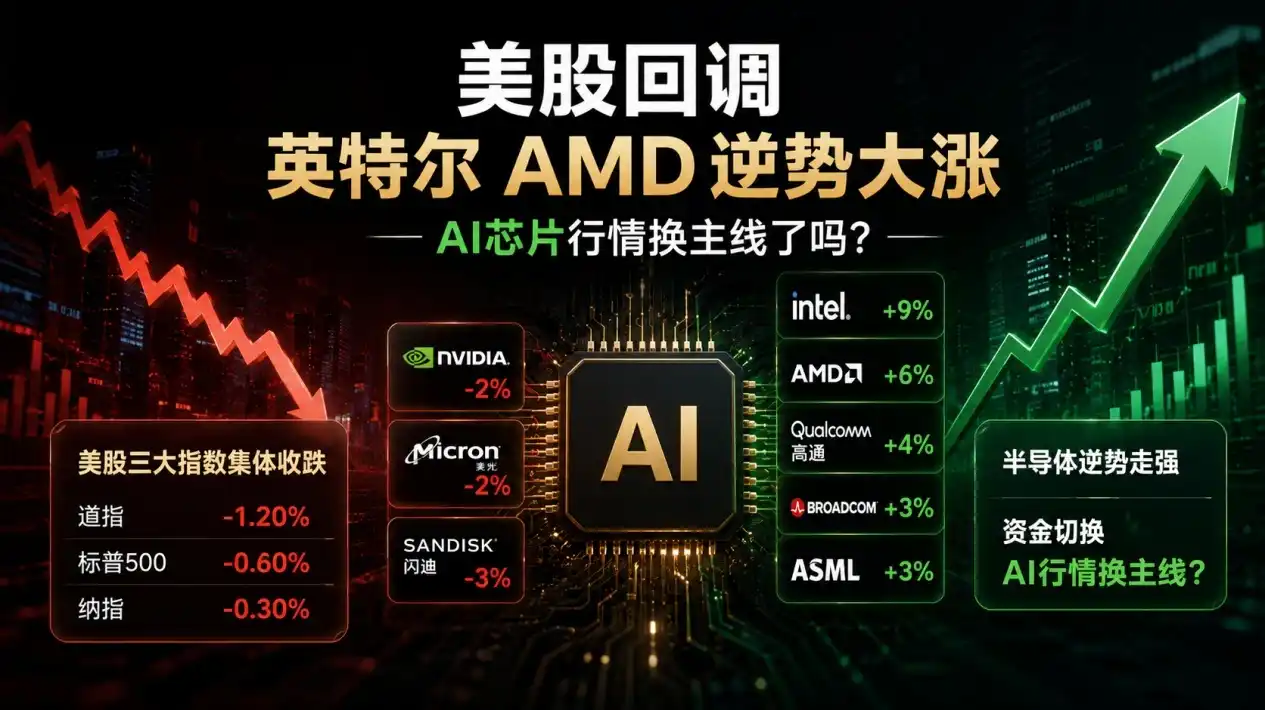
On September 8, BiyaPay market data showed that the three major US stock indices closed lower collectively, with the Dow Jones falling 1.2%, the S&P 500 Index falling 0.6%, and the Nasdaq falling 0.3%. On the surface, this appears to be a normal pullback, but the truly interesting part is that while the indices weakened, there was a clear divergence within the semiconductor sector. Intel surged approximately 9%, AMD rose nearly 6%, while Qualcomm, Broadcom, and ASML also saw varying degrees of gains. On the other hand, Nvidia fell about 2%, and storage-focused companies like Micron and SanDisk showed relative weakness.
This kind of market movement is most likely to create illusions. Looking solely at the indices, one might think tech stocks are cooling down; looking only at individual stocks, one finds that capital hasn't left AI and chips but is rapidly switching between different directions. Especially when oil prices, US Treasury yields, Federal Reserve expectations, and the AI industrial chain are simultaneously impacting the market, focusing on just one market can easily cause one to miss the real signal.

When observing such market movements, it is more useful to look at several assets together. For example, within the BiyaPay App, one can simultaneously follow US stocks like Intel, AMD, Qualcomm, and Nvidia, while also monitoring changes in assets like Hong Kong stocks, BTC, ETH, gold, and crude oil. As a global all-in-one asset allocation platform, BiyaPay covers multiple asset scenarios including digital assets, US stocks, Hong Kong stocks, and fiat currency exchange, making it more suitable for observing price changes across different markets. For such high-volatility markets, the key is not to chase daily price fluctuations, but to understand what exactly the capital is trading—whether it's interest rates, inflation, AI orders, or risk appetite.

This indicates that capital has not simply withdrawn from AI and chips, but is rather choosing new directions.

Over the past period, trading in US tech stocks has been highly concentrated on keywords like Nvidia, AI servers, memory chips, and computing power capital expenditures. However, as oil prices surge again, US Treasury yields rise, and the Federal Reserve's September meeting approaches, market tolerance for high-valuation assets decreases. At such times, capital is more inclined to seek out two types of companies: those with clear orders or customer validation, and those with clearer profit recovery logic.

Intel, Qualcomm, and AMD being pulled back into the spotlight by capital this time precisely follows this logic.
Why Did Chip Stocks Rise Amid Broader Market Pressure?

The pressure on US stocks this round first came from the macro environment.

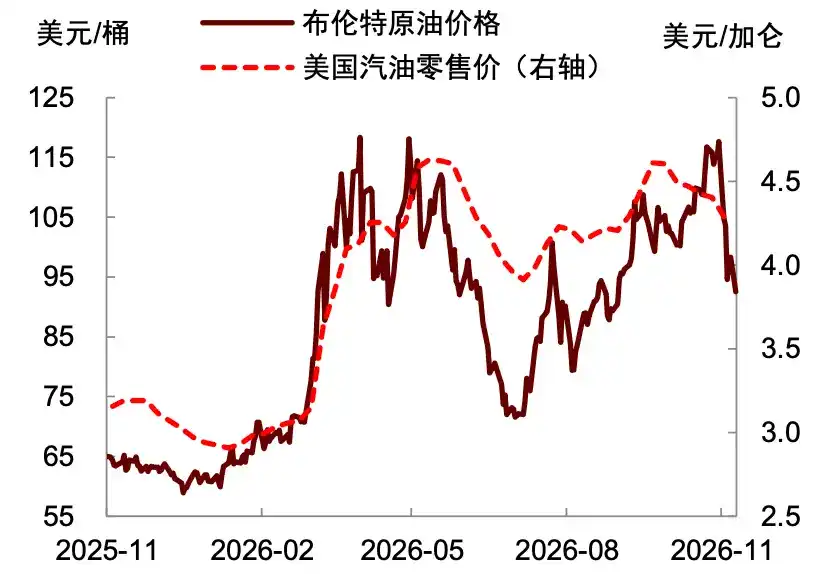
Brent crude oil once approached and briefly broke through the $100 per barrel mark, while WTI also rose above $90. Rising oil prices rekindle inflation expectations, and once inflation becomes more persistent, it becomes harder for the Fed to quickly pivot to easing. Meanwhile, the 10-year US Treasury yield rose to around 4.8%, with the 30-year yield also remaining high. For US stocks, the combined pressure from oil prices, inflation, and interest rates initially impacts valuations.

In theory, tech stocks should be more sensitive, as the valuations of many high-growth companies are based on future cash flows. The higher the interest rate, the less attractive the discounted present value of future profits becomes. However, this time the Nasdaq's decline was smaller than the Dow's, and semiconductors even strengthened against the trend, indicating the market is not broadly selling off tech, but rather undergoing a structural shift.

What capital is truly trading is which companies can continue to articulate their growth story clearly in a high-interest-rate environment, and whose price increases, orders, customers, and product roadmaps can more easily translate into profits.

Intel's Rise Is More Than Just a Sentiment Recovery

Intel's surge this time was superficially triggered by pricing and profit expectations.

DigiTimes reported that Intel may raise PC CPU prices again in October by about 10%. This news drove Intel's stock price higher, making it one of the top performers in the S&P 500 that day. It's important to note that Intel has not officially commented on this, so it cannot yet be considered confirmed company guidance. However, the market's willingness to buy in suggests that capital is paying attention to whether Intel's pricing power is returning.

This point is crucial.

Over the past few years, Intel's biggest problem wasn't a lack of revenue, but rather that profit margins, manufacturing investments, and competitive pressures have consistently weighed on its valuation. If CPU prices are now increasing, server-side demand is improving, and cost pressures are gradually being passed on, the market will reassess its profit recovery potential. Combined with AI data center demand for server CPUs, interconnects, and infrastructure, Intel is no longer just a traditional PC cyclical stock but is being re-priced within the AI infrastructure chain.

Of course, Intel's narrative hasn't completely reversed yet. What will ultimately determine how far the valuation recovery goes is not a single-day 9% gain, but whether it can prove in the coming quarters that price hikes won't significantly suppress demand, whether its data center business can continue to improve, and whether its advanced processes and foundry business can alleviate market concerns.

Qualcomm's Appeal: Transitioning from Phones to AI Data Centers

Qualcomm's strength this time leans more towards industry growth potential.

On September 8, Qualcomm officially announced a multi-generational product collaboration with Amazon, focusing on custom chips and optical interconnect solutions for large-scale AI data centers, with an emphasis on AI inference and optical connectivity capabilities up to 1.6T. The market's focus isn't just on the client name 'Amazon,' but also on whether Qualcomm can use this to open a second growth curve beyond mobile phone chips.

Qualcomm's core identity in the past has been mobile phones, basebands, and mobile computing. However, as AI enters the inference phase, data centers need not only GPUs but also more efficient inference chips, low-power computing, and high-speed interconnects. If Qualcomm can leverage the energy efficiency advantages accumulated in the mobile domain for data centers, it has an opportunity to break free from the traditional mobile phone cycle.

But here it's also necessary to see clearly that the so-called potential scale of up to $600 billion does not equate to confirmed order revenue. Some reports mention this being related to Amazon warrants and future purchasing conditions. Whether it can fully translate into Qualcomm's revenue depends on subsequent product delivery, customer purchasing cadence, and competitive landscape. The short-term market reaction—a price increase—is re-pricing Qualcomm's entry into the AI data center space, not fully confirming revenue for the next decade.

Why Was AMD Also Lifted?

AMD's rise was more driven by sentiment within the AI chip and server chain.

AMD has always occupied a nuanced position. It is not the absolute AI leader like Nvidia, but it's not without presence either. The market's focus on AMD essentially boils down to two points: first, whether its MI series AI accelerators can continue to secure orders from major customers, and second, whether its server CPU and data center business can maintain its share gains.

When Qualcomm secures a collaboration with Amazon and Intel is being re-traded for its pricing power, AMD will also be placed into the same comparative framework. Besides Nvidia, who else can capture a sufficiently large slice of the pie in the AI infrastructure expansion? This is the source of AMD's potential upside.

But AMD's challenge lies precisely here. The market is not giving it a premium for certainty, but rather a 'challenger' premium. Challenger rallies often rise quickly but are also prone to pullbacks due to order cadence, gross margins, supply chain issues, and software ecosystem concerns. Therefore, AMD's rise shouldn't be judged solely by a single-day gain; more importantly, it's about whether subsequent AI revenue share, customer expansion, and product iteration continue to materialize.

This Isn't an AI Downturn, but AI Pricing Becoming More Discerning

In this round of semiconductor divergence, the most noteworthy aspect isn't which stocks rose or fell, but that AI trading is shifting from a single-leader narrative to more granular industrial chain pricing.

In the earlier phase, the market preferred companies with the strongest certainty, hence Nvidia, TSMC, memory chips, and AI servers were the main theme. However, as valuations rise, capital begins to search for new explanatory frameworks. For instance, Intel is being traded for price and profit recovery, Qualcomm for AI inference and a new entry point into data centers, AMD for alternative potential outside of Nvidia, and ASML and semiconductor equipment for the advanced process capacity expansion cycle.

It's still AI, but the positioning is different.

This also explains why semiconductors can rise against the trend even as the broader market falls. The market isn't unconcerned about interest rates, but is seeking tech assets within the high-rate environment that can better prove their own value. As long as AI capital expenditure isn't disproven, chip stocks won't simply exit the stage; they will only rotate between different segments.

What to Really Watch Next?

In the short term, semiconductors rising against the trend have sent a signal to the market: the AI and chip theme hasn't disappeared; capital is simply seeking new pivot points away from crowded trades. Nvidia falling doesn't mean AI is receding; Intel, Qualcomm, and AMD rising don't mean the market theme has completely shifted. More accurately, the market is reallocating pricing power within the AI industrial chain.

Several variables are crucial going forward.

First is the US August CPI. According to the US Bureau of Labor Statistics schedule, the August CPI will be released on September 11. With oil prices having risen significantly, if inflation data also comes in strong, pressure on the Federal Reserve's September meeting will intensify. Second is the FOMC meeting on September 15-16. The market currently prices in a high probability of a September rate hike; the interest rate path will directly impact tech stock valuations. Third is subsequent orders within the AI industrial chain. The collaborations like Qualcomm-Amazon, Intel's price hike expectations, and AMD's server demand all need further validation in upcoming earnings reports and guidance.

Therefore, this round of semiconductor gains resembles a structural re-rating more than a simple sentiment-driven rebound.

Soaring oil prices and rising US Treasury yields should, in theory, pressure risk assets; but semiconductors strengthening against the trend indicates capital is still willing to pay for AI infrastructure, just more selectively. The companies that can continue to outperform in the future may not be the ones telling the most sensational stories, but those that can convincingly link customers, orders, pricing, and profit margins together.

The broader US stock market remains under pressure, yet AI chips show no signs of cooling down. The real question isn't whether chip stocks can still rise, but rather who in this rally will next prove that AI investments can ultimately translate into cash flow.

Trending Cryptos

Related Questions

QAccording to the article, why did major US stock indices decline while semiconductor stocks like Intel and AMD rose on September 8th?

AThe major indices declined due to macro pressures including rising oil prices, elevated US Treasury yields, and related inflation concerns ahead of the Fed's September meeting. Meanwhile, semiconductor stocks like Intel and AMD rose because capital rotated within the AI and chip sector, shifting from the previously crowded trade in names like Nvidia to companies with clearer near-term profitability, pricing power, or new AI data center growth stories.

QWhat was the specific catalyst mentioned for Intel's significant stock price increase?

AThe specific catalyst mentioned was a report from DigiTimes indicating that Intel may raise PC CPU prices by about 10% in October. While Intel did not officially confirm this, the market interpreted it as a sign of returning pricing power and potential profit margin improvement, leading to a significant re-rating of the stock.

QWhat new growth opportunity for Qualcomm is highlighted in the article?

AThe article highlights Qualcomm's multi-generational product collaboration with Amazon focusing on custom chips and optical interconnect solutions for large-scale AI data centers, including AI inference and high-speed optical connectivity up to 1.6T. This partnership represents a potential new growth avenue for Qualcomm beyond its traditional mobile phone chip business, entering the AI data center infrastructure market.

QHow does the article characterize the nature of the current AI and semiconductor market rally compared to the earlier phase?

AThe article characterizes the current phase as a shift from a broad, single-narrative (like the focus on Nvidia) to a more nuanced and selective 'structural repricing' within the AI supply chain. Capital is becoming more挑剔 (picky), focusing on specific company fundamentals like order validation, pricing power, profit recovery, and the ability to translate AI investment into cash flow, rather than just the overall AI theme.

QWhat are the three key upcoming variables mentioned in the article that could impact the market and AI chip stocks?

AThe three key upcoming variables are: 1) The release of US August CPI data on September 11th, which will provide insight into inflation trends. 2) The Federal Open Market Committee (FOMC) meeting on September 15th-16th, which will set the tone for interest rate policy. 3) Subsequent order validation and guidance from AI industry players like Qualcomm (with Amazon), Intel (price hike impact), and AMD (server demand), to see if their growth stories materialize.

Related Reads

Breaking: "Source God" MiniMax Open-Sources H3 Image, the Strongest Open-Source Model Made in China

MiniMax has released H3 Image, an open-source image generation model positioned as SOTA among open-source image models and competitive with the global top tier. Weights, API access, and integrations with MiniMax Code, the open platform, and Hailuo AI were all made available on launch day. Key specs: up to 16 reference images, prompts up to 7,500 characters, and 4K (4096×4096) output generated in just 10–20 seconds—far faster than the minute-level times typical of mainstream models. The headline capability is instruction following: H3 Image handles long text, complex spatial relationships, diagrams, and multi-reference consistency far better than art-focused models like Midjourney, which struggle with text and spatial logic. Early testers highlighted photorealistic portraits without the usual "plastic skin," retro game screenshots upgraded to next-gen 3A quality, 3A game assets, large-text posters, American Sign Language gestures (48.1% accuracy vs. Moss's 20%), CAD-style blueprints, and mechanical exploded views. Tests included an Eiffel Tower reimagined as a cyberpunk relay station in CAD blueprint form, a quadruped robot's HUD with correctly perspective-aligned 3D bounding boxes, a dark fantasy game UI screenshot, felt stop-motion and pen-and-watercolor styles, and a 16-image "matching" task assigning heads, outfits, instruments, and environments without a single mismatch. An ORB-7 flashlight exploded view correctly ordered seven parts with exactly three screws, based only on a front view, cross-section, and parts list. The capability comes from a two-step process: H3's pretraining treated text, images, video, and audio as unified context, building strong image fundamentals; then post-training used reinforcement learning, reduced sampling steps, prompt enhancement, and deployment optimization. MiniMax had previewed a unified generation-editing image model in an August community Q&A. The "源神" (open-source god) reputation stems from H3's generous licensing: free commercial use under $20M annual revenue in covered regions, with separate licenses required above that or for deployment in the US, EU, UK, and South Korea. H3 surpassed 24 million downloads and 300+ derivative models within a month, with derivatives from NVIDIA researchers, Pika, and fal. The strategy: let the world run it on their own GPUs, build trust through code, then monetize. The article concludes that open source and profit don't conflict, and image demand—game art, e-commerce, industrial design—is denser than video, implying even greater opportunity.

marsbit4m ago

Breaking: "Source God" MiniMax Open-Sources H3 Image, the Strongest Open-Source Model Made in China

marsbit4m ago

Don't Just Say Your Product Is Great—First Say What Problem It Solves

Many startup teams introduce their projects by talking about technology and features—what tech they used, what functions they built, how many patents they hold, and how well the product performs. These matter, but for first-time audiences there is a more direct question: what problem does this project actually solve? No matter how rich a product's features are, if it doesn't clearly explain who it serves and what need it meets, outsiders will struggle to understand its value. Real user needs are the starting point of a project story. Many interesting startups come from a concrete problem—an inefficient step in a traditional industry that a team redesigns with AI, consumers facing choice overload for which an entrepreneur develops a new product, or difficult manufacturing problems a technical team tackles with new equipment and processes. What is most worth introducing is often not the technology itself, but why the team is doing this and what change it brings users. Teams should answer: What unmet need did you find? What problem does your product solve? How does it differ from existing solutions? Where is the product now? Good projects need a chance to tell their story. Early-stage teams may have solid technology but lack professional channels to reach broader industry audiences. 36Kr's "Project Recommendation" offers a showcase opportunity, open to hard tech, AI, robotics, consumer, enterprise services, healthcare, and advanced manufacturing. Teams can submit materials about their product, technology, use cases, and progress; approved projects may receive free coverage and exposure on 36Kr, which focuses not only on new technology but on the real needs behind it and the value teams are creating. A startup doesn't need a complete business map or big market results from the start—if it is seriously solving a problem, it has a story worth telling. Submit your project through 36Kr's "Project Recommendation" to let your product, technology, and real business story be better understood. Good projects are not only built—they deserve to be explained clearly, and to be seen earlier.

marsbit5m ago

Don't Just Say Your Product Is Great—First Say What Problem It Solves

marsbit5m ago

The Crypto World Doesn't Lack Tokens, It Lacks Trust: A New Vision for Ethereum's 'Human Commitment Markets'

The crypto world doesn't lack tokens—it lacks trust. Independent researcher hitesh.eth argues that if open finance keeps leaving ordinary people feeling unsafe, they will trade freedom for predictability, accepting surveillance, gatekeeping, and custodial control—hollowing out the movement's original ideals even as the technology survives and gets absorbed by institutions. Drawing on Timothy C. May's crypto-anarchist vision (where reputation is central), Eric Hughes on privacy as selective self-disclosure, David Chaum's blind credentials, Wei Dai's b-money, and Elinor Ostrom's polycentric governance, the article proposes "Human Commitment Markets" on Ethereum. Instead of starting with tokens, these communities start with real services: escrowed payment, staked collateral, predefined evidence of completion, and agreed dispute-resolution paths. Three pillars—commitment, collaboration, and reputation—must be threaded with privacy throughout. Reputation should be domain-specific and non-transferable (using standards like ERC-5484 and ERC-1155/6909 for service credits), with zero-knowledge proofs verifying claims without exposing personal data, and scoped nullifiers preventing reuse. Stealth addresses (ERC-5564) reduce linkage but don't hide amounts, so full privacy needs extra infrastructure—echoing Vitalik's "Three Transitions." Disputes go to independent evaluators who verify real-world evidence, while contracts enforce escrow payouts. Systems need fallback paths, caps on early exposure, gradual trust-building for newcomers, and immutable, forward-only rule changes with exit rights. Pilots should be small: one community, one settlement asset, no speculative governance token, tested on Sepolia, audited, measured by real outcomes—completed jobs, repeat customers, dispute times, losses—not token prices. AI agents (per draft ERC-8004) could participate with capped accounts and staked collateral. Crypto can't solve coercion or physical-world fraud, but it can reduce reliance on blind trust and build economies worth staying in, not just tokens worth flipping.

marsbit54m ago

The Crypto World Doesn't Lack Tokens, It Lacks Trust: A New Vision for Ethereum's 'Human Commitment Markets'

marsbit54m ago

21 Banks Pledge $270 Million to Build New Stablecoin Faro: What to Watch

Goldman Sachs, Citi, Santander, and Deutsche Bank are among institutions that have reportedly committed a combined $270 million to cover five years of operating expenses for a joint-venture stablecoin company, internally codenamed Project Faro. The US-registered venture was announced in September 2026 by 21 institutions, with plans to establish the company in H2 2026 and issue a dollar stablecoin in H1 2027, followed by a euro stablecoin. However, the company's name and CEO remain undisclosed, and none of the four prerequisites—entity registration, licensing path, reserve custody, and blockchain design—have been completed ahead of the GENIUS Act's January 18, 2027 effective date. The budget is modest relative to incumbents: Circle's quarterly revenue is about 16 times Faro's annual budget, and the $270 million represents less than 1.1% of the roughly $290 billion stablecoin market, where USDT and USDC together hold over 80% share. Faro also trails competitors—Open Standard's Open USD, issued by Stripe's Bridge, is already live with over 140 participants, while Europe's Qivalis has obtained a Dutch e-money license. Banks are hedging across multiple tracks, with BBVA in both Faro and Qivalis. Key open questions include whether banks will mandate distribution of their stablecoin and how reserve yields—currently around 3.5% for Circle—will be split among issuers, distributors, and banks. Before January 2027, the company name, leadership, licensing path, and first chain will determine whether Faro becomes an operating issuer or remains an expensive letter of intent.

marsbit54m ago

21 Banks Pledge $270 Million to Build New Stablecoin Faro: What to Watch

marsbit54m ago

Inflation Stickiness Has Not Yet Subsided: CICC Maintains Its Call for a 25 Basis Point Rate Hike in December

US October CPI rose 0.4% m/m (vs 0.6% prior) and core CPI rose 0.3% m/m, both above expectations; no y/y data due to last October's government shutdown. Inflation remains sticky, with core CPI up 0.3% for a third straight month, supporting further Fed tightening. Fed Governor Waller floated a possible 50bp December hike, but CICC argues policy is not clearly "behind the curve" and financial conditions have tightened modestly, so accelerated tightening is unnecessary. CICC maintains its baseline call of a 25bp hike in December, keeping this cycle gradual and mild. Energy inflation eased (0.7% m/m vs 5.2% prior), though electricity rose 0.9% amid数据中心 power demand. Food CPI rose 0.5%, a five-month high, with broad-based gains across fruits/vegetables, dairy and meat, partly reflecting pass-through from earlier energy costs. Core goods rose 0.2%, with used cars down 1.2% and AI-related hardware inflation easing slightly. Housing CPI rose 0.3%, with OER and rent both up 0.3% and 0.2% respectively, showing no acceleration. Supercore services remained sticky at about 0.4%, with transport services up 0.8%; service inflation sources remain broad. CICC notes the 0.3% core reading meets Waller's condition for considering a 50bp hike, but argues larger hikes are meant to catch up on insufficient tightening, whereas recent tightening is already taking effect and inflation shows stickiness rather than acceleration. Waller himself supported a pause in October. Even hawk Dallas Fed's Logan favors two more 25bp hikes. CICC's baseline remains a 25bp December hike within a gradual, moderate tightening cycle.

marsbit1h ago

Inflation Stickiness Has Not Yet Subsided: CICC Maintains Its Call for a 25 Basis Point Rate Hike in December

marsbit1h ago

Trading

Spot

Hot Articles

How to Buy CHIP

Welcome to HTX.com! We've made purchasing USD.AI (CHIP) simple and convenient. Follow our step-by-step guide to embark on your crypto journey.Step 1: Create Your HTX AccountUse your email or phone number to sign up for a free account on HTX. Experience a hassle-free registration journey and unlock all features.Get My AccountStep 2: Go to Buy Crypto and Choose Your Payment MethodCredit/Debit Card: Use your Visa or Mastercard to buy USD.AI (CHIP) instantly.Balance: Use funds from your HTX account balance to trade seamlessly.Third Parties: We've added popular payment methods such as Google Pay and Apple Pay to enhance convenience.P2P: Trade directly with other users on HTX.Over-the-Counter (OTC): We offer tailor-made services and competitive exchange rates for traders.Step 3: Store Your USD.AI (CHIP)After purchasing your USD.AI (CHIP), store it in your HTX account. Alternatively, you can send it elsewhere via blockchain transfer or use it to trade other cryptocurrencies.Step 4: Trade USD.AI (CHIP)Easily trade USD.AI (CHIP) on HTX's spot market. Simply access your account, select your trading pair, execute your trades, and monitor in real-time. We offer a user-friendly experience for both beginners and seasoned traders.

8.9k Total ViewsPublished 2026.04.21Updated 2026.06.02

How to Buy CHIP

Discussions

Welcome to the HTX Community. Here, you can stay informed about the latest platform developments and gain access to professional market insights. Users' opinions on the price of CHIP (CHIP) are presented below.

活动图片