Bernstein Research Report Analysis: TDK Head Business Competition Triggers Sell-off, Seagate and Western Digital Oversold

marsbitPublished on 2026-10-09Last updated on 2026-10-09

Abstract

Bernstein Research Report Analysis: TDK Head Business Dispute Triggers Sell-off, Seagate and Western Digital Oversold Bernstein maintains Outperform ratings on Seagate (target $1350) and Western Digital (target $770), arguing that the market's negative reaction to news of a potential bidding war for TDK's HDD head business is overblown. Seagate and WD shares fell 9% and 7% respectively on concerns that the asset's acquisition by either Toshiba or Seagate would threaten the competitive landscape. The report highlights three exaggerated market fears: Toshiba gaining a competitive edge through vertical integration, potential disadvantages for WD if Seagate wins, and increased industry capacity. Bernstein counters that the news remains unconfirmed, Toshiba's post-acquisition market share growth would be limited (~5.6 percentage points), and the deal faces significant hurdles. Key points include the limited dependency of Seagate and WD on TDK, which supplies only an estimated 1-7% of their combined head needs, with both companies manufacturing the majority in-house. Major regulatory antitrust obstacles exist for any buyer, as acquiring the sole independent head maker would grant control over a key component for competitors. Bernstein is particularly skeptical of Toshiba's ability to finance and successfully integrate the asset, given its weak financial position and past execution issues in HDDs. The firm views the sell-off as a buying opportunity, especially for Seagate, citin...

Written by: Rita

Bernstein believes the dispute over the ownership of TDK's head business does not threaten Seagate and Western Data. This judgment contradicts the market reaction, as well as the single-day stock price drops of 9% and 7% for the two companies, respectively.

In a report dated October 7, 2026, Bernstein maintained its Outperform ratings on Seagate and Western Digital. The price target for Seagate is $1,350, and for Western Digital, it's $770. The core bet is that the direct threat to Seagate and Western Digital from the competition for TDK's assets is far less than what the stock price reaction suggests, with regulatory, financing, and supply risks all posing obstacles to a deal.

Three Exaggerated Concerns

After Bloomberg reported that Seagate and Toshiba were competing for TDK's head business, the market formed three concerns. Toshiba is more aggressive in capacity expansion. If Toshiba ultimately wins the assets, a vertically integrated Toshiba would harm Seagate and Western Digital. If Seagate wins the assets, Western Digital would be at a disadvantage.

Bernstein considers all three concerns to be overblown. The news has not been confirmed. The report contains many details and sources, suggesting some authenticity, but it's unclear how serious the negotiations are. Both TDK and Toshiba denied that any decisions had been made, refuting some details in the Bloomberg report but not directly denying that discussions are ongoing between the parties.

Toshiba's capacity increase would still leave it behind Seagate and Western Digital. Toshiba's market share in hard disk drives (HDDs) on an exabyte (EB) basis is approximately 11%. If Toshiba doubles its EB capacity while Western Digital and Seagate each grow by 25%, Toshiba's EB share would rise from 11.2% to 16.8%. Bernstein believes a 5.6 percentage point increase in share is not concerning. Acquiring the business would further secure Toshiba's existing head supply but would not directly increase HDD manufacturing or head capacity.

TDK is Not Critical for Seagate and Western Digital

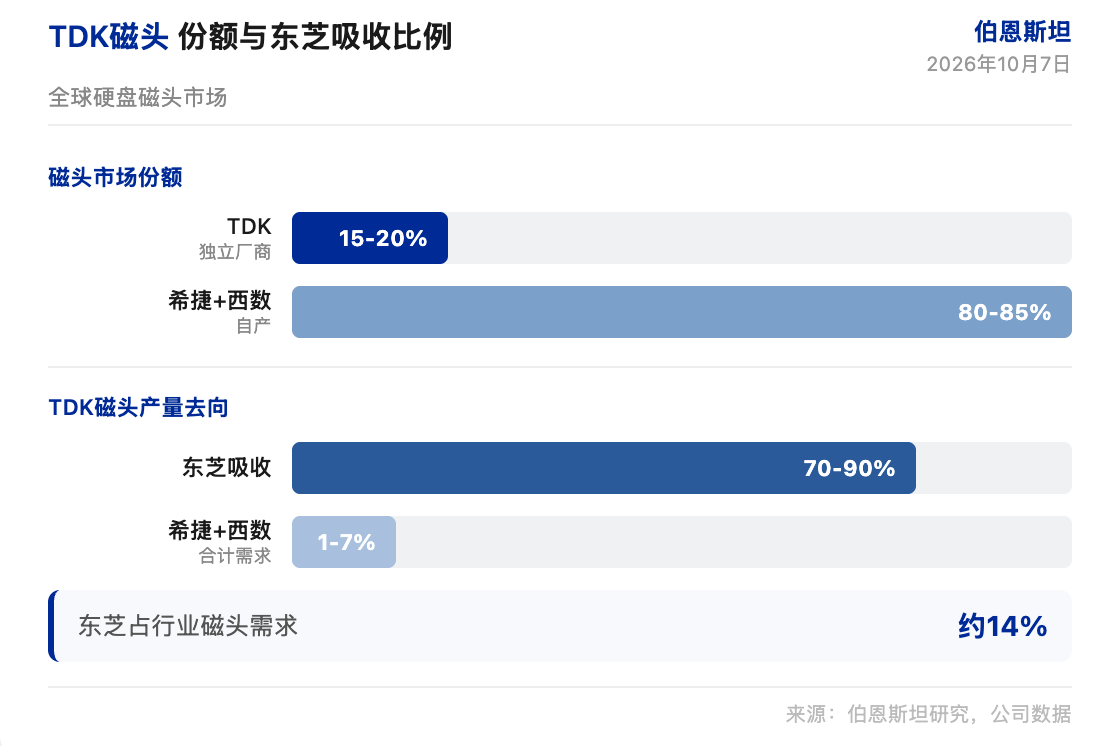
Bernstein points out that Seagate and Western Digital have limited reliance on TDK. TDK holds a 15% to 20% share in the global HDD head market, with Seagate and Western Digital's in-house head production accounting for the remaining 80% to 85%.

Bernstein estimates that Toshiba accounts for about 14% of the HDD industry's head demand, higher than its 11.2% HDD share, because Toshiba's HDDs have lower per-disk capacity, requiring more heads per EB. Toshiba alone absorbs 70% to 90% of TDK's head output. The remaining portion covers only 1% to 7% of Seagate and Western Digital's combined head demand.

Most heads for these two companies are also produced in-house. Seagate states in its filings that the company designs and manufactures many key technologies in its HDD products, including read/write heads, magnetic recording media, and other core components. Western Digital states in its filings that the company designs and manufactures nearly all of the recording heads and magnetic recording media used in its HDD products. Bernstein believes TDK might be marginally important, especially during periods of strong demand, but it is not a key source for the majority of the two companies' production.
Regulatory Hurdles Pose Deal Resistance

Bernstein notes that either potential buyer faces significant regulatory hurdles. TDK is the only independent manufacturer among the three HDD head makers. Approval for either bidder would mean the acquirer controls a critical component input for its competitors, which Bernstein believes would trigger strict antitrust scrutiny.

A combination of Seagate and TDK is unlikely. Bernstein believes this would place over half of global head output under one entity, with Seagate holding over 40% and TDK 15% to 20%. Toshiba would then find itself purchasing heads from one of its two major and larger competitors. Western Digital would also lose the option to purchase capacity.

A combination of Toshiba and TDK is more likely than one with Seagate, but Bernstein is similarly skeptical about the feasibility of such a deal. Seagate and Western Digital produce their own heads but rely on TDK to cover demand peaks. Toshiba could still gain pricing power and potentially limit Seagate and Western Digital's ability to increase capacity during periods of severe storage shortages.

Toshiba's own capital structure poses another obstacle. Toshiba's corporate debt has been rated BB by S&P. Bernstein estimates that a multi-billion dollar acquisition of TDK would add to existing acquisition debt and a potential $380 million in proposed capital expenditures. Given Toshiba's weak financial position and poor execution in the HDD business, Bernstein believes this deal could be a strategic mistake for Toshiba.

Toshiba's past track record in the HDD business is not strong. Bernstein's report mentions that Toshiba's HDD business execution has been weak, with capacity expansion and technology iteration lagging behind peers. This would make integration difficult for Toshiba even if it secures TDK's assets.

Buy Seagate and Western Digital

Bernstein maintains its Outperform ratings on Seagate and Western Digital. The $1,350 price target for Seagate is based on 21 times the FY28 EPS of $64.40. Bernstein believes Seagate's improving fundamentals, a five-year EPS CAGR of over 70%, and its leading position in HAMR are sufficient to support a 21x P/E ratio, possibly even higher.

The $770 price target for Western Digital is similarly based on 21 times FY28 EPS. Bernstein believes Western Digital is largely self-sufficient in HAMR technology and should be insulated from the impact of this news under any circumstances. After its spin-off, Western Digital's head business remains self-sufficient, with marginal reliance on TDK lower than market concerns suggest.

On the risk side, both companies face pressures from hyperscale cloud capital expenditure digestion, changes in hyperscale procurement models, and competition from improving NAND technology eroding HDD share. Western Digital also faces risks that the HAMR technology transition could pressure gross margins and EPS. A shift in hyperscale procurement models would directly pressure HDD demand.

Bernstein recommends buying Seagate and Western Digital on weakness, with Seagate as the preferred choice. This allocation assumes the TDK deal either does not materialize or, if it does, does not affect the two companies' head supply. Regulatory scrutiny and Toshiba's financial pressure make the probability of the deal passing relatively low.
Disclaimer

This article is a compilation and interpretation by Chaoxiang Research of a third-party brokerage research report (Bernstein, October 7, 2026), combined with publicly available market information. The ratings, price targets, earnings forecasts, and related judgments cited in the article are the views of the analysts at that brokerage firm, representing only the position of their affiliated institution. They do not represent the views of Chaoxiang Research and do not constitute any investment advice.

The market carries risks; decisions require independence. This article should not be used as a basis for trading any securities.


Related Questions

QAccording to the Bernstein report, why does the analyst believe the market overreacted to the news about the potential sale of TDK's HDD head business?

AThe analyst believes the market overreacted because the three main concerns are exaggerated: the news remains unconfirmed; even if Toshiba acquires the business and doubles its exabyte (EB) capacity, its market share gain would be marginal (from ~11.2% to ~16.8%); and both Seagate and Western Digital are not critically dependent on TDK for heads, sourcing the vast majority (80-85%) internally.

QWhat are the key regulatory obstacles highlighted by Bernstein that could hinder a potential acquisition of TDK's head business?

AThe key regulatory obstacle is antitrust scrutiny. TDK is the only independent HDD head manufacturer. Any acquisition would give the buyer control over a key component input for its competitors. For example, a Seagate+TDK combination would control over half of global head output, potentially forcing Toshiba to buy from a larger competitor. Even a Toshiba+TDK deal could grant Toshiba pricing power and the ability to limit competitors' capacity during shortages.

QHow dependent are Seagate and Western Digital on TDK for their hard drive head supply, based on Bernstein's analysis?

ASeagate and Western Digital have limited dependence on TDK. They internally produce 80-85% of their required heads. TDK supplies only 15-20% of the global market. Furthermore, Toshiba alone absorbs 70-90% of TDK's head output, leaving only 1-7% of Seagate's and Western Data's combined head demand to be covered by the remaining supply from TDK.

QWhat are Bernstein's price targets and investment ratings for Seagate and Western Digital, and what is the primary rationale for maintaining an 'Outperform' rating?

ABernstein maintains an Outperform rating for both. The price target for Seagate is $1350 and for Western Digital is $770. The primary rationale is that the direct threat from the TDK asset contest is far less than implied by the stock price reaction. The report cites Seagate's improving fundamentals, ~70% EPS CAGR, HAMR leadership, and Western Digital's self-sufficiency in HAMR technology and limited marginal reliance on TDK as reasons for the positive view, assuming the TDK deal does not proceed or does not affect their supply.

QBesides the TDK situation, what other key risks does the Bernstein report identify for Seagate and Western Digital?

AThe report identifies several other key risks: digestion of hyperscale cloud capital expenditure; potential changes in purchasing patterns by hyperscale customers; pressure from NAND technology improvements capturing HDD market share. Specifically for Western Digital, there is an additional risk that the transition to HAMR technology could drag on gross margins and earnings per share (EPS).

Related Reads

Changing Gas Metering Could Break Smart Contracts? Ethereum Urgently Halts Hoodi Fork to Investigate Eight Major Security Risks

Ethereum core developers have paused the Hoodi testnet upgrade after security auditors found that two upcoming Gas improvement proposals could invalidate long-standing assumptions underpinning many deployed smart contracts. The proposals, EIP-8037 and EIP-8038, part of the Glamsterdam upgrade, aim to reprice state storage by decoupling state creation from state access and setting dynamic weights for certain opcodes, in order to curb unchecked growth of Ethereum's state data. However, this overhaul disrupts static Gas constants that developers have relied on as fixed system parameters. ChainSecurity identified eight invariant risks. Many contracts and off-chain infrastructure depend on hardcoded Gas limits, for example to prevent reentrancy or bound execution scope; higher costs could cause cross-contract calls to run out of Gas and revert. Other risks lie in error-handling logic that relies on precise prediction of inner execution costs, and in proxy contracts that forward Gas based on fixed ratios, potentially distorting execution paths or locking funds in incomplete state-machine branches. To avoid systemic compatibility failures and cascading disruptions across multisig wallets, bridges, and lending protocols, developers agreed at an ACD meeting not to hard-fork Hoodi until the affected contracts are fully mapped and compatibility guidance is issued. Because much logic lives off-chain in proprietary routing, settlement scripts, and liquidation bots, the Ethereum Foundation acknowledged it cannot audit the entire ecosystem alone. It has published a public repository detailing the eight affected invariants, sample problem code, and prompt templates for audit and scanning tools, so teams can check their own logic. Findings will be reviewed at next week's ACD meeting, when Hoodi activation conditions will be reassessed.

marsbit2h ago

Changing Gas Metering Could Break Smart Contracts? Ethereum Urgently Halts Hoodi Fork to Investigate Eight Major Security Risks

marsbit2h ago

What Exactly Drives the Value of Layer 1?

This analysis by Marc Arjoon, CFA, examines what actually drives Layer 1 valuation through time-series regression on major L1 assets. Short-term, all L1 price movements remain dominated by Bitcoin beta. Over longer horizons, Ethereum's market cap has fully decoupled from its own protocol revenue—a deliberate policy outcome of Dencun and higher gas limits rather than a demand collapse—with its 2025 rally driven instead by spot ETF and corporate treasury demand. Solana, by contrast, shows revenue and market cap moving in tandem, both rising ~15x since January 2023 and peaking the same week. Active addresses and DEX volumes show weak weekly correlations and large divergences despite long-cycle drift. Testing Metcalfe's Law, the fitted elasticity of market cap to active addresses is only 0.56 for Ethereum and 0.62 for Solana and BNB—closer to the square root of addresses than the square. None of six valuation multiples reliably mean-reverts; Mcap/REV is the only one that predicts positive 13-week returns from low valuation quantiles on Ethereum and TRON. No L1 has Bitcoin's deep holder base: only 4% of Solana and 10% of Ethereum supply has been dormant over three years versus 42% for Bitcoin. Ethereum's pricing anchors to peer capital share—59% of L1 market cap, 70% of DeFi TVL, 75% of tokenized RWA—rather than on-chain activity, where it holds just 5% of active addresses. Across chains, market cap rank correlates strongly with TVL (Spearman 0.87) and stablecoin supply (0.63) but weakly with transactions (0.17). The core conclusion: L1s are valued less as fee-generating businesses and more as monetary assets competing for capital settlement and liquidity share.

marsbit3h ago

What Exactly Drives the Value of Layer 1?

marsbit3h ago

Trading

Spot
活动图片