Robinhood Chain nears $1B TVL as Uniswap drives liquidity: Standard Chartered

cointelegraphОпубліковано о 2026-08-13Востаннє оновлено о 2026-08-13

Анотація

Standard Chartered reports that Robinhood Chain is nearing $1 billion in total value locked (TVL), achieving rapid growth largely driven by its partnership with Uniswap. Uniswap's V2, V3, and V4 protocols are meeting virtually all of Robinhood Chain's liquidity needs, allowing the new blockchain to leverage established DeFi infrastructure without building from scratch. This arrangement is also significantly impacting Uniswap's tokenomics, with fees generated through Robinhood now being the largest source of UNI token burns, doubling the burn rate since late July. Launched on July 1 with a focus on real-world assets, Robinhood Chain is part of the brokerage's broader expansion into crypto, tokenization, and prediction markets, a strategy identified by analysts as a key growth driver despite mixed trends in its overall crypto trading volumes.

Robinhood’s partnership with Uniswap is helping the brokerage rapidly build liquidity on its new blockchain, potentially removing a key obstacle to attracting users and assets, according to Standard Chartered.

In a recent note, Standard Chartered analyst Geoffrey Kendrick said Robinhood Chain has grown to nearly $1 billion in total value locked (TVL), which he described as the fastest growth of any blockchain by that measure. Virtually all of Robinhood Chain’s liquidity needs are being met through Uniswap V2, V3 and V4, Kendrick said.

The arrangement gives Robinhood access to established decentralized finance infrastructure as it scales its blockchain, potentially strengthening its ability to attract users without having to build liquidity from scratch.

The partnership is also having a significant impact on Uniswap’s token economics. According to Standard Chartered, protocol fees generated through Robinhood are now the largest source of UNI token burns.

The UNI burn rate has roughly doubled since a Robinhood-linked fee switch was activated on July 27, reaching an annualized pace of about $90 million. At UNI’s current price of roughly $3.50 apiece, that would translate to 25 million UNI tokens, or just over 4% of the circulating supply, being burned annually.
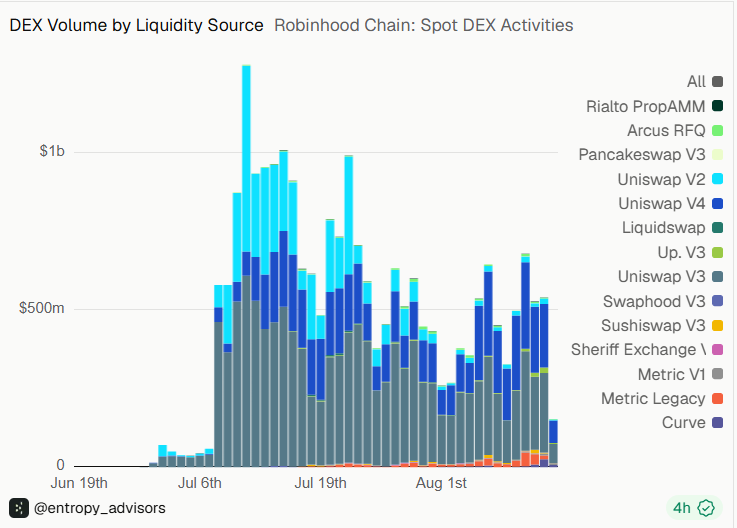
Robinhood Chain’s liquidity sources. Source: Standard Chartered

Robinhood Chain launched on July 1 with a focus on bringing real-world assets onchain. Adoption accelerated quickly after launch, reaching 194,000 daily active users during its first week.

Related: Robinhood Chain sees over $70M in ETH bridged during first week

Robinhood’s crypto push expands into tokenization and prediction markets

Robinhood Chain is part of the brokerage’s broader push beyond traditional stock trading, with the company expanding into crypto, prediction markets and tokenization. The strategy has drawn attention from Wall Street, with analysts at Bernstein raising their price target for Robinhood (HOOD) stock to $160 per share and identifying tokenization and prediction markets as key growth drivers.
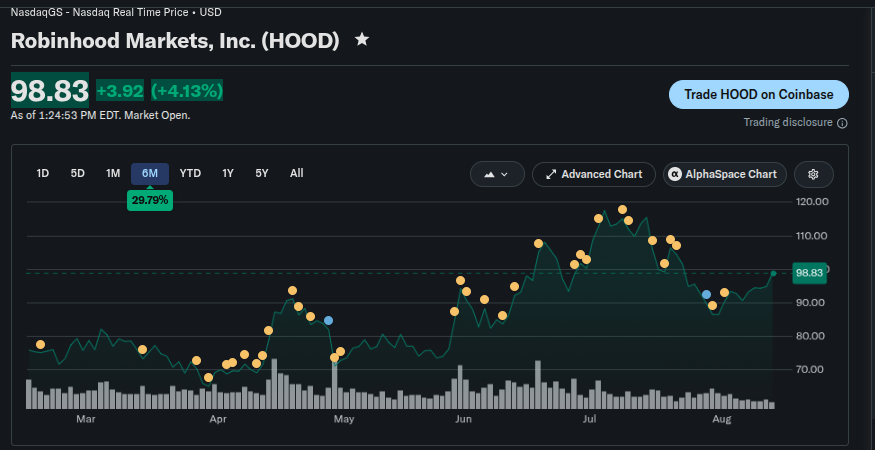
HOOD shares were up more than 4% on Thursday, extending six-month gains to almost 30%. Source: Yahoo Finance.

The expansion has coincided with mixed trends across Robinhood’s crypto business. The company reported record revenue and earnings in the second quarter, even as crypto trading volumes and revenues declined.

Related: Robinhood in talks with Crypto.com over prediction markets: WSJ

Пов'язані питання

QWhat key partnership is helping Robinhood Chain build liquidity rapidly according to Standard Chartered?

ARobinhood's partnership with Uniswap is helping the brokerage rapidly build liquidity on its new blockchain, providing access to established decentralized finance infrastructure.

QWhat is the current Total Value Locked (TVL) of Robinhood Chain and how does its growth compare?

ARobinhood Chain has grown to nearly $1 billion in Total Value Locked (TVL), which Standard Chartered analyst Geoffrey Kendrick described as the fastest growth of any blockchain by that measure.

QHow is the Robinhood Chain partnership affecting Uniswap's UNI token economics?

AProtocol fees generated through Robinhood are now the largest source of UNI token burns. The UNI burn rate has roughly doubled since the Robinhood-linked fee switch was activated, reaching an annualized pace of about $90 million.

QWhat is the primary focus of Robinhood Chain that launched on July 1st?

ARobinhood Chain launched on July 1st with a focus on bringing real-world assets onchain.

QWhat broader strategic expansion does Robinhood Chain represent for the company, and what did Bernstein analysts identify as key growth drivers?

ARobinhood Chain is part of the brokerage's broader push beyond traditional stock trading into crypto, prediction markets, and tokenization. Bernstein analysts identified tokenization and prediction markets as key growth drivers for Robinhood.

Пов'язані матеріали

Stock Market Trend (October 15): U.S. September CPI Exceeds Expectations, CoreWeave Plunges Over 15%

U.S. stocks, led by tech, fell on October 15th as September's CPI data came in hotter than expected, reigniting interest rate hike fears. The Nasdaq dropped 1.88% and the Philadelphia Semiconductor Index fell 4.30% for its sixth consecutive daily decline. The 'Magnificent Seven' tech giants mostly fell, with only Apple rising 0.5% to close with a market cap above $5 trillion for the first time. The core CPI rose 0.3% month-over-month and 2.6% year-over-year, exceeding forecasts. This data increased market expectations for a potential Federal Reserve rate hike in October. AI infrastructure companies with high borrowing costs were hit particularly hard. CoreWeave's stock plummeted over 15%, and its bond yields soared, reflecting investor concerns over financing costs in a higher-rate environment. Other related stocks like Oracle and server makers Dell and Hewlett Packard Enterprise also saw significant declines. Not even strong corporate earnings could stem the sell-off. ASML raised its full-year revenue guidance after a robust Q3 but its U.S.-listed shares fell nearly 4%. Bank of America's stock fell around 4.8% after its earnings missed estimates, while Morgan Stanley also dropped despite beating expectations. Attention now turns to upcoming data, including U.S. PPI and retail sales for September, and earnings from TSMC, for further clues on the economic outlook and the Fed's policy path.

marsbit30 хв тому

Stock Market Trend (October 15): U.S. September CPI Exceeds Expectations, CoreWeave Plunges Over 15%

marsbit30 хв тому

Торгівля

Спот
活动图片