Storm in bonds, hurricane in the gulf, calm in indices: results of the first decade of October

cryptonews.ruPublished on 2026-10-12Last updated on 2026-10-12

Abstract

**Summary of the Article: Bond Storm, Hurricane, and Market Calm – Results of Early October** The first ten days of October saw three simultaneous shocks: 24-year highs in US Treasury yields (10Y at 5.36%, 30Y at 5.73%), Hurricane Isaias halting significant oil production, and Middle East tensions flaring. Oil (Brent) surged from $98 to $104.7. Despite this, major indices like the S&P 500 rose 2.1%, Bitcoin held near $83,700, and gold gained 1.2%. Market stability is attributed to algorithmic liquidity, derivative flows, and peak stress in bonds showing signs of easing after strong auction demand. **Markets and Mechanics:** US stock resilience is explained by stabilizing bond yields and market structure dominated by intraday option hedging (0DTE), which dampens volatility. Liquidity depth, however, is historically low. Sector rotation away from overvalued tech mega-caps is needed. **Capital Rotation:** Money market funds grew by $72 billion to $7.96 trillion, a reserve for future bond purchases. Gold remains a strong competitor to crypto for inflation-hedging capital, with gold ETFs attracting a record $31 billion in Q3 versus $2.1 billion for all crypto ETFs in September. **Cryptocurrency:** Bitcoin held steady, but Ethereum fell 5.6% to $2,535, and altcoins underperformed. Bitcoin ETF outflows totaled $679 million, and Ethereum ETFs saw $542 million exit. The market is sustained by leverage in perpetual futures, as on-chain metrics show a lack of new users. Stablecoin m...

Disclaimer

ForkLog is not responsible for readers' investment decisions. Forecasts of financial markets are the private opinion of the author and do not necessarily coincide with the position of the editorial board.

In an author's column for ForkLog, trader and author of the Telegram channel Coen+ Vladimir Koen assessed how markets survived three shocks at the beginning of October and what to expect from Bitcoin, Ethereum, and gold for the rest of the month.

The first 10 days of October saw markets go through three shocks simultaneously. The yield of 10-year (10Y) US government bonds intraday rose to 5.36%, a 24-year high; 30-year (30Y) yields reached 5.73%. Hurricane "Isaias" halted the extraction of 1.28 million barrels per day in the Gulf of Mexico. Escalation in the Middle East continued with a strike on the Riyadh airport over the weekend. Since the beginning of the month, Brent crude oil has risen in price from 98 to 104.7.

The indices barely noticed this. The S&P 500 added 2.1%, rising to 7,812 points. Bitcoin closed the decade at $83,700 — the level from the end of September — with a low around $80,300. Gold rose in price by 1.2% — to $4,236. The dollar index is holding around 102, and its strength this time is caused by the weakening of the euro amid France's budget risks and pressure on European debt.

The structure is fragile: it rests on algorithmic liquidity and derivatives turnover. But for now, there are no new players capable of shaking it.

Bonds: stress at the peak

My hypothesis: we are at the peak of stress, the first signs of yield stabilization are already present. Auctions took place at highs with strong demand. 10-year yields went below 5.3% with a coverage of 2.77 and a share of foreign and institutional buyers of 80.3%. 30-year yields — below 5.618%, lower than market expectations. Dealers got 6.8% of the issue versus the usual 10%. Buyers found acceptable levels: the 10Y yield closed the week at 5.24%.

I do not expect a strong pullback in yields until the end of the year: inflation forecasts for Q4 are high, energy keeps costs elevated, the Fed maintains hawkish rhetoric. Stress in Europe and globally persists.

Opinion: For Bitcoin, the US bond market turned out to be more important than the Fed

Why the calm in indices

Stabilization of yields explains the resilience of stocks.

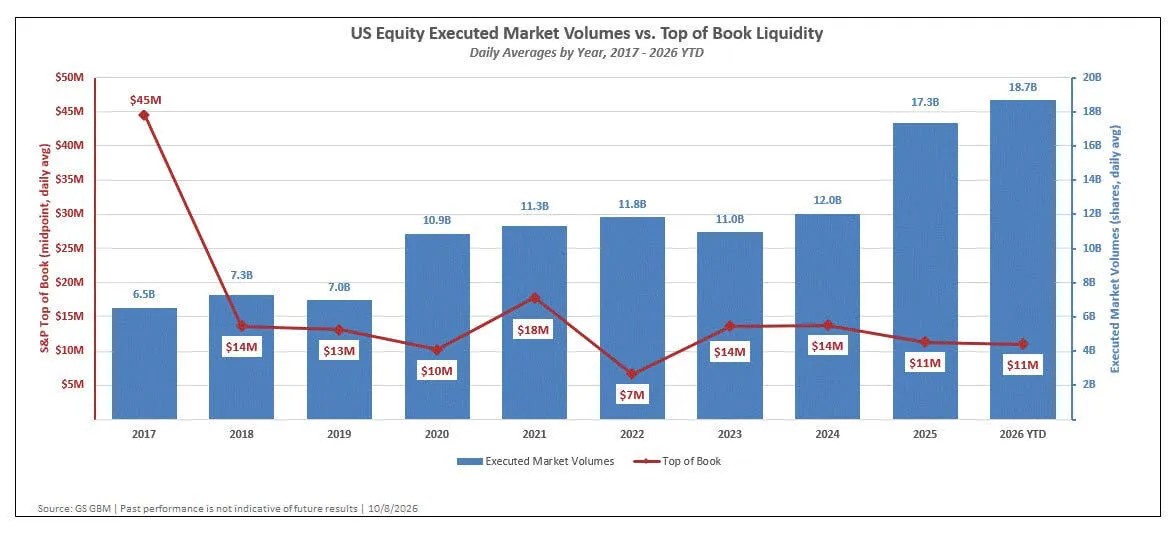
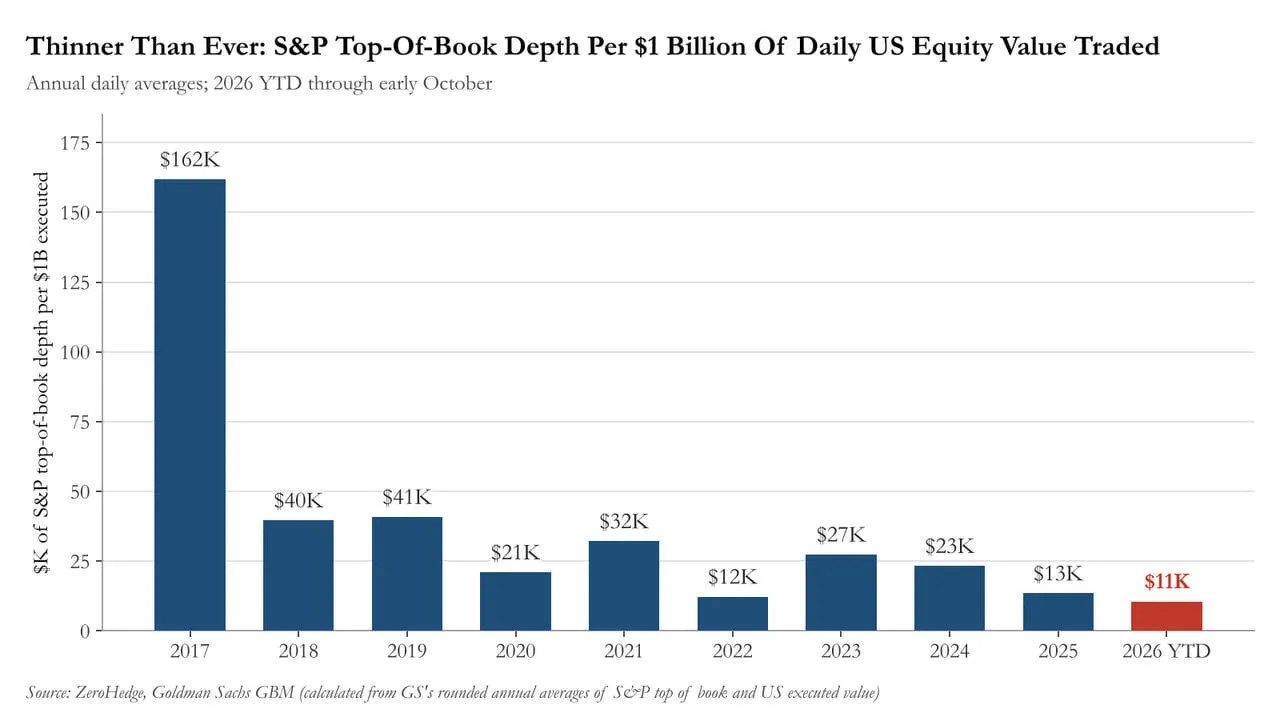
The second reason lies in market mechanics: turnover is maintained by derivatives and options expiring on the trading day (0DTE). Dealers hedge them intraday, selling on rallies and buying back on dips, movements are dampened, and sell-offs don't have time to become a trend. Participants buy back every dip. However, the depth of the best quotes in the S&P 500 is at a historical low: about $11,000 for every $1 billion of daily turnover, with a record 18.7 billion shares per day.
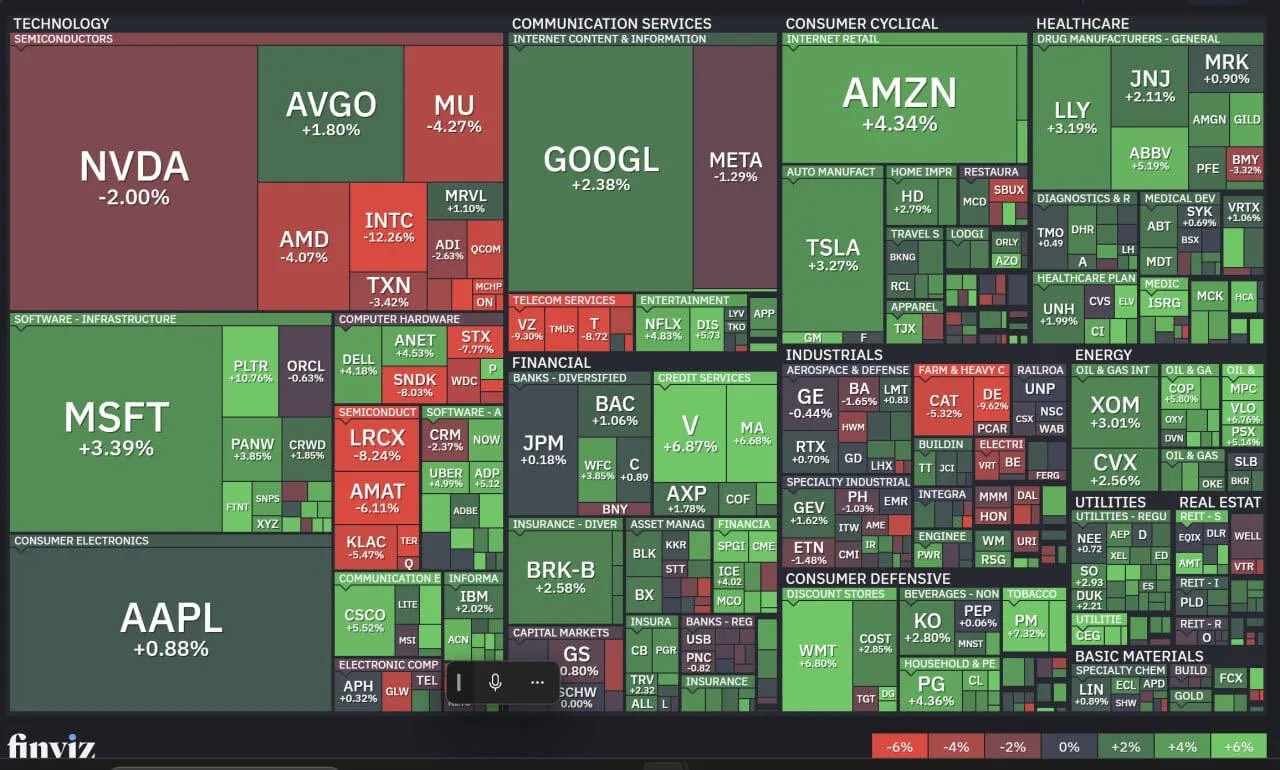
Performance of S&P 500 companies by sector. Source: author.
Depth of best S&P 500 quotes per $1 billion of daily stock turnover in the US. Source: author.
Average daily stock turnover in the US and depth of best S&P 500 quotes from 2017–2026. Source: author.

The market is also kept from selling off by the drop in oil from a peak of $105.6 to $103 on Monday morning, as well as hopes for de-escalation after Washington's statement that there would be no strike on Iran before the midterm elections.

Pressure point: the skew towards technology and megacaps is too high. In October, we need to see rotation into other sectors.

Controlled capital rotation

Money market funds grew by $72 billion during the stress week — to $7.96 trillion. This reserve will become a source for buying long bonds when yields stabilize. Money is not leaving stocks.

Gold remains the main competitor to crypto for capital seeking protection from inflation. We are not seeing demand for geopolitical protection: markets absorb military news without sell-offs. Gold ETFs attracted a record $31 billion in Q3 and $10 billion in September, and their holdings reached a record 4,256 tons. All crypto ETFs attracted $2.1 billion in September. Silver lags: $61 per ounce versus $64.8 at the end of September.
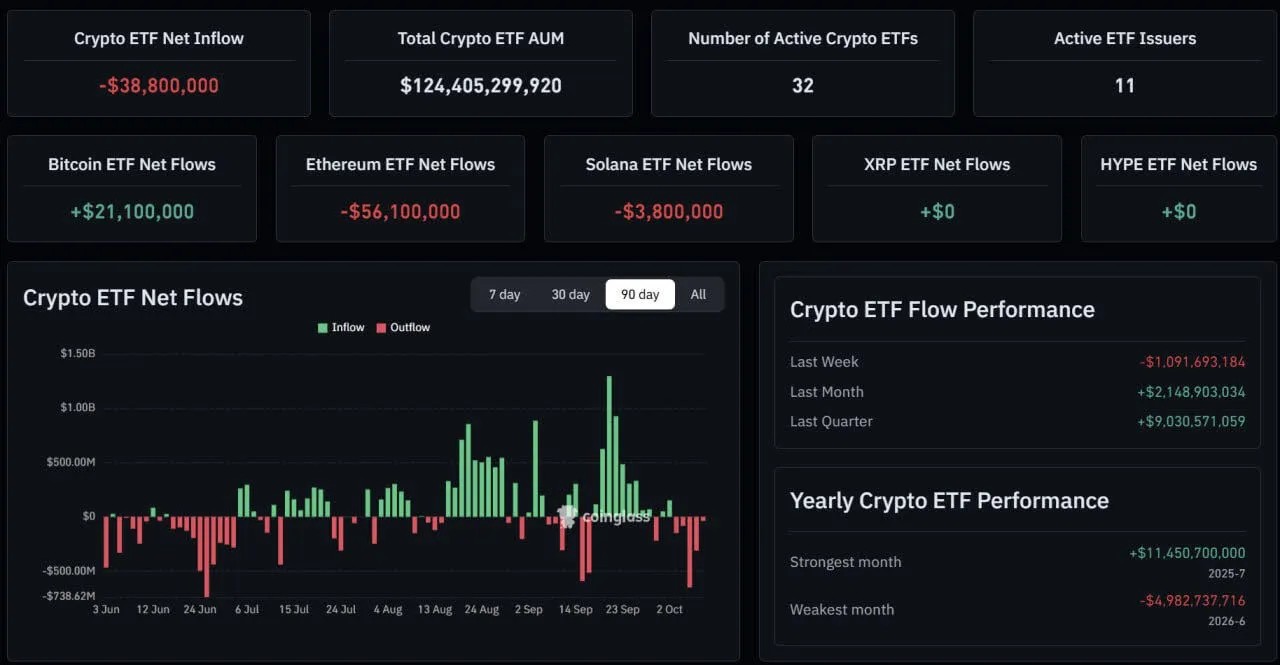
Net flows into crypto ETFs over 90 days. Source: author.

Crypto

$BTC is holding up, $ETH has fallen 5.6% since the beginning of October — to $2,535, Solana — to $111. The dominance of the first cryptocurrency is 59.4%: altcoins are falling two to three times harder than Bitcoin.
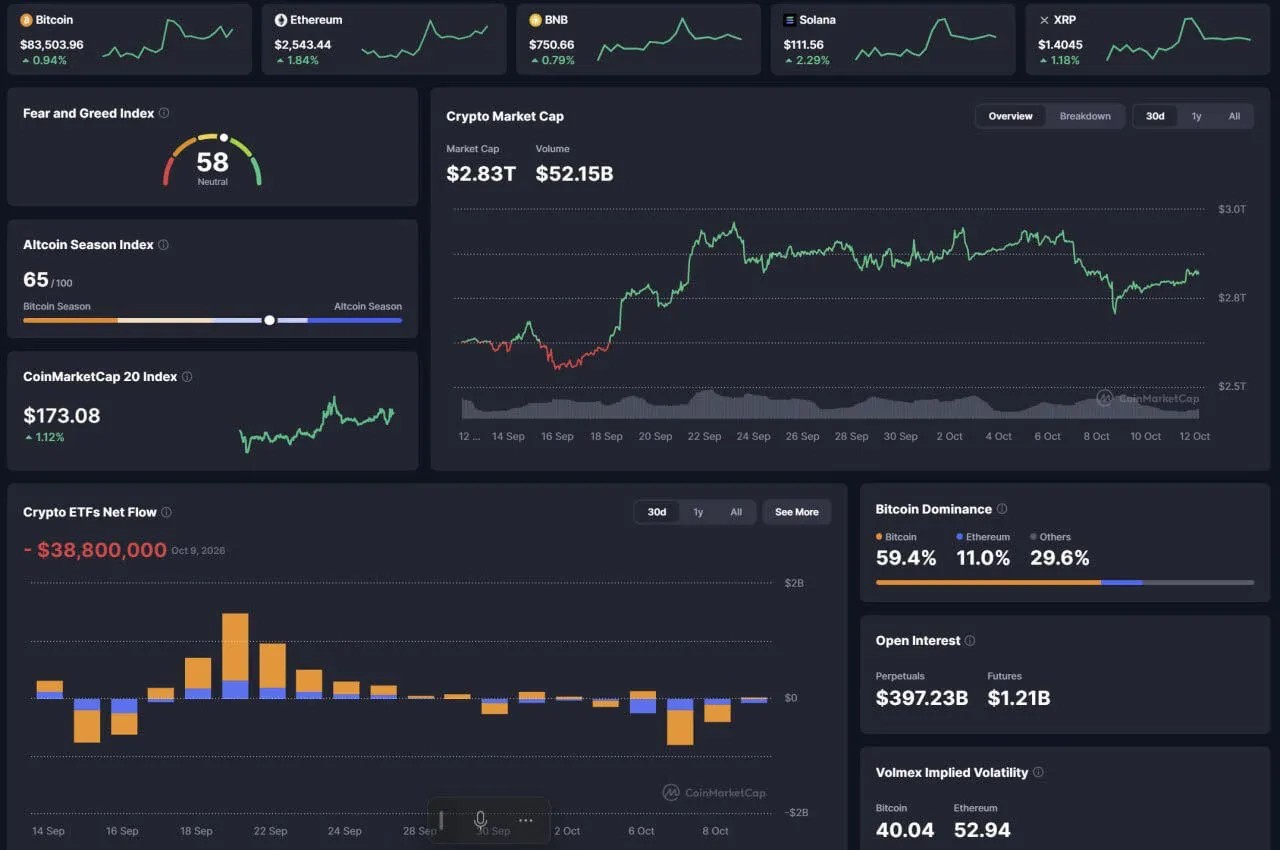
Key crypto market metrics. Source: author.

ETFs last week: $679 million was withdrawn from $BTC funds, $542 million from $ETH funds. Tactical capital exited digital gold-based instruments via FBTC and ARKB, IBIT is flat, and the arbitrage trade remains with a basis of 5.4-6.2% annualized. Outflow from $ETH is mechanical: basis below the risk-free rate, the "long ETHA / short CME" trade is being unwound.

The stablecoin market cap is around $306 billion, having increased by $2 billion over the month. The market value of USDT rose by $700 million, USDC — fell by $1.2 billion: the American channel is shrinking along with ETFs.

New audiences are not arriving: the number of active Coinbase users fell 13% year over year, new $BTC addresses — by 43%, which is below 2021 levels. Open interest in perpetual futures rose 5% — to $390-400 billion amid ETF outflows: crypto is holding up on leverage turnover just as stocks are holding up on options turnover.

JPMorgan estimated inflows into digital assets at $50 billion

October 30 Options

$BTC. The notional value of options is $11.8 billion. Open interest for calls is 95,200 $BTC versus 45,600 $BTC for puts.

Largest call strikes: $95,000 — about 25,000 $BTC, $90,000 — about 15,000 $BTC, $100,000 — about 14,500 $BTC. The max pain point is $78,000. Calls are sold for premium by spot holders, ETFs, and treasury companies, and bought by dealers. Dealer hedging works against price movement: they sell on rallies and buy on dips. The closer the price gets to $90,000, the stronger this effect.
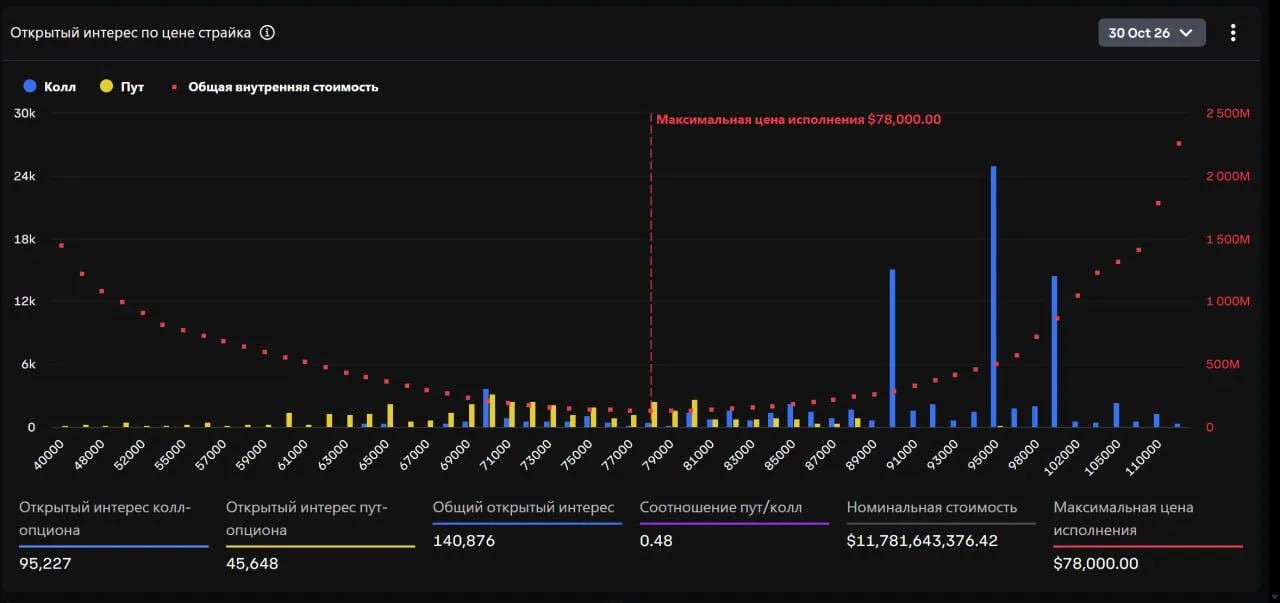
Open interest in Bitcoin options expiring October 30 by strike. Source: author.

$ETH. The max pain point is $2,500. The main volume of puts is concentrated in the $2,300-2,400 range, calls — from $3,000. Iron condors, i.e., bets on movement within a range, account for 37% of block trades.
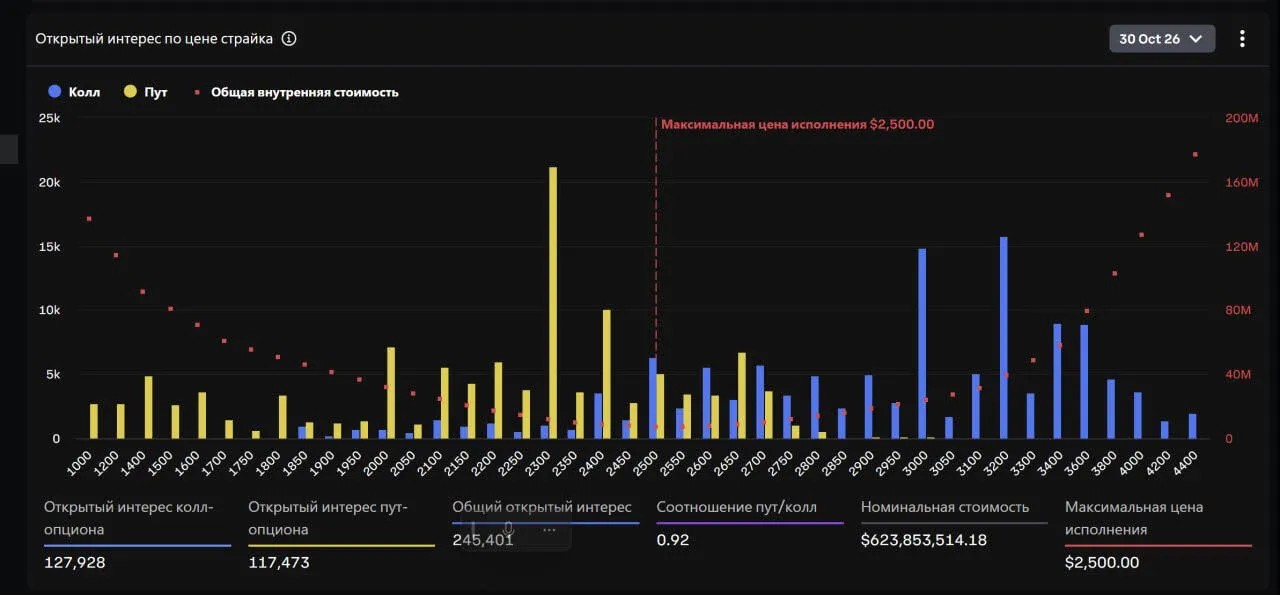
Open interest in Ethereum options expiring October 30 by strike. Source: author.

Key Points for October

A lot will be decided by inflation data: CPI comes out October 14, PPI — October 15. If inflation accelerates, the 10-year bond yield will return above 5.36% and stabilization will be interrupted.

The external risk of the week is related to Tokyo: the USD/JPY exchange rate reached 158.2 — near the 160 level, where Japanese authorities may conduct interventions. A sharp strengthening of the yen would hit carry trades and the most liquid risky assets.

My view on October is moderately positive:

  • $BTC. I expect movement within the $80,000-90,000 range until the October 30 expiration. I estimate the probability of closing the month in the $85,000-90,000 range at 45%, in the $80,000-85,000 range — at 35%, and testing the $77,500-78,500 level — at 20%. For continued growth, we need price stability around $82,000-88,000, a resumption of ETF inflows, and an increase in stablecoin issuance.
  • $ETH. I expect movement in the $2,300-2,800 range until expiration, centered around $2,500. A breakout depends on leverage: if open interest, expressed in $ETH, grows more than 5–7%, the structure will break.
  • Gold. I expect the price in the range of $4,150-4,350 per ounce with an upward bias if yields stabilize. While gold ETFs are gathering tens of billions of dollars per month, crypto is only getting tactical capital.

Amid high leverage and compressed liquidity, we may see sharp spikes in volatility on news. But the market has already adapted well: it withstood oil at $104 and yields at 24-year highs and quickly buys back such moves. As long as this continues, controlled capital rotation continues.


Related Questions

QWhat were the three major shocks that the markets experienced in the first ten days of October, according to the article?

AThe three major shocks were: 1) A surge in US Treasury yields, with the 10-year yield reaching a 24-year high of 5.36% and the 30-year yield hitting 5.73%. 2) The disruption of 1.28 million barrels per day of oil production in the Gulf of Mexico due to Hurricane Isaias. 3) Escalation of the Middle East conflict, including a strike on Riyadh's airport over the weekend.

QWhat key market indicator does the author believe is showing initial signs of stabilization, and what recent evidence supports this view?

AThe author believes US Treasury bond yields are showing initial signs of stabilization. The evidence includes successful auctions where the 10-year yield settled below 5.3% and the 30-year yield at 5.618%, both lower than market expectations, with strong demand and a low share (6.8%) going to dealers.

QAccording to the author, why have major stock indices like the S&P 500 remained relatively stable despite the shocks?

AThe stability is attributed to two main reasons: 1) The stabilization of bond yields. 2) Market mechanics dominated by high-frequency derivatives and intraday option trading (0DTE options). Dealers hedge these intraday, selling on rallies and buying on dips, which dampens sustained selling trends. Additionally, participants buy every dip.

QHow does the flow of capital into Gold ETFs compare to that into Cryptocurrency ETFs as discussed in the article?

AGold ETFs significantly outperformed Cryptocurrency ETFs. In Q3, Gold ETFs attracted a record $31 billion, including $10 billion in September alone, bringing their holdings to a record 4,256 tonnes. In contrast, all cryptocurrency ETFs combined attracted only $2.1 billion for the entire month of September.

QWhat are the author's main price expectations for Bitcoin and Ethereum until the options expiration on October 30th?

AThe author expects Bitcoin ($BTC) to trade in a range of $80,000-$90,000, with a higher probability (45%) of closing between $85,000-$90,000. For Ethereum ($ETH), the author anticipates a range of $2,300-$2,800, centered around $2,500.

Related Reads

Altman Empathizes with Jensen Huang: 'Heroes Have Flaws,' But Does He Support His Return as NVIDIA CEO...

At the Semafor Silicon Valley Summit on November 16, OpenAI CEO Sam Altman publicly addressed Nvidia founder Jensen Huang's resignation as CEO after 33 years, expressing strong personal empathy. Altman called Huang "a hero of mine" and said it's hard to imagine the AI revolution without him, acknowledging that "heroes have flaws." Nvidia's stock fell about 15% within a week, wiping out over $570 billion in market value, and 180,000 people signed a petition urging his reinstatement—echoing Altman's own 2023 board ouster and dramatic return. Altman noted that Nvidia and OpenAI bet on each other early on. On business matters, he dismissed concerns that Nvidia's commitments—including a $105 billion financial guarantee for an OpenAI data center in Ohio—would lose credibility, saying the company is now a massive giant whose backing remains trusted. He also expressed optimism that the AI industry will keep advancing without Huang, given strong market demand and validated AI value. Altman identified scientific research as the next major AI breakthrough area, citing progress in math and physics, and predicted AI will take over repetitive, process-driven enterprise work. He also clarified his controversial memory chip remarks (saying he actually supports consumers upgrading their own PCs), explained that chip demand projections from multiple suppliers overlap even though real data center demand is solid, said OpenAI has not yet launched fully autonomous recursive self-improvement due to safety concerns, and stated OpenAI is in no rush to IPO despite Anthropic's filing, noting investor demand far exceeds quality supply.

marsbit3m ago

Altman Empathizes with Jensen Huang: 'Heroes Have Flaws,' But Does He Support His Return as NVIDIA CEO...

marsbit3m ago

If you lose money helping a friend trade cryptocurrency, will it be deemed fraud?

When friends entrust you with money to trade cryptocurrency on their behalf and the market turns against them, two distinct legal questions arise: whether you must compensate them, and whether your conduct constitutes fraud. These are separate issues. Civil liability depends on the nature of the relationship—whether it was a loan, a委托 investment, or a joint venture—and on the validity of any agreement. Under Chinese policy, virtual currency investment activities are treated as illegal financial activities, and civil acts involving them that violate public order and good morals are void, with losses generally borne by the parties themselves. Courts have reached different outcomes: in one case, an investor's claim for full repayment was rejected because the loss stemmed from market risk; in another, the operator was ordered to bear 20% of the loss for failing to recognize compliance risks, while the investor bore 80%. Fraud, by contrast, requires proof of deceptive conduct and intent to illegally possess the funds—mere trading losses or refusal to repay do not establish fraud. However, fabricating trade records, misappropriating funds, or secretly using leverage contrary to instructions can change the analysis. If a dispute escalates or police become involved, the priority is to preserve complete records of the agreement, fund flows, and trading history, avoid making unauthorized repayment promises, and cooperate truthfully with authorities while seeking professional legal advice.

marsbit3m ago

If you lose money helping a friend trade cryptocurrency, will it be deemed fraud?

marsbit3m ago

Stop Asking, I Just Love Money! The Naked-Quit Genius Researcher Backtracks, May Want to Return to Big Tech

Jacob Coxon, a 27-year-old Cambridge mathematics graduate and former pretraining researcher at both OpenAI and Anthropic, publicly reversed his stance just two months after a high-profile resignation. Speaking at a Stanford University event hosted by professor Rob Reich, Coxon admitted he is unsure whether leaving was the right decision and suggested he might return to a top AI lab. When pressed on why he still holds OpenAI stock options despite describing frontier labs as existential threats, he candidly replied, "I like money, brother. I admit it's blood money," and deflected further questions by blaming the host for raising the issue. He also said he remains anxious about no longer seeing frontier progress from the inside and feels he is "shouting into the void," questioning whether staying inside a lab would have been more influential. On technical matters, he argued that pretraining is not hitting a wall—compute efficiency is following a "super-exponential" curve—that recursive self-improvement requires only one narrow technical capability rather than broad mastery, and that deceptive or uncontrolled behavior in models originates solely from reinforcement learning during post-training, a loop labs cannot escape because RL remains the only effective tool for making models follow complex instructions. The episode, in which he clings to valuable equity while warning of AI risk, is seen as a candid portrait of Silicon Valley's AI culture.

marsbit7m ago

Stop Asking, I Just Love Money! The Naked-Quit Genius Researcher Backtracks, May Want to Return to Big Tech

marsbit7m ago

Acquisition Complete: Fei-Fei Li Officially Leads Team into AMD, Lisa Su Personally Welcomes Her

AMD has completed its acquisition of World Labs, the spatial intelligence startup co-founded by AI pioneer Fei-Fei Li, in an all-stock deal valued at approximately $8.2 billion (about 14.98 million shares). The transaction, signed September 28 and closed November 13—just 46 days later—marks AMD's second-largest acquisition after Xilinx in 2022. Li now serves as AMD Executive Vice President and Chief Scientist, reporting directly to CEO Lisa Su, while co-founders Justin Johnson and Ben Mildenhall remain to lead an independent frontier research group. World Labs, founded in 2024, focuses on spatial intelligence and 3D world models rather than large language models. Its Atlas world model, released September 2026, uses camera pose-conditioned prediction ("Viewpoint Is All You Need") and topped blind tests with over 500,000 human evaluations, generating coherent 1440p videos over 60 seconds. The company also acquired robotics firm Scenix and opened Atlas to the public on November 12. The deal deepens AMD's push into physical AI and robotics—a market Su calls a multi-trillion-dollar opportunity—allowing Li's team to co-design future Instinct chips and the ROCm software stack. AMD positions this against Nvidia's integrated hardware-software dominance, emphasizing an open AI ecosystem. AMD shares dipped about 5% on announcement day amid a broader semiconductor pullback.

marsbit7m ago

Acquisition Complete: Fei-Fei Li Officially Leads Team into AMD, Lisa Su Personally Welcomes Her

marsbit7m ago

Hackers inject credit card, crypto-stealing malware into 178 major websites

Cyber attackers planted cryptocurrency and credit card-stealing malware on websites associated with Ledger, Coinpass and scores of other major businesses in an attack exploiting website optimization platform Optimizely on Monday. Dubbed "Optimjack" by researcher Amirul Iman, the campaign delivered malicious code through scripts hosted by Optimizely. The malware could replace legitimate cryptocurrency wallet addresses with attacker-controlled alternatives when visitors copied addresses, and it also captured credit card details entered into website forms, according to a separate analysis by cybersecurity firm StepSecurity. The campaign affected website scripts belonging to 178 organizations, including hardware wallet Ledger, OANDA / Coinpass and trading platforms IG, Interactive Investor and TMS Brokers, according to Report URI's investigation. Other affected brands included IKEA, Salesforce, Zoom, the BBC and CNN, websites that collectively attract millions of visitors a day. BBC was among the first websites observed to serve the Optimizely injection at around 4:21 am UTC on Monday. By 9:52 pm UTC, most of the malicious code had been removed, with Ledger's snippet cleaned at about 8:41 pm UTC. Cointelegraph reached out to Ledger, Coinpass, and a number of other major businesses reported to be impacted by the malicious injection. This is a developing story, more information will be added as it becomes available.

cointelegraph18m ago

Hackers inject credit card, crypto-stealing malware into 178 major websites

cointelegraph18m ago

Trading

Spot
活动图片