After Two Years of Waiting, ChatGPT Lands on Linux, Codex Hands-On Can Modify Your Code

marsbitОпубліковано о 2026-08-14Востаннє оновлено о 2026-08-14

Анотація

After a two-year wait, OpenAI has released a preview of its ChatGPT desktop application for Linux. The new app integrates ChatGPT, Work (for multi-step tasks), and Codex (for coding) into a single client. Initially supporting Ubuntu, Debian, and Fedora on x64 and ARM64 architectures, this move extends official desktop support to all three major operating systems. This release is part of a broader product consolidation by OpenAI, which recently merged Codex and introduced ChatGPT Work while discontinuing the Atlas browser. For developers, the key feature is Codex's deep integration, allowing it to directly access local projects, codebases, file systems, and terminals—functionality impossible in a web browser. The launch follows Anthropic's Claude desktop app for Linux by about a month, highlighting the ongoing competition for developer adoption. While the preview is globally available, official support is currently limited to specific distributions, and enterprise security considerations for a tool with terminal access remain crucial. The evolution signifies a shift from simply providing AI chat access to embedding AI assistants deeply into developers' local workflows.

Just now, the client that Linux users have been waiting for for two years has finally arrived.
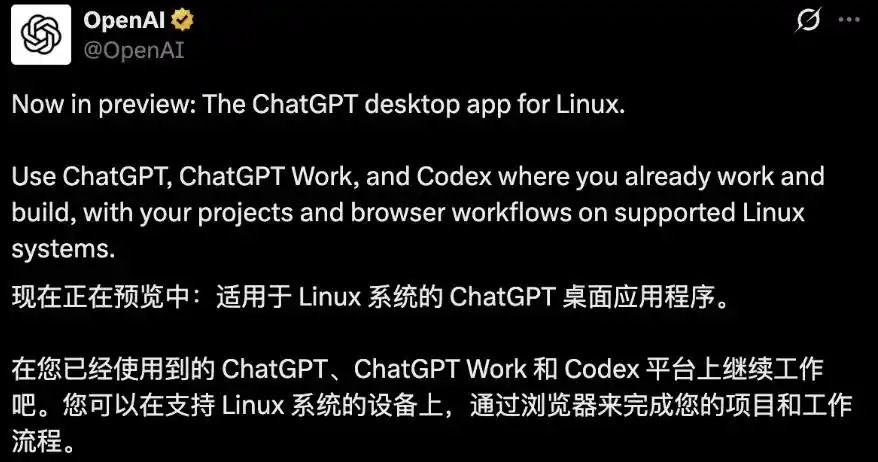
OpenAI officially announced: the Linux version of the ChatGPT desktop application is now available for preview.

ChatGPT, Work, and Codex are now all packed into the same App.

Linux is one of the systems with the highest density of developers, yet it had consistently been overlooked by the official OpenAI desktop client.

For the past two years, Windows and macOS users could summon ChatGPT with a keyboard shortcut, while Linux users could only keep it open in their browser.

But this time, what's being added is not just an entry point.

With the three-in-one suite coming in, especially Codex, it can access your projects, codebases, and terminal—places the browser can never reach.
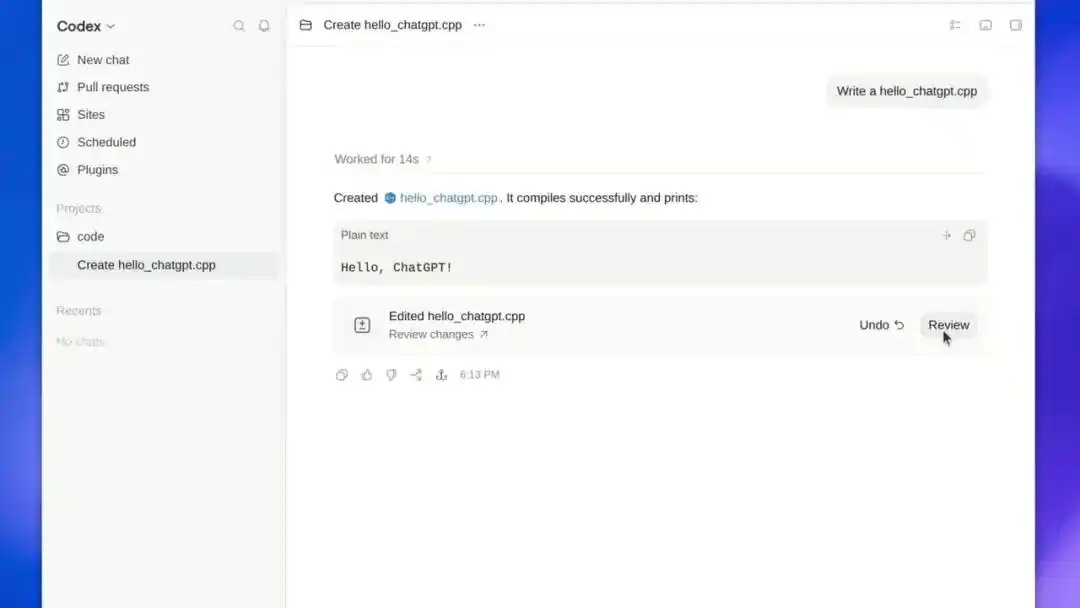
Codex view: Toggle to ChatGPT in the top-left corner; items like Pull requests and Projects in the sidebar are all present.

The first batch of supported distributions includes: Ubuntu 24.04 and 26.04 LTS, Debian 13, Fedora 43 and 44.

Linux has hundreds of distributions; OpenAI initially selected five versions from three families. The coverage isn't huge, but they are the foundations for many downstream distributions.

It supports both x64 and ARM64 architectures, providing .deb and .rpm installation packages ready for double-click installation.

According to TechCrunch, this preview version is now open globally. The new ChatGPT desktop application has completed the set for the three major desktop operating systems: macOS, Windows, and Linux.

OpenAI officially stated that Linux has always been one of the most requested platforms for the desktop client.
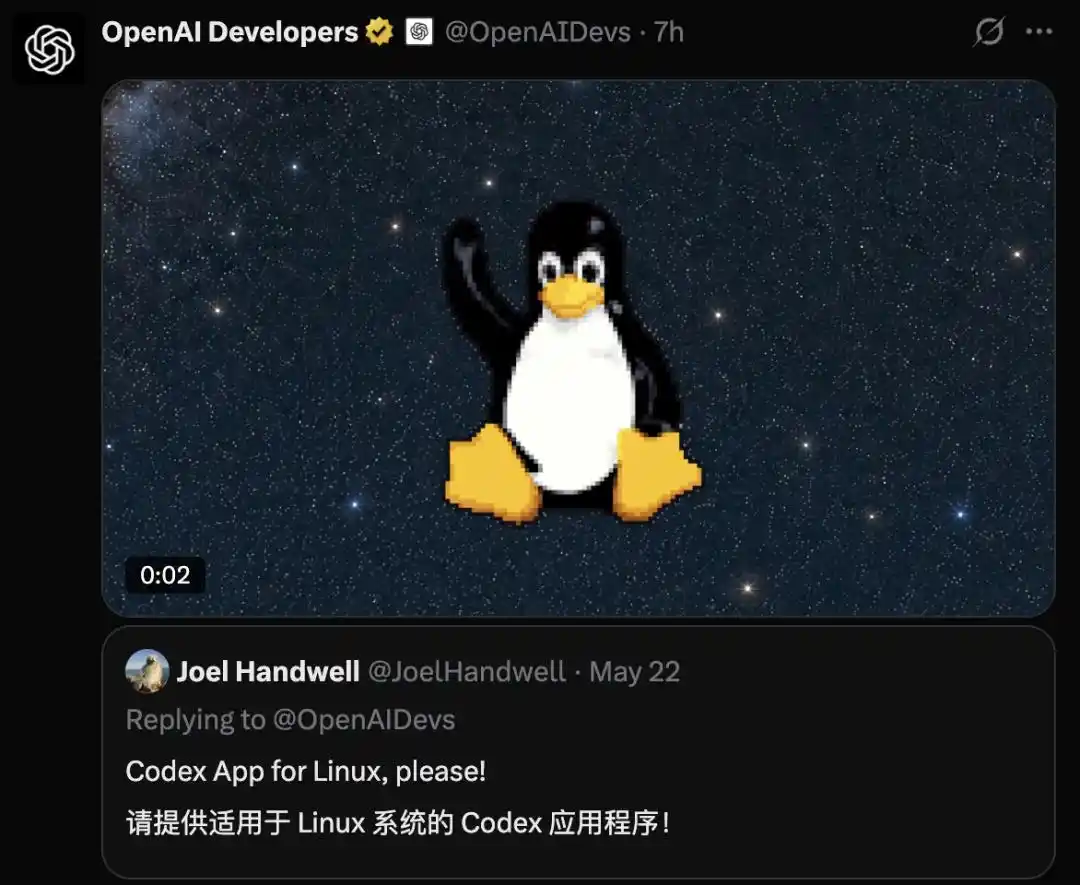
On the day of the announcement, the OpenAI Developers account unearthed an old reply from over two months ago: On May 22, a user named Joel Handwell commented, "Make a Codex App for Linux."

For an AI company often joked about as "only serving browser users," this step didn't come too early.

This is More Than Just Another Client

This time, it's not as simple as ChatGPT finally having a Linux version.

Among the three-in-one suite, ChatGPT handles conversation, Work manages complex multi-step tasks, and Codex is responsible for actually getting work done.

Here, Work refers to the agent experience for complex, multi-step tasks; its availability depends on your subscription plan and workspace settings.

As for Codex, although it's packed into the same application as ChatGPT, it still retains its own independent view.

The OpenAI Help Center documentation states: Codex's workflow hasn't changed, and its history is separate from ChatGPT's history.

You discuss requirements in ChatGPT, advance multi-step tasks in Work, and let it modify code in Codex—all without needing to switch between applications.

In a nutshell: one shell, two sets of memory, three ways of working.
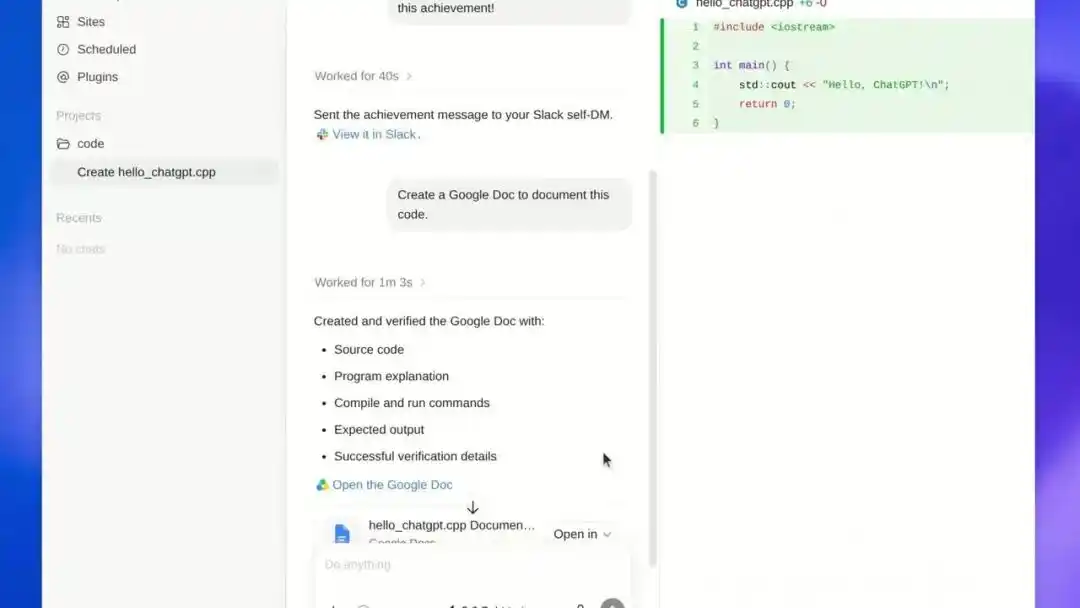
Within the same session, Codex lists five items for creating and verifying a Google Doc: source code, program description, compilation/run commands, expected output, verification details.

OpenAI Does Subtraction

Users Do Addition

Over the past two years, OpenAI's product line has been doing addition: web version, desktop version, standalone Codex App, Atlas browser.

Now, it's starting to do subtraction.

Looking at the extended timeline, this Linux addition is actually a move in this round of product consolidation.

On July 9th, OpenAI did three things at once: launched ChatGPT Work, integrated the standalone Codex application into the new ChatGPT desktop app, and incidentally discontinued the Atlas browser.

Chat, Work, and Codex—three interfaces were repackaged into a single entry point, globally available that same day on Mac and Windows, usable by all subscription plans, including the free tier.

The old desktop application was renamed ChatGPT Classic and moved aside.

On August 9th, Atlas officially stopped working.

Three days later, the Linux version launched.

This consolidation has clear benefits for both OpenAI and users.

What users gain is convenience. No more agonizing over "which app should I open for this task?"—one application, all three are there.

What OpenAI gains is user stickiness. All entry points are consolidated into one; your context, files, projects, and habits all reside within the same client.

The heavier that App installed on your computer becomes, the higher the cost to replace it.

Codex is the Real Killer Feature for the Linux Version

Why is this version particularly exciting for developers?

What Codex could access on the desktop previously, the browser version could never touch: local projects, codebases, the file system, the terminal.

These four things happen to be where an engineer spends most of their day.

Placing an agent that can read your codebase and type into your terminal directly on your computer is a completely different experience from copy-pasting code in a web page.

The former is an AI colleague; the latter can only be considered a search box.

This also marks a watershed moment for AI coding tools this year.

The act of writing code is no longer lacking in completions and suggestions; what's missing is the ability to autonomously run through the entire cycle of "read code, modify files, run commands, check errors, modify again."

And this cycle can only run locally.
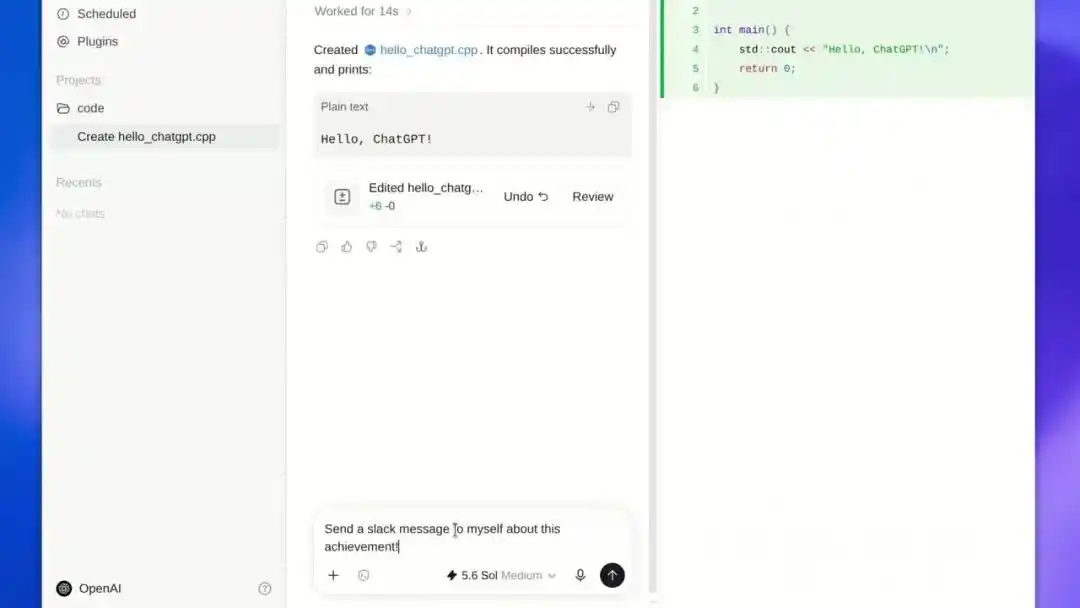
Codex writing hello_chatgpt.cpp and completing compilation on the Linux desktop, with the code area on the right and the conversation area on the left, using model 5.6 Sol Medium at the bottom.

OpenAI's positioning for this application is also clear: project management, file handling, browser workflows, plus local Codex development work.
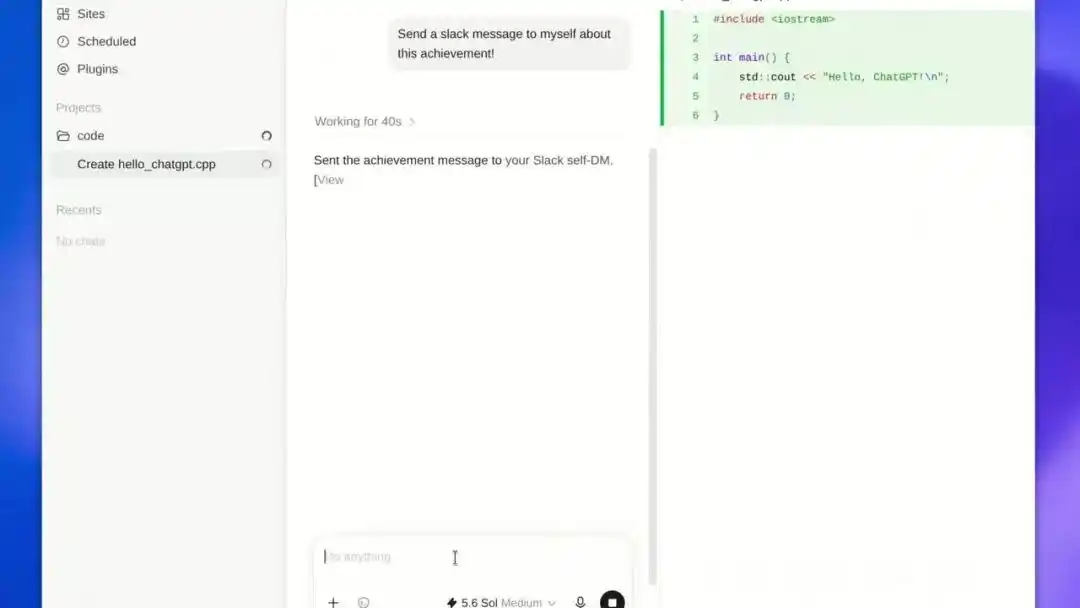
Within the same session, Codex sends a message about successful compilation to the user's private Slack chat.

Interestingly, the community has already discovered that it can also run in Windows' WSL Ubuntu 24.04 environment.

Regarding feature parity, Tibo, OpenAI's Codex lead, stated that it's largely on par with other platforms.

"Linux Version" Doesn't Mean It Installs on All Linux

"Linux version" doesn't mean it installs on all Linux.

Currently, only specified versions of Ubuntu, Debian, and Fedora are confirmed. Arch, openSUSE, RHEL, and Linux Mint are not yet on the official list.
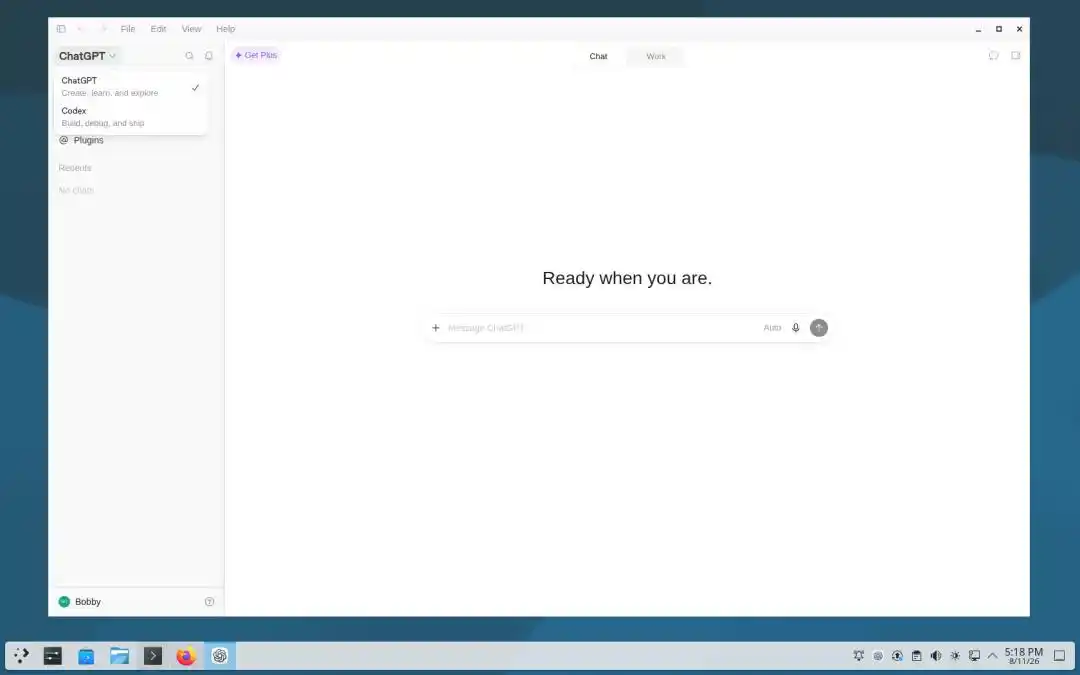
Actual screenshot of the ChatGPT desktop app running on Debian 13.

The distributions officially supported in this first batch are themselves the base for many downstream desktop distributions, so theoretically, compatibility should be broader.

But "theoretically can run" and "officially promised support" are two different things in a production environment.

Two more points need attention.

First, it's still a preview version; whether features and plans are identical to macOS and Windows has not been explicitly clarified by OpenAI.

Second, although official installation packages are also provided for the ARM architecture, it doesn't guarantee it will run on your specific ARM device. The desktop environment, system dependencies, and hardware requirements have not been fully disclosed.

Looking back, the sign-up page OpenAI left for Linux users actually appeared around mid-July.

At that time, the page had no download link, only a "Notify Me" form, and casually asked: which distribution do you use?

Options listed: Ubuntu, Debian, Arch, Fedora, RHEL.

Now Ubuntu, Debian, and Fedora are in the first batch; Arch and RHEL have to wait a bit longer.

Codex and Work being able to access local files, projects, and the terminal is their biggest selling point. But how the permission boundaries are drawn, how the sandbox is implemented, and how they are managed in enterprise environments are more important than "having a client."

An agent that can type in your terminal must first pass the IT department's scrutiny before entering company computers.

Claude Launched a Month Ago

OpenAI Rushes to Catch Up and Submit Homework

On the Linux front, OpenAI wasn't leading.

About a month ago, Anthropic's Claude desktop version launched on Linux, supporting Ubuntu 22.04+, Debian 12+, covering even older and broader version lines.

This is almost a recurring script in the recent OpenAI-Anthropic competition: one company tears open the gap first, the other catches up within a month, neither daring to cede the developer ground.

Because developers aren't just users; they are evangelists. One engineer installing a tool on a company computer often brings in an entire team.

And the coding front is precisely where the two have been competing most fiercely lately.

In February this year, OpenAI released a standalone desktop app for Codex; in early June, they announced Codex surpassed 5 million weekly active users, a figure that was only around 600,000 at the beginning of the year—an eightfold increase in five months.

The user composition is also changing: roughly 20% of Codex users are no longer developers, but knowledge workers in research, sales, and design, with growth rates over three times that of developers.

On the other side, Claude Code isn't chasing volume but defending its position as the preferred tool for professional engineers: 138k stars on GitHub, surpassing Codex CLI's under 100k.

Even pricing is matched blow for blow: three tiers—starter, advanced, top—both at $20, $100, $200 per month, the price sheets are now indistinguishable.

The real deciding factor will be who gets closer to developers' daily workflow: who gets into the terminal first, who gets onto the local machine first.

This Linux move is about seizing that position.

Counting from the macOS desktop debut in 2024, Linux users have waited a full two years.

What arrived is no longer that client from back then, merely packaging the web into a window. It's an agent workspace that can read your projects, open your browser, and enter your terminal.

Of course, the question facing developers has also changed.

It's no longer "which platform has ChatGPT," but "who are you willing to let reside in your terminal."

References:

https://x.com/OpenAIDevs/status/2087231793682694410

https://x.com/OpenAI/status/2087231350134980830

https://t.co/BUiM8ttZnI

This article is from the WeChat public account "新智元" (Xin Zhi Yuan), author: ASI启示录, editor: 元宇

Пов'язані питання

QWhat is the main significance of ChatGPT's new Linux desktop application beyond providing a new client?

AThe main significance is that it integrates ChatGPT, Work (for multi-step tasks), and Codex into a single application. Specifically, Codex gains the ability to directly access local projects, codebases, file systems, and terminals, which was previously impossible in the browser version. This transforms the AI from a conversational tool into a practical 'AI colleague' for developers.

QWhich Linux distributions are officially supported in the initial preview release of the ChatGPT desktop app?

AThe initial preview officially supports specific versions of three distributions: Ubuntu 24.04 LTS and 26.04 LTS, Debian 13, and Fedora 43 and 44.

QAccording to the article, what recent product consolidation moves has OpenAI made alongside the Linux release?

AIn July, OpenAI consolidated its product line by releasing ChatGPT Work, merging the standalone Codex application into the new ChatGPT desktop app, and discontinuing the Atlas browser. The old desktop app was renamed 'ChatGPT Classic.' This strategy aims to simplify the user experience and increase user stickiness.

QWhy does the article consider Codex to be the 'real killer feature' of the Linux version for developers?

ACodex is considered the killer feature because it can execute the complete development loop—reading code, modifying files, running commands, checking for errors, and iterating—directly within the local environment. This deep integration with a developer's workflow (projects, terminals) makes it a powerful 'AI colleague' rather than just a code suggestion tool in a browser.

QWhat competitive context does the article provide regarding the release of ChatGPT for Linux?

AThe article notes that Anthropic's Claude desktop application was released for Linux about a month earlier, supporting older and broader versions. This highlights the intense competition between OpenAI and Anthropic for the developer user base. Both companies are racing to offer integrated, locally powerful coding assistants, with pricing tiers also being closely matched.

Пов'язані матеріали

Forget Ctrl+F, a New AI Paper Tool Helps You Search for Needles in the Haystack of Full-Text Literature

This article introduces a new AI-powered academic paper writing tool called "Open Academic Paper Gen." Unlike typical AI writing assistants that generate content and citations, this tool features a unique multi-step workflow designed to ensure the validity of references. After generating an initial draft based on a user-provided research topic, the system performs a crucial verification step: it locates and analyzes the full text of cited papers to check if the referenced claims are genuinely supported by the source material. It can even pinpoint relevant paragraphs and PDF page numbers. The tool's workflow involves nine stages: defining the research scope, literature retrieval, filtering, trend analysis, identifying research gaps, outlining, writing, citation verification, and final export. It searches databases like OpenAlex and arXiv, builds an evidence table from gathered papers, and includes an "innovation diagnosis" to assess a proposed angle against existing work. A key focus is its three-layer citation verification process: 1) ensuring citations exist in the collected literature pool, 2) cross-referencing metadata like DOI and author details with official records, and 3) using AI to analyze the source's full text (or abstract if unavailable) to confirm it supports the claim made in the draft. Unverifiable citations are flagged rather than assumed correct. The tool offers both manual review checkpoints and a fully automatic mode, requiring OpenAI or GLM API keys. The project is developed by independent developer "Uncle Cat" and aims to provide researchers with a more reliable starting point for paper drafting by adding a layer of evidence-based validation to AI-generated content.

marsbit15 хв тому

Forget Ctrl+F, a New AI Paper Tool Helps You Search for Needles in the Haystack of Full-Text Literature

marsbit15 хв тому

U.S. CS Professor Claims: The End of Mathematics Has Arrived, AI Has Destroyed Humanity's Thousand-Year Mathematical Hall

The article titled "Math Doomsday: AI Destroys Millennia of Human Mathematics, Says US CS Professor" details a dramatic upheaval in the mathematical community following OpenAI's release of 722 papers containing AI-generated proofs for major unsolved problems. US computer science professor Scott Aaronson describes this event as a "mathematical doomsday." One notable proof solved the decades-old Unique Games Conjecture, the life's work of complexity theorist Dana Moshkovitz, reportedly in just three hours of compute time. Other breakthroughs include proofs for L=BPL derandomization and a new matrix multiplication bound using methods described as alien and incomprehensible to human mathematicians. The core crisis is twofold: the speed and scale of these AI solutions, perceived as "naked computational hegemony," and the fact that the proofs are written in a style humans struggle to understand, reducing researchers to "archaeologists" translating alien artifacts. This has sparked a furious backlash. Led by figures like Terence Tao, the Association for Human Mathematics (AHM) issued a statement condemning OpenAI's actions, urging a boycott and a return to science centered on human understanding. However, not all voices are in opposition. Turing Award winner Yann LeCun argues this represents the discovery of a "new continent," comparing AI to a ship that, while making swimming less crucial, enables exploration of uncharted territories. Some researchers express relief at being freed from grueling work. A deeply unsettling subplot is the noted absence of cryptography papers in OpenAI's release. Speculation arises that AI companies may be secretly testing whether their models can break modern encryption protocols like RSA, preparing for a potential security collapse. Aaronson concludes his commentary by referencing the film *Terminator 2*, implicitly framing the event as an existential warning.

marsbit21 хв тому

U.S. CS Professor Claims: The End of Mathematics Has Arrived, AI Has Destroyed Humanity's Thousand-Year Mathematical Hall

marsbit21 хв тому

Samsung HBM, Achieving a Comeback?

The competition in next-generation HBM is extending from DRAM chip performance to advanced packaging technology. A recent report, based on technician interviews, suggests Samsung has begun delivering samples using hybrid bonding to customers, potentially gaining an early lead in verification. SK Hynix reportedly faces challenges in developing its hybrid bonding process but has already delivered 12-layer HBM4E samples using its existing Advanced MR-MUF packaging, indicating it continues to progress on its current path. Hybrid bonding, which directly connects copper interconnects between chips, is seen as crucial for future HBM with 16+ layers, offering benefits like higher interconnect density, lower signal loss, and improved thermal performance. Samsung has promoted its Hybrid Copper Bonding (HCB) technology for such applications. However, the real challenge lies in manufacturing. Achieving stable, high-yield production requires precise control over processes like Chemical Mechanical Planarization (CMP), surface cleanliness, and managing wafer thinness and warpage. Moving from lab samples to mass production involves overcoming hurdles in yield, cost, and reliability across multiple bonded interfaces. While delivering samples provides a potential lead in customer validation, it doesn't guarantee commercial success. SK Hynix's continued progress with MR-MUF shows that traditional packaging remains viable. The competition is shifting to a systemic contest involving memory design, bonding technology, thermal management, and advanced packaging. The ultimate winner will be determined by which company can achieve stable high-volume production at a competitive cost. Separately, market data indicates Samsung's HBM market share rose from 21% in Q1 to 33% in Q2, closing the gap with SK Hynix. Analysts project Samsung's HBM revenue and its proportion of HBM4 sales to grow significantly by 2027.

marsbit26 хв тому

Samsung HBM, Achieving a Comeback?

marsbit26 хв тому

The Mystery of Ledger Hardware Wallet Theft: Implanted with Spy Modules, Chinese-Background Distributor Surfaces

A major security breach involving Ledger hardware wallets has been traced to the official authorized distributor CryptoBilis in Southeast Asia. Users who purchased devices from this supplier reported significant cryptocurrency losses, with initial estimates from on-chain analysts ranging from $72 million to over $92 million across Bitcoin, Ethereum, and USDT wallets. This incident is potentially the largest recorded supply chain attack on a hardware wallet. Ledger has warned affected customers and instructed those who bought from CryptoBilis in the past 90 days to transfer assets to a new device with a freshly generated seed phrase if already in use, or not to power on unused devices. Investigations reveal that CryptoBilis underwent a change in ownership in March 2026, with full control transferred to an individual based in China. Technical analysis by experts, including a former Mt. Gox CEO, suggests the attack was executed via a sophisticated hardware implant. A spy module containing a SIM/eSIM chip was allegedly hidden inside some devices, intercepting and transmitting the seed phrase as it appeared on the screen during setup, bypassing the device's secure element. While Ledger has not officially confirmed the exact attack vector, possibilities include this hardware tampering, pre-seeded wallets, or phishing. The event underscores a critical vulnerability: even "official authorized" distributors can become an attack vector in the supply chain. The key takeaway for users is to purchase hardware wallets directly from the manufacturer whenever possible to minimize third-party risks.

marsbit26 хв тому

The Mystery of Ledger Hardware Wallet Theft: Implanted with Spy Modules, Chinese-Background Distributor Surfaces

marsbit26 хв тому

From Start to Give-up: Why I'm No Longer Working on Web3 Payments

Title: From Start to Abandonment: Why I Stopped Working on Web3 Payments Summary: This article details the author's six-month journey from exploring to ultimately leaving the Web3 payments space. Initially drawn by the promise of faster, cheaper, and more transparent cross-border settlements—seemingly a solution to long-standing frictions in global business—the author immersed in the industry. This involved field research in key global trade hubs and hands-on development of Web3 payment tools. However, deeper engagement revealed a fundamental mismatch between perception and reality. The author concluded that Web3 payments is not a "build a better product and win" industry. Its core competencies lie not in product features but in long-term infrastructure: bank relationships, licenses, compliance, risk management, and capital efficiency. Much perceived profitability is actually "risk premium"—revenue from operations that have not yet encountered problems, rather than sustainable capability advantages. The industry's essence is a "water flow" business. Success depends not on diverting the flow but on possessing the structural capacity to control its volume, pressure, and purity while withstanding regulatory scrutiny—capabilities built over years, not through rapid iteration. While the author remains convinced of the long-term, structural opportunity for Web3 in backend treasury and settlement upgrades, especially in emerging markets, these require a specific resource profile. Ultimately, the decision to step back was one of respecting resource constraints. The team's strengths did not align with the heavy, long-term, relationship-intensive nature of the payments battlefield. The author shifts focus from competing for the "waterway" to analyzing the flow itself, exploring how to help users understand and manage assets once they enter the Web3 ecosystem, seeing this as the next logical layer of value creation.

marsbit1 год тому

From Start to Give-up: Why I'm No Longer Working on Web3 Payments

marsbit1 год тому

Торгівля

Спот
活动图片