Hyperliquid's Path to U.S. Compliance: From Permissionless to Permissioned HIP-3

marsbitОпубліковано о 2026-09-04Востаннє оновлено о 2026-09-04

Анотація

Hyperliquid's evolution from a permissionless platform to a regulated one for the US market is its central narrative. Its core infrastructure, HyperCore, separates functions like trading, clearing, and brokerage in a modular, on-chain system. However, its permissionless, self-custody model conflicts with US regulations requiring registered exchanges (DCM), clearinghouses (DCO), and brokers (FCM). To address this, Hyperliquid has geoblocked the US and launched the Hyperliquid Policy Center (HPC) to advocate for regulatory modernization, allowing licensed entities to build compliant products on its infrastructure. The proposed solution involves HIP-3, a permissioned DEX framework on the testnet. This allows regulated deployers to list markets and whitelist KYC'd users, creating compliant order books. Crucially, liquidity can bridge between these and the native permissionless markets via market makers, preventing fragmentation. Features like direct account control ("PA" payload) mimic traditional broker authorities. The strategy aims to "onshore" Hyperliquid by enabling US firms to use its neutral infrastructure while fulfilling their regulatory duties, keeping the core protocol unchanged.

Author: shaunda devens

Compilation: Baihua Blockchain

Disclaimer: This article is reproduced content. Readers can obtain more information through the original link. If the author has any objections to the reproduction form, please contact us, and we will make modifications as requested by the author. Reproduction is for information sharing only and does not constitute any investment advice, nor does it represent the views or positions of Wu Shuo.

Full text as follows:

Hyperliquid continues to implement geographic blocking (geoblocked) for the U.S. market because its permissionless on-chain infrastructure conflicts with U.S. market structure laws—which strictly limit futures trading to registered trading platforms, clearinghouses, and brokers. The Hyperliquid Policy Center has urged the CFTC and SEC to modernize these regulatory frameworks, advocating that regulated entities should be allowed to build products on HyperCore through builder and deployer seats, as long as they undertake corresponding compliance obligations. Now, corroborated by Trump's statement, the most likely path for Hyperliquid's onshoring is through a permissioned HIP-3 DEX.

I. Core Details

Over the past year, much of our work on Hyperliquid has been to reposition it from a "decentralized perpetual contract trading platform" to "modern market infrastructure": a globally accessible, composable platform for financial instruments encompassing perpetual contracts, spot, and prediction markets.

Unlike monolithic crypto platforms like Coinbase and Binance that handle the entire process themselves (from user onboarding, custody to trade execution), Hyperliquid's infrastructure layer is more akin to the separation of duties across entities in traditional finance (TradFi): the trading platform (DCM) is responsible for listing contracts and matching trades; the clearinghouse (DCO) is responsible for providing margin and ensuring settlement; the broker (FCM) is responsible for user onboarding and routing trading access.

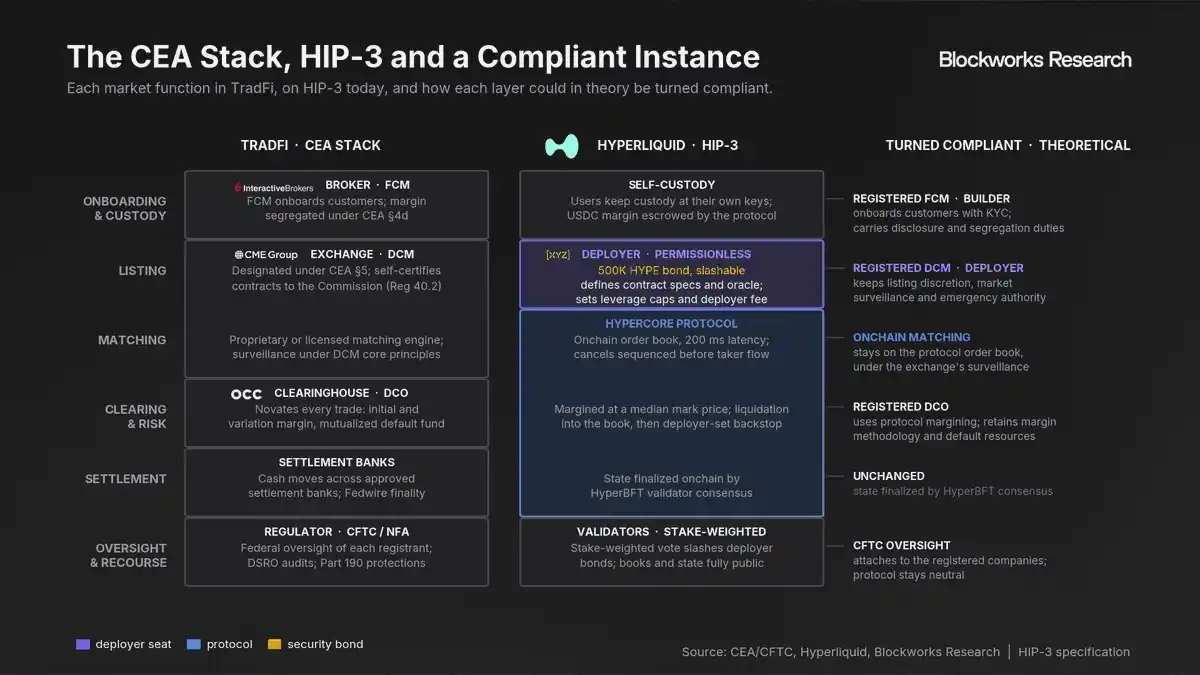
Similarly, Hyperliquid's modular technology stack embodies this exact same separation of duties. HyperCore (the trading platform and clearing layer) runs matching, margin calculation, and settlement as underlying protocol logic, marking positions to market based on validator oracles, and executing liquidations through a deterministic waterfall mechanism. Deployers must stake 500,000 HYPE as slashable margin, responsible for token listing, setting contract specifications, leverage limits and oracle configurations, and can retain up to 50% of the fees generated by their markets. Builders act as brokers, responsible for guiding user onboarding and routing trading flow to HyperCore, receiving a share of transaction fees.
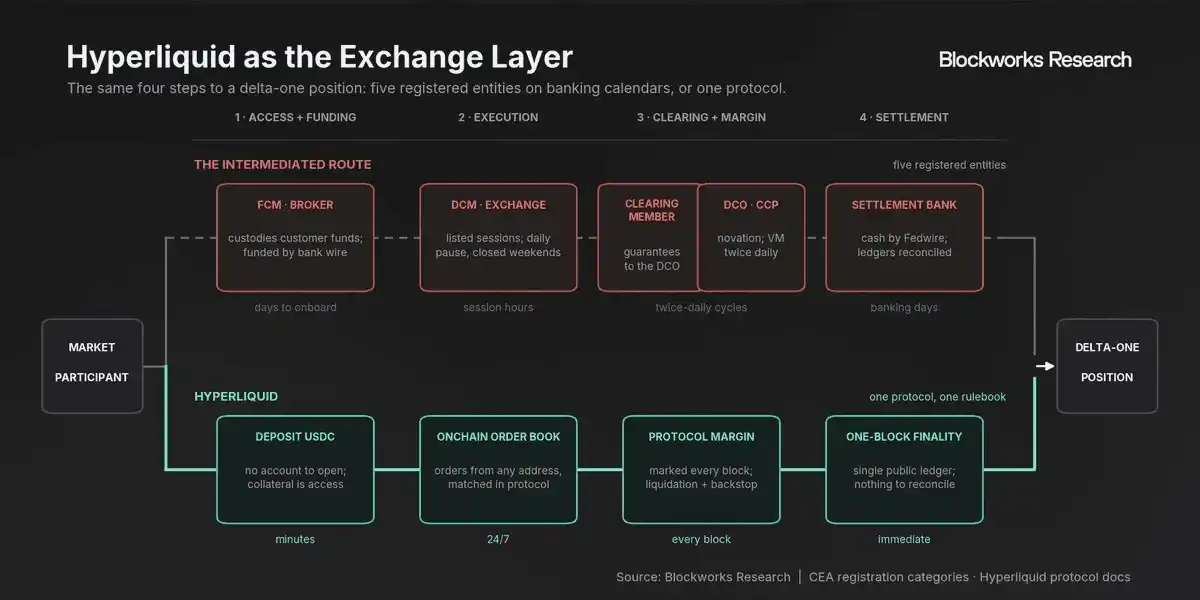
However, Hyperliquid reconstructs these layers on-chain and enforces them through programmed code: onboarding and market creation are permissionless, assets are fully self-custodied by users, other applications can be built on top of it, and all assets are traded 24/7 on a single global platform, eliminating the geographical and legal fragmentation of traditional finance.

II. Hyperliquid's Regulatory Dilemma

In this context, Hyperliquid's biggest challenge is regulation: U.S. market structure laws are tailored for traditional architecture, and each of its legally defined registered roles structurally conflicts with Hyperliquid's underlying design. For example:

• A Designated Contract Market (DCM) must adhere to 23 core principles under Section 5(d) of the Commodity Exchange Act (CEA), including market surveillance and customer identification. Yet anyone with a wallet can access HyperCore.

• A Derivatives Clearing Organization (DCO) must calculate margin using models approved by its board with 99% confidence levels and settle through approved settlement banks (17 CFR §§39.13–39.14). HyperCore relies on protocol logic for margin calculation and settles at the consensus layer.

• A Futures Commission Merchant (FCM) must segregate customer funds under CEA Section 4d. Hyperliquid users self-custody, which is fundamentally different from the custodial FCM model.

It is these stringent requirements that have forced even centralized KYC-enforcing platforms like Coinbase to register as FCMs and acquire existing DCM companies for their U.S. operations. Hyperliquid cannot replicate this model because acquiring a DCM and conforming to existing regulation would contradict its goal of "revolutionizing underlying infrastructure"; therefore, it chose to self-impose geographic blocking, withdrawing from the world's largest capital market.

Nonetheless, Hyperliquid's goal is not to remain offshore permanently: In February 2026, it announced the establishment of the Hyperliquid Policy Center (HPC), funded with 1 million HYPE (approximately $72.5 million at current prices), dedicated to bringing this new market structure within the U.S. legal framework.

In July, HPC, alongside Phantom, petitioned the CFTC to confirm that releasing on-chain software itself does not trigger licensing requirements, allowing existing licensed institutions to run matching, settlement, and margin calculation on on-chain infrastructure, and establishing exemptions that permit non-custodial wallets to route users to regulated derivatives. In August, HPC and TradeXYZ brought the same logic to the SEC, proposing a regulatory framework for Pre-IPO perpetual contracts (such as SpaceX and Cerebras, already trading on Hyperliquid), accompanied by disclosure and qualification rules necessary for opening them to U.S. investors. Early signs indicate the strategy is working and U.S. regulators are receptive, the most visible signal being Trump's announcement that Chairman Selig plans to push for Hyperliquid's onshoring.
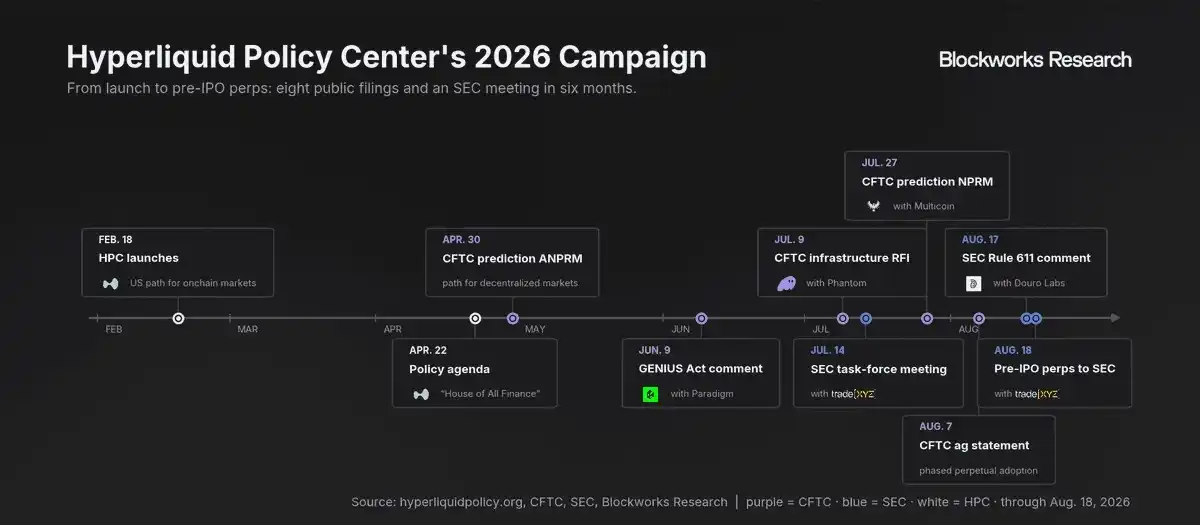
HPC's strategy is not to request opening Hyperliquid directly to U.S. investors without KYC, but to advocate for it as neutral infrastructure: if U.S. companies can use it while fulfilling their regulatory duties under current law, then it should be an option alongside traditional DCMs. For instance, brokers could route client trading flow to HyperCore as long as they fulfill KYC obligations; or deployers could take on the role of registered trading platforms, retaining listing discretion, market surveillance, and emergency intervention powers.
III. Hyperliquid's Compliance Examples

As policy advocacy progresses in Washington, Hyperliquid Labs has already rolled out updates on testnet, theoretically enabling such compliant access. The most typical example is the permissioned HIP-3 deployer: unlike Hyperliquid's native markets and existing HIP-3 deployments which are completely open, these new deployments are only accessible to whitelisted users. Such deployments provide a clear path for regulated entities to list markets, enforce KYC, and whitelist compliant users for trading.
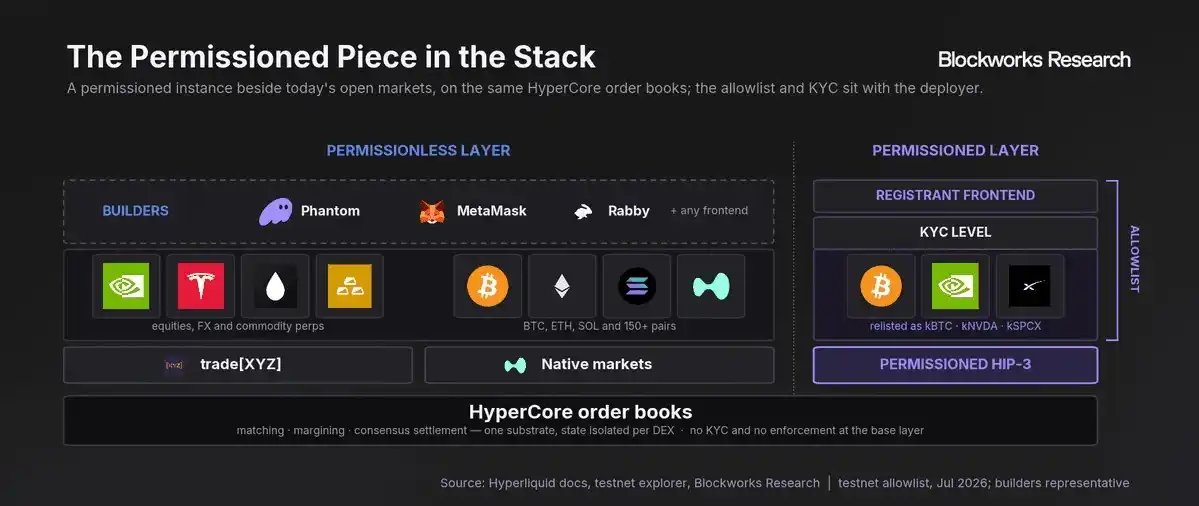
These compliance instances will manifest as fragmented order books, as all markets (e.g., BTC and RWA markets) need to be re-listed. However, whitelisted market makers will bridge liquidity between the two order books, thereby eliminating liquidity fragmentation, allowing the new deployments to inherit Hyperliquid's deep liquidity while maintaining independent order books. This independent order book model has precedents (e.g., early Binance US and Lighter's deployment on Robinhood Chain today), but the difference is that because both markets on Hyperliquid run on the same L1, sharing collateral and margin without the need for cross-chain or cross-exchange transfers, liquidity can flow seamlessly between order books rather than being isolated.
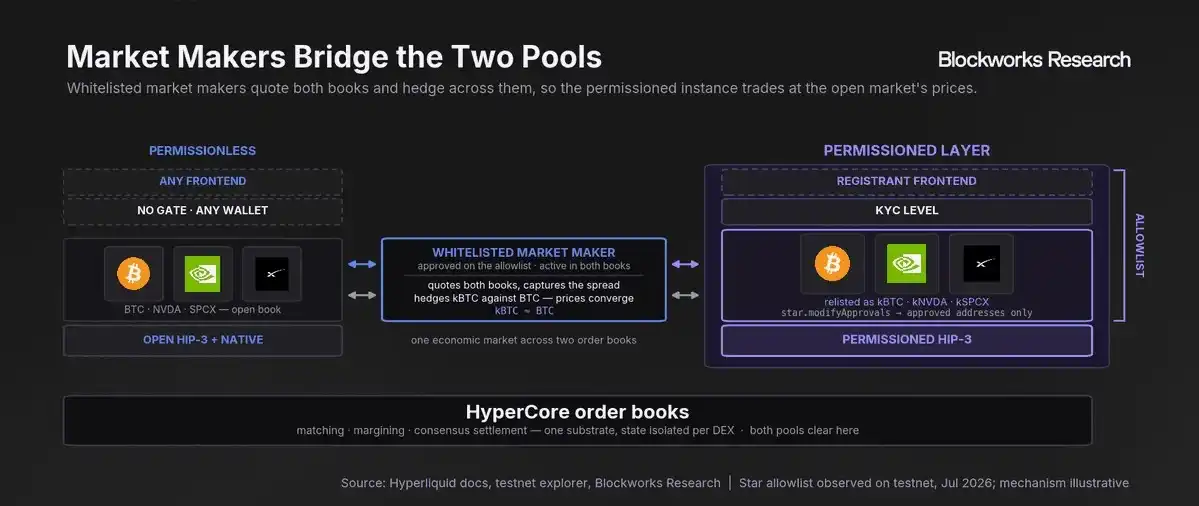
These trading platforms also include other parameters, such as the "PA" account operation permission in the payload, which allows the DEX to directly execute operations on user accounts: submitting reduce-only orders, canceling orders, and transferring USDC internally within the DEX, similar to the close-out authority an FCM has over client accounts. These elements collectively outline the future evolutionary path: U.S. brokers and institutions now have the tools to build compliant Hyperliquid products on HyperCore. This choice is additive—Hyperliquid's native markets remain permissionless, and its position as neutral infrastructure remains unchanged.

IV. Research View

Hyperliquid's recent moves in Washington indicate that gaining compliant entry into the U.S. domestic market is a current core priority; yet it is equally clear that operating directly through its native, KYC-free frontend is not compliant under current U.S. law. We believe HPC's efforts point to a path for achieving KYC-compliant access: allowing the use of Hyperliquid's underlying infrastructure, provided the enterprises offering access fully adhere to regulations. With enabling tools now live on testnet (permissioned HIP-3 deployers, PA account control), we expect this implementation method will provide a compliant channel for U.S. investors to participate in Hyperliquid's markets, while preserving the protocol's nature as neutral infrastructure.


Пов'язані питання

QWhat is the main regulatory challenge Hyperliquid faces in the US market according to the article?

AHyperliquid faces a regulatory challenge because its permissionless, on-chain infrastructure conflicts with US market structure laws. These laws restrict futures trading to registered exchanges, clearinghouses, and brokers, which clashes with Hyperliquid's design where anyone with a wallet can access its core protocol (HyperCore) and where users self-custody assets.

QWhat is the primary strategy of the Hyperliquid Policy Center (HPC) for achieving compliance in the US?

AThe Hyperliquid Policy Center's strategy is to advocate for regulatory modernization. It urges the CFTC and SEC to update frameworks so that regulated entities (like brokers or exchanges) can build compliant products on Hyperliquid's neutral infrastructure (HyperCore) as long as they fulfill their corresponding legal obligations (like KYC). This allows the protocol to remain permissionless while enabling regulated access.

QHow does the article describe the functionality of a HIP-3 deployer with permissions management?

AA HIP-3 deployer with permissions management creates markets that are only accessible to a whitelist of users. This provides a clear path for regulated entities to list markets, perform KYC on users, and only allow compliant users to trade. It functions with a separate order book but can inherit liquidity from Hyperliquid's main markets through market makers bridging the two.

QWhat does the 'PA' (Payload Authority) operational permission allow a DEX to do, according to the article?

AThe 'PA' (Payload Authority) operational permission allows a DEX to directly execute actions on a user's account. This includes submitting reduce-only orders, canceling orders, and transferring USDC within the DEX. This is analogous to the close-out authority that a Futures Commission Merchant (FCM) has over a client's account in traditional finance.

QWhat is the ultimate goal of Hyperliquid's compliance efforts as presented in the article, and how does it aim to achieve it?

AThe ultimate goal is to 'onshore' Hyperliquid to the US market in a compliant manner without abandoning its core infrastructure principles. It aims to achieve this by positioning HyperCore as neutral infrastructure. The path involves regulated entities (brokers, exchanges) using tools like permissioned HIP-3 deployments to create compliant, KYC-gated products on top of Hyperliquid, thereby providing US investors access while the underlying protocol remains permissionless.

Пов'язані матеріали

New Huo Research Institute: Bitcoin Enters Critical Data Window, Market Searches for Direction Between Interest Rates, ETF Fund Flows, and Technical Resistance

Sinohope Research reports that digital asset markets are at a critical juncture. While expectations for US interest rate hikes have cooled, long-term Treasury yields remain high, and institutional capital flow signals are mixed. Bitcoin trades in a narrow range near key resistance, with focus shifting from Fed policy to whether incoming economic data can support risk assets. The probability of a November FOMC rate hike has dropped significantly, theoretically supporting assets like Bitcoin. However, persistent high yields mean financial conditions aren't fully accommodative, explaining the lack of a decisive breakout. Capital flows are divergent. US spot Bitcoin ETFs show alternating inflows and outflows, suggesting no large-scale renewed institutional buying yet. Ethereum-related ETFs are influenced by sector rotation. Market attention is also on crypto-heavy public companies like Marathon Digital and Riot Platforms as proxies for corporate adoption. Policy developments, including the US stablecoin bill progress and SEC/CFTC regulatory stances, continue shaping institutional participation expectations. For Ethereum, staking queues remain positive, indicating sustained long-term demand, though short-term price action hinges on overall risk appetite. Key near-term catalysts include upcoming US inflation/employment data and the late-October FOMC meeting. Supportive data could push Bitcoin to test higher resistance, while hot data or rising yields could pressure valuations. Technically, Bitcoin consolidates between ~$80,300 and ~$87,100. A breakout above $85,600 with volume could target ~$87,395, while failure could lead to tests of support near $83,000 or $79,000. Key moving averages and Bollinger Bands indicate ongoing high-volatility consolidation.

marsbit16 хв тому

New Huo Research Institute: Bitcoin Enters Critical Data Window, Market Searches for Direction Between Interest Rates, ETF Fund Flows, and Technical Resistance

marsbit16 хв тому

After the Cooldown, Let's Review: Who Actually Made Money on Papertrade?

"Papertrade Review: Who Actually Made Money?" Following Papertrade's launch, $23.9M in dividends were distributed to stakers in the first 8 hours, but only $2.4M over the next 37 hours, highlighting the game's rapid shift. Research accurately predicted the mechanics but underestimated the speed of evolution. Real traders on Papertrade collectively lost $32.4M. The majority of the $26.3M distributed to stakers was captured by early, large-scale depositors before UTC 22:00 on launch day, facilitated by a relayer prioritizing large orders. Two key strategies emerged: 1) A "hunting" address (0x2025...) profited ~$1.1M by manipulating ETH prices on another platform and placing massive opposing orders on Papertrade. 2) A "volume farming" address (0x35b2...) executed $10.1B in trades, broke even on cash flow, but secured a massive 4% share of the staked PAPER supply, generating substantial passive yield. For new entrants, the economics are now challenging. The cost to farm 1000 PAPER is ~$33 via direct loss or ~$4.50 via hedged arbitrage. With current staking yields (~$0.055 daily per 1000 PAPER), payback periods are ~80 days and ~590 days respectively, assuming static conditions—which is unlikely. The situation will worsen on October 17th when the dividend trigger threshold rises from $5M to $10M in the house LP pool. Stakers will only receive fees until the pool refills. The future hinges on four metrics: the house LP pool exceeding and sustaining above $8M, genuine non-farming trading volume, net long Open Interest, and a payout queue remaining at zero. Current participation is less about steady yield and more a bet on future traders losing enough to refill the LP pool past the new threshold.

marsbit21 хв тому

After the Cooldown, Let's Review: Who Actually Made Money on Papertrade?

marsbit21 хв тому

Storage 'Deleveraging' Triggers 'Margin Call Fear' Among South Korean Retail Investors

Korean retail investors are gripped by "margin call fears" as the KOSPI index experiences a sharp correction, falling nearly 32% from its June peak. The downturn, triggered by a strong Q3 earnings preview from Samsung Electronics, reflects market anxiety over the sustainability of the memory chip boom cycle. Concerns center on whether AI-driven demand for HBM and DRAM can continue to justify high valuations amid signs of a potential cyclical peak. Compounding the sell-off was a recalibration of revenue expectations for leading AI labs like OpenAI, whose reported annualized revenue fell short of some inflated market estimates. While long-term AI infrastructure investment remains robust, the immediate market reaction highlighted sensitivity to growth narratives. Korean memory giants Samsung and SK Hynix face the dual pressure of immense capital expenditure for HBM production and rising costs from upstream equipment suppliers like ASML. Despite strong demand, their profitability is under scrutiny. The market decline has exposed the acute risks of high-leverage trading among Korean retail investors. Foreign capital outflows and the amplification effect of leveraged products, such as single-stock ETFs, have intensified the downturn, leading to widespread margin calls and significant losses for individuals. The situation underscores the vulnerability of leveraged positions when market momentum reverses, leaving many散户 unable to participate in a potential recovery.

marsbit25 хв тому

Storage 'Deleveraging' Triggers 'Margin Call Fear' Among South Korean Retail Investors

marsbit25 хв тому

Goldman Sachs Decodes: AI Giants Focus on Expansion, Who's Taking Over the Baton of US Stock Buybacks?

Goldman Sachs: Who's Taking Over the Baton of US Stock Buybacks as AI Giants Expand? Summary: While major cloud service providers are reducing share buybacks to fund increased AI capital expenditures, this contraction is being offset by robust buyback growth from AI infrastructure companies. According to Goldman Sachs, this shift in buyback sources means the overall corporate demand for US equities remains strong and is still expanding. The investment bank notes that AI capital spending is altering the composition of US stock buybacks. Although large cloud vendors are repurchasing fewer shares, AI infrastructure firms are actively increasing their buybacks, and this growth surpasses the decline from cloud providers. For instance, Nvidia recently announced a massive new buyback authorization. Goldman Sachs forecasts total US corporate buybacks will reach $1.5 trillion in 2026 and rise to $1.7 trillion in 2027. Concurrently, investor sentiment remains cautious, and hedge fund net exposure is relatively low, leaving room for potential increased positioning if corporate earnings provide a catalyst. Goldman's view that the S&P 500 could soon surpass 8,000 points is predicated on this combination of strong corporate demand (via buybacks), weak investor sentiment creating potential buying capacity, and, crucially, the delivery of solid corporate profits. The upcoming earnings season will be key to validating this outlook.

marsbit56 хв тому

Goldman Sachs Decodes: AI Giants Focus on Expansion, Who's Taking Over the Baton of US Stock Buybacks?

marsbit56 хв тому

Торгівля

Спот
活动图片