Large-scale Long-Term Bond Sell-off Forces a Severe Budgetary Reassessment

cryptonews.ruОпубліковано о 2026-08-15Востаннє оновлено о 2026-08-15

Анотація

Large-scale sell-offs in long-term government bonds have forced a major budget reassessment. Yields on key bonds surged to levels not seen in years or even decades: US 30-year Treasuries hit around 5.25% (highest since 2001), while German 30-year Bunds approached 3.73% (highest since 2011). French long-term yields returned to levels last seen during the global financial crisis, and Japan's 5-year government bond yields broke above 2.14%, signaling a departure from years of ultra-loose monetary policy. The era of ultra-cheap money, sustained by central bank stimulus post-2008 and during the pandemic, is ending. Investors now demand higher compensation for lending over decades, seeking protection against inflation, heavy bond issuance, and currency devaluation. Market patience with fiscal dysfunction is wearing thin, as seen in soaring yields for highly indebted European nations like France. The pressure stems from widening fiscal gaps in major economies (US, France, Japan), which face rising spending on defense, infrastructure, energy, and aging populations. In the US, annual federal interest payments now exceed $1 trillion. As central banks reduce bond holdings via quantitative tightening, they are withdrawing as major buyers. Governments are flooding the market with new debt, forcing private investors to demand higher yields—a rising term premium. The impact extends beyond government budgets: higher long-term yields push up mortgage rates, increase borrowing costs for cor...

A synchronous sell-off has pushed the yields of major long-term bonds to levels unseen in many years, and in some cases, decades. The yield on 30-year US Treasury bonds reached approximately 5.25%—the highest level since 2001—while the yield on 30-year German Bunds approached 3.73%—the highest level since 2011.

"Good morning from Germany, where the bond market is sending an unambiguous signal: the yield on 30-year German Bunds has risen to 3.73%—the highest level since 2011," wrote German journalist, author, and senior financial editor Holger Zschaepitz on X. "Germany now pays as much for borrowing as it did during the euro crisis era. The era of ultra-cheap money is over."
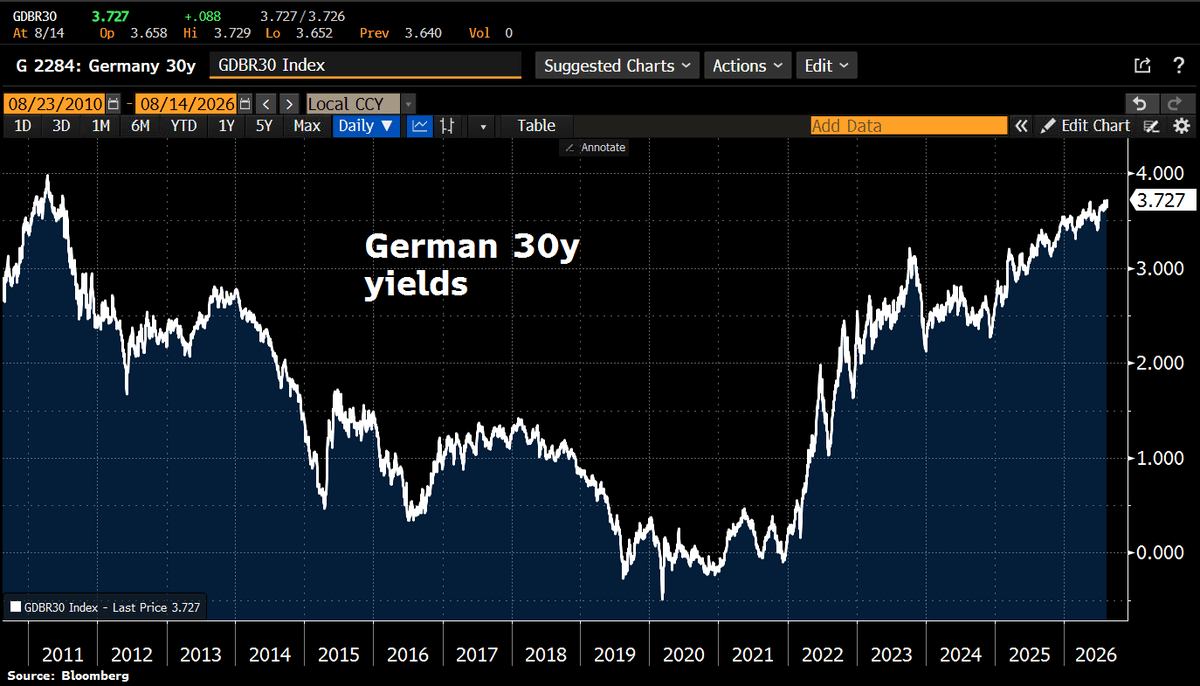
Bund yield chart provided by Holger Zschaepitz in his X post on August 15, 2026.

The yield on long-term French OAT bonds (short for Obligations Assimilables du Trésor) has returned to levels characteristic of the global financial crisis period. The yield on Japan's 5-year government bonds rose above 2.14%, marking a clear break after years of artificially soft monetary policy.

Investors Demand Compensation

Bond yield is the price governments pay investors for their money. When yields rise sharply, bond prices fall, and borrowing quickly becomes more expensive.

For over a decade after the 2008 financial crisis, central banks kept rates low and purchased vast amounts of government debt. This drove down yields, which in Europe and Japan even fell below zero. The pandemic doubled down on this trend: governments borrowed freely, and central banks prevented the market from asking inconvenient questions.

This scheme is collapsing. Investors providing credit for decades ahead now want protection from inflation, rampant bond issuance, and the erosion of the purchasing power of the cash they will get back.

"This week has seen a significant rise in the yields of long-term government bonds in heavily indebted European countries," explained Robin Brooks, a senior fellow in the Economic Studies Program at the Brookings Institution. "The situation is most notable in France, where the yield on 10y10y (orange line) and 10y20y (red line) has reached new historical highs."

Brooks added:

"The market's patience with fiscal dysfunction is running out."

Debt Markets Begin to Dictate Terms

The pressure point is fiscal policy—the growing gap between government spending and tax revenues. The United States, France, Japan, and other developed economies have accumulated massive debt while simultaneously increasing spending on defense, infrastructure, energy, and addressing aging populations.

In the US, according to recent estimates, the federal government's annual interest expense has exceeded $1 trillion. Each refinancing cycle locks in higher rates, turning yesterday's debt into tomorrow's budgetary problem.
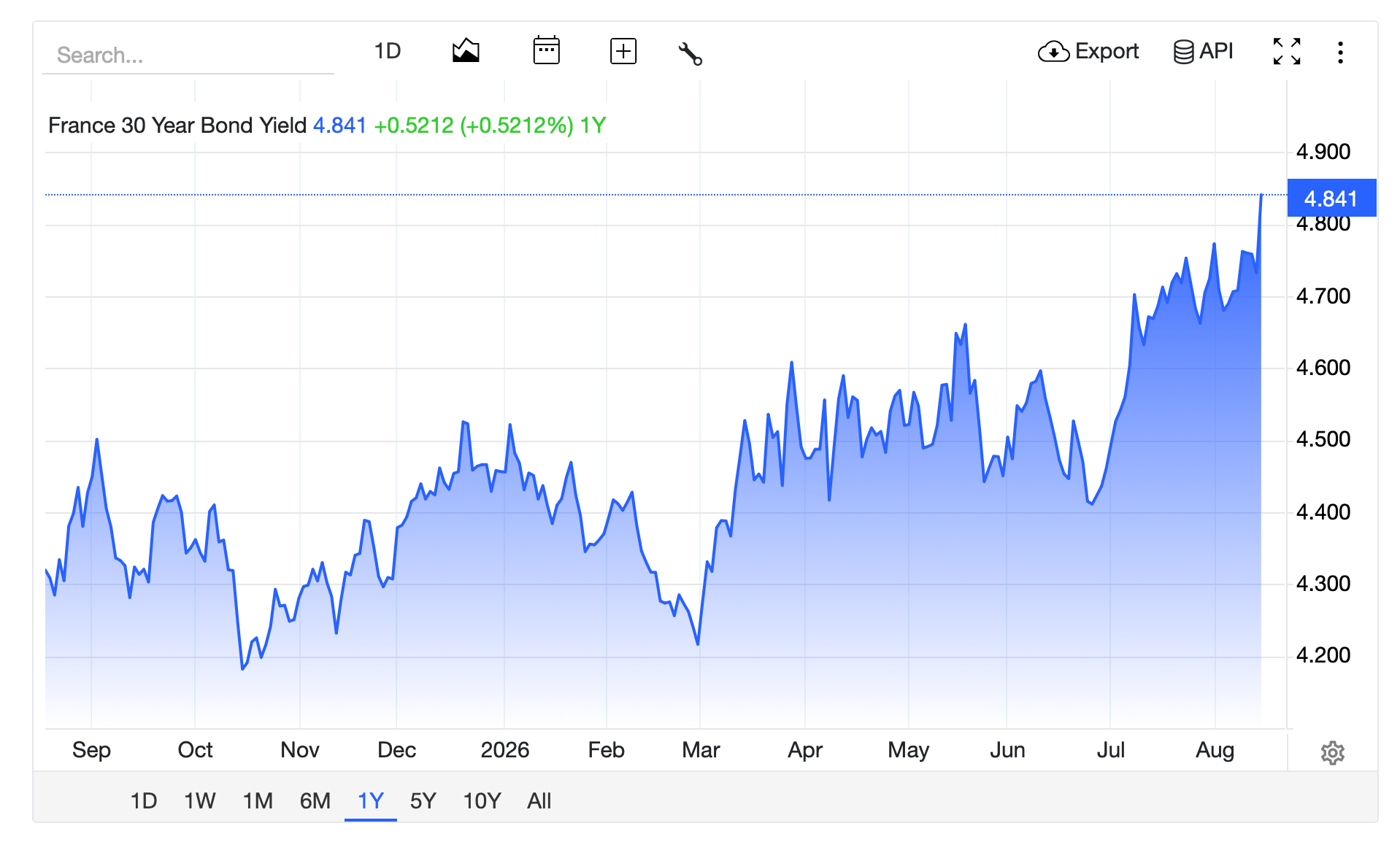
Yield on France's 30-year bonds according to tradingeconomics.com.

France has its own political and budgetary issues. Bond market participants are closely watching spending negotiations and debt forecasts, contributing to the rise in French bond yields compared to German benchmark bonds.

Germany, long considered the eurozone's most reliable borrower, plans to increase spending on infrastructure and defense. This means a larger supply of bonds, i.e., more government debt competing for investors' money.

Central Banks Exit the Market

Japan's actions are hard to ignore, as the Bank of Japan for years suppressed yields through yield curve control—a policy designed to keep borrowing costs low. As it gradually unwinds this regime, markets are re-pricing for higher rates and much less official support.

"Cheap money was a temporary phenomenon," wrote the Wealthmoose account on X. "Debt is forever. Now the bond market is presenting the bill."

The same trend is visible elsewhere. The Federal Reserve and other central banks have shrunk their bond portfolios through quantitative tightening, thereby removing a major buyer from the market.

Governments are flooding the market with bonds while central banks are buying fewer and fewer of them. Private investors can buy these securities, but only at higher yields. This extra compensation is the term premium—the fee for locking money away in long-term bonds.

The Bill Extends Beyond Government Budgets

The rise in long-term yields primarily hits households through mortgage rates. In the US, 30-year mortgage rates often follow Treasury yields, making home buying and refinancing more expensive.

Businesses face higher rates when issuing long-term bonds. Stocks also suffer as higher bond yields attract cash flows and reduce the present value investors assign to distant future profits. Savers, pension funds, and insurance companies can earn more on bonds. However, this resource reallocation comes at a high cost to governments and borrowers accustomed to the cheap money era.

end-content
Пов'язані питання

QWhat has caused long-term bond yields in major economies like the US and Germany to surge to multi-year highs?

AA large-scale, synchronized sell-off in the bond market has pushed yields to levels not seen in many years or even decades. This reflects a fundamental shift from the era of ultra-cheap money, as central banks withdraw support and investors demand higher compensation for inflation and fiscal risks.

QAccording to market analysts cited in the article, what message is the bond market sending to governments with high debt?

AThe bond market is sending a clear signal that its patience with fiscal dysfunction is running out. Analysts like Robin Brooks state that investors are now demanding a premium for lending to governments for decades, seeking protection against inflation, rampant bond issuance, and the erosion of purchasing power.

QWhat are the two main factors creating the current pressure on bond markets, according to the article?

AThe two main factors are expansive fiscal policy (governments increasing spending and accumulating huge debt) and the withdrawal of central bank support. Governments are flooding the market with new bonds while central banks are buying fewer of them through quantitative tightening, forcing private investors to step in only at higher yields.

QHow do rising long-term bond yields impact the broader economy beyond government budgets?

ARising long-term yields make mortgages and corporate borrowing more expensive, dampen stock prices by reducing the present value of future earnings, and increase costs for all borrowers. While savers and pension funds may earn more, the overall effect is a costly redistribution of resources away from entities accustomed to cheap money.

QWhat specific example illustrates the breaking of Japan's long-standing artificial monetary policy regime?

AThe yield on Japan's 5-year government bonds rose above 2.14%, which the article describes as a clean break after years of artificially soft monetary policy. This reflects the Bank of Japan's gradual retreat from its Yield Curve Control policy, forcing markets to reprice debt with much less official support.

Пов'язані матеріали

BTC Daily Adjustment in Progress, HYPE Nears Short-term Directional Decision | Invited Analysis

This weekly analysis examines the recent price action of Bitcoin (BTC) and HYPE, focusing on key technical developments and outlining potential trading strategies. **Bitcoin (BTC) Analysis:** * **Market Trend Assessment:** The analysis applies a "52-week moving average confirmation method" to assess the broader trend. While BTC's weekly closing price has broken above this key average, the moving average itself remains in a downtrend, and a proper pullback confirmation is still lacking. The conclusion is that the rally from the July 1st low is still classified as a technical rebound, not yet confirming a new bull market. * **Daily Chart Structure:** The report argues that the five-wave rally (a-e) from the July low likely concluded at the September 21st high. The recent breakdown below the key support of $82,500, followed by a weak-volume rebound, supports this view. If the e-wave is complete, a larger corrective decline (potentially in three sub-waves) is anticipated. The first leg of this correction is underway, with an initial target around $78,000. * **Weekly Outlook & Strategy:** * **Outlook:** The focus is on the downside targets from the September 21st high. Key resistance is seen at $85,500 and the $87,500-$90,000 zone. Support levels are identified at $80,500-$82,500, $75,000-$78,000, and $69,100-$70,500. * **Strategy:** The medium-term posture is neutral/cautious, recommending watching for a potential pullback to a "channel" for confirmation. For short-term traders, two scenarios are outlined: (A) Selling into strength near the $85,500-$87,500 resistance if bearish signals appear, or (B) Selling a confirmed breakdown below the $80,500-$82,500 support zone. A 30% position size with strict stop-loss management is advised. **HYPE Analysis:** * **Daily Chart Structure:** HYPE broke below the lower boundary of its two-month ascending channel on October 8th. Price is currently in a "pullback confirmation" phase, testing this breached support-turned-resistance. A failure to reclaim this level would signal weakness and open the path towards the $75-$77 support area. The longer-term uptrend line, however, remains intact. * **Weekly Outlook & Strategy:** * **Outlook:** The critical watchpoint is the outcome of the current test of the former channel support. Resistance levels are noted at $88-$90, $94, and $102. Key support zones are $80-$82 and $75-$77. * **Strategy:** Two bullish scenarios are proposed for short-term trades: (1) A light long position if price convincingly reclaims and holds above the former channel support, or (2) A light long position if price falls to the $75-$77 support area and shows signs of stabilization. A 30% position size with strict stop-loss discipline is emphasized. **Risk Management Reminder:** The article includes a standard trailing stop-loss protocol (moving stop to breakeven at +1% profit, then locking in profits progressively). It strongly cautions that all analysis is for informational purposes only, not investment advice, and strategies must be adapted to changing market conditions.

marsbit1 год тому

BTC Daily Adjustment in Progress, HYPE Nears Short-term Directional Decision | Invited Analysis

marsbit1 год тому

U.S. Defense Procurement Seeks to Exclude Chinese PCBs, Stirring Domestic Disputes Among American Companies

A U.S. defense procurement rule set to take effect in January 2027, which aims to exclude printed circuit boards (PCBs) from China, Russia, Iran, and North Korea, has sparked debate within the American industry. While the policy, stemming from the 2021 National Defense Authorization Act, is intended to bolster U.S. domestic manufacturing and supply chain security, it faces conflicting pressures. The U.S. PCB industry association (PCBAA) urges swift implementation to redirect defense contracts to local manufacturers. In contrast, technology industry groups like the Information Technology Industry Council (ITI) seek a longer transition period, citing high costs and complexities for companies needing to establish new, certified supply lines and production facilities. The rule's direct impact on China's vast PCB industry is estimated to be minimal, affecting less than 1% of its total demand. However, it highlights a broader U.S. strategy to revive advanced electronics manufacturing through defense contracts, tax credits, and subsidies. Despite these efforts, rebuilding a competitive domestic PCB industry faces significant hurdles, including multi-year factory construction timelines, reliance on overseas materials and equipment, and the challenge of achieving commercial scale without sufficient non-defense orders. Notably, even U.S. defense contractors like TTM continue to expand production capacity in China to leverage its mature, cost-effective supply chain. Meanwhile, China's PCB sector is transitioning from scale to technological sophistication, making significant inroads in high-end areas like AI servers and advanced packaging. Leading Chinese firms are achieving breakthroughs in materials and complex multi-layer board production, supported by a deep industrial ecosystem of suppliers, manufacturers, and end-client collaboration. This entrenched system of scale, iterative development, and integrated supply chains represents a competitive advantage that U.S. policy alone cannot quickly replicate. The core challenge for the U.S. is not merely redirecting orders but rebuilding the comprehensive manufacturing capabilities and commercial viability that have shifted overseas.

marsbit1 год тому

U.S. Defense Procurement Seeks to Exclude Chinese PCBs, Stirring Domestic Disputes Among American Companies

marsbit1 год тому

Торгівля

Спот
活动图片